
Prosthetic Joint Infections — MCQs

A 3-year-old boy sustained a leg injury while playing. A few days later, crepitations are felt in the injured area. What is the probable causative organism?
Answer: C. Clostridium welchii
A 12 year old girl was brought with fever, malaise, and migrating polyarthritis. She had a history of recurrent throat infections in the past. Elevated erythrocyte sedimentation rate is noted. Which among the following is NOT a major Jones criteria for diagnosis of acute rheumatic fever?
Answer: A. Elevated erythrocyte sedimentation rate
The risk of catheter-associated urinary tract infection increases with catheter duration. Which bacterial property most directly enables persistent surface-adherent communities within an extracellular matrix?
Answer: A. Biofilm formation
In the traditional classification of early prosthetic valve endocarditis as occurring within 60 days of surgery, which organism is classically the most common cause?
Answer: B. S. epidermidis
Which organism is classically associated with Waterhouse–Friderichsen syndrome?
Answer: A. Neisseria meningitidis
All are correct about antibiotic PMMA beads except:
Answer: B. IV-equivalent serum antibiotic levels
Which of the following statements about Mycoplasma is correct?
Answer: B. Cause of atypical pneumonia
An elderly patient slipped in the bathroom and sustained injury over the hip joint. X- Ray is shown below. What is the expected position of the affected limb?
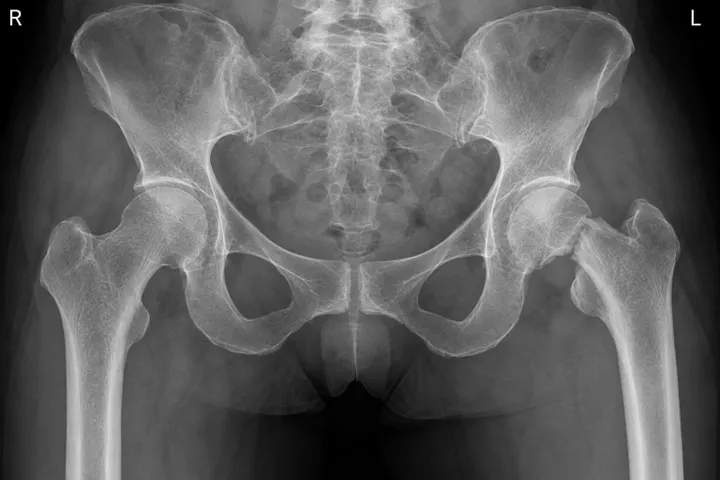
Answer: B. Shortened and externally rotated
A 45-year-old man has fever and an acutely painful, swollen knee for 1 day. Synovial-fluid Gram stain shows gram-positive cocci. What is the most likely diagnosis?
Answer: A. Septic arthritis
Which test provides evidence of antecedent group A streptococcal infection in acute rheumatic fever?
Answer: A. ASO
Want unlimited practice?
Get full access to all questions, explanations, and performance tracking.
Scan to download app