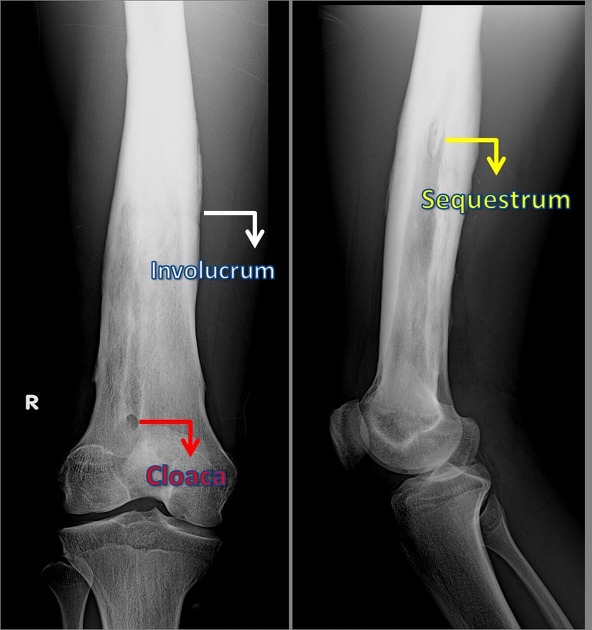
All of the following are associated with chronic osteomyelitis except?
What pathological process causes both destruction of bone and reduction of joint space?
Aspirated synovial fluid in septic arthritis will typically show which of the following characteristics?
The deformity shown in the image is characteristic of which condition?

What is the term for painless effusion in congenital syphilis?
All are true about acute osteomyelitis except?
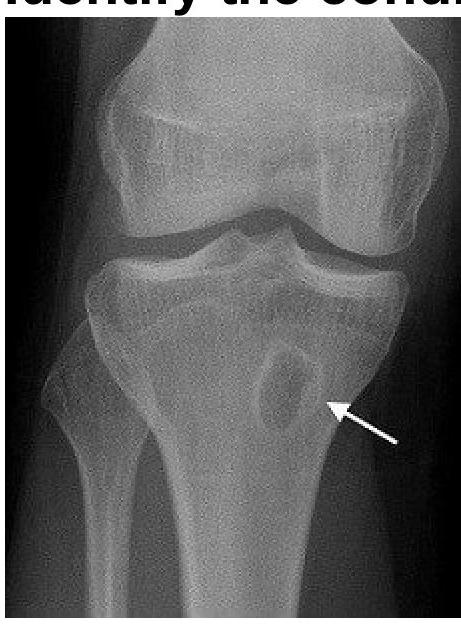
A patient presents with a ring-shaped (lytic) lesion in the bone. Which of the following is the most likely diagnosis?
An elderly patient with the following deformity was brought to the OPD. What is the most probable diagnosis? 
A 15-day-old neonate was brought with complaints of high grade fever for 2 days and decreased playing movements of right leg. On examination the right knee joint is red, tender and shows fluctuation. All are true about the condition shown except:

All the following statements regarding this image are true except: (Recent NEET Pattern 2016-17)

Explanation: **Explanation:** Chronic osteomyelitis is a persistent infection of the bone characterized by low-grade inflammation, bone necrosis, and reactive bone formation. **Why Myositis Ossificans is the Correct Answer:** **Myositis Ossificans** is a condition where bone forms within muscle or soft tissue, usually following blunt trauma (hematoma). It is a **post-traumatic** complication, not an infectious one. It does not occur as a result of chronic bone infection, making it the "except" in this list. **Analysis of Incorrect Options:** * **Amyloidosis:** Chronic infections like osteomyelitis lead to the persistent production of Serum Amyloid A (SAA) protein. This can result in **Secondary (AA) Amyloidosis**, which often affects the kidneys. * **Sequestrum:** This is the hallmark of chronic osteomyelitis. It refers to a piece of **dead bone** that has become detached from its blood supply and is surrounded by infected tissue or pus. * **Metastatic Abnormality:** Chronic irritation of a long-standing sinus tract in osteomyelitis can lead to malignant transformation. The most common "metastatic" or malignant complication is **Squamous Cell Carcinoma** (Marjolin’s ulcer). **NEET-PG High-Yield Pearls:** 1. **Involucrum:** The layer of new, living bone formed around a sequestrum. 2. **Cloaca:** An opening in the involucrum through which pus and sequestra are discharged. 3. **Brodie’s Abscess:** A localized form of chronic osteomyelitis characterized by a radiolucent lesion with a sclerotic rim. 4. **Gold Standard Investigation:** MRI is highly sensitive, but for chronic cases, a **CT scan** is superior for visualizing the sequestrum and involucrum.
Explanation: ### Explanation The correct answer is **Tuberculosis (A)**. **Why Tuberculosis is Correct:** In musculoskeletal tuberculosis, the infection typically begins in the bone (metaphysis or epiphysis) or the synovium. As the disease progresses, the granulomatous process leads to the destruction of subchondral bone. Unlike pyogenic arthritis, where proteolytic enzymes destroy cartilage rapidly, TB causes a slow destruction of the articular cartilage through the formation of **pannus** and subchondral erosions. This dual involvement of the bone (osteolysis/caries) and the cartilage leads to the characteristic **reduction of joint space** seen on X-rays. In the spine (Pott’s disease), the destruction of the vertebral bodies and the intervening disc space is a classic hallmark. **Why Other Options are Incorrect:** * **B, C, and D (Metastasis, Multiple Myeloma, Lymphoma):** These are primarily neoplastic processes involving the bone marrow or cortex. While they cause significant **bone destruction** (lytic lesions), they characteristically **spare the joint space and the intervertebral discs**. Cartilage acts as a relative barrier to the spread of malignancy; therefore, a preserved joint space in the presence of extensive bone destruction is a key radiological feature distinguishing tumors from infections like TB. **High-Yield Clinical Pearls for NEET-PG:** * **Phemister’s Triad (Radiological features of TB Arthritis):** 1. Juxta-articular osteopenia, 2. Peripherally located osseous erosions, 3. Gradual narrowing of the joint space. * **Cold Abscess:** A hallmark of TB, where a collection of pus forms without the classic signs of inflammation (heat, redness). * **Spinal TB:** The most common site is the **thoracolumbar junction**. The disc is involved early in TB, whereas it is spared in malignancy.
Explanation: **Explanation:** Septic arthritis is a medical emergency characterized by an intense inflammatory response within the joint space, usually due to pyogenic bacteria. **1. Why Option C is Correct:** In response to bacterial invasion, the body recruits a massive number of white blood cells to the synovial fluid. In septic arthritis, the total WBC count typically exceeds **50,000/mm³** (often >100,000/mm³), with a predominance of **polymorphonuclear leukocytes (PMNs) >75-90%**. These neutrophils release lysosomal enzymes which, while attempting to kill bacteria, can also damage articular cartilage. **2. Why Other Options are Incorrect:** * **Option A (Clear color):** Normal synovial fluid is straw-colored and transparent. In septic arthritis, the fluid becomes **opaque, turbid, or purulent** due to the high density of inflammatory cells and debris. * **Option B (High viscosity):** Normal synovial fluid has high viscosity due to hyaluronan. In infection, bacterial enzymes (like hyaluronidase) and inflammatory mediators degrade the hyaluronan, leading to **low viscosity** (the fluid "watery" and fails the "string test"). **NEET-PG High-Yield Pearls:** * **Gold Standard Diagnosis:** Synovial fluid culture (though Gram stain provides the quickest presumptive diagnosis). * **Glucose Levels:** Typically **low** (<40 mg/dL or <50% of serum glucose) because bacteria and WBCs consume glucose. * **Most Common Organism:** *Staphylococcus aureus* overall; *Neisseria gonorrhoeae* in sexually active young adults. * **Kocher’s Criteria:** Used to differentiate septic arthritis from transient synovitis in children (includes non-weight bearing, ESR >40, Fever >38.5°C, and WBC >12,000).
Explanation: ***Rheumatoid arthritis*** - Characteristic hand deformities include **ulnar deviation**, **swan neck deformity**, and **boutonnière deformity** due to chronic synovial inflammation affecting ligaments and tendons. - These deformities result from **erosive joint destruction** and **tendon rupture/displacement**, particularly affecting the **metacarpophalangeal (MCP)** and **proximal interphalangeal (PIP)** joints. *Osteoarthritis* - Presents with **Heberden's nodes** (DIP joints) and **Bouchard's nodes** (PIP joints), which are bony enlargements rather than the soft tissue deformities seen in RA. - Typically causes **joint space narrowing** and **osteophyte formation** but does not produce ulnar deviation or swan neck deformities. *Ankylosing spondylitis* - Primarily affects the **axial skeleton** (spine and sacroiliac joints) with characteristic **bamboo spine** appearance on X-ray. - Hand involvement is **rare** and when present, does not cause the classic deformities associated with rheumatoid arthritis. *Psoriatic arthritis* - Characterized by **pencil-in-cup deformity** and **sausage-shaped digits (dactylitis)** due to enthesitis and tenosynovitis. - Often shows **asymmetric joint involvement** and **nail pitting**, distinct from the symmetric hand deformities of rheumatoid arthritis.
Explanation: **Explanation:** **Clutton’s joints** are a classic late manifestation of **congenital syphilis**, typically occurring between the ages of 8 and 15 years. The condition is characterized by symmetrical, painless swelling (effusion) of the large joints, most commonly the **knees**. The underlying pathology is a chronic hydrarthrosis (synovitis) that does not involve the bone or cartilage, meaning the joint remains functional despite the swelling. It is often associated with other stigmata of congenital syphilis, such as interstitial keratitis and Hutchinson’s teeth (Hutchinson’s Triad). **Analysis of Incorrect Options:** * **Charcot joints (Neuropathic Arthropathy):** This refers to progressive joint destruction due to loss of pain and proprioception. While it can be caused by *acquired* syphilis (Tabes Dorsalis), it is characterized by "painless deformity" and instability rather than simple effusion, and it occurs in adults. * **Baon joints:** This is not a recognized medical term in orthopedic or infectious disease literature. It is likely a distractor. **High-Yield Clinical Pearls for NEET-PG:** * **Hutchinson’s Triad:** Interstitial keratitis, sensorineural deafness (8th nerve), and Hutchinson’s teeth. * **Saber Shin:** Anterior bowing of the tibia due to periostitis in congenital syphilis. * **Wimberger’s Sign:** Focal destruction of the medial proximal tibial metaphysis (seen in early congenital syphilis). * **Treatment:** Penicillin remains the drug of choice, though Clutton’s joints may be slow to resolve even with therapy.
Explanation: ### Explanation **1. Why Option C is the Correct Answer (The "Except" Statement):** In acute hematogenous osteomyelitis (AHO), the **epiphyseal plate (growth plate) acts as a physical barrier** that prevents the spread of infection from the metaphysis to the epiphysis. This is because the metaphyseal nutrient arteries loop back sharply at the level of the growth plate and do not cross it in children. Therefore, the infection is typically confined to the metaphysis. * *Exception:* In infants (under 1 year), small trans-physeal vessels exist, allowing infection to cross into the epiphysis and joint. **2. Analysis of Incorrect Options:** * **A. Common in children:** This is true. AHO primarily affects the pediatric population due to the highly vascularized and growing nature of long bones. * **B. Severe pain:** This is true. The infection causes increased intraosseous pressure and subperiosteal abscess formation, leading to exquisite tenderness and "pseudoparalysis" (the child refuses to move the limb). * **D. Treatment involves 6 weeks of antibiotics:** This is true. Standard management requires a prolonged course (usually 4–6 weeks) of antibiotics to ensure complete eradication of the pathogen and prevent progression to chronic osteomyelitis. **3. Clinical Pearls for NEET-PG:** * **Most common site:** Metaphysis of long bones (due to sluggish blood flow in venous hair-pin bends, favoring bacterial seeding). * **Most common organism:** *Staphylococcus aureus* (overall). In Sickle Cell Anemia patients, look for *Salmonella*. * **Earliest X-ray sign:** Soft tissue swelling (Bone changes like periosteal reaction take 7–14 days to appear). * **Investigation of choice:** MRI is the most sensitive early diagnostic tool. * **Surgical Indication:** If there is no clinical improvement within 24–48 hours of starting antibiotics or if a fluctuant abscess is present.
Explanation: ***Brodie's abscess*** - This is a localized, subacute or chronic form of **osteomyelitis** that presents radiographically as a well-circumscribed, **lytic lesion** with a thick, **sclerotic** rim, perfectly matching the “ring-shaped” appearance in the image. - It most commonly affects the **metaphysis** of long bones, particularly the tibia, and is often caused by *Staphylococcus aureus*. *Simple bone cyst* - A **simple bone cyst** (or unicameral bone cyst) is a fluid-filled lesion that typically appears as a central, lytic lesion causing **cortical thinning**, but it usually lacks the prominent sclerotic margin seen in a Brodie's abscess. - It is most common in the proximal **humerus** and **femur** of children and may show a **"fallen leaf" sign** if a pathological fracture has occurred. *Aneurysmal bone cyst* - An **aneurysmal bone cyst** (ABC) is a blood-filled, **expansile** lytic lesion that often has a multiloculated or **"soap bubble"** appearance on radiographs. - Unlike the contained lesion shown, an ABC is typically more aggressive, causing significant bony expansion and cortical thinning. *Osteoid osteoma* - An **osteoid osteoma** is a benign bone tumor characterized by a small radiolucent **nidus** (less than 1.5 cm) surrounded by a large area of extensive, dense reactive **sclerosis**. - Clinically, it is associated with characteristic **night pain** that is promptly relieved by **NSAIDs**, a key diagnostic feature not mentioned here.
Explanation: ***Rheumatoid arthritis*** - The image displays classic deformities of advanced **rheumatoid arthritis**, including **ulnar deviation** of the fingers at the metacarpophalangeal (MCP) joints and swelling, which are characteristic of this condition. - The presence of a subcutaneous nodule over the olecranon process (elbow) is highly suggestive of a **rheumatoid nodule**, a common extra-articular manifestation of the disease. *Rickets* - Rickets is a disease of **children** caused by defective mineralization of growing bone, typically due to **vitamin D deficiency**. This patient is described as elderly. - It presents with skeletal deformities like **bowed legs (genu varum)** and **rachitic rosary**, not the specific erosive small joint arthritis seen in the image. *Osteomalacia* - Osteomalacia is the adult counterpart of rickets, characterized by softening of bones. It typically causes diffuse **bone pain**, muscle weakness, and fractures rather than joint deformities. - It does not cause the **inflammatory synovitis** and characteristic joint erosions that lead to the deformities seen in rheumatoid arthritis. *Osteoarthritis* - Osteoarthritis is a **degenerative** joint disease that typically affects the distal interphalangeal (DIP) and proximal interphalangeal (PIP) joints, leading to **Heberden's** and **Bouchard's nodes**, while characteristically sparing the MCP joints. - It lacks the systemic inflammatory features and does not cause **ulnar deviation** or **rheumatoid nodules**.
Explanation: **Intravenous treatment given till CRP levels normalize** - Treatment for **septic arthritis** in neonates typically involves intravenous antibiotics. However, the duration of treatment is usually guided by clinical improvement and normalization of **ESR and CRP levels**, not just CRP. - While CRP normalization is a good indicator of falling inflammation, maintaining IV antibiotics until **ESR also normalizes** is often recommended to ensure complete eradication and prevent recurrence. *Most common cause is Staph. aureus* - **Staphylococcus aureus** is indeed the **most common cause** of septic arthritis in neonates. - The clinical presentation of **fever**, **decreased limb movement**, and a **red, tender, fluctuating joint** is highly suggestive of septic arthritis. *Golden yellow pigment produced by organism* - **Staphylococcus aureus** gets its name from its golden (aureus) pigment, **staphyloxanthin**, which gives colonies a golden-yellow hue. - This pigment also functions as a **virulence factor**, primarily as an antioxidant, helping the bacteria resist immune defenses. *Urgent arthrotomy to debride infected synovium* - **Urgent arthrotomy** (surgical drainage and debridement) is indicated in **septic arthritis** to remove pus, reduce intra-articular pressure, and prevent cartilage damage. - This procedure is crucial in preventing **long-term complications** such as joint destruction and growth disturbances in infants, especially in joints like the hip and knee.
Explanation: ***This is a soft tissue tumor*** - The image shows a swelling over the olecranon process, which is characteristic of **olecranon bursitis**. This condition is an **inflammation of the bursa**, not a soft tissue tumor. - A tumor implies an abnormal growth of tissue that can be benign or malignant, which is not depicted here; the swelling is related to fluid accumulation within a bursa. *This condition could result from student's elbow* - **Student's elbow** is another name for olecranon bursitis, which is the condition depicted in the image. - This common term refers to the inflammation of the olecranon bursa, often caused by **repetitive pressure or trauma** to the elbow, such as leaning on it for extended periods while studying. *It is secondary to trauma* - **Trauma**, especially repetitive minor trauma or a single significant impact, is a very common cause of olecranon bursitis due to injury to the bursa. - This trauma can lead to inflammation and fluid accumulation within the bursa, causing the characteristic swelling. *This condition is due to inflammation of the sub-cutaneous fat* - The condition shown is **olecranon bursitis**, which is an inflammation of the **olecranon bursa**. - The olecranon bursa is a fluid-filled sac that lies between the skin and the olecranon process of the ulna to reduce friction, and its inflammation is distinct from inflammation of the subcutaneous fat (panniculitis).
Septic Arthritis
Practice Questions
Osteomyelitis
Practice Questions
Tuberculosis of Bones and Joints
Practice Questions
Fungal and Parasitic Infections
Practice Questions
Diabetic Foot Infections
Practice Questions
Prosthetic Joint Infections
Practice Questions
Reactive Arthritis
Practice Questions
Management of Joint Infections
Practice Questions
Prevention of Orthopaedic Infections
Practice Questions
Biofilms in Orthopaedic Infections
Practice Questions
Antibiotic Prophylaxis
Practice Questions
Implant-Related Infections
Practice Questions
Get full access to all questions, explanations, and performance tracking.
Start For Free