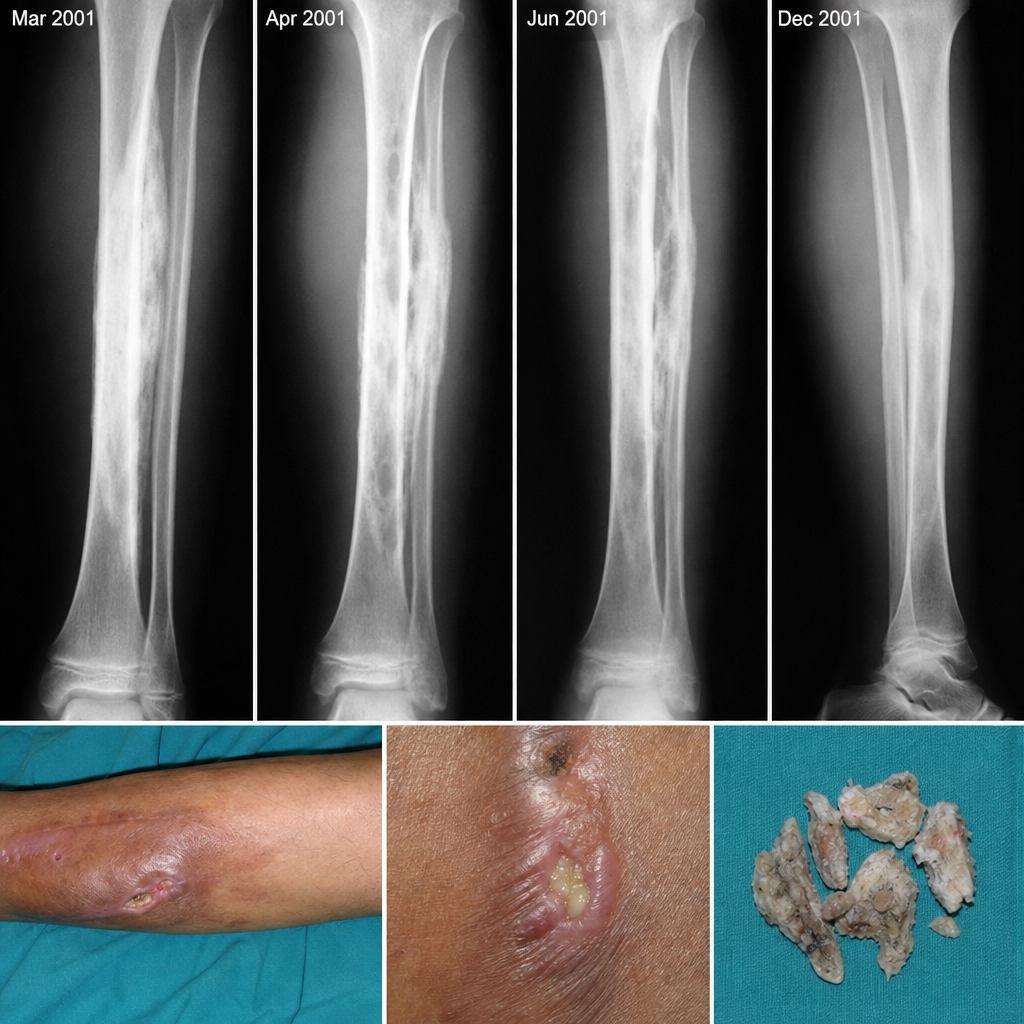
What is the most common site for osteomyelitis in adults?
What is the earliest site of bone involvement in hematogenous osteomyelitis?
In gout, tophi are typically found in which of the following locations?
Joint mice are seen in which of the following diseases?
What is the management of acute osteomyelitis?
What is spina ventosa?
What is the gold standard diagnostic method for guiding antibiotic therapy in a case of osteomyelitis?
What is localized acute alveolar osteomyelitis?
What is true regarding knee movements?
Which of the following conditions is associated with a swan neck deformity?
Explanation: **Explanation:** In adults, the pathophysiology of osteomyelitis differs significantly from children. While hematogenous osteomyelitis in children primarily affects the metaphysis of long bones due to high vascularity and sluggish blood flow, the adult skeleton undergoes changes in vascular patterns. **Why Thoracolumbar Spine is Correct:** In adults, the **vertebral column** is the most common site for hematogenous osteomyelitis. The **thoracolumbar junction** is particularly susceptible due to the rich venous plexus (Batson’s plexus), which allows for the retrograde spread of bacteria from pelvic organs or urinary tract infections. Unlike children, where the growth plates are active, the adult vertebrae remain highly vascularized, making them the primary target for blood-borne pathogens. **Analysis of Incorrect Options:** * **A & D (Lower end of femur / Upper end of tibia):** These are the most common sites for **acute hematogenous osteomyelitis in children** (the "knee" is the most common area overall in pediatrics). In adults, long bone involvement is usually secondary to open fractures or surgical intervention rather than hematogenous spread. * **B (Cervical spine):** While vertebral osteomyelitis can occur here, it is far less common than the thoracolumbar region, which bears more mechanical stress and has a more extensive venous drainage system connected to the pelvis. **NEET-PG High-Yield Pearls:** * **Most common organism:** *Staphylococcus aureus* (overall); *Salmonella* (in Sickle Cell Anemia); *Pseudomonas* (in IV drug abusers). * **Gold Standard Investigation:** MRI is the most sensitive and specific imaging modality for early diagnosis. * **Earliest Sign on X-ray:** Soft tissue swelling (bone destruction is not visible until 30-50% of bone mineral is lost, usually after 10-14 days). * **Adult vs. Child:** In adults, the infection often starts in the **subchondral bone** and spreads to the intervertebral disc (discitis), whereas in children, the disc is often spared initially.
Explanation: ### Explanation **Correct Option: A. Metaphysis** The metaphysis is the most common and earliest site of involvement in acute hematogenous osteomyelitis due to its unique vascular anatomy. In children, the **hairpin loops** of the nutrient artery end at the metaphysis before turning back into the venous sinusoids. This anatomical arrangement leads to: 1. **Sluggish blood flow:** The sharp turns in the vessels cause turbulence and slow flow. 2. **Lack of phagocytosis:** The capillary loops lack a robust population of reticuloendothelial cells (macrophages), allowing bacteria to settle and proliferate easily. **Analysis of Incorrect Options:** * **B. Diaphysis:** While infection can spread to the diaphysis via the medullary canal or subperiosteal space, it is rarely the primary site (except in specific cases like *Salmonella* osteomyelitis in Sickle Cell Disease). * **C. Epiphysis:** In children, the growth plate (physis) acts as a physical barrier to the spread of infection. The epiphysis is usually spared unless the patient is an infant (where trans-physeal vessels exist) or an adult (where the physis has closed). * **D. Point of entry of the nutrient artery:** While the nutrient artery carries the bacteria, the high velocity of blood flow at the entry point prevents bacterial seeding. Seeding only occurs where the flow slows down (the metaphysis). **High-Yield Clinical Pearls for NEET-PG:** * **Most common organism:** *Staphylococcus aureus* (overall). * **Sickle Cell Anemia:** *Salmonella* is a high-yield association, though *S. aureus* remains common. * **Drug Abusers:** Increased incidence of *Pseudomonas* and *Serratia*. * **Earliest Radiographic Sign:** Soft tissue swelling (seen at 3–5 days). Bony changes (periosteal reaction/rarefaction) take **10–14 days** to appear on X-ray. * **Investigation of Choice:** **MRI** is the most sensitive and specific early imaging modality.
Explanation: **Explanation:** Gout is a metabolic disorder characterized by hyperuricemia and the deposition of **monosodium urate (MSU) crystals** in and around joints. **Tophi** are pathognomonic clinical features of chronic tophaceous gout, representing large, chalky aggregations of urate crystals surrounded by an intense inflammatory granulomatous reaction. **Why the Joint Capsule is correct:** While MSU crystals initially deposit in the synovial membrane, chronic accumulation leads to the formation of tophi in the **periarticular soft tissues**, most notably the **joint capsule**, ligaments, and tendons. The joint capsule provides the structural environment where these deposits can enlarge significantly, often leading to joint deformity and bone erosions (punched-out lesions). **Analysis of Incorrect Options:** * **A. Synovial fluid:** While MSU crystals are found here during an acute attack (characteristically needle-shaped and negatively birefringent), they exist as free crystals, not as organized "tophi." * **B. Articular cartilage:** Crystals do deposit on the surface of the cartilage (causing the "double contour sign" on ultrasound), but the avascular nature of cartilage does not support the formation of large, granulomatous tophaceous masses. * **D. Skin:** Tophi are frequently seen *under* the skin (subcutaneous), particularly on the helix of the ear or olecranon bursa, but they originate in the underlying connective tissue or bursae rather than the skin layers themselves. **NEET-PG High-Yield Pearls:** * **Most common site for Tophi:** The helix of the ear and the Achilles tendon. * **First joint affected:** 1st Metatarsophalangeal joint (Podagra). * **Radiology:** Look for "Martel’s sign" or "G-pull sign" (overhanging edges of bone). * **Polarizing Microscopy:** MSU crystals show **strong negative birefringence** (yellow when parallel to the slow axis).
Explanation: **Explanation:** **Joint mice** (also known as loose bodies) are small, mobile fragments of bone or cartilage that float freely within the synovial fluid of a joint space. **1. Why Osteoarthritis (OA) is correct:** In Osteoarthritis, the primary pathology involves the progressive degeneration of articular cartilage. As the cartilage thins and cracks, small pieces of bone or fibrocartilage can break off into the joint cavity. Additionally, the formation of **osteophytes** (bony outgrowths) at the joint margins can lead to fragments snapping off during movement. These fragments become "joint mice," which can cause sudden joint locking or a "giving way" sensation. **2. Why other options are incorrect:** * **Rheumatoid Arthritis (RA):** This is primarily an inflammatory synovitis. While it causes joint destruction, it typically results in the formation of **Rice bodies** (small, white masses made of fibrin and collagen) rather than bony joint mice. * **Juvenile Idiopathic Arthritis (JIA):** Similar to RA, this is an inflammatory condition. While chronic inflammation can damage the joint, it does not characteristically produce the detached osteochondral fragments seen in degenerative OA. **Clinical Pearls for NEET-PG:** * **Most common cause:** Osteoarthritis is the most common cause of joint mice. * **Other causes:** Osteochondritis Dissecans (OCD), Synovial Chondromatosis (where the synovium undergoes metaplasia to form multiple cartilaginous bodies), and intra-articular fractures. * **Clinical Sign:** The classic presentation is **intermittent locking** of the joint, often the knee. * **Radiology:** They appear as radio-opaque loose bodies if they contain bone; purely cartilaginous mice may only be visible on MRI or arthroscopy.
Explanation: ### Explanation **1. Why Option A is Correct:** Acute osteomyelitis is a medical emergency that primarily affects the metaphysis of long bones in children. The cornerstone of management is **early and aggressive intravenous antibiotic therapy**. The goal is to sterilize the blood and the bone before an abscess forms or the blood supply is compromised. It is critical to obtain a **blood culture** first to identify the causative organism (most commonly *Staphylococcus aureus*), but treatment must start immediately after with empirical broad-spectrum antibiotics to prevent the formation of a sequestrum (dead bone). **2. Why Other Options are Incorrect:** * **Option B (Surgical excision):** This is too radical for acute stages. Excision is generally reserved for tumors or specific cases of chronic osteomyelitis where the bone is non-viable. * **Option C (Sequestrectomy):** A sequestrum (dead bone surrounded by granulation tissue) is a hallmark of **Chronic Osteomyelitis**. In the acute stage, a sequestrum has not yet formed; therefore, sequestrectomy is not indicated. * **Option D (Amputation):** This is a last resort, reserved for life-threatening infections, gas gangrene, or severe chronic cases with malignant transformation (Marjolin’s ulcer), not for uncomplicated acute osteomyelitis. **3. NEET-PG High-Yield Pearls:** * **Most common site:** Metaphysis (due to hair-pin vascular loops and sluggish blood flow). * **Most common organism:** *Staphylococcus aureus* (overall); *Salmonella* (in Sickle Cell Anemia patients). * **Earliest Sign on X-ray:** Soft tissue swelling (appears in 3–5 days). Bony changes (periosteal reaction/rarefaction) take 10–14 days to appear. * **Investigation of Choice:** **MRI** (most sensitive for early detection). * **Indication for Surgery (Drilling/Fenestration):** If there is no clinical improvement after 24–48 hours of IV antibiotics or if an abscess is clinically evident.
Explanation: ### Explanation **Spina Ventosa** is the clinical term for **Tuberculous Dactylitis**, which refers to the tubercular infection of the short tubular bones (metacarpals, metatarsals, and phalanges) of the hands and feet. #### 1. Why the Correct Answer is Right The term is derived from Latin: *Spina* (short bone) and *Ventosa* (inflated with air). In this condition, the tubercle bacilli cause a granulomatous infection in the marrow cavity. This leads to extensive **endosteal resorption** and simultaneous **subperiosteal new bone formation**. Radiologically, this results in a "ballooned-out" or "expanded" appearance of the bone with a thin cortex, mimicking a bone filled with air. It is most commonly seen in children under the age of 5. #### 2. Why Other Options are Wrong * **Tuberculosis of the spine (Pott’s Disease):** This is the most common site of skeletal TB, typically involving the vertebral bodies and disc spaces, but it is not referred to as spina ventosa. * **Tuberculosis of the vertebral pedicles:** While TB can involve the posterior elements (pedicles/laminae), this is rare and distinct from the dactylitis seen in small bones. * **Extra-axial lesion:** This is a general neurosurgical/radiological term for lesions located outside the brain parenchyma or spinal cord (e.g., meningiomas) and is unrelated to osteoarticular tuberculosis. #### 3. NEET-PG High-Yield Clinical Pearls * **Most common site:** Proximal phalanx of the index and middle fingers. * **Radiological hallmark:** Expansion of the bone (ballooning) with a "honeycomb" appearance and lack of significant involucrum or sequestrum (unlike pyogenic osteomyelitis). * **Clinical presentation:** Usually presents as a painless, spindle-shaped swelling of the finger. * **Treatment:** Primarily medical (AKT/RNTCP regimen). Surgery is rarely required unless there is a secondary infection or deformity.
Explanation: **Explanation:** The gold standard for diagnosing osteomyelitis and identifying the causative organism is a **bone biopsy** (either open or percutaneous needle biopsy). This method provides direct access to the infected tissue, allowing for both histopathological confirmation and accurate microbiological culture. It is the most reliable way to guide targeted antibiotic therapy, especially in chronic or recalcitrant cases. **Why other options are incorrect:** * **Blood Culture (A):** While useful in acute hematogenous osteomyelitis (positive in ~40-50% of cases), it often remains negative in chronic cases and does not provide direct evidence of the pathogen residing within the bone. * **Wound Swab (C):** Swabs from the skin surface or ulcer bed are highly unreliable. They often grow superficial contaminants or skin flora (e.g., *Staphylococcus epidermidis*) rather than the deep-seated pathogen causing the bone infection. * **Sinus Tract Culture (D):** Similar to wound swabs, cultures from a sinus tract have poor correlation with the actual organism in the bone. They are frequently contaminated by polymicrobial flora colonizing the tract. **Clinical Pearls for NEET-PG:** * **Most common organism:** *Staphylococcus aureus* is the overall most common cause of osteomyelitis. * **Sickle Cell Anemia:** *Salmonella* is a high-yield specific pathogen associated with this group. * **Imaging:** MRI is the most sensitive imaging modality for early detection (shows marrow edema). * **IV Drug Users:** Increased incidence of *Pseudomonas aeruginosa* infections. * **Brodie’s Abscess:** A form of subacute osteomyelitis characterized by a radiolucent lesion with a sclerotic rim, typically in the metaphysis.
Explanation: **Explanation:** **Localized acute alveolar osteomyelitis**, commonly known as **Dry Socket**, is clinically termed **Fibrinolytic Alveolitis**. It is a painful condition that occurs following a tooth extraction when the blood clot fails to form or is prematurely dislodged from the socket. 1. **Why Fibrinolytic Alveolitis is correct:** The pathophysiology involves the activation of plasminogen to plasmin, which leads to the **fibrinolysis** (dissolution) of the blood clot. This leaves the alveolar bone exposed to the oral environment, causing localized inflammation and severe radiating pain. It typically occurs 3–4 days post-extraction. 2. **Analysis of Incorrect Options:** * **Garre’s Osteomyelitis:** Also known as *Periosteitis Ossificans*, this is a chronic form of osteomyelitis characterized by subperiosteal new bone formation (onion-skin appearance), usually seen in children and young adults. * **Sclerotic Cemental Masses:** These are localized, radiopaque lesions of the jaw representing dysplastic bone/cementum, typically asymptomatic and not inflammatory. * **Florid Osseous Dysplasia:** A more extensive form of fibro-osseous disease involving multiple quadrants of the jaw, often seen in middle-aged females. **NEET-PG High-Yield Pearls:** * **Risk Factors:** Smoking, oral contraceptives, and traumatic extractions increase the risk of dry socket. * **Clinical Feature:** Absence of a clot and a "foul odor" (halitosis) are hallmark signs. * **Management:** It is a self-limiting condition. Treatment is symptomatic, involving irrigation with saline and placement of an obtundent dressing (e.g., **Zinc Oxide Eugenol** or Alvogyl). Antibiotics are generally not required unless systemic symptoms are present.
Explanation: ### Explanation **1. Why Option C is Correct:** The menisci are dynamic structures that move posteriorly during flexion and anteriorly during extension. Due to the anatomy of the meniscotibial (coronary) ligaments and the pull of the semimembranosus and popliteus muscles, the **posterior horns undergo significantly more excursion** than the anterior horns. Specifically, the lateral meniscus is more mobile than the medial meniscus because it is not attached to the collateral ligament, allowing it to glide further to accommodate the rolling of the femoral condyles. **2. Why the Other Options are Incorrect:** * **Option A:** Flexion is actually coupled with **medial rotation** of the tibia (or lateral rotation of the femur). This is the reverse of the "Screw-Home Mechanism" (which occurs during terminal extension). * **Option B:** While there is differential motion between the medial and lateral compartments (the lateral side moves more), this is a general anatomical observation. However, in the context of standard orthopedic teaching regarding meniscal kinematics, the specific movement of the horns (Option C) is the established biomechanical fact. * **Option D:** In full extension, the **Cruciate ligaments** (ACL/PCL) and the **Collateral ligaments** (MCL/LCL) are all taut to provide maximum stability. While this statement is technically true, in many standardized exams, Option C is favored as the "most true" or specific biomechanical principle regarding intra-articular movement. *(Note: If this were a multiple-choice question where D is also considered correct, C remains the classic textbook answer for meniscal dynamics).* **3. High-Yield Clinical Pearls for NEET-PG:** * **Screw-Home Mechanism:** Occurs in the last 30° of extension. The tibia rotates **laterally** on the femur (open chain) to "lock" the knee. * **Unlocking the Knee:** The **Popliteus** muscle (the "Key" to the knee) initiates flexion by **medially** rotating the femur on the tibia. * **Meniscal Mobility:** The **Medial Meniscus** is fixed and less mobile (C-shaped), making it more prone to injury than the more mobile **Lateral Meniscus** (O-shaped).
Explanation: **Explanation:** **Swan neck deformity** is a characteristic finger deformity defined by **hyperextension of the Proximal Interphalangeal (PIP) joint** and **flexion of the Distal Interphalangeal (DIP) joint**. 1. **Why Rheumatoid Arthritis (RA) is correct:** In RA, chronic synovitis leads to laxity of the volar plate and shortening of the intrinsic muscles. This causes an imbalance of forces, pulling the PIP joint into hyperextension. Simultaneously, the stretching or rupture of the distal extensor tendon (mallet deformity) results in compensatory flexion at the DIP joint. It is a hallmark finding in chronic RA. 2. **Why other options are incorrect:** * **Osteoarthritis:** Typically presents with **Heberden’s nodes** (DIP) and **Bouchard’s nodes** (PIP). While OA can cause joint deviation, swan neck is not a classic feature. * **Tubercular Arthritis:** Usually presents as a monoarthritis (commonly hip or knee) with "cold abscess" formation and "Phemister triad" on X-ray, rather than specific small joint finger deformities. * **Psoriatic Arthritis:** Classically associated with **"Dactylitis" (sausage digit)** and **Boutonniere deformity**, but the most pathognomonic feature is involvement of the DIP joints and "pencil-in-cup" appearance on imaging. **High-Yield Clinical Pearls for NEET-PG:** * **Boutonniere Deformity:** The opposite of Swan neck (PIP flexion + DIP hyperextension); caused by rupture of the central slip of the extensor digitorum communis tendon. * **Z-deformity:** Refers to radial deviation of the wrist with ulnar deviation of the digits, commonly seen in RA. * **Hitchhiker’s Thumb:** Flexion of the MCP and hyperextension of the IP joint (RA). * **Mnemonic:** In **S**wan neck, the **S**econd joint (PIP) is extended.
Septic Arthritis
Practice Questions
Osteomyelitis
Practice Questions
Tuberculosis of Bones and Joints
Practice Questions
Fungal and Parasitic Infections
Practice Questions
Diabetic Foot Infections
Practice Questions
Prosthetic Joint Infections
Practice Questions
Reactive Arthritis
Practice Questions
Management of Joint Infections
Practice Questions
Prevention of Orthopaedic Infections
Practice Questions
Biofilms in Orthopaedic Infections
Practice Questions
Antibiotic Prophylaxis
Practice Questions
Implant-Related Infections
Practice Questions
Get full access to all questions, explanations, and performance tracking.
Start For Free