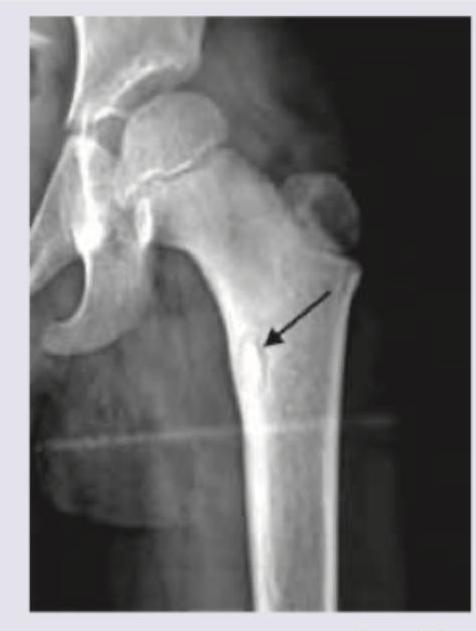
Onion skin appearance is seen in which of the following conditions?
Which of the following conditions can be responsible for heterotopic calcification?
Acute osteomyelitis is most commonly caused by which microorganism?
Which of the following is NOT true about septic arthritis?
What is the most common site of Garre's osteomyelitis?
An 8-year-old boy presents with a gradually progressing swelling and pain over the upper tibia for the past 6 months. Radiography reveals a lytic lesion with sclerotic margins in the upper tibial metaphysis. What is the most likely diagnosis?
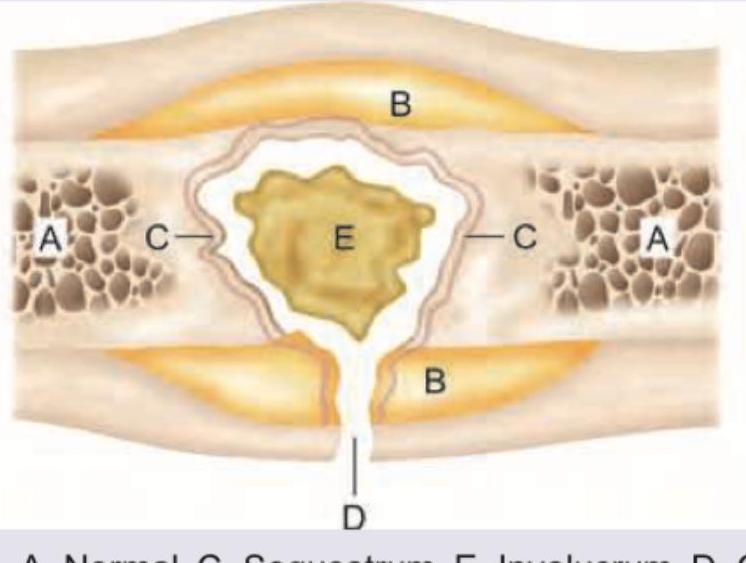
What is an involucrum?
Most common Charcot's joints involved in diabetes mellitus are those of:
Synovial chondromatosis commonly affects which of the following joints?
Which of the following statements regarding osteomyelitis is correct?
Explanation: **Explanation** The "onion skin" appearance refers to a **laminated periosteal reaction** where multiple layers of new bone are deposited under the periosteum. This occurs due to repetitive, rhythmic bouts of inflammation or subperiosteal irritation. **Why Option D is Correct:** The onion skin appearance is a hallmark of **Garre’s Osteomyelitis**, which is medically synonymous with **Chronic Osteomyelitis with Proliferative Periostitis**. * **Pathophysiology:** It is a unique, non-suppurative form of chronic osteomyelitis characterized by peripheral reactive bone formation. It typically affects children and young adults, most commonly involving the mandible (often due to dental infection) or the tibia. * **Radiology:** The characteristic feature is the thickening of the periosteum with several layers of new bone formation, creating the classic "onion skin" look. **Analysis of Other Options:** * **Option A (Chronic Osteomyelitis):** While chronic osteomyelitis involves bone remodeling, the classic presentation includes a *sequestrum* (dead bone) and *involucrum* (new bone sheath). It does not typically present with the specific laminated "onion skin" pattern unless it is the proliferative subtype. * **Options B & C:** Both are correct individually, but since they represent the same clinical entity, the combined option (D) is the most accurate choice for a competitive exam. **NEET-PG High-Yield Pearls:** * **Differential Diagnosis for Onion Skin Appearance:** 1. **Ewing’s Sarcoma:** The most common malignant cause (due to rapid tumor growth lifting the periosteum). 2. **Garre’s Osteomyelitis:** The most common inflammatory cause. 3. **Langerhans Cell Histiocytosis (LCH):** Can occasionally show this pattern. * **Garre’s Osteomyelitis Key Fact:** It is a **non-suppurative** condition; therefore, you will not see pus formation or a cloaca on imaging. * **Treatment:** Primarily involves addressing the underlying source of infection (e.g., tooth extraction or antibiotics); surgery is rarely required for the bony overgrowth itself.
Explanation: **Explanation:** **Ankylosing Spondylitis (AS)** is the correct answer because it is characterized by **enthesitis**—inflammation at the site where ligaments, tendons, or joint capsules insert into bone. This chronic inflammation leads to erosions followed by fibrocartilaginous regeneration and eventual **ossification (heterotopic calcification)**. In the spine, this manifests as **syndesmophytes** (calcification of the outer fibers of the annulus fibrosus), leading to the classic "Bamboo Spine" appearance. **Analysis of Options:** * **Gouty Arthritis:** Characterized by the deposition of **Monosodium Urate (MSU) crystals** in the joint space and soft tissues (tophi). While it causes erosions, it does not typically lead to the ligamentous ossification seen in AS. * **Osteoarthritis:** A degenerative joint disease marked by cartilage loss and **osteophyte** formation (bony outgrowths at joint margins). While new bone is formed, it is a reactive process at the joint surface rather than true heterotopic calcification of spinal ligaments. * **Reactive Arthritis:** Part of the seronegative spondyloarthropathies, it can cause enthesitis, but it typically presents as asymmetric oligoarthritis of the lower limbs. It does not lead to the extensive, systemic heterotopic calcification/fusion characteristic of AS. **NEET-PG High-Yield Pearls:** * **HLA-B27:** Strongly associated with AS (>90% of cases). * **Schober’s Test:** Used to clinically assess restricted lumbar flexion in AS. * **Earliest Sign:** Sacroiliitis (seen first on MRI, then X-ray). * **Dagger Sign:** A single central radiodense line on X-ray due to ossification of the supraspinous and interspinous ligaments. * **Trolley Track Sign:** Three vertical lines on X-ray due to ossification of the central ligaments and lateral facet joint capsules.
Explanation: **Explanation:** **Staphylococcus aureus (Option A)** is the most common cause of acute osteomyelitis across almost all age groups, including children and adults. The underlying medical concept involves the organism's high affinity for bone tissue due to its surface receptors (adhesins) that bind to bone matrix components like collagen, fibronectin, and laminin. In children, it typically spreads via the **hematogenous route**, seeding the highly vascularized metaphysis of long bones. **Analysis of Incorrect Options:** * **Actinomyces bovis (Option B):** This is an anaerobic, filamentous bacterium primarily responsible for "Lumpy Jaw" in cattle. In humans, *Actinomyces israelii* is the more common species, causing chronic granulomatous lesions with sulfur granules, not acute pyogenic osteomyelitis. * **Nocardia asteroides (Option C):** This is an opportunistic pathogen that typically causes pulmonary or cutaneous infections in immunocompromised patients. While it can disseminate, it is a rare cause of bone infection. * **Borrelia vincentii (Option D):** Also known as *Treponema vincentii*, this spirochete is associated with Vincent’s angina (trench mouth) and necrotizing ulcerative gingivitis, not bone infections. **High-Yield Clinical Pearls for NEET-PG:** * **Overall Most Common:** *Staphylococcus aureus*. * **Sickle Cell Disease:** *Salmonella* is a high-yield association, though *S. aureus* remains frequent. * **IV Drug Users:** Increased incidence of *Pseudomonas aeruginosa* (often affecting the spine or sacroiliac joints). * **Neonates:** Group B Streptococcus and *E. coli* are significant alongside *S. aureus*. * **Most Common Site:** Metaphysis of long bones (due to hairpin bends in vessels causing sluggish blood flow).
Explanation: **Explanation:** Septic arthritis is a surgical emergency characterized by a pyogenic infection of the joint space [2]. Understanding its clinical profile is crucial for NEET-PG. **1. Why Option A is the correct answer (The False Statement):** Septic arthritis is most commonly seen in **infants and children under the age of 5**, with a peak incidence in those under 3 years old [4]. The age group 6-12 years is more typically associated with conditions like Perthes disease or Slipped Capital Femoral Epiphysis (SCFE). In neonates and young children, the presence of transphyseal vessels allows infection to spread easily from the metaphysis to the joint [4]. **2. Analysis of other options:** * **Option B (Child appears toxic):** True. Unlike transient synovitis, children with septic arthritis present with high-grade fever, irritability, and systemic toxicity [2], [3]. * **Option C (ESR is increased):** True. Inflammatory markers (ESR and CRP) are almost always elevated [1]. CRP is particularly useful as it rises and falls more rapidly than ESR, making it ideal for monitoring treatment response. * **Option D (Absent limb movements):** True. This is known as **"Pseudoparalysis."** [2] The child holds the limb in a position of maximum joint capacity (e.g., flexion, abduction, and external rotation for the hip) to minimize pain and refuses to move it [3]. **Clinical Pearls for NEET-PG:** * **Most common organism:** *Staphylococcus aureus* (overall); *Streptococcus agalactiae* (neonates); *Kingella kingae* (children <4 years) [4]. * **Kocher’s Criteria:** Used to differentiate septic arthritis from transient synovitis [5] (Non-weight bearing, ESR >40, WBC >12,000, Fever >38.5°C). * **Gold Standard Diagnosis:** Joint aspiration (Arthrocentesis) showing a synovial WBC count >50,000 cells/mm³. * **Management:** Emergency incision and drainage (Arthrotomy) followed by intravenous antibiotics.
Explanation: **Explanation:** **Garre’s Osteomyelitis** (also known as Chronic Non-Suppurative Sclerosing Osteomyelitis or Periostitis Ossificans) is a specific type of chronic osteomyelitis characterized by prominent peripheral subperiosteal bone formation. It is typically a reaction to a low-grade, chronic infection or irritation. **Why Mandibular Molar is Correct:** The **mandible** is the most common bone involved because it has a dense cortex and a relatively poor collateral blood supply compared to the maxilla. Within the mandible, the **molar region** (specifically the first permanent molar) is the most frequent site. The condition usually affects children and young adults, often triggered by periapical infections or dental caries in these teeth. The infection stimulates the osteogenic potential of the periosteum, leading to the "onion-skin" appearance on imaging. **Why Other Options are Incorrect:** * **Mandibular Canine:** While the mandible is the preferred bone, the canine region is less frequently involved compared to the molar region, which bears the brunt of early childhood caries. * **Maxillary Molar/Canine:** The maxilla is rarely affected by Garre’s Osteomyelitis. This is due to its high vascularity and thin cortical plates, which allow infections to drain or dissipate more easily rather than causing a chronic, sclerosing periosteal reaction. **High-Yield Clinical Pearls for NEET-PG:** * **Radiological Hallmark:** "Onion-skin" appearance (laminated layers of new subperiosteal bone). * **Demographics:** Most common in children and adolescents (mean age ~13 years). * **Key Feature:** It is a **non-suppurative** process; there is usually no pus formation or sinus tract. * **Treatment:** Primarily involves removing the source of infection (e.g., root canal treatment or extraction of the offending tooth); the bone usually remodels itself over time.
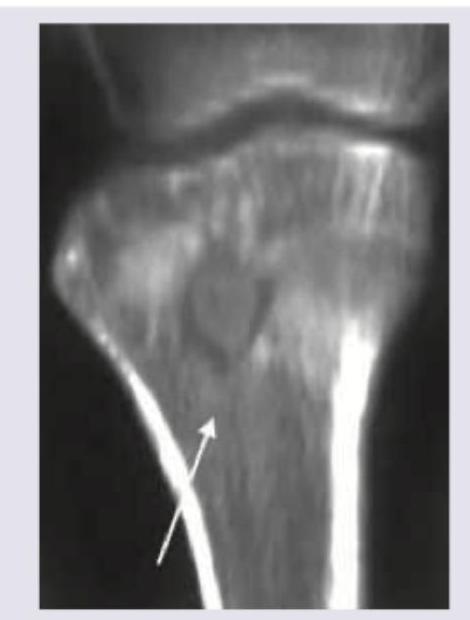
Explanation: ### Explanation **Correct Answer: C. Brodie's abscess** **Reasoning:** Brodie’s abscess is a form of **chronic subacute osteomyelitis**. It typically presents in children and adolescents (most common in the first two decades). * **Clinical Presentation:** It follows an indolent course with gradual pain and swelling, often lasting months, without significant systemic symptoms like high fever. * **Radiological Hallmark:** The classic appearance is a **geographic lytic lesion** located in the **metaphysis** (most commonly the tibia) surrounded by a well-defined **sclerotic rim** (reactive bone formation). This sclerotic margin is the key differentiator from aggressive malignant lesions. **Why other options are incorrect:** * **A. Osteogenic Sarcoma:** While it occurs in the metaphysis of children, it is an aggressive malignancy characterized by a "moth-eaten" appearance, Sunray spiculation, or Codman’s triangle, rather than a well-defined sclerotic margin. * **B. Osteoclastoma (Giant Cell Tumor):** This is typically seen in adults (20–40 years) after epiphyseal closure. It is an **epiphyseal** lesion that is purely lytic ("soap-bubble" appearance) and lacks a sclerotic rim. * **D. Ewing’s Sarcoma:** This usually involves the **diaphysis** of long bones. Radiologically, it presents with a "permeative" pattern and characteristic "onion-peel" periosteal reaction. **NEET-PG High-Yield Pearls:** * **Most common site:** Upper end of Tibia (followed by lower end of Femur). * **Pathogen:** *Staphylococcus aureus* is the most common causative organism. * **Treatment:** Surgical curettage and evacuation of the abscess under antibiotic cover. * **Differential Diagnosis:** Often confused with Osteoid Osteoma; however, Osteoid Osteoma has a smaller nidus (<2cm) and presents with nocturnal pain relieved by aspirin.
Explanation: ### Explanation In the context of **Chronic Osteomyelitis**, the infection leads to the elevation of the periosteum by pus. This process strips the bone of its blood supply, resulting in bone necrosis. **Why Option B is correct:** An **involucrum** is a layer of **new, living bone** that forms around the infected, necrotic bone. It is produced by the stripped periosteum as a physiological attempt to maintain structural integrity and wall off the infection. It often contains openings called **cloacae**, through which pus and debris (sequestrum) can escape to the skin surface via a sinus tract. **Why the other options are incorrect:** * **Option A (Dead bone):** This is known as a **Sequestrum**. It is a piece of devitalized bone that has become separated from the surrounding living bone during the process of necrosis. * **Option C (Previous live bone):** This is a non-specific description. While the sequestrum was once live bone, the term "involucrum" specifically refers to the *new* reactive bone formation. * **Option D (Sclerotic bone):** While the involucrum may appear dense on X-rays, "sclerotic bone" is a general term for increased bone density seen in various conditions (like osteoarthritis or Garre’s sclerosing osteomyelitis) and is not the specific definition of an involucrum. **High-Yield Clinical Pearls for NEET-PG:** * **Sequestrum:** Dead bone (Radiologically appears **more radio-opaque/dense** because it lacks blood supply and cannot undergo resorption). * **Cloaca:** An opening in the involucrum for the exit of pus/sequestrum. * **Garre’s Osteomyelitis:** A specific type of chronic osteomyelitis characterized by massive subperiosteal new bone formation (sclerosis) without suppuration or sequestrum formation. * **Gold Standard Investigation:** MRI is the most sensitive for early diagnosis, but X-ray is the initial investigation of choice for chronic cases.
Explanation: **Explanation:** **Charcot’s Joint (Neuropathic Osteoarthropathy)** is a progressive degenerative condition characterized by joint destruction, bone resorption, and eventual deformity in a limb that has lost sensory innervation. **Why Foot is the Correct Answer:** In patients with **Diabetes Mellitus**, the most common cause of neuropathic arthropathy today, the involvement follows a "distal-to-proximal" pattern due to peripheral neuropathy. The **tarsal and metatarsal joints (Midfoot/Foot)** are most frequently affected (specifically the **Lisfranc joint**). The loss of pain and proprioception leads to repetitive microtrauma, causing inflammatory bone destruction and the classic "rocker-bottom" foot deformity. **Analysis of Incorrect Options:** * **Shoulder (Option A):** Most commonly involved in **Syringomyelia**. Upper limb involvement is rare in diabetes. * **Ankle (Option B):** While the ankle can be involved in diabetes, it is statistically less common than the midfoot/tarsal joints. * **Knee (Option C):** Classically associated with **Tabes Dorsalis (Tertiary Syphilis)**. While it can occur in diabetes, it is not the most frequent site. **High-Yield Clinical Pearls for NEET-PG:** * **Most common cause overall:** Diabetes Mellitus (Foot). * **Syringomyelia:** Shoulder (Upper limb). * **Tabes Dorsalis:** Knee. * **Leprosy:** Hands and Feet. * **Radiological Hallmark:** The "6 Ds" (Distension, Density increase, Debris, Disorganization, Dislocation, Destruction). * **Clinical Tip:** A hot, swollen, red foot in a diabetic patient with no fever and a low ESR/CRP should raise immediate suspicion of Charcot’s joint rather than osteomyelitis.
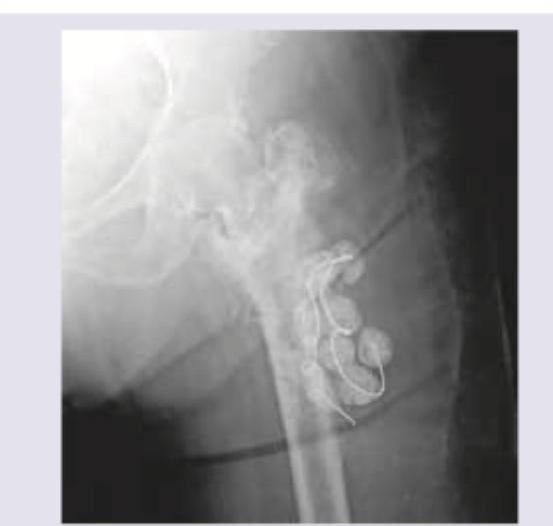
Explanation: **Explanation:** **Synovial Chondromatosis** (also known as Reichel’s syndrome) is a benign, idiopathic metaplastic condition where the synovial membrane undergoes cartilaginous transformation. This results in the formation of multiple intra-articular cartilaginous loose bodies, which may eventually ossify (synovial osteochondromatosis). 1. **Why the Knee is Correct:** The **knee joint** is the most common site of involvement, accounting for over 50% of cases. It typically presents in males aged 30–50 as a monoarticular condition characterized by pain, swelling, and restricted range of motion. Other large joints like the hip and shoulder are also frequently affected. 2. **Why Other Options are Incorrect:** * **Hands:** While small joints can be involved, it is rare. Involvement of the hands is more characteristic of "Tenosynovial Chondromatosis" rather than the primary intra-articular form. * **Pelvis:** The hip joint is the second most common site, but the pelvic bones themselves are not the primary site of this synovial pathology. * **Vertebrae:** Synovial chondromatosis rarely involves the axial skeleton or the small facet joints of the vertebrae. **High-Yield Clinical Pearls for NEET-PG:** * **Radiology:** Classic "Snowstorm appearance" on X-ray due to multiple calcified loose bodies of uniform size. * **Pathology:** Characterized by "cartilaginous clusters" with hypercellularity, which can sometimes be mistaken for low-grade chondrosarcoma. * **Milgram’s Classification:** Divided into three stages: I (Active intrasynovial disease), II (Transitional/Mixed), and III (Multiple free loose bodies with quiescent synovium). * **Treatment:** Arthroscopic or open synovectomy with removal of loose bodies. There is a small risk (approx. 5%) of malignant transformation to chondrosarcoma.
Explanation: **Explanation:** **1. Why Option C is Correct:** Osteomyelitis of the mandible frequently involves the **Inferior Alveolar Nerve (IAN)**, which runs within the mandibular canal. As the infection progresses, the resulting inflammatory edema and pressure within the confined bony canal lead to nerve compression (neuropraxia). Since the **mental nerve** is a terminal branch of the IAN, patients often present with **paresthesia or anesthesia of the lower lip** (Vincent’s sign). This is a classic clinical hallmark that helps differentiate osteomyelitis from other dental infections. **2. Why Other Options are Incorrect:** * **Option A:** Osteomyelitis **can occur in infants**. In fact, neonatal osteomyelitis is a distinct clinical entity, often characterized by multiple joint involvement and a higher risk of epiphyseal damage due to the presence of transphyseal vessels. * **Option B:** While osteomyelitis weakens the bone, **pathological fractures are a late complication**, not a "very common" feature of acute cases. Acute osteomyelitis is primarily characterized by pain, swelling, and systemic symptoms. * **Option D:** Osteomyelitis is an infectious process. Regional **lymphadenopathy** (e.g., submandibular or cervical nodes) is a common finding due to the body’s immune response to the offending pathogen (most commonly *Staphylococcus aureus*). **Clinical Pearls for NEET-PG:** * **Most Common Site:** Metaphysis of long bones (due to hair-pin loops of vessels and sluggish blood flow). * **Most Common Organism:** *Staphylococcus aureus* (overall); *Salmonella* (in Sickle Cell Anemia patients). * **Radiology:** The earliest sign is soft tissue swelling (3-5 days); bony changes (sequestrum/involucrum) take 10-14 days to appear on X-ray. **MRI** is the most sensitive early imaging modality. * **Sequestrum:** Dead bone (appears radiopaque); **Involucrum:** New bone formation (surrounds the sequestrum).
Septic Arthritis
Practice Questions
Osteomyelitis
Practice Questions
Tuberculosis of Bones and Joints
Practice Questions
Fungal and Parasitic Infections
Practice Questions
Diabetic Foot Infections
Practice Questions
Prosthetic Joint Infections
Practice Questions
Reactive Arthritis
Practice Questions
Management of Joint Infections
Practice Questions
Prevention of Orthopaedic Infections
Practice Questions
Biofilms in Orthopaedic Infections
Practice Questions
Antibiotic Prophylaxis
Practice Questions
Implant-Related Infections
Practice Questions
Get full access to all questions, explanations, and performance tracking.
Start For Free