Calcification of meniscal cartilage is a feature of which condition?
Spina ventosa is a radiographic finding associated with which of the following conditions?
What are the theories of TMJ ankylosis?
What is the most common causative microorganism for acute osteomyelitis?
What is the most common causative organism of septic arthritis in a 2-year-old child?
Which of the following conditions can cause bony ankylosis?
What is the main diagnostic feature of chronic osteomyelitis?
Which condition is diagnosed using Morrey and Peterson's criteria?
Which of the following is NOT true about HIV-associated osteomyelitis?
A patient with tubercular synovitis of the hip joint was treated with anti-tubercular therapy (ATT) and skin traction. Despite prolonged chemotherapy, no improvement is observed. What is the next best step in management?
Explanation: ### Explanation **Correct Answer: B. Pseudogout** **Concept:** Calcification of the articular or meniscal cartilage is known as **Chondrocalcinosis**. This is the hallmark radiological feature of **Pseudogout**, a condition caused by the deposition of **Calcium Pyrophosphate Dihydrate (CPPD)** crystals in the joints. In the knee, these crystals typically deposit within the fibrocartilaginous menisci and the hyaline articular cartilage, appearing as linear or punctate radiopaque densities on X-rays. **Analysis of Incorrect Options:** * **A. Gaucher’s Disease:** This is a lysosomal storage disorder characterized by the accumulation of glucocerebrosides. Orthopaedic manifestations include "Erlenmeyer flask" deformity of the femur, avascular necrosis (AVN), and bone crises, but not primary meniscal calcification. * **C. Achondroplasia:** This is a genetic disorder of endochondral ossification leading to dwarfism. It features rhizomelic shortening of limbs and spinal stenosis, but does not involve pathological cartilage calcification. * **D. Hyperparathyroidism:** While hyperparathyroidism *can* be an underlying metabolic cause associated with secondary CPPD, it is not the primary definition of meniscal calcification itself. Pseudogout is the specific clinical entity defined by this finding. **High-Yield Clinical Pearls for NEET-PG:** * **Crystal Morphology:** CPPD crystals are **positively birefringent** and **rhomboid-shaped** under polarized microscopy (unlike Gout, which has negatively birefringent, needle-shaped urate crystals). * **Common Site:** The **Knee** is the most common joint involved in Pseudogout, followed by the wrist (triangular fibrocartilage complex). * **Associated Conditions:** Always screen for the "4 Hs" in patients with chondrocalcinosis: **H**yperparathyroidism, **H**emochromatosis, **H**ypomagnesemia, and **H**ypothyroidism. * **Radiology:** Look for a thin, shaggy linear opacity parallel to the subchondral bone.
Explanation: **Explanation:** **Spina Ventosa** is a classic radiographic term used to describe **Tuberculous Dactylitis**. It refers to the involvement of the short tubular bones of the hands and feet (metacarpals, metatarsals, and phalanges) by *Mycobacterium tuberculosis*. 1. **Why Tuberculosis is Correct:** In children, the bone marrow of short tubular bones is highly vascular. TB infection leads to a granulomatous reaction in the medullary canal, causing bone destruction and internal pressure. This results in **expansile destruction** of the bone (ballooning) and simultaneous subperiosteal new bone formation. The term "Spina" refers to the thin shell of bone, and "Ventosa" means "inflated with air," describing the characteristic cystic, puffed-up appearance on X-ray. 2. **Analysis of Incorrect Options:** * **Sarcoidosis:** While Sarcoidosis can cause "Lace-like" rarefaction or punched-out cystic lesions in the phalanges (Jüngling’s disease), the specific term "Spina Ventosa" is historically and pathologically reserved for Tuberculosis. * **Histiocytosis X (LCH):** This typically presents with "punched-out" lytic lesions without significant expansion or periosteal reaction, commonly affecting the skull or femur. * **Option D:** Incorrect because although Sarcoidosis involves small bones, the radiographic morphology and nomenclature differ. **High-Yield Clinical Pearls for NEET-PG:** * **Most common site:** Proximal phalanx of the index and middle fingers. * **Age group:** Primarily seen in children under 5 years of age. * **Radiographic hallmark:** Expansile lytic lesion with a "thinning of the cortex" and "ballooned-out" appearance. * **Differential Diagnosis:** Syphilitic dactylitis (usually presents with massive periosteal thickening rather than destruction).
Explanation: ### Explanation Temporomandibular Joint (TMJ) ankylosis refers to the fusion of the mandibular condyle to the glenoid fossa, leading to restricted mouth opening. The pathogenesis is primarily explained by two major theories: 1. **Condylar Burst Theory:** This theory suggests that trauma (typically a blow to the chin) causes a longitudinal fracture of the condyle. This "bursts" the condylar head, leading to the extravasation of osteogenic cells and blood into the joint space. The subsequent organization of this hematoma results in bony bridge formation (bony ankylosis). 2. **Synovial Fluid Leak Theory:** This theory proposes that trauma causes a breach in the joint capsule, allowing synovial fluid to leak into the surrounding tissues. This fluid attracts calcium ions and promotes the precipitation of hydroxyapatite crystals, leading to ectopic calcification and eventual fusion of the joint. **Analysis of Options:** * **Option A & B:** Both are established pathophysiological mechanisms for TMJ ankylosis. * **Option C:** Correct, as it encompasses both valid theories. * **Option D:** Incorrect, as these theories are widely accepted in maxillofacial and orthopedic literature. **Clinical Pearls for NEET-PG:** * **Most Common Cause:** Trauma (especially undiagnosed subcondylar fractures in children) is the #1 cause, followed by infections (Otitis media). * **Clinical Feature:** "Bird-face" deformity (Micrognathia) occurs if ankylosis happens before growth is complete. * **Treatment of Choice:** Gap arthroplasty or Interpositional arthroplasty (using temporalis fascia or cartilage). * **Radiology:** "Mushroom-shaped" deformity of the condyle is often seen on imaging.
Explanation: **Explanation:** **Staphylococcus aureus** (part of the Staphylococcus species) is the most common causative organism for acute osteomyelitis across almost all age groups and clinical scenarios. The underlying medical concept involves its high virulence factors, specifically its ability to express **surface adhesins** (MSCRAMMs) that allow it to bind effectively to bone matrix components like collagen, fibronectin, and laminin. Additionally, it can survive intracellularly and form biofilms, making it highly resilient. **Analysis of Options:** * **Staphylococcus species (Correct):** Specifically *S. aureus*, it accounts for approximately 70-90% of cases. In children, it usually spreads via the hematogenous route, seeding the metaphysis of long bones. * **Neisseria gonorrhoeae:** While a common cause of **septic arthritis** in sexually active young adults, it is a rare cause of osteomyelitis. * **Streptococcus species:** Group B Streptococcus is a significant cause in neonates, and *Streptococcus pneumoniae* can occur in children, but they remain statistically secondary to *S. aureus*. * **Enterococcus species:** These are typically associated with polymicrobial infections, often following abdominal surgery or UTIs, but are not primary agents for acute osteomyelitis. **High-Yield Clinical Pearls for NEET-PG:** * **Sickle Cell Disease:** While *S. aureus* is still common, **Salmonella** is a highly characteristic and frequently tested causative agent in these patients. * **IV Drug Users:** Increased incidence of **Pseudomonas aeruginosa** (often affecting the spine or sacroiliac joints). * **Puncture wounds through footwear:** Associated with **Pseudomonas** infection. * **Neonates:** Most common are *S. aureus*, *Group B Streptococcus*, and *E. coli*. * **Most common site:** Metaphysis of long bones (due to sluggish blood flow in hair-pin loops of vessels).
Explanation: **Explanation:** **1. Why Staphylococcus aureus is correct:** *Staphylococcus aureus* is the most common cause of septic arthritis across **all age groups**, including infants, children, and adults. In a 2-year-old child, it accounts for the majority of cases. The organism typically reaches the joint via hematogenous spread, often originating from a minor skin lesion or an asymptomatic respiratory infection. Its ability to produce various toxins and enzymes (like coagulase) allows it to rapidly destroy articular cartilage if not treated promptly. **2. Why the other options are incorrect:** * **Haemophilus influenzae (Option A):** Historically, this was a leading cause in children under 5 years. However, since the introduction of the **Hib vaccine**, the incidence has plummeted, making it a rare cause in immunized populations. * **Neisseria gonorrhoeae (Option C):** This is the most common cause of septic arthritis in **sexually active young adults**. It is not a primary pathogen in the toddler age group unless there are specific concerns regarding child abuse. * **Streptococcus pneumoniae (Option D):** While a common cause of respiratory infections and meningitis in children, it is a less frequent cause of septic arthritis compared to *S. aureus*. **3. NEET-PG High-Yield Clinical Pearls:** * **Most common joint involved:** The **Hip joint** is the most common site in children, followed by the knee. * **Diagnosis:** The gold standard is **Arthrocentesis** (joint aspiration) with synovial fluid analysis (WBC count >50,000/mm³ with >75% neutrophils). * **Surgical Emergency:** Septic arthritis of the hip is a surgical emergency because increased intra-articular pressure can tamponade the blood supply to the femoral head, leading to **Avascular Necrosis (AVN)**. * **Neonates:** In newborns, *Group B Streptococcus* and *Gram-negative bacilli* are also significant pathogens alongside *S. aureus*. * **Sickle Cell Patients:** *Salmonella* is a high-yield association, though *S. aureus* remains common.
Explanation: ### Explanation The key to answering this question lies in understanding the difference between **fibrous ankylosis** and **bony ankylosis**. Ankylosis refers to the stiffness or fixation of a joint due to disease, injury, or surgery. **1. Why Pyogenic Arthritis is Correct:** Pyogenic (septic) arthritis is characterized by the presence of proteolytic enzymes released by polymorphonuclear leukocytes (neutrophils) and bacteria (like *Staphylococcus aureus*). These enzymes cause rapid and complete destruction of the articular cartilage. When the protective cartilage is entirely lost, the underlying raw bone surfaces come into direct contact and fuse together through ossification, resulting in **bony ankylosis**. Another classic cause of bony ankylosis is **Ankylosing Spondylitis**. **2. Analysis of Incorrect Options:** * **Rheumatoid Arthritis (RA):** RA primarily causes **fibrous ankylosis**. While it is an inflammatory condition that destroys cartilage via pannus formation, the destruction is usually not as rapid or "clean" as in pyogenic infections, leading to dense fibrous tissue adhesion rather than true bony fusion (except in the carpal/tarsal bones in advanced stages). * **Osteoarthritis (OA):** This is a degenerative condition. While it leads to joint space narrowing and osteophyte formation, it does not result in ankylosis; the joint remains mobile, albeit painful and restricted. * **Traumatic Arthritis:** Post-traumatic stiffness is usually due to intra-articular adhesions or extra-articular scarring (fibrous), not spontaneous bony fusion of the joint surfaces. **3. NEET-PG High-Yield Pearls:** * **Bony Ankylosis:** Seen in Pyogenic arthritis and Ankylosing spondylitis. * **Fibrous Ankylosis:** Classically seen in **Tuberculous (TB) arthritis** and Rheumatoid arthritis. * **Triple Deformity of Knee:** Often a result of untreated TB arthritis (Flexion, Posterior subluxation, and External rotation). * **Key Concept:** If the articular cartilage is completely destroyed (as in pyogenic infection), bony ankylosis occurs. If the cartilage is only partially destroyed or replaced by fibrous tissue (as in TB), fibrous ankylosis occurs.
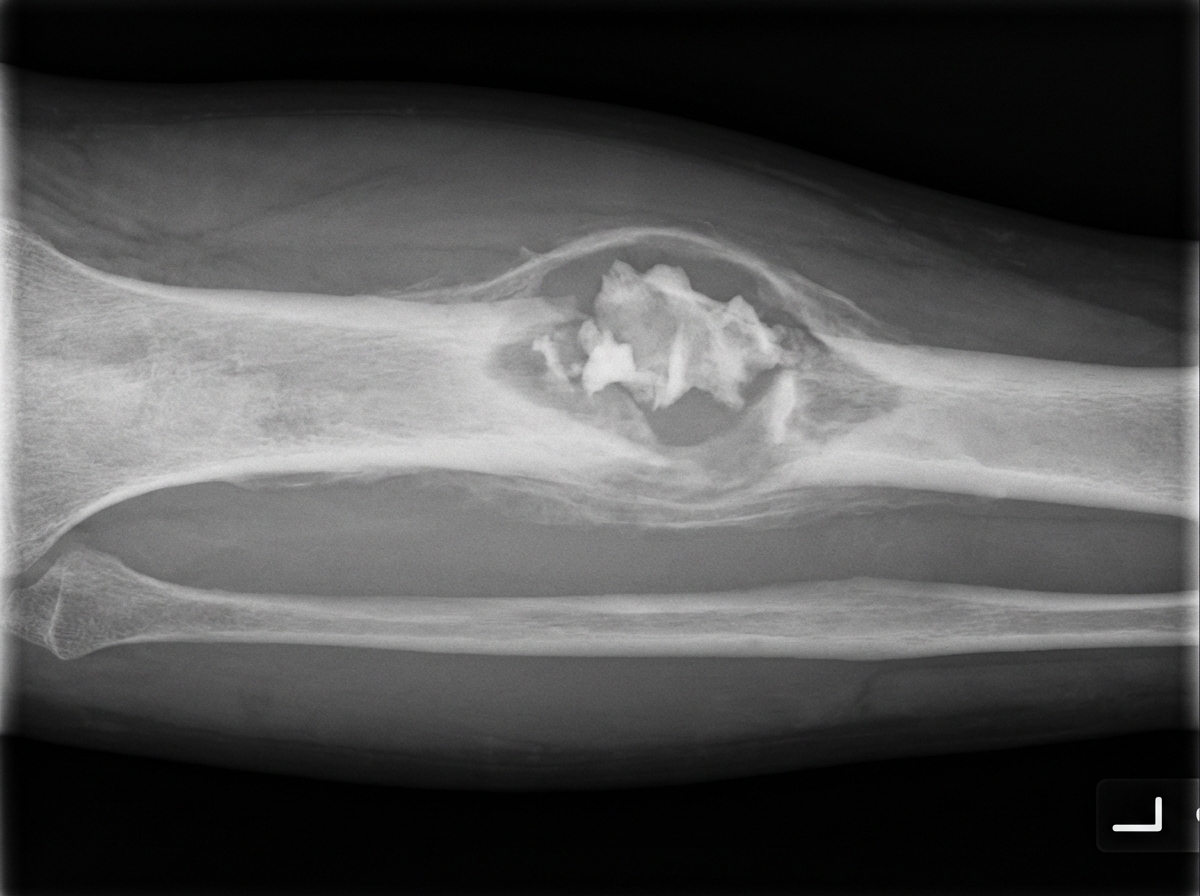
Explanation: **Explanation:** Chronic osteomyelitis is characterized by persistent infection leading to bone necrosis and new bone formation. The **Sequestrum** is the hallmark diagnostic feature of this condition. 1. **Why Sequestrum is Correct:** A sequestrum is a piece of dead (necrotic) bone that has become separated from the surrounding living bone during the process of necrosis. It occurs because the pus in the medullary cavity and subperiosteal space strips the periosteum, compromising the blood supply. Because it is avascular, it appears **radiodense (whiter)** on X-rays compared to the surrounding osteoporotic bone and acts as a nidus for persistent infection. 2. **Analysis of Incorrect Options:** * **Bone Fracture:** While pathological fractures can occur in chronic osteomyelitis due to weakened bone structure, they are a complication rather than a diagnostic hallmark. * **Deformity:** Chronic infection can lead to growth plate disturbances or malunion, resulting in deformity, but this is a late sequela and not specific to the diagnosis of the infection itself. * **Brodie’s Abscess:** This is a localized form of **subacute osteomyelitis**, typically found in the metaphysis of long bones (most commonly the tibia). While it involves infection, it represents a contained, chronic-onset abscess rather than the generalized necrotic process of classic chronic osteomyelitis. **NEET-PG High-Yield Pearls:** * **Involucrum:** The layer of new living bone formed around the sequestrum. * **Cloaca:** An opening in the involucrum through which pus and sequestra are discharged. * **Marjolin’s Ulcer:** A rare but high-yield complication where squamous cell carcinoma develops in a long-standing sinus tract of chronic osteomyelitis. * **Gold Standard Investigation:** MRI is the most sensitive for early detection, but the presence of a sequestrum on X-ray is the classic diagnostic sign.
Explanation: **Explanation:** **Morrey and Peterson’s criteria** are clinical and diagnostic parameters used specifically to diagnose **Chronic Osteomyelitis**. Since the diagnosis of chronic bone infection can be complex, these criteria help clinicians categorize the disease based on clinical findings, radiological evidence, and microbiological/pathological confirmation. * **Why Option B is Correct:** Morrey and Peterson defined chronic osteomyelitis through criteria including: 1. Presence of a draining sinus. 2. Radiographic evidence of bone destruction or sequestrum. 3. Positive cultures from bone biopsy or deep tissue. 4. Histopathological evidence consistent with chronic infection. The presence of any two of these (or a positive culture/histopathology alone) confirms the diagnosis. * **Why Other Options are Incorrect:** * **Tuberculosis of the Hip/Knee (A & D):** These are diagnosed primarily through the **Modified Tuli’s Classification** or the **Shanmugasundaram Classification**. Clinical signs like the "Night Cry" and radiological signs like Phemister’s triad are more characteristic. * **Brodie’s Abscess (C):** This is a localized form of subacute osteomyelitis. While it is a type of bone infection, it is specifically characterized by a radiolucent lesion with a sclerotic rim (usually in the metaphysis) and is not the primary focus of Morrey and Peterson’s criteria. **High-Yield Clinical Pearls for NEET-PG:** * **Cierny-Mader Classification:** The most widely used system for staging Osteomyelitis based on anatomy and host status. * **Waldvogel Classification:** Categorizes osteomyelitis by etiology (Hematogenous vs. Contiguous). * **Gold Standard Diagnosis:** Bone biopsy and culture remain the gold standard for diagnosing osteomyelitis. * **MRI:** The most sensitive imaging modality for early detection of bone marrow edema.
Explanation: **Explanation:** HIV-associated osteomyelitis presents with unique pathological features compared to pyogenic osteomyelitis in immunocompetent individuals. **1. Why "Necrosis is absent" is the correct answer (False Statement):** In HIV-associated osteomyelitis, **necrosis is actually a hallmark feature.** The infection is often aggressive due to the compromised immune system, leading to extensive bone destruction and the formation of **sequestrum** (dead bone). The statement that necrosis is absent is incorrect, making it the right choice for this "NOT true" question. **2. Analysis of Incorrect Options:** * **B. It is often bilateral:** Unlike standard osteomyelitis, which is typically unifocal, HIV-associated bone infections frequently present with **multifocal or bilateral involvement** due to hematogenous spread and poor host containment. * **C. Periosteal new bone formation is present:** Despite the necrosis, the body attempts to stabilize the bone. Radiologically, this manifests as **involucrum** (periosteal new bone formation) surrounding the infected area. * **D. The most common cause is *Staphylococcus aureus*:** Even in HIV-positive patients, ***Staphylococcus aureus*** remains the most common causative organism. However, there is a higher-than-normal incidence of atypical pathogens like *Salmonella*, *Mycobacterium avium-intracellulare*, and fungi. **Clinical Pearls for NEET-PG:** * **Radiological triad:** Look for bone destruction (necrosis), sequestrum, and involucrum. * **Atypical Presentation:** In advanced AIDS, inflammatory markers (like ESR/CRP) may be lower than expected due to a blunted immune response. * **Differential:** Always consider **Bacillary Angiomatosis** (caused by *Bartonella*) in HIV patients presenting with lytic bone lesions and overlying skin nodules.
Explanation: ### Explanation **1. Why Synovectomy and Joint Debridement is Correct:** In the management of skeletal tuberculosis, the primary treatment is medical (ATT). However, if there is no clinical or radiological improvement despite adequate chemotherapy and rest (traction), it indicates that the disease has likely progressed to a stage where **caseous material, necrotic debris, or thick granulation tissue** (pannus) is preventing the drugs from reaching the bacilli effectively. **Synovectomy and joint debridement** are indicated to surgically remove this infected tissue, reduce the bacterial load, and allow better penetration of ATT into the joint space. This "surgical toilet" helps in arresting the disease and preserving the joint architecture before irreversible destruction occurs. **2. Why Other Options are Incorrect:** * **A. Total Hip Replacement (THR):** This is a reconstructive procedure performed for a "burnt-out" or healed TB hip with secondary osteoarthritis. It is contraindicated in the active stage of infection. * **B. Arthrodesis:** This is a salvage procedure aimed at fusing the joint to provide a painless, stable hip. It is considered only after the infection is controlled and if the joint is severely destroyed beyond repair. * **C. Continue the same treatment:** If there is no improvement after a reasonable trial of ATT (usually 3–6 months), continuing the same regimen is futile and risks further bone destruction and drug resistance. **3. Clinical Pearls for NEET-PG:** * **Stages of TB Hip:** Synovitis → Early Arthritis → Advanced Arthritis → Wandering Acetabulum (Dislocation/Subluxation). * **Gold Standard Diagnosis:** Synovial biopsy and Culture/NAAT (CBNAAT). * **Girdlestone Excision Arthroplasty:** A salvage procedure for TB hip where the head and neck of the femur are removed, resulting in a mobile but unstable hip. * **Key Concept:** Surgery in bone TB is generally "supplementary" to ATT, not a replacement for it.
Septic Arthritis
Practice Questions
Osteomyelitis
Practice Questions
Tuberculosis of Bones and Joints
Practice Questions
Fungal and Parasitic Infections
Practice Questions
Diabetic Foot Infections
Practice Questions
Prosthetic Joint Infections
Practice Questions
Reactive Arthritis
Practice Questions
Management of Joint Infections
Practice Questions
Prevention of Orthopaedic Infections
Practice Questions
Biofilms in Orthopaedic Infections
Practice Questions
Antibiotic Prophylaxis
Practice Questions
Implant-Related Infections
Practice Questions
Get full access to all questions, explanations, and performance tracking.
Start For Free