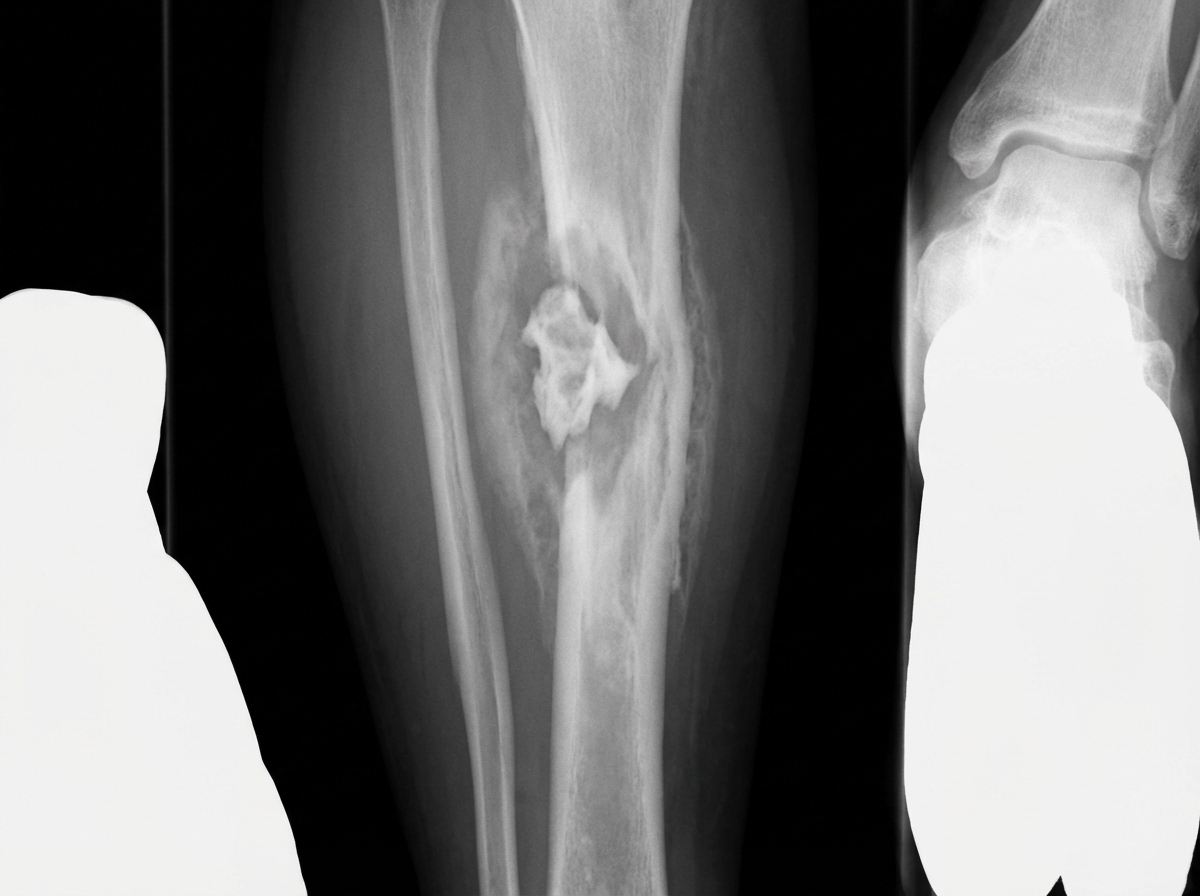
A ring sequestrum is a characteristic finding in which of the following conditions?
In bony ankylosis, what is characteristically observed?
Multiple loose bodies are seen in which of the following conditions?
What is the most common osteomyelitis-causing organism in intravenous drug abusers?
Which of the following is not typically seen in pseudogout?
What is the ideal age for performing a Posterior Malleolar Screw Fixation (PMSTR)?
What is the most common organism causing osteomyelitis?
What is the most common joint involved in gouty arthritis?
Which of the following statements is NOT true about acute osteomyelitis?
What is the most common cause of neuropathic joint?
Explanation: **Explanation:** A **sequestrum** is defined as a piece of dead bone that has become separated from the surrounding healthy bone during the process of necrosis. The morphology of a sequestrum often provides a diagnostic clue to the underlying etiology. **Why the correct answer is right:** A **Ring Sequestrum** is a characteristic radiological and pathological finding seen in **amputation stumps**. It occurs due to the necrosis of the distal end of the bone at the site of the saw cut. The devitalization happens because the blood supply to the bone end is disrupted, and if low-grade infection or excessive periosteal stripping occurs, a ring-shaped segment of bone separates from the stump. **Analysis of Incorrect Options:** * **Typhoid Osteomyelitis:** Typically presents with a **"Snow-lace" appearance** or small, multiple sequestra. It commonly affects the ribs or spine. * **Chronic Osteomyelitis:** The most common sequestrum here is the **Feathery Sequestrum** (in pyogenic cases). It is characterized by the presence of an *involucrum* (new bone) surrounding the dead bone. * **Tuberculosis Osteomyelitis:** Characterized by a **"Sand-like" sequestrum** (fine, gritty particles) due to the slow, progressive destruction of bone by granulomatous tissue. **High-Yield Clinical Pearls for NEET-PG:** * **Coke-like/Black Sequestrum:** Seen in Actinomycosis. * **Tubular Sequestrum:** Seen in long bone diaphyseal infections. * **Ivory Sequestrum:** Seen in Syphilitic osteomyelitis (dense and heavy). * **Involucrum:** The layer of living bone that forms around a sequestrum. * **Cloaca:** An opening in the involucrum through which pus and sequestra are discharged.
Explanation: **Explanation:** **Understanding Bony Ankylosis:** Ankylosis refers to the stiffness or fixation of a joint. **Bony ankylosis** (true ankylosis) occurs when there is a complete bridge of bone across the joint space, obliterating the joint cavity. Because the joint is replaced by solid bone, there is **zero movement**. Since pain in joint pathologies usually arises from friction between damaged surfaces or stretching of the capsule during movement, the total lack of motion in bony ankylosis results in a **painless** state. This is commonly seen in the late stages of Septic Arthritis or Ankylosing Spondylitis. **Analysis of Options:** * **Option A (Correct):** Bony fusion prevents all mechanical friction and stress on the joint receptors, leading to a painless, immobile joint. * **Option B & C:** These are incorrect because "complete movement" contradicts the definition of ankylosis (fixation). * **Option D:** This describes **Fibrous Ankylosis**. In fibrous ankylosis, the joint is held together by tough fibrous tissue rather than bone. This allows for slight, restricted movement which is typically **painful** because the underlying disease process is often still active or the fibrous bands are being stretched. **High-Yield Clinical Pearls for NEET-PG:** * **Bony Ankylosis:** No movement, Painless. (Classic cause: Pyogenic/Septic arthritis). * **Fibrous Ankylosis:** Restricted/Incomplete movement, Painful. (Classic cause: Tuberculous arthritis). * **Radiological Sign:** In bony ankylosis, trabeculae can be seen crossing the joint space on an X-ray. * **Management:** If the joint is fixed in a non-functional position, an osteotomy or arthroplasty may be required to restore function.
Explanation: **Explanation:** **Osteochondritis Dissecans (OCD)** is the most common cause of multiple loose bodies in a joint. It is a pathological process where a localized segment of articular cartilage and underlying subchondral bone separates from the joint surface due to aseptic necrosis. This fragment eventually detaches, becoming a "loose body" (joint mouse). It most commonly affects the lateral aspect of the medial femoral condyle. **Analysis of Options:** * **Osteochondritis Dissecans (Correct):** Characterized by the separation of osteochondral fragments. While it can present with a single fragment, it is the classic textbook answer for the primary cause of multiple loose bodies. * **Synovial Chondromatosis:** This is a benign metaplasia where the synovium produces numerous cartilaginous nodules. While it produces the *highest number* of loose bodies (often hundreds of "snowstorm" appearances), in standard orthopedic nomenclature and MCQ patterns, OCD remains the primary clinical association for "multiple loose bodies" unless "innumerable" or "synovial origin" is specified. * **Osteoarthritis:** May result in loose bodies due to the breaking off of marginal osteophytes, but these are usually few and secondary to the degenerative process. * **Rheumatoid Arthritis:** Loose bodies are rare; joint symptoms are primarily due to synovial pannus and symmetrical joint space narrowing. **High-Yield Clinical Pearls for NEET-PG:** * **Most common site for OCD:** Lateral aspect of the Medial Femoral Condyle (L-MFC). * **Wilson’s Sign:** Positive in OCD of the knee (pain on internal rotation of the tibia during extension, relieved by external rotation). * **Rice Bodies:** Specifically associated with **Tuberculous Arthritis** or Rheumatoid Arthritis (fibrin masses), not to be confused with osteochondral loose bodies. * **Imaging:** MRI is the gold standard for assessing the stability of the fragment.
Explanation: **Explanation:** The correct answer is **Pseudomonas (Option B)**. While *Staphylococcus aureus* remains the most common cause of osteomyelitis in the general population, **Intravenous Drug Abusers (IVDAs)** represent a specific high-risk group with a unique microbiological profile. In these individuals, there is a significantly increased incidence of infections caused by Gram-negative organisms, specifically **Pseudomonas aeruginosa**. This is often attributed to the use of contaminated water or paraphernalia during drug preparation. A classic clinical presentation in IVDAs is "S-syndrome" involvement—infections affecting the **S**ternoclavicular, **S**acroiliac, and **S**ymphysis pubis joints. **Analysis of Incorrect Options:** * **A. Staphylococcus aureus:** Although it is the overall #1 cause of osteomyelitis across all age groups and categories, the question specifically asks for the organism characteristic of the IVDA population, where *Pseudomonas* is the high-yield differentiator. * **C. Salmonella:** This is the most common cause of osteomyelitis specifically in patients with **Sickle Cell Anemia** (due to functional asplenia and intestinal infarctions). * **D. Pasteurella multocida:** This organism is classically associated with osteomyelitis or septic arthritis following **animal bites** (cats and dogs). **High-Yield Clinical Pearls for NEET-PG:** * **Overall most common:** *Staphylococcus aureus*. * **Sickle Cell Disease:** *Salmonella* (followed by *S. aureus*). * **IV Drug Abusers:** *Pseudomonas aeruginosa*. * **Neonates:** Group B Streptococcus (*S. agalactiae*) and *E. coli*. * **Prosthetic Joints:** *Staphylococcus epidermidis*. * **Puncture wound through footwear:** *Pseudomonas*.
Explanation: **Explanation:** Pseudogout, also known as **Calcium Pyrophosphate Deposition Disease (CPPD)**, is a crystal-induced arthropathy characterized by the accumulation of calcium pyrophosphate dihydrate crystals in the joint space. **Why Option A is correct:** Unlike Gout, which classically involves small joints (specifically the 1st metatarsophalangeal joint), **Pseudogout predominantly affects large joints**. The **knee** is the most common site (involved in >50% of cases), followed by the wrist and shoulder. Small joint involvement is rare and not a typical feature, making this the correct "except" choice. **Why other options are incorrect:** * **Large joints affected (B):** This is a hallmark of the disease. It typically presents as monoarthritis or oligoarthritis of the knee, wrist, or hip. * **Chondrocalcinosis (C):** This refers to the calcification of hyaline or fibrocartilage. It is the classic radiographic finding in CPPD, appearing as linear or punctate radiodensities within the joint space (e.g., in the meniscus of the knee). * **Deposition of calcium pyrophosphate (D):** This is the underlying pathophysiology. These crystals are **rhomboid-shaped** and show **weak positive birefringence** under polarized light microscopy (unlike the needle-shaped, negatively birefringent crystals of gout). **High-Yield Clinical Pearls for NEET-PG:** 1. **Demographics:** More common in the elderly (>60 years). 2. **Metabolic Associations:** Always screen for **Hyperparathyroidism, Hemochromatosis, Hypomagnesemia,** and **Hypophosphatasia**. 3. **Radiology:** Look for "hook-like" osteophytes at the metacarpal heads (especially 2nd and 3rd MCP joints). 4. **Treatment:** Acute management involves NSAIDs, colchicine, or intra-articular corticosteroids.
Explanation: **Explanation:** The question refers to the surgical management of **Posterior Medial Soft Tissue Release (PMSTR)**, a definitive surgical procedure for the correction of resistant or neglected **Congenital Talipes Equinovarus (CTEV)**. **1. Why 1–3 years is the correct answer:** The ideal age for PMSTR is **1–3 years**. At this stage, the child has usually started walking, which helps in remodeling the bones after the soft tissues (ligaments, tendons, and capsules) are surgically released. Before 1 year, the bones are largely cartilaginous and may be crushed by surgical handling; after 3 years, significant bony deformities (secondary adaptive changes) often develop, making soft tissue release alone insufficient. **2. Analysis of Incorrect Options:** * **Less than 1 year:** Most cases of CTEV are now managed by the **Ponseti method** (serial casting), which is highly successful in infants. Surgery is reserved for cases that fail conservative management. Performing extensive PMSTR too early increases the risk of scarring and stiffness. * **3–6 years:** By this age, soft tissue release alone is rarely successful. Children in this age group usually require **"Dwyer’s Osteotomy"** or lateral column shortening to correct the bony architecture. * **6–9 years:** In older children (neglected CTEV), salvage procedures like **Triple Arthrodesis** or the use of an **Ilizarov external fixator** are preferred over simple soft tissue releases. **High-Yield Clinical Pearls for NEET-PG:** * **Order of Correction (Ponseti):** CAVE (Cavus, Adduction, Varus, Equinus). * **Turco’s Incision:** The standard surgical approach used for PMSTR. * **Components of PMSTR:** Release of the Master Knot of Henry, lengthening of the Tendo-Achilles (TAL), and release of the posterior ankle capsule and subtalar joints. * **Radiology:** The **Kite’s Angle** (talocalcaneal angle) is decreased in CTEV (<20°).
Explanation: **Explanation:** **Staphylococcus aureus** is the most common cause of pyogenic osteomyelitis across almost all age groups and clinical scenarios. Its dominance is due to specific virulence factors, such as **surface adhesins** (MSCRAMMs) that allow it to bind to bone matrix components like collagen, and its ability to form **biofilms**, which protect the bacteria from host immune responses and antibiotics. **Analysis of Options:** * **Option A (Correct):** *S. aureus* is the overall leading cause. Even in specific populations like neonates or patients with Sickle Cell Disease (where *Salmonella* is a high-yield association), *S. aureus* remains a primary pathogen. * **Option B:** *Streptococcus pneumoniae* can cause osteomyelitis but is much rarer, usually occurring secondary to respiratory infections or in immunocompromised states. * **Option C:** *Haemophilus influenzae* was previously a common cause in children under age 5; however, its incidence has plummeted due to the widespread adoption of the **HiB vaccine**. * **Option D:** *Escherichia coli* and other Gram-negative bacilli are common causes of osteomyelitis in elderly patients, IV drug users, or following urinary tract infections, but they do not surpass *S. aureus* in frequency. **High-Yield Clinical Pearls for NEET-PG:** * **Sickle Cell Disease:** *Salmonella* is the most characteristic organism, but *S. aureus* is still statistically the most common. * **IV Drug Users:** High incidence of *Pseudomonas aeruginosa* (often affecting the S-joints: Sternoclavicular and Sacroiliac). * **Puncture wound through footwear:** Highly associated with *Pseudomonas aeruginosa*. * **Neonates:** Group B Streptococcus and *E. coli* are significant alongside *S. aureus*. * **Chronic Osteomyelitis:** Characterized by the **Involucrum** (new bone) and **Sequestrum** (dead bone).
Explanation: **Explanation:** Gouty arthritis is a metabolic disorder characterized by the deposition of **monosodium urate (MSU) crystals** in synovial fluid and tissues. The **first metatarsophalangeal (MTP) joint of the big toe** is the most common site of involvement, affected in approximately 50% of first attacks and up to 90% of patients eventually. This specific clinical presentation is known as **Podagra**. The predilection for the first MTP joint is attributed to: 1. **Lower Temperature:** Peripheral joints are cooler, which decreases the solubility of uric acid, favoring crystal precipitation. 2. **Repeated Microtrauma:** The big toe bears significant weight and stress during walking. **Analysis of Incorrect Options:** * **Knee Joint:** While the knee is the second most common site involved in gout (especially in polyarticular presentations), it is less frequent than the first MTP joint. It is, however, the most common site for **Pseudogout** (CPPD). * **Hip Joint:** Involvement of the hip in gout is extremely rare. Gout typically affects distal, cooler, peripheral joints rather than large axial joints. * **MTP Joint of the Thumb:** This is a distractor. While gout can affect the small joints of the hand (especially in elderly patients on diuretics), the first MTP joint of the foot remains the classic and most frequent site. **NEET-PG High-Yield Pearls:** * **Gold Standard Diagnosis:** Polarized light microscopy showing **needle-shaped**, **negatively birefringent** crystals. * **Radiology:** Characterized by "punched-out" erosions with overhanging edges (**Martel’s sign**). * **Acute Management:** NSAIDs (first-line), Colchicine, or Corticosteroids. * **Chronic Management:** Allopurinol (Xanthine oxidase inhibitor) is the mainstay for urate-lowering therapy.
Explanation: ### Explanation **1. Why Option D is the Correct (False) Statement:** In acute osteomyelitis, a **Technetium-99m (Tc-99m) bone scan** is highly sensitive and can detect increased osteoblastic activity within **24 to 48 hours** of the onset of symptoms. The statement claiming it takes 2 weeks is incorrect; it is the **plain X-ray** that typically requires 10–14 days (or 30–50% bone mineral loss) to show visible changes like periosteal reaction or rarefaction. **2. Analysis of Other Options:** * **A. Metaphysis is involved:** This is true. The metaphysis is the most common site because it has **hairpin-shaped capillary loops** where blood flow slows down, allowing bacteria to settle. It also has a relatively deficient phagocytic system. * **B. Commonly caused by Staphylococcus aureus:** This is true. *S. aureus* is the most common causative organism across almost all age groups. (Note: *Salmonella* is a specific high-yield association for Sickle Cell patients). * **C. May present with pseudoparalysis:** This is true. In infants and young children, the intense pain caused by the infection leads the patient to refuse to move the affected limb, mimicking paralysis (pseudoparalysis). **Clinical Pearls for NEET-PG:** * **Gold Standard Investigation:** MRI is the most sensitive and specific imaging modality for early diagnosis (detects marrow edema within hours). * **Definitive Diagnosis:** Aspiration of pus or bone biopsy for culture. * **Sequestrum:** Dead bone (radiodense); **Involucrum:** New bone formation around the sequestrum (characteristic of chronic osteomyelitis). * **Cloaca:** An opening in the involucrum for the exit of pus/sequestrum. * **Brodie’s Abscess:** A form of subacute osteomyelitis characterized by a circumscribed radiolucent lesion with a sclerotic rim.
Explanation: **Explanation:** A **Neuropathic Joint (Charcot Joint)** is a progressive, degenerative arthropathy caused by a loss of pain and proprioceptive sensation. Without these protective mechanisms, repetitive microtrauma leads to joint destruction, instability, and deformity. **1. Why Diabetes Mellitus is correct:** Currently, **Diabetes Mellitus** is the most common cause of neuropathic joints worldwide. It primarily affects the **foot and ankle** (tarsal and metatarsal joints) due to peripheral neuropathy. As the prevalence of diabetes has risen, it has surpassed historical causes like syphilis. **2. Analysis of Incorrect Options:** * **Hypertension:** This is a vascular condition and does not cause sensory neuropathy or joint destruction. * **Leprosy:** While a common cause of neuropathy in specific endemic regions (leading to Charcot joints in the hands and feet), it is not the most common cause globally or statistically compared to Diabetes. * **Tabes Dorsalis (Neurosyphilis):** Historically, this was the most common cause, typically affecting the **knee joint**. However, with the advent of antibiotics, it is now rare. **3. High-Yield Clinical Pearls for NEET-PG:** * **Most common site (Overall):** Foot and Ankle (due to Diabetes). * **Most common site in Tabes Dorsalis:** Knee. * **Most common site in Syringomyelia:** Shoulder/Upper limb (due to "dissociated sensory loss"). * **Radiological Hallmark:** The **"6 Ds"** (Distension, Density increase/Sclerosis, Debris, Disorganization, Dislocation, and Destruction). * **Clinical Paradox:** The joint often looks "horrible" on X-ray (severe destruction) but is relatively **painless** for the patient.
Septic Arthritis
Practice Questions
Osteomyelitis
Practice Questions
Tuberculosis of Bones and Joints
Practice Questions
Fungal and Parasitic Infections
Practice Questions
Diabetic Foot Infections
Practice Questions
Prosthetic Joint Infections
Practice Questions
Reactive Arthritis
Practice Questions
Management of Joint Infections
Practice Questions
Prevention of Orthopaedic Infections
Practice Questions
Biofilms in Orthopaedic Infections
Practice Questions
Antibiotic Prophylaxis
Practice Questions
Implant-Related Infections
Practice Questions
Get full access to all questions, explanations, and performance tracking.
Start For Free