Anencephaly is best diagnosed using which of the following methods?
Which of the following is not an indication for amniocentesis for chromosomal detection?
The oxytocin challenge test for assessing fetal well-being is contraindicated in all except which of the following conditions?
What are the advantages of ultrasound nuchal translucency screening over biochemical screening for Down syndrome?
At which gestational age does the uterus reach the umbilical level?
Which of the following are signs considered positive in early pregnancy?
A woman has a history of 2 pregnancies. What is her gravidity?
According to CDC recommendations, what is the recommended approach for HIV screening of pregnant women?
One of the parents has a balanced translocation between chromosome 15 and 21. What advice will you provide to the couple to prevent a child being born with Down syndrome?
Transabdominal CVS can be done in which gestational period?
Explanation: **Explanation:** **Anencephaly** is a lethal neural tube defect (NTD) characterized by the absence of the cranial vault and cerebral hemispheres. **Why Ultrasound (USG) is the Correct Answer:** Ultrasound is the **gold standard and investigation of choice** for diagnosing anencephaly. It can reliably detect the condition as early as **11–14 weeks** (late first trimester). Key sonographic features include the absence of the calvarium above the orbits (the **"Frog-eye appearance"** or "Mickey Mouse sign") and the presence of a vascular stroma instead of brain tissue (*Area cerebrovasculosa*). Its high sensitivity (nearly 100%), non-invasive nature, and real-time visualization make it superior to biochemical markers. **Analysis of Incorrect Options:** * **Maternal Serum Alpha-Fetoprotein (MSAFP):** This is a **screening tool**, not a diagnostic one. While MSAFP is elevated in 80-90% of open NTDs, it requires confirmation via USG due to high false-positive rates (e.g., multiple gestations, incorrect dating). * **Amniotic Fluid Alpha-Fetoprotein (AFAFP):** This is more specific than MSAFP but requires an invasive procedure (amniocentesis). With the advancement of high-resolution USG, invasive testing for anencephaly is rarely necessary. * **X-ray:** Historically used to see the absence of the skull vault, it is now **obsolete** due to radiation risks and the superior diagnostic accuracy of USG. **Clinical Pearls for NEET-PG:** * **Earliest Diagnosis:** 11 weeks by USG. * **Associated Finding:** **Polyhydramnios** is common in the third trimester due to the fetus's inability to swallow amniotic fluid. * **Prevention:** Periconceptional **Folic Acid (400 mcg/day)** reduces the risk of NTDs. For women with a previous affected pregnancy, the dose is increased to **4 mg/day**. * **Management:** Since it is a lethal anomaly, termination of pregnancy is offered regardless of gestational age.
Explanation: **Explanation:** Amniocentesis is an invasive prenatal diagnostic procedure used primarily to obtain fetal cells for karyotyping and genetic analysis. The indications for chromosomal detection are based on an increased risk of aneuploidy or genetic disorders. **Why Gestational Diabetes Mellitus (GDM) is the correct answer:** GDM is a metabolic complication of pregnancy characterized by glucose intolerance. While GDM increases the risk of macrosomia, polyhydramnios, and neonatal hypoglycemia, it is **not** associated with an increased risk of fetal chromosomal anomalies. Therefore, GDM alone is not an indication for amniocentesis. **Analysis of Incorrect Options:** * **Previous Down’s syndrome child:** A history of a prior pregnancy affected by trisomy increases the recurrence risk, making genetic testing essential in subsequent pregnancies. * **Maternal age > 35 years:** Advanced maternal age is a classic indication due to the increased risk of non-disjunction during meiosis, leading to trisomies (e.g., Down syndrome). * **Parents with known chromosomal anomaly:** If either parent is a carrier of a balanced translocation or other structural rearrangements, there is a high risk of unbalanced gametes and fetal chromosomal defects. **High-Yield Clinical Pearls for NEET-PG:** * **Timing:** Amniocentesis is ideally performed between **15–20 weeks** of gestation. * **Complication:** The most significant risk is procedure-related pregnancy loss (approx. 0.5%). * **Other Indications:** Assessment of fetal lung maturity (L/S ratio), diagnosis of fetal infections (CMV), and therapeutic drainage of polyhydramnios. * **Gold Standard:** While screening (Dual/Quadruple markers) provides risk probability, amniocentesis provides a **definitive diagnosis** via karyotyping or FISH.
Explanation: **Explanation:** The **Oxytocin Challenge Test (OCT)**, also known as the Contraction Stress Test (CST), evaluates the fetal heart rate response to uterine contractions. The primary goal is to identify if the feto-placental unit can withstand the temporary reduction in blood flow that occurs during labor. **1. Why Breech Presentation is the Correct Answer:** Breech presentation is **not** a contraindication for OCT. While breech presentation may influence the mode of delivery (often leading to a planned cesarean), it does not pose an inherent risk of uterine rupture or catastrophic hemorrhage when exposed to mild, induced uterine contractions. Therefore, fetal well-being can be safely assessed using OCT in these patients if a vaginal trial is being considered or if monitoring is required before an elective procedure. **2. Why the Other Options are Contraindicated:** The OCT is contraindicated in any condition where **uterine contractions are dangerous** or where **vaginal delivery is prohibited**: * **Placenta Previa (Option A):** Contractions can cause cervical effacement and dilatation, leading to massive maternal hemorrhage. * **Previous Two LSCS (Option B):** Multiple previous uterine scars significantly increase the risk of **uterine rupture** during induced contractions. (Note: A single previous LSCS is a relative contraindication). * **Premature Labor (Option C):** Inducing contractions in a patient at risk for preterm birth can trigger or accelerate the labor process, leading to the delivery of a premature infant. **Clinical Pearls for NEET-PG:** * **Positive OCT:** Defined by late decelerations occurring with >50% of contractions. It indicates feto-placental insufficiency. * **Negative OCT:** No late or significant variable decelerations; this is a reassuring sign. * **Absolute Contraindications:** Placenta previa, vasa previa, previous classical CS, and history of extensive myomectomy. * **Prerequisite:** A minimum of 3 contractions (lasting 40–60 seconds) in a 10-minute window is required for a valid interpretation.
Explanation: ### Explanation **Correct Option: C. Offers better performance in multiple gestations.** In multiple pregnancies (twins/triplets), biochemical screening (PAPP-A and β-hCG) is less reliable because the markers from both fetuses enter the single maternal circulation, making it difficult to distinguish which fetus is at risk. Ultrasound-based **Nuchal Translucency (NT)** screening allows for the **independent assessment** of each fetus. This makes it the preferred screening method for Down syndrome in multiple gestations, as it can identify the specific fetus affected. **Analysis of Incorrect Options:** * **A. Utilizes a transvaginal approach:** While NT can be measured transvaginally if the abdominal view is poor, it is primarily performed via a **transabdominal** approach. This is not a comparative "advantage" over biochemical screening, which only requires a simple maternal blood draw. * **B. Provides more consistent measurements:** NT is highly **operator-dependent**. It requires strict adherence to Fetal Medicine Foundation (FMF) criteria (e.g., mid-sagittal plane, neutral neck position). Laboratory biochemical tests are generally more standardized and less prone to inter-operator variability. * **D. Covers a wider gestational age range:** NT screening has a very narrow window (**11 weeks to 13 weeks 6 days**; CRL 45–84 mm). Biochemical screening can be done in both the first trimester (PAPP-A/hCG) and the second trimester (Quadruple test), thus covering a wider range. **High-Yield Clinical Pearls for NEET-PG:** * **Combined Test:** The gold standard for first-trimester screening is the "Combined Test" (NT + PAPP-A + free β-hCG), which has a detection rate of ~90%. * **NT Cut-off:** An NT measurement **>3.5 mm** is considered abnormal and is associated not only with aneuploidy (Trisomy 21, 18, 13) but also with **congenital heart defects**. * **Nasal Bone:** The absence of the nasal bone on an 11–14 week scan is another strong soft marker for Down syndrome.
Explanation: **Explanation:** The height of the uterine fundus is a critical clinical marker used to assess fetal growth and gestational age during prenatal visits. **1. Why 24 weeks is correct:** By convention and clinical observation, the fundus of the uterus reaches the **level of the umbilicus at 24 weeks** of gestation. While some older textbooks previously cited 20–22 weeks, modern obstetric guidelines (including DC Dutta and Williams Obstetrics) standardize the umbilical level at 24 weeks for examination purposes. At this stage, the fundal height in centimeters (measured from the symphysis pubis) typically correlates 1:1 with the weeks of gestation. **2. Analysis of Incorrect Options:** * **16 weeks:** At this stage, the fundus is midway between the symphysis pubis and the umbilicus. * **20 weeks:** The fundus is generally 2 finger-breadths below the umbilicus. * **28 weeks:** The fundus is approximately 3 finger-breadths above the umbilicus (at the junction of the lower 2/3 and upper 1/3 of the distance between the umbilicus and the xiphisternum). **3. NEET-PG High-Yield Clinical Pearls:** * **12 weeks:** The uterus first becomes an abdominal organ (just palpable at the pubic symphysis). * **36 weeks:** The fundus reaches the highest point (xiphisternum). * **40 weeks:** The fundal height actually *drops* to the level of 32 weeks due to "lightening" (engagement of the fetal head), though the flanks will be full. * **Rule of Thumb:** If the fundal height is significantly greater than the dates, consider multiple pregnancy, polyhydramnios, or molar pregnancy. If less than dates, consider IUGR or oligohydramnios.
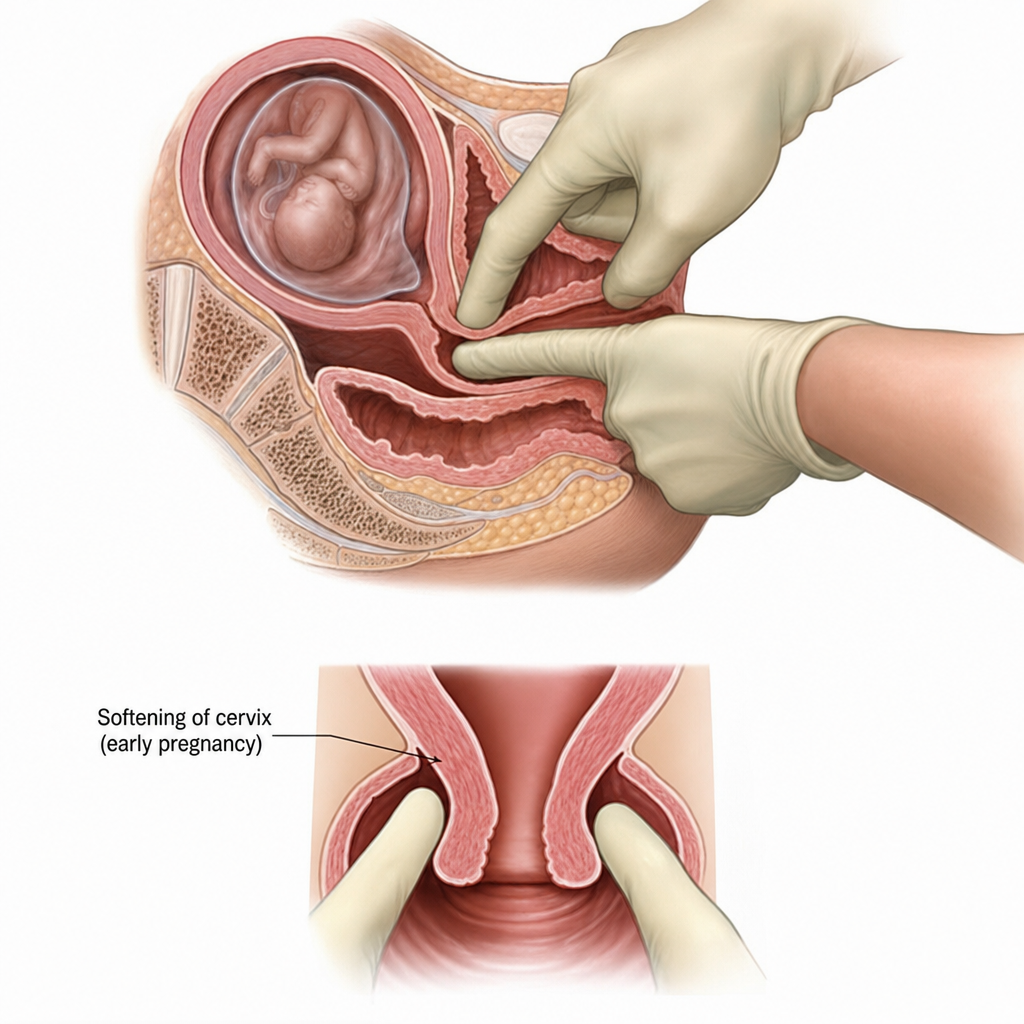
Explanation: In early pregnancy, the pelvic organs undergo significant physiological changes due to increased vascularity (hyperemia) and hormonal influences (estrogen and progesterone). These changes manifest as specific clinical signs during a bimanual examination. **Explanation of the Correct Answer:** The correct answer is **D (All of the above)** because Hegar’s, Palmer’s, Goodell’s, and Osiander’s signs are all classic clinical markers of early pregnancy: * **Hegar’s Sign:** Softening of the uterine isthmus. On bimanual examination, the upper part of the uterus and the cervix feel like two separate entities because the isthmus is so soft it cannot be felt. (Appears at 6–10 weeks). * **Palmer’s Sign:** Regular, rhythmic, painless uterine contractions felt during a digital examination. (Appears as early as 4–8 weeks). * **Goodell’s Sign:** Softening of the cervix. The cervix normally feels like the "tip of the nose," but in pregnancy, it feels like the "lips." (Appears at 6 weeks). * **Osiander’s Sign:** Increased pulsation felt through the lateral vaginal fornices due to increased vascularity of the uterine arteries. (Appears at 8 weeks). **Why other options are "wrong":** Options A, B, and C are individual components of the clinical picture. Since all three represent valid signs of early pregnancy, "All of the above" is the most comprehensive and correct choice. **High-Yield NEET-PG Clinical Pearls:** * **Chadwick’s Sign (Jacquemier’s Sign):** Bluish discoloration of the cervix, vagina, and labia due to venous congestion (8 weeks). * **Piskacek’s Sign:** Asymmetrical enlargement of the uterus if implantation occurs near the cornua. * **Internal Ballottement:** Can be elicited between 16–28 weeks. * **Ladins Sign:** Softening of the anterior midline of the uterus at the junction with the cervix (6 weeks).
Explanation: **Explanation:** The correct answer is **C. G2**. **Understanding the Concept:** In obstetrics, **Gravidity (G)** refers to the total number of times a woman has been pregnant, regardless of the duration or the outcome of those pregnancies (e.g., live birth, stillbirth, miscarriage, or ectopic pregnancy). Since the patient has a history of two pregnancies, she is classified as **Gravida 2 (G2)**. **Analysis of Options:** * **A. G0 (Nulligravida):** This term describes a woman who has never been pregnant. * **B. G1 (Primigravida):** This describes a woman who is pregnant for the first time or has been pregnant only once. * **D. G3 (Multigravida):** This would apply if the woman had a history of three pregnancies. **High-Yield Clinical Pearls for NEET-PG:** 1. **GTPAL System:** To provide a complete obstetric history, clinicians use the GTPAL acronym: * **G (Gravida):** Total pregnancies. * **T (Term):** Births at ≥37 weeks. * **P (Preterm):** Births between 20–36 weeks 6 days. * **A (Abortion/Loss):** Pregnancies ending before 20 weeks. * **L (Living):** Number of currently living children. 2. **Multiple Gestations:** Twins or triplets count as **one** pregnancy (G1) and **one** parous event (P1). Gravidity and Parity refer to the *episodes* of pregnancy, not the number of fetuses. 3. **Parity vs. Gravidity:** While Gravidity counts the number of times pregnant, **Parity** counts the number of pregnancies that reached the age of viability (typically 20 or 24 weeks depending on local guidelines), regardless of whether the child was born alive or stillborn.
Explanation: **Explanation:** The CDC and major international health guidelines (including NACO in India) recommend **Opt-out testing** as the standard of care for HIV screening in all pregnant women. **1. Why Opt-out testing is correct:** In an "Opt-out" approach, HIV testing is included in the standard battery of prenatal tests. The patient is informed that the test will be performed as part of routine care unless she specifically declines it. This approach is superior because it normalizes HIV testing, reduces the stigma associated with "risk-based" screening, and ensures maximum coverage. Identifying HIV-positive status early allows for the initiation of **Antiretroviral Therapy (ART)**, which can reduce the risk of mother-to-child transmission (MTCT) from ~25-40% to **less than 1%**. **2. Why other options are incorrect:** * **Opt-in testing:** Requires the patient to specifically request or sign a separate consent for the test after counseling. This often leads to lower testing rates due to perceived stigma or administrative hurdles. * **Compulsory testing:** Mandatory testing without consent violates patient autonomy and ethical standards. * **Symptomatic testing:** Waiting for symptoms to appear is dangerous in pregnancy, as many HIV-positive individuals are asymptomatic for years, during which time the virus can be transmitted to the fetus. **High-Yield Clinical Pearls for NEET-PG:** * **Repeat Testing:** A second test in the **third trimester** (before 36 weeks) is recommended for women at high risk of acquiring HIV. * **Window Period:** If a woman presents in labor with unknown status, a **Rapid HIV test** should be performed immediately. * **Breastfeeding:** In the Indian context (NACO guidelines), HIV-positive mothers are encouraged to exclusively breastfeed for the first 6 months while on ART, whereas in developed countries (CDC), breastfeeding is generally avoided if safe alternatives exist.
Explanation: **Explanation:** **1. Why Option A is Correct:** A balanced translocation between chromosomes 15 and 21 (a Robertsonian translocation) in a parent significantly increases the risk of **Down Syndrome** in the offspring. During meiosis, the gametes can inherit the translocated chromosome along with a normal chromosome 21, leading to **Trisomy 21** upon fertilization. * If the mother is the carrier, the risk of Down syndrome is approximately **10–15%**. * If the father is the carrier, the risk is lower, about **1–2%**. Because the risk is substantial, the standard clinical management involves **prenatal diagnosis** (via Chorionic Villus Sampling or Amniocentesis) to check the fetal karyotype. If the fetus is affected, the couple is offered the option of elective **abortion** (Medical Termination of Pregnancy). **2. Why Other Options are Incorrect:** * **Option B:** Artificial insemination is only effective if the *father* is the carrier. If the mother carries the translocation, donor sperm does not mitigate the risk. It is not the universal "first-line" advice. * **Option C:** Adoption is a lifestyle choice for family building but does not address the medical management of a current or future pregnancy. * **Option D:** This is factually incorrect. A balanced translocation carrier has a significantly higher risk of miscarriage and chromosomal abnormalities compared to the general population. **Clinical Pearls for NEET-PG:** * **Robertsonian Translocation:** Occurs only between **acrocentric chromosomes** (13, 14, 15, 21, and 22). * **Most Common Translocation:** The most common Robertsonian translocation is **t(14;21)**. * **100% Risk:** If a parent has a **21;21 balanced translocation**, the risk of Down syndrome in a live-born child is **100%**. * **Recurrence Risk:** While most Down syndrome cases are due to primary nondisjunction (risk increases with maternal age), translocation Down syndrome is independent of maternal age and has a high recurrence risk.
Explanation: **Explanation:** **Chorionic Villus Sampling (CVS)** is a prenatal diagnostic procedure used to obtain chorionic villi for genetic analysis. The correct timing for CVS is crucial to balance diagnostic accuracy with fetal safety. **1. Why 11–13 weeks is correct:** The standard window for performing CVS (both transabdominal and transcervical) is **10 to 13+6 weeks** of gestation. Performing the procedure during this period ensures there is sufficient placental tissue for sampling while minimizing risks to the developing fetus. The 11–13 week window is the most common clinical practice as it aligns with first-trimester screening protocols. **2. Why the other options are incorrect:** * **Options A, C, and D (Before 10 weeks):** Performing CVS before 10 weeks is contraindicated. Early CVS is strongly associated with **Limb Reduction Defects** (e.g., oromandibular-limb hypogenesis) due to vascular disruption during the critical period of limb development. It also carries a higher risk of miscarriage. **High-Yield Clinical Pearls for NEET-PG:** * **Advantage over Amniocentesis:** CVS can be performed earlier in pregnancy (1st trimester), allowing for earlier diagnosis and safer termination if required. * **Confined Placental Mosaicism (CPM):** This is a specific limitation of CVS where the chromosomal makeup of the placenta differs from the fetus, potentially leading to false-positive results. * **Rh Isoimmunization:** In Rh-negative unsensitized mothers, **Anti-D immunoglobulin** must be administered following the procedure to prevent sensitization. * **Amniocentesis Timing:** Usually performed between **15–20 weeks**. Early amniocentesis (before 15 weeks) is avoided due to risks of clubfoot (talipes equinovarus) and fetal loss.
Preconception Counseling
Practice Questions
Pregnancy Diagnosis and Dating
Practice Questions
Routine Antenatal Assessments
Practice Questions
Maternal Physiological Changes
Practice Questions
Nutrition in Pregnancy
Practice Questions
Screening Tests in Pregnancy
Practice Questions
Fetal Growth Assessment
Practice Questions
High-Risk Pregnancy Identification
Practice Questions
Antenatal Complications Management
Practice Questions
Psychosocial Aspects of Pregnancy
Practice Questions
Get full access to all questions, explanations, and performance tracking.
Start For Free