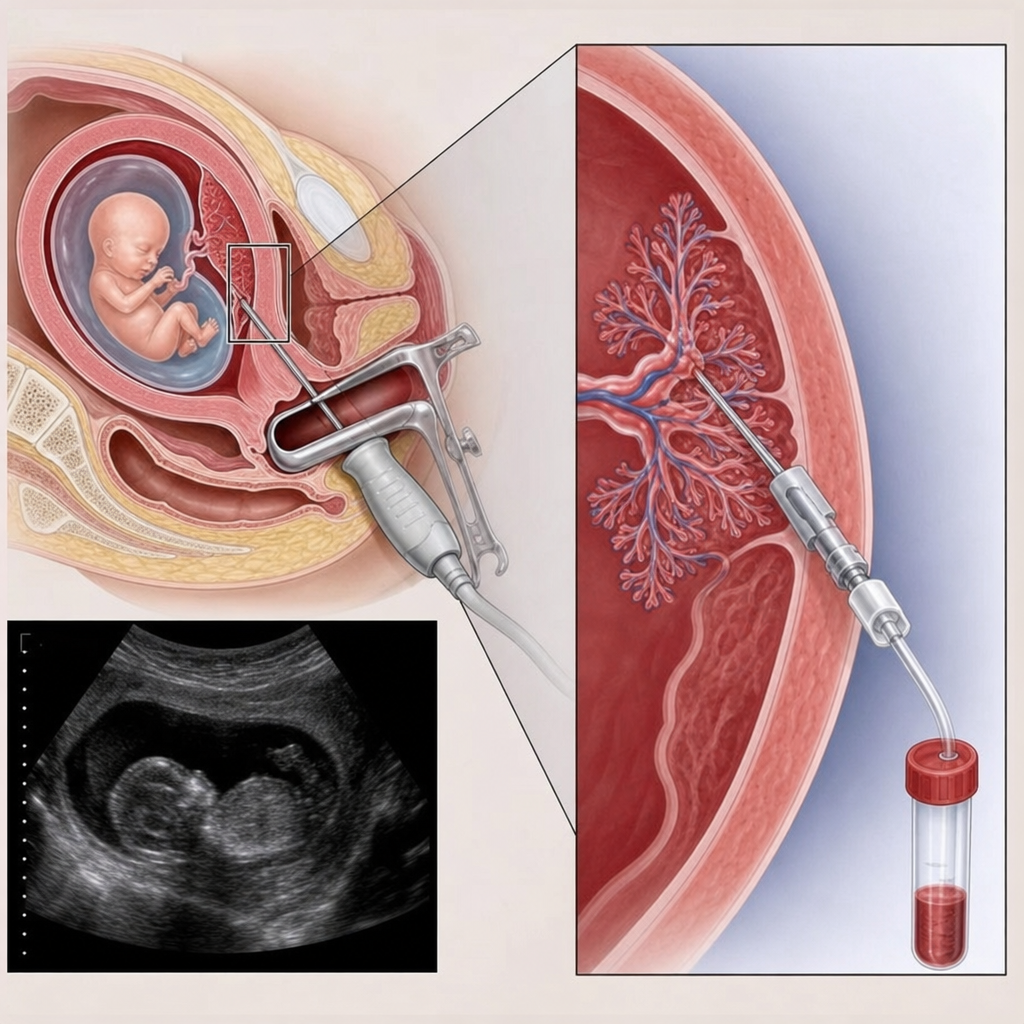
What is the earliest finding seen on ultrasonography?
A 25-year-old primigravida at 25 weeks of gestation presents for an antenatal check-up. She has a history of genital herpes infection for 5 years, usually asymptomatic with 3 flares in the past 5 years. She is concerned about exposing her unborn child to the infection. What is the most appropriate counsel to offer this patient?
During pregnancy, urine frequency increases in which trimester?
Which of the following statements regarding folic acid supplementation is FALSE?
A 28-week pregnant woman (G2P1) detected with major placenta previa on ultrasound (transvaginal scan) should have a confirmatory scan performed at which gestational age?
A positive "Stallworthy's sign" is suggestive of which of the following conditions?
Which of the following conditions does NOT fall under the high-risk category in obstetrics?
Which of the following is NOT a diagnostic serum marker for Down's syndrome?
Which vaccine should not be administered during pregnancy?
All of the following are true about anencephaly except?
Explanation: ### Explanation In early pregnancy, ultrasonography (USG) follows a predictable chronological sequence of findings. The **Yolk Sac** is the correct answer because it is the first structure to appear *within* the gestational sac, confirming an intrauterine pregnancy. **1. Why Yolk Sac is Correct:** The yolk sac is the first anatomical structure visible inside the gestational sac. On Transvaginal Sonography (TVS), it typically appears at **5 weeks** of gestation (when the Mean Sac Diameter is ~8 mm). It serves as a critical landmark to rule out a "pseudogestational sac" seen in ectopic pregnancies. **2. Why the other options are incorrect:** * **Fetal Heart:** Cardiac activity is usually detected after the appearance of the yolk sac and the fetal pole. It is visible via TVS at approximately **6 weeks** (when the Crown-Rump Length is >7 mm). * **Chorion:** While the chorionic sac (gestational sac) is technically the very first sign of pregnancy (visible at 4.5 weeks), it is a cavity rather than a distinct internal structure. Among the options provided, the yolk sac is the earliest *definitive* structure identified within that cavity. * **Placenta:** The definitive placenta (chorion frondosum) begins to take shape and become sonographically distinct much later, usually around **10–12 weeks** of gestation. **3. High-Yield Clinical Pearls for NEET-PG:** * **Order of appearance (TVS):** Gestational Sac (4.5 wks) → Yolk Sac (5 wks) → Embryo/Fetal Pole (5.5 wks) → Fetal Heart Rate (6 wks). * **Double Decidual Sign:** The earliest sign of an intrauterine pregnancy (IUP) before the yolk sac appears. * **Discriminatory Zone:** The level of β-hCG at which a gestational sac should be visible. For TVS, this is typically **1,500–2,000 mIU/mL**. * **Yolk Sac Size:** A diameter **>6 mm** or an irregular shape is often associated with poor pregnancy outcomes or chromosomal abnormalities.
Explanation: The management of genital herpes in pregnancy focuses on preventing neonatal herpes, which carries high morbidity and mortality. **Explanation of the Correct Answer (Option D):** The risk of vertical transmission is highest (30–50%) during a primary infection at the time of delivery and significantly lower (<1%) in recurrent infections. For women with a history of recurrent herpes, the standard of care is to allow **vaginal delivery if no active lesions or prodromal symptoms** (like tingling or burning) are present at the onset of labor. An **elective LSCS** is indicated **only if active genital lesions or prodromal symptoms** are present at the time of delivery to minimize direct contact with the virus. **Analysis of Incorrect Options:** * **Option A:** A single dose of acyclovir is insufficient. If lesions are present, the goal is to bypass the birth canal via LSCS, not just treat the mother. * **Option B:** While suppressive antiviral therapy (Acyclovir/Valacyclovir) is recommended for women with recurrent herpes, it typically starts at **36 weeks gestation**, not 25 weeks. This reduces the likelihood of a flare-up at term but does not replace the need for an LSCS if lesions appear. * **Option C:** Routine LSCS for all women with a history of herpes is unnecessary. Since the transmission risk in recurrent cases without active lesions is extremely low, the risks of surgery outweigh the benefits. **High-Yield Clinical Pearls for NEET-PG:** * **Primary Infection at Term:** Highest risk of transmission; LSCS is strongly recommended. * **Suppressive Therapy:** Start Acyclovir 400 mg TID from **36 weeks** until delivery. * **Scalp Electrodes:** Avoid internal fetal monitoring in patients with a history of HSV as it increases the risk of neonatal infection. * **Acyclovir:** It is considered safe (Category B) in all trimesters of pregnancy.
Explanation: **Explanation:** Increased frequency of micturition is a common physiological symptom in pregnancy, occurring primarily due to mechanical and hormonal changes. **Why the First Trimester is correct:** During the **first trimester**, the enlarging uterus remains a pelvic organ. As it grows, it exerts direct **mechanical pressure** on the urinary bladder, reducing its capacity. Additionally, increased levels of progesterone cause relaxation of the bladder wall, and the rise in renal plasma flow (RPF) and glomerular filtration rate (GFR) increases urine production. This combination leads to the classic symptom of increased frequency. **Analysis of Incorrect Options:** * **Second Trimester:** As the uterus grows further (after 12 weeks), it ascends out of the pelvis and becomes an abdominal organ. This relieves the direct pressure on the bladder, and the frequency of micturition typically **subsides** during this period. * **Third Trimester:** Frequency often **reappears** late in the third trimester (especially after 36 weeks) when the fetal head engages into the pelvis, again compressing the bladder. However, the question asks when it *increases* (initial onset), which is the first trimester. * **Puerperium:** While there is postpartum diuresis to eliminate excess fluid, this is a physiological recovery phase and not the primary period associated with pregnancy-induced frequency. **High-Yield Clinical Pearls for NEET-PG:** * **Bimodal Distribution:** Remember that urinary frequency in pregnancy follows a bimodal pattern—appearing in the 1st trimester, disappearing in the 2nd, and reappearing in the 3rd. * **Red Flag:** If increased frequency is accompanied by dysuria, hematuria, or suprapubic pain, investigate for **UTI/Asymptomatic Bacteriuria**, as pregnancy increases the risk of pyelonephritis. * **Renal Changes:** GFR increases by nearly 50% during pregnancy, leading to lower baseline serum creatinine levels (0.4–0.8 mg/dL).
Explanation: **Explanation:** The correct answer is **B**. While the USA and several other countries have mandatory folic acid fortification of cereal grains (wheat/flour) to reduce the incidence of Neural Tube Defects (NTDs), **India does not have a mandatory national policy for the fortification of all wheat products.** Although the FSSAI has established standards for voluntary fortification, it is not universal or legally mandated across all wheat products as it is in the USA. **Analysis of other options:** * **Option A:** Folic acid is essential for DNA synthesis and neurulation. Supplementation must begin **preconceptionally** (ideally 1–3 months before) because the neural tube closes by the 28th day of gestation, often before a woman realizes she is pregnant. * **Option C:** Dietary sources of folate (Vitamin B9) include dark green leafy vegetables (spinach), legumes, citrus fruits, and liver. * **Option D:** The WHO and Indian guidelines recommend a daily intake of **400–500 mcg** of folic acid for routine pregnancies. **High-Yield Clinical Pearls for NEET-PG:** * **Standard Dose:** 400 mcg (0.4 mg) daily for low-risk pregnancies. * **High-Risk Dose:** 4 mg (4000 mcg) daily if there is a previous history of a child with NTD, maternal diabetes, or intake of anti-epileptic drugs (e.g., Valproate). * **Timing:** Start 4 weeks before conception and continue until 12 weeks of gestation (end of the first trimester). * **Mechanism:** It prevents NTDs like Anencephaly and Spina Bifida by ensuring proper closure of the neural tube.
Explanation: **Explanation:** The management of placenta previa is guided by the phenomenon of **"placental migration."** As the lower uterine segment (LUS) develops and stretches in the third trimester, a placenta that appeared to be "low-lying" or "previa" earlier in pregnancy often moves away from the internal os. **Why 32 weeks is correct:** According to standard obstetric guidelines (RCOG and FIGO), if a placenta previa is suspected or diagnosed at the mid-trimester scan (18–22 weeks), a follow-up scan is required. For women who remain asymptomatic and have **major placenta previa** (encroaching or covering the os) at the mid-trimester scan, a confirmatory scan is recommended at **32 weeks** gestation. This timing allows for the initial development of the LUS while providing enough time to plan for elective delivery or further monitoring if the previa persists. **Analysis of Incorrect Options:** * **34 weeks:** While some protocols suggest 34 weeks for *minor* low-lying placenta, 32 weeks is the standard threshold for confirming *major* previa to facilitate early multidisciplinary planning. * **36 weeks:** This is too late for a primary follow-up, as many women with major previa may experience bleeding or go into preterm labor before this date. 36 weeks is typically when the final decision for the mode of delivery is made if the 32-week scan was still inconclusive. * **Onset of labor:** This is contraindicated. Placenta previa must be diagnosed antenatally to avoid catastrophic hemorrhage caused by cervical dilation during labor. **High-Yield Clinical Pearls for NEET-PG:** * **Gold Standard Diagnosis:** Transvaginal Ultrasound (TVS) is safer and more accurate than transabdominal ultrasound for measuring the distance between the placental edge and the internal os. * **Low-lying Placenta:** Defined when the placental edge is **<2 cm** from the internal os but not covering it. * **Management:** If the placental edge is **>2 cm** from the internal os at the 32-week scan, a vaginal delivery is likely safe. If it remains over the os, a planned Cesarean Section is scheduled (usually at 36–37 weeks).
Explanation: **Explanation:** **Stallworthy’s Sign** (also known as the "Postural Sign") is a classic clinical finding in **Posterior Placenta Previa** (Low-lying placenta). 1. **Mechanism of the Correct Answer:** In cases of a posterior low-lying placenta, the bulk of the placenta occupies the pelvic brim, preventing the fetal head from engaging. This results in a high, floating head. When pressure is applied to the fetal head to push it into the pelvis, the fetal heart rate (FHR) slows down (bradycardia) due to compression of the placenta and umbilical cord between the head and the sacral promontory. When the pressure is released, the FHR returns to normal. This positive sign is highly suggestive of a posterior placenta previa. 2. **Analysis of Incorrect Options:** * **Twin Pregnancy:** Associated with a large-for-dates uterus and multiple fetal parts, but does not involve positional FHR changes related to pelvic engagement. * **Breech Presentation:** While breech can lead to a high-lying presenting part, Stallworthy’s sign specifically refers to the compression of a posterior placenta by the fetal head. * **Vesicular Mole:** Characterized by "snowstorm appearance" on USG and disproportionately high hCG levels; it does not present with fetal heart rate variations as there is usually no viable fetus. **High-Yield Clinical Pearls for NEET-PG:** * **Dangerous Placenta:** Posterior placenta previa is often called the "dangerous placenta" because it is more likely to interfere with engagement and is harder to detect on routine clinical examination compared to anterior types. * **Diagnosis:** Transvaginal Sonography (TVS) is the gold standard for diagnosing placenta previa. * **Management:** If Stallworthy’s sign is suspected, a per-vaginal (PV) examination is strictly contraindicated unless performed in an "Operation Theatre" setup (Double Setup Examination) due to the risk of torrential hemorrhage.
Explanation: **Explanation:** A high-risk pregnancy is one in which the mother, fetus, or newborn is at increased risk of adverse outcomes due to pre-existing medical conditions, obstetric complications, or demographic factors. **Why Option C is Correct:** A **BMI of 24 kg/m²** falls within the **normal range** (18.5–24.9 kg/m²) according to WHO classification. It does not pose an increased risk to the pregnancy. In contrast, a BMI <18.5 (underweight) or ≥30 (obese) is considered high-risk due to associations with intrauterine growth restriction (IUGR) or gestational diabetes and preeclampsia, respectively. **Why Other Options are Incorrect:** * **A. Diabetes:** Both pre-gestational and gestational diabetes are high-risk conditions associated with congenital anomalies, macrosomia, polyhydramnios, and neonatal hypoglycemia. * **B. Epilepsy:** It is high-risk due to the potential for increased seizure frequency during pregnancy and the teratogenic risks associated with Anti-Epileptic Drugs (AEDs), such as neural tube defects. * **D. Elderly Women:** Advanced maternal age (typically **≥35 years**) is a high-risk factor. These women have a higher incidence of chromosomal abnormalities (e.g., Down Syndrome), gestational hypertension, and placenta previa. **High-Yield Clinical Pearls for NEET-PG:** * **Primi-elderly:** A woman conceiving for the first time at age 35 or older. * **Grand Multipara:** A woman who has had 5 or more previous pregnancies (increased risk of PPH and malpresentations). * **Short Stature:** Height **<145 cm** (4'9") is a high-risk factor for cephalopelvic disproportion (CPD). * **Anemia:** Hemoglobin **<11 g/dL** in pregnancy is the most common high-risk factor in India.
Explanation: **Explanation:** In prenatal screening for Down’s syndrome (Trisomy 21), specific biochemical markers are measured to assess risk. **Progesterone (Option D)** is the correct answer because it is not used as a diagnostic or screening marker for chromosomal aneuploidies. While progesterone is vital for maintaining pregnancy, its levels do not show a consistent, predictive correlation with Down’s syndrome. **Analysis of Screening Markers:** The "Triple Test" (performed between 15–20 weeks) utilizes the other three options. In a pregnancy affected by Down’s syndrome, the typical pattern is: * **Alpha-fetoprotein (AFP) (Option B):** Levels are **decreased**. AFP is produced by the fetal yolk sac and liver. * **Free Estriol (uE3) (Option A):** Levels are **decreased**. It reflects the integrity of the fetal-placental unit. * **hCG (Option C):** Levels are **increased**. This is a characteristic finding in Trisomy 21. **High-Yield Clinical Pearls for NEET-PG:** 1. **Quadruple Test:** Adds **Inhibin-A** to the triple test. In Down’s syndrome, Inhibin-A levels are **increased** (Mnemonic: **HI**gh = **H**CG and **I**nhibin are elevated). 2. **First Trimester Screening (11–13.6 weeks):** Uses **PAPP-A** (decreased) and **free β-hCG** (increased), combined with Nuchal Translucency (NT) ultrasound. 3. **Edward Syndrome (Trisomy 18):** Unlike Down’s syndrome, **all** markers (AFP, uE3, and hCG) are typically **decreased**. 4. **Neural Tube Defects (NTD):** Characterized by significantly **elevated AFP** levels.
Explanation: **Explanation:** The fundamental principle in obstetric immunization is the distinction between **Live-Attenuated Vaccines** and **Inactivated/Killed Vaccines**. **1. Why MMR is the Correct Answer:** The **MMR vaccine** is a live-attenuated vaccine. Live vaccines are generally **contraindicated** during pregnancy because of the theoretical risk of the attenuated virus crossing the placenta and causing congenital infection or teratogenic effects in the fetus. Specifically, the Rubella component carries a risk of Congenital Rubella Syndrome (CRS). Women are advised to avoid pregnancy for at least 28 days (1 month) after receiving the MMR vaccine. **2. Why the other options are incorrect:** * **Rabies (Option B):** This is a killed vaccine. It is administered as post-exposure prophylaxis if a pregnant woman is bitten by a suspected animal. Pregnancy is not a contraindication to life-saving rabies vaccination. * **Hepatitis B (Option C):** This is a subunit (recombinant) vaccine. It is safe and indicated for pregnant women at high risk of infection. * **Diphtheria (Option D):** Usually given as part of the **Tdap** (Tetanus, Diphtheria, and acellular Pertussis) combination. Tdap is actively recommended during the third trimester (ideally 27–36 weeks) to provide passive immunity to the neonate against pertussis. **High-Yield Clinical Pearls for NEET-PG:** * **Contraindicated Vaccines:** MMR, Varicella, BCG, Yellow Fever, and Live Attenuated Influenza Vaccine (Nasal spray). * **Recommended Vaccines:** Tdap (every pregnancy) and Inactivated Influenza (Injectable). * **Exception:** Yellow Fever vaccine may be given if the risk of exposure is high and travel is unavoidable. * **Postpartum:** MMR and Varicella vaccines can be safely administered immediately after delivery, even if breastfeeding.
Explanation: **Explanation:** Anencephaly is a lethal neural tube defect characterized by the absence of the cranial vault and cerebral hemispheres. **Why Option C is the correct answer (The False Statement):** Contrary to common belief, **post-term pregnancy (prolonged pregnancy)** is more common in anencephaly than preterm delivery. This occurs because the fetal pituitary-adrenal axis is defective or absent. The lack of fetal cortisol and precursors for estrogen synthesis leads to a failure in the initiation of labor, often resulting in a pregnancy that continues beyond 42 weeks unless medical intervention occurs. **Analysis of Incorrect Options:** * **A. Face presentation:** Due to the absence of the vertex (calvarium), the head cannot engage normally. The face becomes the leading part, making face presentation a common clinical finding. * **B. Increased alpha-fetoprotein (AFP):** Anencephaly is an open neural tube defect. This allows AFP to leak from the fetal circulation into the amniotic fluid and maternal serum, leading to significantly elevated levels. * **D. Polyhydramnios:** This occurs due to two reasons: (1) the fetus lacks the swallowing reflex due to neurological deficit, and (2) transudation of fluid from the exposed meninges (cerebrospinal fluid) into the amniotic sac. **High-Yield Clinical Pearls for NEET-PG:** * **Screening:** Elevated Maternal Serum AFP (MSAFP) at 15–20 weeks. * **Diagnosis:** Ultrasound is the gold standard (shows "Frog-eye appearance" or "Mickey Mouse sign" in early scans). * **Prevention:** 4 mg of Folic acid daily (pre-conceptionally) for women with a previous history; 400 mcg for low-risk pregnancies. * **Associated finding:** "Shoulder dystocia" can occur because these fetuses often have large trunks despite the absent cranial vault.
Preconception Counseling
Practice Questions
Pregnancy Diagnosis and Dating
Practice Questions
Routine Antenatal Assessments
Practice Questions
Maternal Physiological Changes
Practice Questions
Nutrition in Pregnancy
Practice Questions
Screening Tests in Pregnancy
Practice Questions
Fetal Growth Assessment
Practice Questions
High-Risk Pregnancy Identification
Practice Questions
Antenatal Complications Management
Practice Questions
Psychosocial Aspects of Pregnancy
Practice Questions
Get full access to all questions, explanations, and performance tracking.
Start For Free