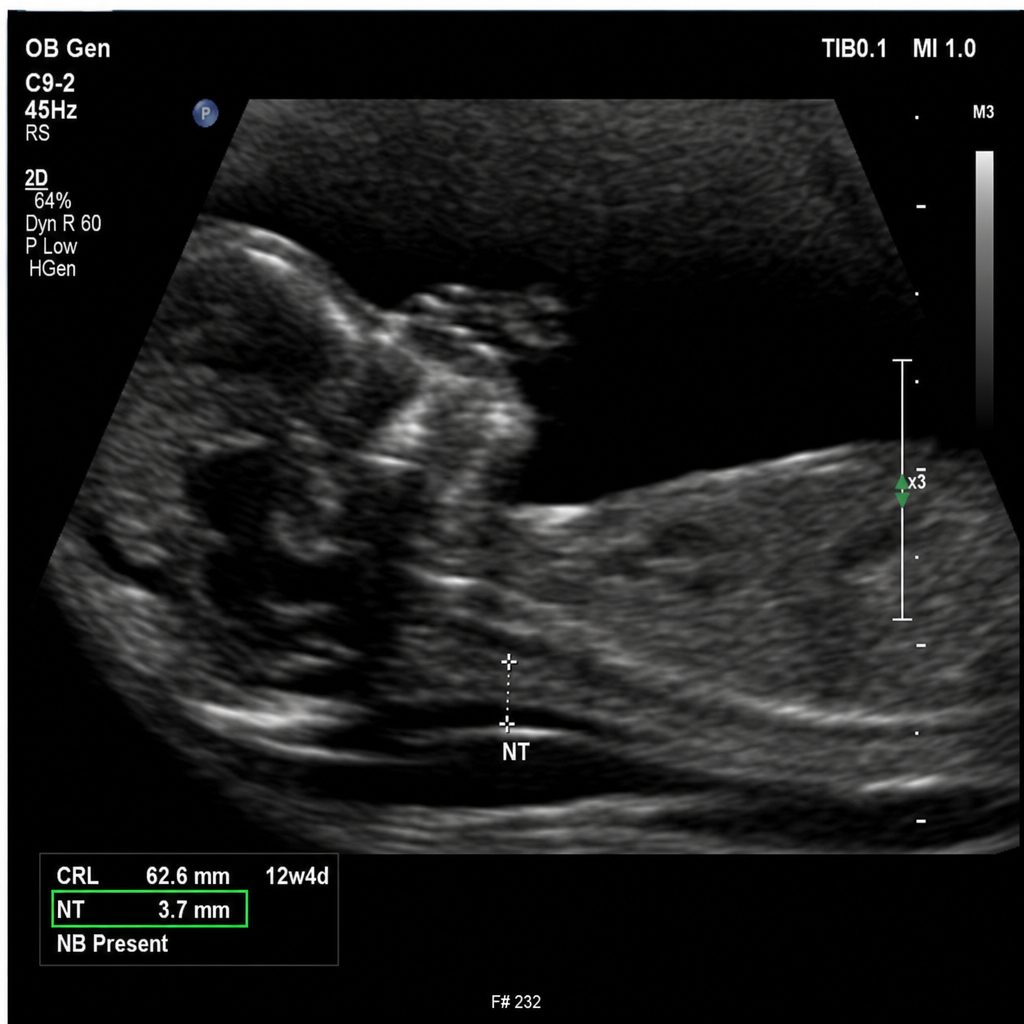
Maternal serum alpha-fetoprotein screening helps to detect which of the following conditions, except?
A newly married couple, both of whom have achondroplastic dwarfism, presents for preconception counseling. Which of the following advice should NOT be given to the couple?
All of the following strategies are effective in preventing mother-to-child transmission of HIV, except?
Nuchal translucency is useful in?
Which one of the following tests detects fetal skin cells?
Rhythmic contractions of the uterus elicited by bimanual examination at 4-8 weeks is called?
During a routine return OB visit, an 18-year-old G1P0 patient at 23 weeks gestational age undergoes a urinalysis. The dipstick indicates the presence of trace glucosuria. All other parameters of the urine test are normal. Which of the following is the most likely etiology of the increased sugar detected in the urine?
What is the recommended daily intake of folic acid during pregnancy?
Which of the following tests has the highest detection rate for Down's syndrome?
A 35-year-old female, who previously had a child with Down syndrome, becomes pregnant. Amniocentesis is performed to screen for Down syndrome in the current pregnancy. What is the most appropriate gestational age for performing amniocentesis?
Explanation: **Explanation:** Maternal Serum Alpha-Fetoprotein (MSAFP) is a glycoprotein produced initially by the yolk sac and later by the fetal liver. It is a crucial screening marker measured between **15–20 weeks** of gestation. **Why Talipes Equinovarus is the correct answer:** Talipes equinovarus (clubfoot) is a structural musculoskeletal deformity involving the bones and tendons of the foot. It does not involve a breach in the fetal skin or an opening into a body cavity; therefore, it does not cause leakage of AFP into the amniotic fluid or maternal circulation. Consequently, MSAFP levels remain normal. **Analysis of Incorrect Options (Conditions with Elevated MSAFP):** Elevated MSAFP occurs when there is a defect in the fetal "barrier," allowing AFP to leak into the amniotic fluid. * **Neural Tube Defects (NTDs):** Conditions like anencephaly and spina bifida (aperta) have exposed neural tissue, leading to significantly high MSAFP. * **Omphalocele & Gastroschisis:** These are ventral abdominal wall defects where the absence of skin coverage over the herniated viscera allows AFP to escape. * **Duodenal Atresia:** This is associated with impaired fetal swallowing of amniotic fluid. Since the fetus cannot clear the AFP normally present in the fluid, levels rise and subsequently increase in maternal serum. **High-Yield Clinical Pearls for NEET-PG:** * **Low MSAFP:** Associated with **Down Syndrome (Trisomy 21)**, Edward Syndrome (Trisomy 18), and Gestational Trophoblastic Disease. * **High MSAFP:** Associated with NTDs, abdominal wall defects, multiple gestations, renal anomalies (Finnish-type nephrosis), and **underestimation of gestational age** (most common cause of unexplained elevation). * **Next Step:** If MSAFP is elevated, the first step is a **Targeted Ultrasound** to rule out dating errors or multiple pregnancies.
Explanation: **Explanation:** **Achondroplasia** is the most common form of skeletal dysplasia, characterized by a mutation in the **FGFR3 gene**. It follows an **Autosomal Dominant (AD)** inheritance pattern. **1. Why Option C is the correct (incorrect advice) answer:** In this scenario, both parents are heterozygotes (Aa) for achondroplasia. According to Mendelian inheritance (Aa x Aa): * **25% chance (AA):** Homozygous dominant. This is **lethal** in the neonatal period due to severe respiratory insufficiency. * **50% chance (Aa):** Heterozygous. The child will have achondroplasia. * **25% chance (aa):** Homozygous recessive. The child will have **normal stature**. Therefore, the advice that there is a 50% chance of normal stature is mathematically incorrect; the actual chance is only **25%**. **2. Analysis of other options:** * **Option A:** Achondroplasia primarily affects endochondral ossification of long bones. It does **not** affect cognitive development or intelligence. * **Option B:** Women with achondroplasia have a **contracted, platypelloid pelvis**. Due to the significant cephalopelvic disproportion (CPD), a Cesarean section is almost always mandatory. * **Option D:** Achondroplasia is a classic example of an **Autosomal Dominant** condition with 100% penetrance. **High-Yield Clinical Pearls for NEET-PG:** * **Most common cause:** De novo mutations (80%), often associated with **advanced paternal age** (>40 years). * **Radiological sign:** "Trident hand" (persistent space between the 3rd and 4th fingers). * **Homozygous Achondroplasia:** Always lethal; characterized by severe rhizomelic shortening and a small thorax.
Explanation: **Explanation:** The goal of preventing mother-to-child transmission (PMTCT) of HIV is to reduce the viral load in the mother and minimize the infant's exposure to infected maternal fluids. **Why Option B is the Correct Answer:** **Vaginal cleansing** (using antiseptic solutions like chlorhexidine) before or during labor has been studied extensively and has **not** been shown to reduce the risk of HIV transmission. While it may reduce the risk of other neonatal infections (like Group B Strep), it does not impact the cell-associated or cell-free HIV virus present in birth canal secretions. **Analysis of Other Options:** * **A. Zidovudine (AZT):** Antiretroviral therapy (ART) is the cornerstone of PMTCT. AZT administered to the mother during pregnancy/labor and to the infant post-exposure significantly reduces viral replication and transmission risk. * **C. Stopping Breastfeeding:** HIV is secreted in breast milk. In developed settings, complete avoidance of breastfeeding (replacement feeding) is recommended to eliminate postnatal transmission. (Note: In resource-limited settings, WHO recommends exclusive breastfeeding with maternal ART). * **D. Elective Cesarean Section:** Performing a C-section before the onset of labor or rupture of membranes avoids the infant's contact with vaginal secretions and blood, reducing transmission risk, especially if the maternal viral load is >1,000 copies/mL. **High-Yield Clinical Pearls for NEET-PG:** * **Most common timing of transmission:** Intrapartum (during labor and delivery). * **Current Protocol (WHO/NACO):** All pregnant women living with HIV should be started on **Lifelong ART (TDF + 3TC + EFV/DTG)** regardless of CD4 count or clinical stage. * **Infant Prophylaxis:** Nevirapine (NVP) is typically given to the infant for 6 weeks. * **Best Indicator:** Maternal viral load at the time of delivery is the strongest predictor of transmission risk.
Explanation: **Explanation:** **Nuchal Translucency (NT)** refers to the sonographic appearance of a collection of fluid under the skin behind the fetal neck in the first trimester. It is a critical screening tool for **fetal malformations**, specifically chromosomal abnormalities (aneuploidies) and structural defects. 1. **Why Option B is Correct:** An increased NT thickness (typically >3.0 mm or >95th percentile for crown-rump length) is strongly associated with **Trisomy 21 (Down Syndrome)**, Trisomy 18, and Trisomy 13. Beyond chromosomal issues, an increased NT is a marker for major **structural malformations**, most notably **congenital heart defects**, diaphragmatic hernias, and skeletal dysplasias. 2. **Why Other Options are Incorrect:** * **Option A & C:** Fetal age and size are primarily determined in the first trimester by the **Crown-Rump Length (CRL)**, which is the most accurate parameter for dating. * **Option D:** Placental location is assessed via routine ultrasonography; while important, it is unrelated to the fluid collection in the nuchal space. **High-Yield Clinical Pearls for NEET-PG:** * **Timing:** NT must be measured between **11 weeks and 13 weeks 6 days** of gestation (CRL between 45 mm and 84 mm). * **Combined Test:** NT is used alongside maternal serum markers (**PAPP-A and free β-hCG**) in the "First Trimester Combined Screening" for Down Syndrome. * **Nuchal Fold vs. NT:** Do not confuse these. NT is measured in the **first trimester**, while Nuchal Fold thickness is measured in the **second trimester** (16–20 weeks); both are markers for aneuploidy.
Explanation: **Explanation:** The **Nile blue sulphate test** is a cytological method used to assess fetal maturity by identifying fetal skin cells (sebocytes) in the amniotic fluid. As the fetus matures, its sebaceous glands begin to function, shedding cells laden with lipids into the amniotic fluid. When Nile blue sulphate stain is added, these **anuclear orange-stained cells** (also called "orangeoid cells") represent mature fetal skin cells. A concentration of >20% orange cells typically indicates a gestational age of more than 36 weeks, correlating with functional fetal maturity. **Analysis of Incorrect Options:** * **A. Shake Test (Bubble Stability Test):** This is a bedside biochemical test used to assess **fetal lung maturity**. It measures the ability of pulmonary surfactants (lecithin) in the amniotic fluid to generate stable bubbles in the presence of ethanol. It does not detect skin cells. * **C. Litmus Test:** This is used to detect the **premature rupture of membranes (PROM)**. Amniotic fluid is alkaline (pH 7.0–7.5), while vaginal secretions are acidic (pH 4.5–5.5). A change from red to blue litmus indicates the presence of liquor, not specific cellular components. **High-Yield Clinical Pearls for NEET-PG:** * **L/S Ratio:** The gold standard for lung maturity; a ratio **>2:1** indicates mature lungs. * **Phosphatidylglycerol (PG):** Its presence is the most reliable indicator of lung maturity, especially in diabetic pregnancies where L/S ratio might be falsely reassuring. * **Fern Test:** Used for PROM; identifies a "arborization" pattern due to high sodium chloride content in amniotic fluid. * **Amniotic Fluid Color:** Golden yellow (Rh incompatibility), Green (Meconium/Distress), Dark tobacco/Saffron (Post-maturity), Dark red (Abruptio placentae).
Explanation: **Explanation:** The correct answer is **Palmer’s sign**. This clinical sign refers to the regular, rhythmic, and symmetrical contractions of the uterus that can be elicited during a bimanual examination as early as **4 to 8 weeks** of gestation. These contractions are spontaneous and can be felt by the examining fingers, serving as one of the early "probable" signs of pregnancy. **Analysis of Incorrect Options:** * **Hegar’s sign:** This refers to the softening of the lower uterine segment (isthmus). It is typically elicited between **6 to 10 weeks** when the upper part of the uterus is enlarged with the growing fetus, but the lower part is empty and soft, making the two fingers of the bimanual exam feel as if they meet. * **Braxton Hicks’ sign:** These are painless, irregular, non-rhythmic uterine contractions that occur throughout pregnancy. While they are similar to Palmer’s sign, they are usually felt later (after the first trimester) and are not specifically elicited by bimanual examination in the early 4-8 week window. * **Goodell’s sign:** This refers to the significant **softening of the cervix**, which occurs around **6 weeks** of gestation. In a non-pregnant state, the cervix feels like the tip of the nose; in pregnancy, it feels like the lips. **High-Yield Clinical Pearls for NEET-PG:** * **Osiander’s sign:** Increased pulsation felt through the lateral vaginal fornices due to increased vascularity (8 weeks). * **Chadwick’s sign (Jacquemier's sign):** Bluish discoloration of the cervix, vagina, and labia due to venous congestion (6-8 weeks). * **Piskacek’s sign:** Asymmetrical enlargement of the uterus if implantation occurs near one of the cornua (7-8 weeks).
Explanation: **Explanation:** The correct answer is **C. The patient's urinalysis is consistent with normal pregnancy.** **1. Why the correct answer is right:** During pregnancy, significant physiological changes occur in the renal system. There is a marked increase in the **Glomerular Filtration Rate (GFR)**—by approximately 50%—which increases the filtered load of glucose. Simultaneously, pregnancy causes a **decrease in the renal threshold for glucose reabsorption** in the proximal convoluted tubules. Because the tubules cannot reabsorb the excess filtered glucose, **trace glucosuria (up to 1+ on a dipstick)** is considered a normal physiological finding in nearly 50% of pregnant women and does not necessarily indicate pathology. **2. Why the incorrect options are wrong:** * **Option A:** While diabetes can cause glucosuria, a "trace" finding at 23 weeks in an otherwise asymptomatic patient is more likely physiological. Screening for Gestational Diabetes Mellitus (GDM) is typically performed between 24–28 weeks using a Glucose Tolerance Test (GTT), not a urine dipstick. * **Option B:** A urinary tract infection (UTI) would typically present with symptoms (dysuria, frequency) or dipstick findings like positive nitrites, leukocyte esterase, or pyuria. Glucosuria is not a diagnostic marker for infection. * **Option D:** Contamination (e.g., vaginal discharge) usually results in the presence of epithelial cells or mucus, not isolated glucosuria. **Clinical Pearls for NEET-PG:** * **Renal Changes in Pregnancy:** GFR and Renal Plasma Flow (RPF) increase; Serum Creatinine and BUN levels **decrease** (Normal Cr in pregnancy is ~0.4–0.8 mg/dL). * **Glucosuria vs. Proteinuria:** While trace glucosuria is normal, **proteinuria** (≥1+ or >300mg/24h) is always pathological and warrants investigation for preeclampsia or renal disease. * **GDM Screening:** The gold standard is the Oral Glucose Tolerance Test (OGTT). Urine sugar is a poor screening tool for GDM due to its low sensitivity and high false-positive rate in pregnancy.
Explanation: **Explanation:** The correct answer is **500 micrograms (0.5 mg)**. Folic acid is a critical B-vitamin required for DNA synthesis and amino acid metabolism. During pregnancy, the demand for folate increases significantly to support rapid cell division in the fetus and the expansion of maternal red blood cell mass. **Why 500 micrograms is correct:** According to the **Ministry of Health and Family Welfare (MoHFW)** and the **National Iron Plus Initiative (NIPI)** guidelines in India, the recommended daily dose for a pregnant woman is **500 mcg (0.5 mg)** of folic acid combined with 100 mg of elemental iron, starting from the second trimester (14 weeks) for 180 days. However, for the prevention of **Neural Tube Defects (NTDs)**, supplementation should ideally begin periconceptionally (at least 4 weeks before conception) at a dose of **400 mcg to 500 mcg** daily. **Analysis of Incorrect Options:** * **A & C (100 and 300 mcg):** These doses are insufficient to meet the increased physiological demands of pregnancy and do not provide adequate protection against NTDs. * **B (500 milligrams):** This is a massive overdose. Folic acid is measured in micrograms (mcg) or milligrams (mg). 500 mg is 1,000 times the recommended dose. **High-Yield Clinical Pearls for NEET-PG:** * **High-Risk Dose:** For women with a **previous history of a child with NTD**, the recommended dose is **4 mg to 5 mg daily** (10 times the standard dose), starting 3 months before conception through the first trimester. * **Timing:** The neural tube closes by **day 28** of gestation; therefore, folic acid must be present in the system *before* most women realize they are pregnant. * **Other Indications for 5 mg:** Women with epilepsy (on anticonvulsants), diabetes mellitus, or malabsorption syndromes also require the higher 5 mg dose.
Explanation: **Explanation:** The detection rate for Down syndrome (Trisomy 21) depends on the number of markers used and the timing of the screening. **Integrated Screening** is the most effective non-invasive biochemical screening method because it combines data from both the first and second trimesters. **Why Integrated Screening is Correct:** Integrated screening involves a two-stage process: 1. **First Trimester:** Nuchal Translucency (NT) ultrasound and Pregnancy-Associated Plasma Protein-A (PAPP-A). 2. **Second Trimester:** Quadruple marker test. By integrating these results, the **detection rate reaches approximately 94–96%** with a low false-positive rate (5%). It is superior because it captures the physiological changes across two distinct gestational windows. **Analysis of Incorrect Options:** * **Maternal serum AFP (MSAFP):** Used primarily to screen for Neural Tube Defects (NTD). In Down syndrome, AFP is decreased, but as a standalone marker, its detection rate is very low (~20-30%). * **Quadruple Marker Test:** Performed between 15–20 weeks (AFP, hCG, uE3, and Inhibin-A). While better than the triple test, its detection rate is only about **81%**. * **hCG levels:** While hCG is characteristically elevated in Down syndrome pregnancies, it is only one component of screening. Using it alone is clinically insufficient for diagnosis. **NEET-PG High-Yield Pearls:** * **Best Screening Test (Overall):** Combined Screening (NT + PAPP-A + hCG) is the standard first-trimester screen (85% detection). * **Most Sensitive Screen:** Cell-free DNA (cfDNA/NIPT) has the highest detection rate (>99%), but among the *biochemical/integrated* options listed, Integrated Screening is the answer. * **Down Syndrome Marker Profile:** ↓ AFP, ↓ uE3, **↑ hCG, ↑ Inhibin-A**, and ↑ NT thickness.
Explanation: **Explanation:** **Correct Answer: C. 15-20 weeks** Amniocentesis is the gold standard for invasive prenatal diagnosis of chromosomal abnormalities like Down syndrome. The ideal timing is **15 to 20 weeks** of gestation. At this stage, there is an adequate volume of amniotic fluid (approx. 150-200 mL), and the ratio of viable fetal desquamated cells to fluid volume is optimal for successful cell culture and karyotyping. Performing it during this window also minimizes the risk of procedure-related complications while allowing enough time for legal termination of pregnancy if an abnormality is detected. **Analysis of Incorrect Options:** * **A & B (6-12 weeks):** These are too early for traditional amniocentesis. "Early amniocentesis" (performed before 14 weeks) is generally avoided due to a higher risk of procedure failure, fetal loss, and orthopedic deformities like clubfoot (talipes equinovarus) caused by the sudden reduction in fluid pressure. For diagnosis at 10-12 weeks, **Chorionic Villus Sampling (CVS)** is the preferred procedure. * **D (24-28 weeks):** While amniocentesis can be performed in the third trimester (e.g., for fetal lung maturity or managing Rh isoimmunization), it is not the standard "screening" or diagnostic window for Down syndrome, as it exceeds the legal limit for medical termination of pregnancy (MTP) in many jurisdictions and results take 2-3 weeks. **NEET-PG High-Yield Pearls:** * **Most common complication:** Fetal loss (approx. 0.5% or 1 in 200). * **Early Amniocentesis risk:** Strongly associated with **Talipes Equinovarus**. * **CVS vs. Amniocentesis:** CVS is done earlier (10-12 weeks) but cannot detect Neural Tube Defects (NTDs) because it doesn't measure Alpha-fetoprotein. Amniocentesis can detect both chromosomal issues and NTDs. * **Prerequisite:** Always perform an ultrasound before the procedure to locate the placenta and confirm gestational age. If the mother is Rh-negative, **Anti-D immunoglobulin** must be administered post-procedure.
Preconception Counseling
Practice Questions
Pregnancy Diagnosis and Dating
Practice Questions
Routine Antenatal Assessments
Practice Questions
Maternal Physiological Changes
Practice Questions
Nutrition in Pregnancy
Practice Questions
Screening Tests in Pregnancy
Practice Questions
Fetal Growth Assessment
Practice Questions
High-Risk Pregnancy Identification
Practice Questions
Antenatal Complications Management
Practice Questions
Psychosocial Aspects of Pregnancy
Practice Questions
Get full access to all questions, explanations, and performance tracking.
Start For Free