
Uterine Fibroids — MCQs

A woman with a history of primary infertility is found to have two fibroids in the cornual region and bilateral tubal blockage, with normal ovulation and semen analysis. What is the most appropriate treatment?
What is the most common type of degeneration observed in uterine fibroids?
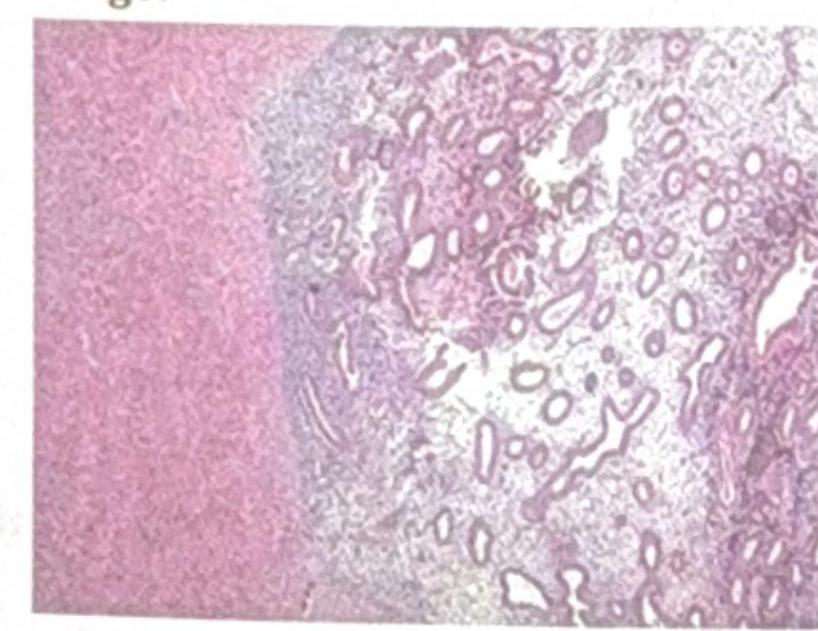
Identify the pathological condition shown in the image:
Which of the following statements about the management of uterine inversion is false?
A patient with infertility has an ultrasound (USG) suggestive of a uterine anomaly. Which of the following is the best method to confirm the diagnosis?
A Post-Menopausal woman complains of spotting per vaginum after 5 years of menopause. USG reveals endometrial thickness of 7 mm and an intramural fibroid of size 3cm. Next step in management is?
A 39 year old nulliparous female has presented to Gynaecology OPD with complaint of post-coital bleeding for past six months. The first investigation to be offered to this female will be
A 67-year-old female with hypertension and diabetes presents with heavy vaginal bleeding. What is the next step in management?
Consider the following statements regarding Uterine Leiomyoma: 1. Prevalence is highest between 35 and 45 years 2. More common in nulliparous women 3. Display reversible shrinkage after treatment with GnRH 4. Requires to be treated only if symptomatic Which of the statements given above are correct?
A 25-year-old woman presents to the Gynaecology OPD with complaints of abdominal pain and heavy menstrual bleeding. On examination, there is a mass arising from the hypogastrium corresponding to 16 weeks gravid uterus. Her urine pregnancy test is negative. The most likely diagnosis is
Want unlimited practice?
Get full access to all questions, explanations, and performance tracking.
Scan to download app