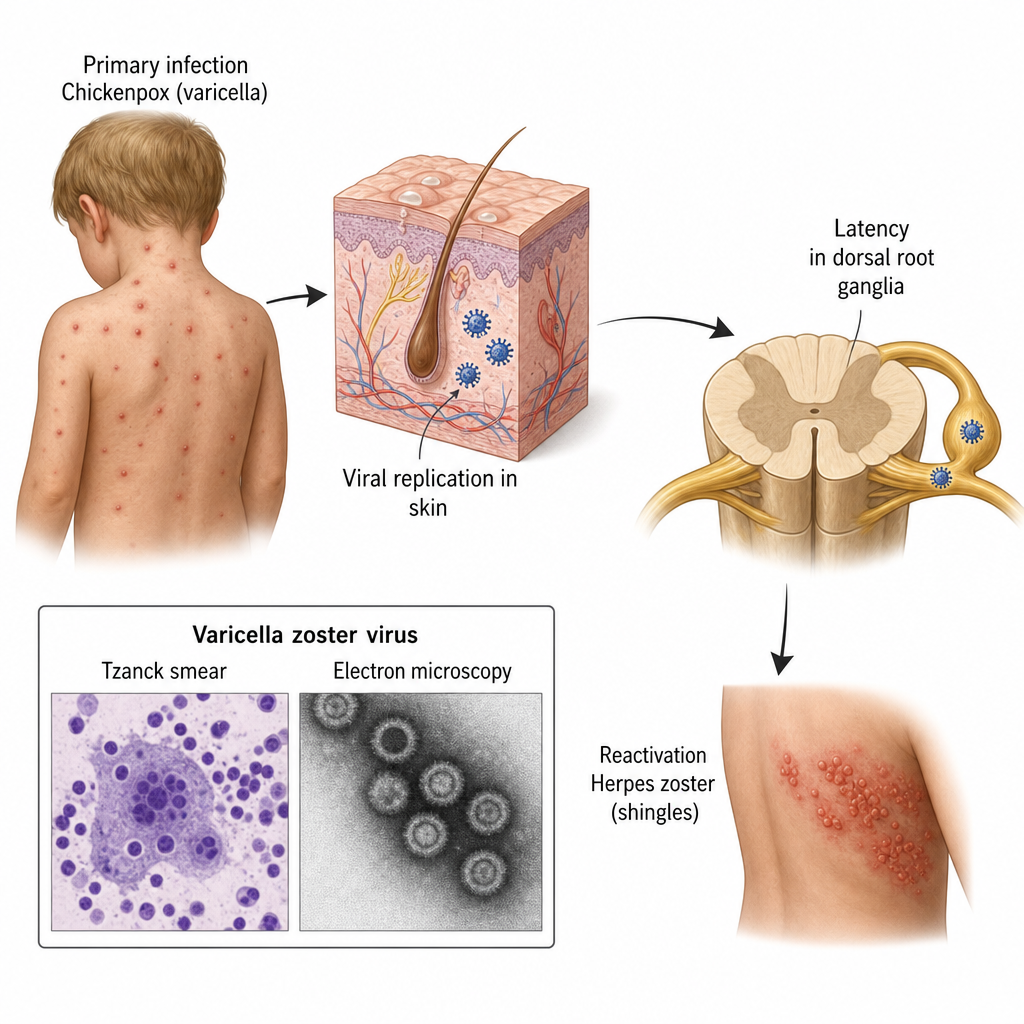
Pocks on chick embryo are formed by all except?
Which method is used to diagnose ROTA virus infection?
Which strain of influenza causes Swine flu and leads to serious systemic manifestations?
Which of the following is NOT a characteristic of a virus?
What is the best diagnostic test for recent hepatitis B infection?
Which of the following diseases is NOT associated with Epstein-Barr virus infection?
Which of the following is false regarding the transmission of Rubella?
A 12-year-old boy develops fever, accompanied by occasional headaches, malaise, fatigue, and nausea a month after being bitten by a dog. One day later, he experiences episodes of rigidity, hallucinations, breath-holding, and difficulty swallowing because of uncontrollable oral secretions. Considering this clinical presentation and the historical context of early rabies treatment attempts, which of the following histologic findings in the brain would be most likely present in a rabid animal?
Cowdry type A inclusion bodies are characteristic of which virus?
Which of the following statements is true about herpes viruses?
Explanation: ### Explanation The correct answer is **Chickenpox (Varicella-Zoster Virus)**. **1. Why Chickenpox is the correct answer:** The formation of **pocks** (visible necrotic lesions) occurs when certain viruses are inoculated onto the **Chorioallantoic Membrane (CAM)** of a 10–12 day old embryonated chick embryo. This is a classic method for cultivating and identifying members of the **Poxvirus** family. **Chickenpox**, despite its name, is caused by the **Varicella-Zoster Virus (VZV)**, which belongs to the **Herpesvirus** family (*Alphaherpesvirinae*). Herpesviruses do not produce pocks on CAM; VZV, in particular, is highly cell-associated and grows poorly in non-human systems like chick embryos. **2. Analysis of Incorrect Options:** * **Variola (Smallpox):** Produces small, white, convex, non-hemorrhagic pocks. * **Vaccinia:** Produces large, irregular, necrotic pocks with central ulceration. * **Cowpox:** Produces large, **hemorrhagic** (red) pocks. * *Note:* All three belong to the *Orthopoxvirus* genus, which characteristically grow on CAM. **3. High-Yield Clinical Pearls for NEET-PG:** * **Pock Morphology:** * *Variola:* Small, shiny, white pocks. * *Vaccinia:* Large, opaque pocks. * *Cowpox:* Hemorrhagic pocks. * **Temperature Sensitivity:** Variola cannot grow on CAM at temperatures above 38.5°C, whereas Vaccinia can (used to differentiate the two). * **Inclusion Bodies:** * Poxviruses produce **Guarnieri bodies** (intracytoplasmic). * Herpesviruses (like VZV) produce **Cowdry Type A** (intranuclear) inclusions. * **Mnemonic:** "Chickenpox is a Herpes, not a Pox." It does not follow the rules of Poxviruses.
Explanation: **Explanation:** Rotavirus is the most common cause of severe dehydrating diarrhea in infants and young children worldwide. The diagnosis primarily relies on identifying the virus or its components in the **stool**, where it is shed in high concentrations during the acute phase. **Why Option A is Correct:** The detection of **IgM-specific antibodies in the stool** (copro-antibodies) is a highly specific diagnostic marker for an acute or recent Rotavirus infection. While serum antibodies can be measured, the presence of secretory IgM directly in the fecal matter indicates a local immune response to the active viral replication in the intestinal mucosa. **Analysis of Incorrect Options:** * **Option B:** While ELISA is the most common method used, it is typically used to detect the **viral antigen** (VP6 protein) rather than the antibody in the stool for routine diagnosis. * **Option C:** Immunofluorescence is generally used for tissue-based viral detection. For Rotavirus, **ELISA or Latex Agglutination** for antigen detection is the preferred rapid diagnostic method. * **Option D:** Rotavirus is notoriously **difficult to culture** in standard diagnostic laboratories. It requires specialized cell lines (like MA104) and the addition of proteolytic enzymes (trypsin) to enhance infectivity, making it impractical for routine clinical diagnosis. **High-Yield Clinical Pearls for NEET-PG:** * **Morphology:** Characterized by a "wheel-like" appearance under electron microscopy (*Rota* = wheel) due to its short spikes and double-layered capsid. * **Genome:** Segmented, double-stranded RNA (11 segments). * **Pathogenesis:** Produces a viral enterotoxin called **NSP4**, which induces secretory diarrhea by increasing intracellular calcium. * **Vaccines:** Live attenuated oral vaccines (Rotarix, RotaTeq, and the indigenous Rotavac) are part of the Universal Immunization Programme (UIP) in India.
Explanation: **Explanation:** **Correct Option: A (H1N1)** Influenza A virus subtype **H1N1** is the causative agent of **Swine Flu**. The 2009 pandemic strain (A/H1N1pdm09) is a quadruple reassortant virus containing genes from avian, human, and swine influenza viruses. While seasonal flu typically remains localized to the respiratory tract, H1N1 can lead to serious systemic manifestations, including primary viral pneumonia, ARDS, and multi-organ failure. It binds to alpha 2-6 sialic acid receptors (found in the upper respiratory tract) but can also infect the lower respiratory tract, leading to severe cytokine storms. **Incorrect Options:** * **B (H5N1):** This is the highly pathogenic **Avian Influenza** (Bird Flu). While it has a high mortality rate in humans, it does not spread easily from person to person and is not classified as Swine Flu. * **C & D (H3N1/H3N3):** These are less common subtypes. While H3N2 is a major cause of seasonal human influenza, H3N1 and H3N3 are not the primary strains associated with the global Swine Flu outbreaks or systemic pandemics discussed in medical curricula. **High-Yield Clinical Pearls for NEET-PG:** * **Antigenic Shift:** Major genetic changes (reassortment) leading to **Pandemics** (seen in H1N1). * **Antigenic Drift:** Minor point mutations leading to **Epidemics**. * **Drug of Choice:** **Oseltamivir** (Neuraminidase inhibitor), effective against both Influenza A and B. * **Diagnosis:** Real-time RT-PCR is the gold standard. * **Hemagglutinin (H):** Responsible for cell attachment; **Neuraminidase (N):** Responsible for the release of new virions.
Explanation: **Explanation:** The fundamental definition of a virus is an obligate intracellular parasite that contains **only one type of nucleic acid**—either DNA or RNA, but never both. This is a classic high-yield distinction between viruses and other microorganisms like bacteria or chlamydia. * **Why Option C is correct:** Viruses lack the cellular machinery to house both types of genetic material simultaneously. They exist as either DNA viruses (e.g., Herpesvirus, Hepatitis B) or RNA viruses (e.g., HIV, Influenza). While some viruses use a different nucleic acid as an intermediate during replication (e.g., Retroviruses use a DNA intermediate), the mature virion contains only one type. * **Why Option A is incorrect:** Most viruses are **heat labile**. They are easily inactivated by heat (usually 56°C for 30 minutes), with the notable exception of Hepatitis B and some adeno-associated viruses. * **Why Option B is incorrect:** Viruses lack cell walls, ribosomes, and metabolic pathways targeted by antibiotics. Therefore, they are inherently **antibiotic-resistant**. * **Why Option D is incorrect:** The complete, extracellular infectious form of a virus is called a **virion**. Its primary function is to protect the genome and facilitate its transfer between host cells. **High-Yield Clinical Pearls for NEET-PG:** 1. **Exceptions to the Rule:** While viruses have one type of nucleic acid, **Mimiviruses** (giant viruses) have been found to contain traces of both, but for exam purposes, the "one nucleic acid" rule remains the standard. 2. **Prions:** These are infectious proteins that contain **no** nucleic acids (neither DNA nor RNA). 3. **Viroids:** These consist of small, circular, single-stranded RNA **without** a protein coat (capsid). 4. **Ether Sensitivity:** Enveloped viruses are susceptible to organic solvents like ether, while non-enveloped (naked) viruses are resistant.
Explanation: **Explanation:** The diagnosis of acute/recent Hepatitis B infection relies on identifying markers that appear during the early phase of the disease. **IgM anti-HBcAg** (Immunoglobulin M antibody to Hepatitis B core antigen) is the definitive marker for recent infection. **Why IgM anti-HBcAg is correct:** 1. **The Window Period:** In some patients, HBsAg may have cleared, but Anti-HBs has not yet appeared. During this "window period," IgM anti-HBcAg is the **only** detectable serological marker of acute infection. 2. **Specificity for Acute Phase:** It appears shortly after HBsAg and persists for about 6–12 months. Its presence differentiates an acute infection from a chronic one (where IgG anti-HBc predominates). **Analysis of Incorrect Options:** * **A. HBsAg:** While it is the first marker to appear in blood, it only indicates the presence of the virus. It cannot distinguish between an acute infection and a chronic carrier state. * **C. Anti-HBe:** This antibody indicates reduced viral replication and low infectivity. It appears later in the course of the disease. * **D. Anti-HBs:** This is a protective antibody that appears during recovery or after vaccination. Its presence signifies immunity, not an active/recent infection. **High-Yield Clinical Pearls for NEET-PG:** * **First marker to appear:** HBsAg. * **First antibody to appear:** IgM anti-HBc. * **Marker of infectivity/replication:** HBeAg (and HBV DNA). * **Marker of recovery/immunity:** Anti-HBs. * **Chronic infection definition:** Persistence of HBsAg for >6 months. * **Vaccination profile:** Only Anti-HBs is positive (HBsAg and Anti-HBc are negative).
Explanation: **Explanation:** The correct answer is **B. Epidermodysplasia verruciformis**. **Epidermodysplasia verruciformis (EV)**, also known as "tree man syndrome," is a rare autosomal recessive genetic hereditary skin disorder associated with a high risk of skin cancer. It is caused by an abnormal susceptibility to specific types of **Human Papillomavirus (HPV)**, most commonly types 5 and 8, rather than the Epstein-Barr virus (EBV). **Why the other options are incorrect:** * **Infectious Mononucleosis (Option A):** This is the classic primary infection caused by EBV (Glandular fever). It is characterized by the triad of fever, pharyngitis, and lymphadenopathy, with the presence of atypical lymphocytes (Downey cells) on a peripheral smear. * **Nasopharyngeal Carcinoma (Option C):** EBV is strongly oncogenic and is a major etiological factor for nasopharyngeal carcinoma, particularly the undifferentiated type (Type III), common in Southern China and Southeast Asia. * **Oral Hairy Leukoplakia (Option D):** This is a white, non-scrapable plaque on the lateral borders of the tongue, seen almost exclusively in HIV-positive or immunocompromised patients. It is caused by the opportunistic replication of EBV in the oral epithelium. **High-Yield Clinical Pearls for NEET-PG:** * **EBV Receptor:** It binds to the **CD21** receptor (CR2) on B-cells. * **Diagnosis:** The **Paul-Bunnell Test** (Heterophile antibody test) is the classic screening test for Infectious Mononucleosis. * **Other EBV Associations:** Burkitt Lymphoma (starry-sky appearance), Hodgkin Lymphoma (Mixed cellularity type), and Gastric Carcinoma. * **EV Association:** Remember that EV is linked to **HPV-5 and HPV-8**, which are considered "high-risk" in the context of this specific genetic predisposition.
Explanation: ### Explanation The correct answer is **C (Infection in early pregnancy causes milder disease)** because this statement is factually incorrect. In Rubella, the severity of fetal damage is **inversely proportional** to the gestational age at the time of infection. 1. **Why Option C is False:** Infection during the **first trimester** (especially the first 8–12 weeks) is the most critical period. During this stage of organogenesis, the virus causes chronic fetal infection leading to cell death and inhibited mitosis, resulting in severe Congenital Rubella Syndrome (CRS) or spontaneous abortion. 2. **Why Option A is Correct:** Rubella is primarily transmitted via **respiratory droplets** from the nasopharyngeal secretions of infected individuals. 3. **Why Option B is Correct:** **Vertical transmission** (transplacental) is the hallmark of Rubella, where the virus crosses the placenta to infect the fetus during maternal viremia. 4. **Why Option D is Correct:** As gestational age increases, the risk of multi-organ defects decreases. If infection occurs after the 16th week (late pregnancy), the risk of major malformations is low, but **sensorineural hearing loss** may occur as an isolated finding. --- ### High-Yield Clinical Pearls for NEET-PG * **Gregg’s Triad (Classic CRS):** 1. Cataract (Salt & Pepper Retinopathy), 2. Cardiac defects (Patent Ductus Arteriosus is most common), 3. Sensorineural Deafness. * **Blueberry Muffin Rash:** Seen in neonates due to extramedullary hematopoiesis. * **Diagnosis:** IgM antibodies in the neonate or persistence of IgG beyond 6 months (since maternal IgG should normally wane). * **Vaccine:** Live attenuated **RA 27/3 strain** (grown in human diploid cells). It is contraindicated in pregnancy; pregnancy should be avoided for 1 month post-vaccination.
Explanation: ### Explanation **Correct Answer: B. Negri bodies** The clinical presentation describes the classic **encephalitic (furious) rabies** following a dog bite. The symptoms of hydrophobia (difficulty swallowing/spasms), aerophobia, hallucinations, and autonomic instability are pathognomonic. **Negri bodies** are the hallmark histopathological finding in rabies. They are **intracytoplasmic, eosinophilic, round-to-oval inclusion bodies** found in the neurons. They represent sites of viral replication (nucleocapsid assembly). They are most commonly found in the **Pyramidal cells of the Hippocampus** and the **Purkinje cells of the Cerebellum**. Notably, they are absent in about 20% of rabies cases, so their absence does not rule out the diagnosis. **Analysis of Incorrect Options:** * **A. Multinucleate giant cells:** These are characteristic of **HIV Encephalitis** (formed by the fusion of infected microglia/macrophages) or certain granulomatous inflammations. * **C. Perivascular lymphocytes:** While "perivascular cuffing" is a feature of viral encephalitis (including rabies), it is a **non-specific** inflammatory response seen in many viral infections (e.g., Japanese Encephalitis, HSV) and is not as diagnostic as Negri bodies. * **D. Pseudocysts with bradyzoites:** These are characteristic of **Toxoplasmosis**, a parasitic infection that typically presents as ring-enhancing lesions on imaging in immunocompromised patients. **NEET-PG High-Yield Pearls:** * **Virus:** Rhabdoviridae family, Genus *Lyssavirus*. It is a negative-sense, single-stranded RNA virus with a **bullet-shaped** morphology. * **Receptor:** The virus binds to **Nicotinic Acetylcholine receptors (nAChR)** at the neuromuscular junction. * **Centripetal spread:** The virus travels via **retrograde axonal transport** (dynein motors) to the CNS. * **Diagnosis:** The gold standard for diagnosis in animals is the **Direct Fluorescent Antibody (DFA)** test on brain tissue. In humans (antemortem), skin biopsy from the nape of the neck (hair follicles) is often used.
Explanation: **Explanation:** **Cowdry Type A inclusion bodies** (also known as "Lipschütz bodies") are eosinophilic, intranuclear, granular deposits surrounded by a clear halo (the "halo effect"). They represent sites of viral replication within the nucleus. 1. **Why HSV is correct:** Herpes Simplex Virus (HSV-1 and HSV-2) characteristically produces Cowdry Type A inclusions. In clinical practice, these are classically identified on a **Tzanck smear** or histopathology of skin lesions. They are a hallmark of the Alphaherpesvirinae subfamily. 2. **Analysis of Incorrect Options:** * **Cytomegalovirus (CMV):** While CMV also produces intranuclear inclusions, they are typically much larger and surrounded by a very prominent clear halo, giving the classic **"Owl’s Eye" appearance**. CMV also uniquely produces *intracytoplasmic* inclusions. * **Varicella-Zoster Virus (VZV):** VZV *does* produce Cowdry Type A inclusions (as it is also an Alphaherpesvirus). However, in the context of standard medical examinations like NEET-PG, if both HSV and VZV are listed, **HSV** is the primary prototype and the most frequent "textbook" answer for this specific term. * **HHV-6:** This virus is associated with Roseola Infantum and does not typically present with classic Cowdry Type A bodies in standard diagnostic pathology. **High-Yield Clinical Pearls for NEET-PG:** * **Cowdry Type A:** HSV, VZV, and Yellow Fever virus (Torres bodies in the liver). * **Cowdry Type B:** Poliovirus and Adenovirus (though Adenovirus is more commonly associated with "Smudge cells"). * **Negri Bodies:** Eosinophilic *intracytoplasmic* inclusions in pyramidal cells of the hippocampus (Pathognomonic for **Rabies**). * **Guarnieri Bodies:** Intracytoplasmic inclusions seen in **Variola (Smallpox)**. * **Henderson-Paterson Bodies:** Large intracytoplasmic inclusions seen in **Molluscum Contagiosum**.
Explanation: ### Explanation **1. Why the correct answer is right:** Herpesviruses (Family: *Herpesviridae*) are characterized by a **large, linear, double-stranded DNA (dsDNA)** genome. This genome is encased in an icosahedral capsid, which is further surrounded by a proteinaceous layer called the **tegument** and a lipid **envelope** derived from the host nuclear membrane. Upon entering the host cell nucleus, the linear DNA circularizes to facilitate replication and establish latency. **2. Why the incorrect options are wrong:** * **Option A (Circular dsDNA):** While the genome circularizes during the latent phase inside the host nucleus, the **virion** itself carries linear DNA. Examples of viruses with circular dsDNA include *Papillomaviridae* (HPV) and *Polyomaviridae*. * **Option C & D (RNA viruses):** All members of the *Herpesviridae* family are DNA viruses. There are no known "circular double-stranded RNA" viruses infecting humans. Most RNA viruses are single-stranded (except *Reoviridae*, which is dsRNA but linear). **3. Clinical Pearls & High-Yield Facts for NEET-PG:** * **Site of Latency:** A favorite NEET-PG topic. * **HSV-1 & 2:** Sensory nerve ganglia (Trigeminal and Sacral). * **Varicella-Zoster (VZV):** Dorsal root ganglia. * **EBV:** B-cells (binds to CD21). * **CMV:** Monocytes and Neutrophils. * **Morphology:** They are the only viruses that acquire their envelope by **budding from the inner nuclear membrane**. * **Tzanck Smear:** Used for HSV and VZV to identify **multinucleated giant cells** with Cowdry Type A intranuclear inclusion bodies. * **HHV-8:** Associated with Kaposi Sarcoma, especially in HIV patients.
Virus Structure and Classification
Practice Questions
Viral Replication
Practice Questions
Pathogenesis of Viral Infections
Practice Questions
DNA Viruses: Herpesviruses
Practice Questions
DNA Viruses: Poxviruses and Adenoviruses
Practice Questions
Hepatitis Viruses
Practice Questions
RNA Viruses: Orthomyxoviruses
Practice Questions
RNA Viruses: Paramyxoviruses
Practice Questions
Enteroviruses and Rhinoviruses
Practice Questions
Arboviruses
Practice Questions
HIV and Retroviruses
Practice Questions
Oncogenic Viruses
Practice Questions
Get full access to all questions, explanations, and performance tracking.
Start For Free