An 18-year-old lady presents with severe sore throat, fever, and malaise. She has cervical lymphadenopathy, splenomegaly, and scattered petechiae on the soft palate with enlarged tonsils covered with white exudates. Which of the following investigations is most likely to help guide your management?
Pleomorphism is seen in which of the following conditions?
Varicella zoster virus remains latent in which of the following locations?
Which of the following is NOT a general property of viruses?
Which of the following diagnostic tests is NOT useful for its corresponding purpose?
Viruses grow well on which of the following?
Herpes simplex virus is classified as which of the following?
Condyloma acuminatum is caused by which types of Human Papillomavirus (HPV)?
A 2-year-old child attending daycare develops diarrhea and gastroenteritis as a result of adenoviral infection. Which of the following adenoviral serotypes would most likely be responsible for this child's illness?
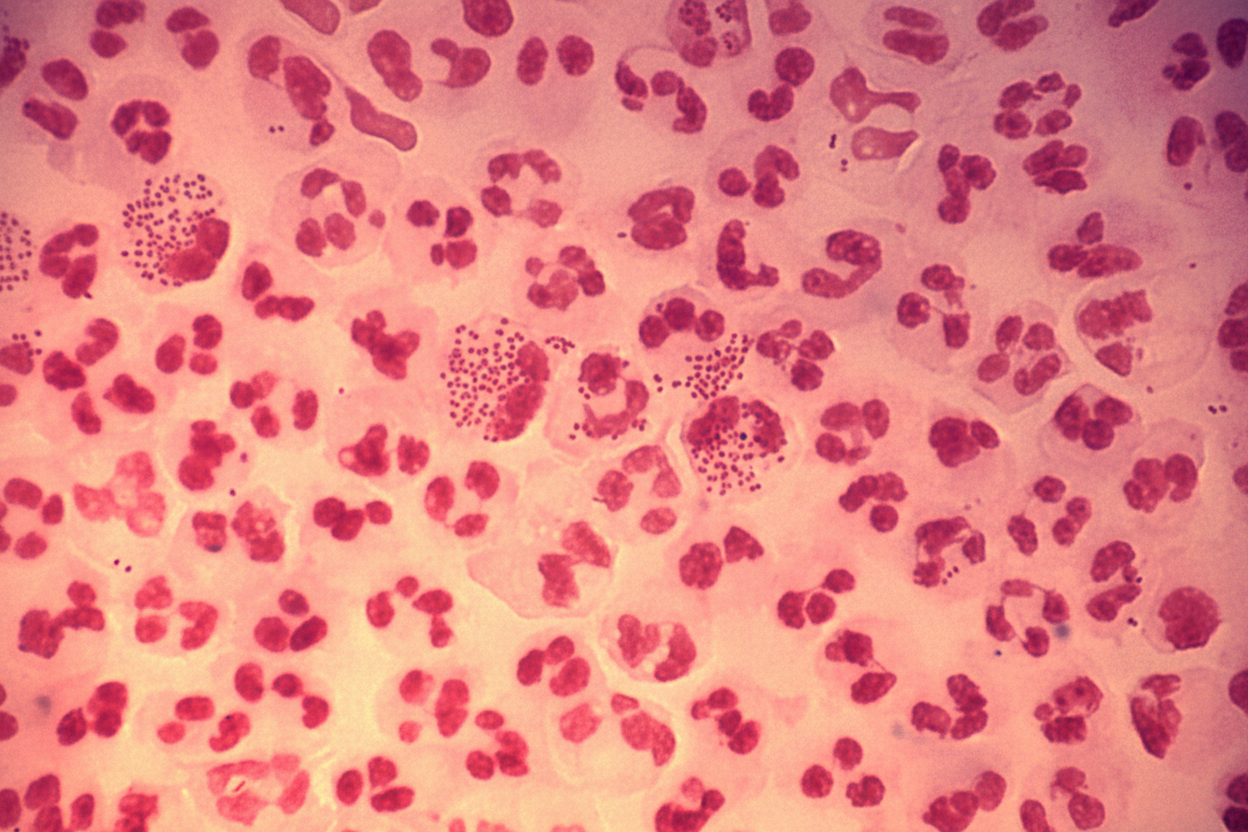
A 35-year-old male presents with a history of urethral discharge for the last three days. A Gram stain smear of the discharge is shown. Which of the following is true regarding the likely etiology?
Explanation: ### Explanation The clinical presentation of **fever, sore throat (exudative pharyngitis), cervical lymphadenopathy, and splenomegaly** in a young adult is the classic triad of **Infectious Mononucleosis (IM)**, primarily caused by the **Epstein-Barr Virus (EBV)**. **1. Why Heterophile Antibody Test is Correct:** The Heterophile antibody test (e.g., **Monospot test**) is the screening investigation of choice. It detects IgM antibodies that agglutinate sheep or horse red blood cells. These antibodies are produced during the acute phase of EBV infection due to polyclonal B-cell activation. In a patient with palatal petechiae and splenomegaly, this test confirms the diagnosis of IM, guiding management toward supportive care and avoidance of contact sports (to prevent splenic rupture). **2. Why Other Options are Incorrect:** * **Fine needle aspiration (FNA):** While lymphadenopathy is present, FNA is unnecessary and typically reserved for suspected malignancy (lymphoma). In IM, nodes are reactive and tender. * **Hepatitis B surface antigen:** While EBV can cause mild hepatitis, the primary symptoms (pharyngitis, tonsillar exudates) are not characteristic of HBV. * **HIV test:** Acute Retroviral Syndrome can mimic IM (mononucleosis-like illness), but the presence of **exudative tonsillitis** and **splenomegaly** strongly favors EBV over HIV. **Clinical Pearls for NEET-PG:** * **Atypical Lymphocytes:** Peripheral smear shows "Downey cells" (activated T-cells/CD8+). * **Ampicillin Rash:** Administration of Ampicillin or Amoxicillin in a patient with IM often triggers a characteristic maculopapular rash. * **Specific Serology:** If the heterophile test is negative but IM is suspected, test for **Anti-VCA (Viral Capsid Antigen) IgM**. * **Complication:** Splenic rupture is a rare but life-threatening complication; patients must avoid heavy lifting for 3–4 weeks.
Explanation: **Explanation:** **Pleomorphism** in the context of viral exanthems refers to the simultaneous presence of skin lesions in **different stages of development** (macules, papules, vesicles, and crusts) in the same anatomical area. 1. **Why Chickenpox is correct:** Chickenpox, caused by the **Varicella-Zoster Virus (VZV)**, is characterized by a "centripetal" rash that appears in successive crops. Because new lesions appear while older ones are healing, all stages of the rash are visible at once. This is a hallmark clinical feature of VZV. 2. **Why other options are incorrect:** * **Smallpox:** Unlike Chickenpox, the rash in Smallpox is **monomorphic**. All lesions in a particular area are at the same stage of development (e.g., all are pustules). * **Rubella (German Measles):** Presents with a pinkish maculopapular rash that spreads rapidly downwards (cephalocaudal) and disappears in the same order. It does not exhibit pleomorphism. * **Toxocara:** This is a helminthic infection (Visceral Larva Migrans) and does not typically present with a pleomorphic vesicular rash. **High-Yield Clinical Pearls for NEET-PG:** * **Dew-drop on a rose petal:** Classic description of the Varicella vesicle on an erythematous base. * **Centripetal distribution:** Chickenpox rash is more profuse on the trunk than the face and extremities (opposite of Smallpox). * **Scabs:** In Chickenpox, the crusts/scabs are **not infectious** (unlike the vesicular fluid). * **Tzanck Smear:** Used for rapid diagnosis; shows **multinucleated giant cells** with Cowdry Type A intranuclear inclusion bodies.
Explanation: **Explanation:** The **Varicella-Zoster Virus (VZV)**, a member of the *Alphaherpesvirinae* subfamily (Human Herpesvirus 3), follows a distinct pathogenesis. After the primary infection (Chickenpox), the virus travels via retrograde axonal transport from skin lesions to the **sensory nerve ganglia**, where it establishes lifelong latency. **Why the Trigeminal Ganglion is Correct:** VZV remains latent in the **dorsal root ganglia** (spinal nerves) and **cranial nerve ganglia**, most notably the **trigeminal ganglion**. Upon reactivation—usually due to waning cell-mediated immunity—the virus travels back down the sensory nerve to cause **Herpes Zoster (Shingles)**, characterized by a painful, unilateral vesicular rash restricted to a specific dermatome. **Analysis of Incorrect Options:** * **A & B (Lymphocytes & Monocytes):** These are common latency sites for the *Betaherpesvirinae* (e.g., CMV in monocytes) and *Gammaherpesvirinae* (e.g., EBV in B-lymphocytes). VZV does not persist in hematopoietic cells. * **D (Plasma Cells):** While plasma cells are involved in the immune response, they are not reservoirs for viral latency. **High-Yield Clinical Pearls for NEET-PG:** * **Ramsay Hunt Syndrome:** Reactivation of VZV in the **geniculate ganglion**, leading to facial palsy and ear vesicles. * **Tzanck Smear:** Shows **Multinucleated Giant Cells** with Cowdry Type A intranuclear inclusions (common to HSV and VZV). * **Post-Herpetic Neuralgia:** The most common complication of Shingles. * **Vaccine:** Live attenuated **Oka strain** is used for prevention.
Explanation: **Explanation:** The core concept of viral structure is that viruses are obligate intracellular parasites characterized by a simple organization. Traditionally, the fundamental rule of virology was that a virus contains **only one type of nucleic acid** (either DNA or RNA) as its genome. However, modern molecular virology has identified exceptions, most notably the **Human Cytomegalovirus (HCMV)**, which has been shown to contain a DNA genome along with specific mRNA molecules packaged within the mature virion. Therefore, the absolute statement that they *cannot* contain both is no longer strictly true in advanced microbiology, making it the "incorrect" general property among the choices. **Analysis of other options:** * **Option B:** Viruses exist in two phases: the intracellular replicating phase and the **extracellular infectious phase**, known as the **virion**. * **Option C:** Most viruses are **heat labile**. They are generally inactivated by heating at 56°C for 30 minutes (with exceptions like Hepatitis B and adeno-associated viruses). They are better preserved at low temperatures (-70°C to -196°C). * **Option D:** Viruses lack metabolic pathways (like cell wall synthesis or protein synthesis on 70S ribosomes); thus, they are **not affected by antibiotics**. They are, however, sensitive to Interferons. **NEET-PG High-Yield Pearls:** * **Smallest Virus:** Parvovirus (DNA); Picornavirus (RNA). * **Largest Virus:** Poxvirus (resembles a brick). * **Exceptions to Symmetry:** Most DNA viruses are icosahedral (except Poxvirus); most RNA viruses are helical (except Reo, Picorna, Toga, and Calici which are icosahedral). * **Antibiotic Sensitivity:** Only the **Chlamydiae** (once thought to be viruses) are sensitive to antibiotics; true viruses are not.
Explanation: ### Explanation **1. Why Option C is the Correct Answer (The Concept):** In serology, **IgM antibodies** are indicators of a **recent or acute infection** because they are the first isotype produced during the primary immune response. They are transient and disappear within weeks to months. To **assess immunity** (protection from past infection or vaccination), we look for **Specific IgG antibodies**. IgG persists for years (often lifelong) and provides long-term protection. Therefore, testing for Rubella-specific IgM would tell you if a patient *currently* has the disease, but it cannot confirm if they are *immune* to it. **2. Analysis of Other Options:** * **Option A:** Ziehl-Neelsen (Acid-Fast) staining is the gold standard bedside/laboratory method for detecting *Mycobacterium tuberculosis* by identifying acid-fast bacilli (AFB) in clinical samples like sputum. * **Option B:** Direct Immunofluorescence (DFA) uses fluorescent-tagged antibodies to detect viral antigens (like Influenza) in respiratory secretions. It is a rapid and highly specific diagnostic tool. * **Option D:** As mentioned above, IgM is the "first responder" antibody. Its presence is the hallmark of an acute/primary infection across most viral and bacterial pathologies. **3. NEET-PG High-Yield Pearls:** * **Rubella Screening:** In pregnancy, a positive **IgG** with a negative IgM indicates immunity. A positive **IgM** indicates a primary infection, posing a high risk of **Congenital Rubella Syndrome (CRS)**. * **IgG Avidity Test:** If IgM is positive in a pregnant woman, an "IgG Avidity Test" is done. High avidity IgG suggests the infection occurred at least 3–4 months ago, reducing the risk of acute fetal transmission. * **Window Period:** The time between infection and the appearance of detectable antibodies (IgM). For HIV, this is a classic exam topic. * **Z-N Stain:** Remember that *Nocardia* is "weakly" acid-fast, while *Mycobacteria* are "strongly" acid-fast.
Explanation: **Explanation:** **1. Why Cell Culture is Correct:** Viruses are **obligate intracellular parasites**. Unlike bacteria, they lack the metabolic machinery (ribosomes, enzymes) to generate energy or synthesize proteins independently. They require a living host cell to replicate. **Cell culture** involves growing cells (derived from humans or animals) in a laboratory setting to provide the necessary intracellular environment for viral replication. In modern virology, "cell culture" is the most widely used method for isolation and study. **2. Why Other Options are Incorrect:** * **Agar agar (B):** This is a solidifying agent used in bacteriological media (like Blood Agar). It provides nutrients for extracellular growth but lacks living cells, making it unsuitable for viruses. * **Cell-free media (C):** By definition, these media do not contain living cells. Viruses cannot replicate in cell-free environments (with the rare exception of certain complex synthetic biology experiments not applicable to standard microbiology). * **Tissue culture (D):** While often used interchangeably with cell culture in older texts, "Tissue Culture" technically refers to the growth of whole tissue fragments or organs. While viruses *can* grow in them, **Cell Culture** (growth of individual cells in monolayers or suspensions) is the more precise, standard, and contemporary term for routine viral cultivation. **High-Yield Clinical Pearls for NEET-PG:** * **Gold Standard:** Cell culture is the "gold standard" for viral isolation. * **Types of Cell Lines:** * *Primary:* Derived from normal tissue (e.g., Monkey Kidney). * *Diploid (Semi-continuous):* Derived from embryonic tissue (e.g., WI-38). * *Continuous (Immortal):* Derived from cancer cells (e.g., **HeLa**, **Vero**, **Hep-2**). * **Detection:** Viral growth in culture is often identified by the **Cytopathic Effect (CPE)**—characteristic structural changes in the host cells (e.g., syncytia formation by RSV or "grape-like clusters" by Adenovirus).
Explanation: **Explanation:** **Herpes Simplex Virus (HSV)** belongs to the family *Herpesviridae*. All members of this family are characterized by a **linear, double-stranded DNA (dsDNA)** genome, an icosahedral capsid, and a lipid envelope derived from the host's nuclear membrane. 1. **Why Option B is Correct:** HSV-1 and HSV-2 are classic examples of dsDNA viruses. Their replication occurs in the host cell nucleus, where they utilize host DNA-dependent RNA polymerase for transcription. A defining feature of this group is the ability to establish **latency** in sensory nerve ganglia (e.g., trigeminal ganglion for HSV-1 and sacral ganglia for HSV-2). 2. **Why Other Options are Incorrect:** * **Option A (ssDNA):** Single-stranded DNA viruses are rare in human pathology; the most notable example is **Parvovirus B19**. * **Option C (ssRNA):** This is the largest group of viruses, including Influenza, HIV, Hepatitis C, and SARS-CoV-2. HSV does not use an RNA genome. * **Option D (dsRNA):** Double-stranded RNA viruses are uncommon; the most clinically significant example is **Rotavirus** (Reoviridae family). **High-Yield Clinical Pearls for NEET-PG:** * **Morphology:** HSV is an enveloped virus with a "teguement" (protein-filled space) between the envelope and capsid. * **Diagnosis:** The gold standard for bedside diagnosis is the **Tzanck Smear**, which shows **multinucleated giant cells** and **Cowdry Type A** intranuclear inclusion bodies. * **Clinical Presentation:** HSV-1 is typically associated with orofacial lesions (herpes labialis) and is the most common cause of **sporadic viral encephalitis** (affecting the temporal lobe). HSV-2 is primarily associated with genital herpes and neonatal meningitis. * **Treatment:** The drug of choice is **Acyclovir**, which acts by inhibiting the viral DNA polymerase.
Explanation: **Explanation:** **Condyloma acuminatum**, commonly known as anogenital warts, is caused by **Human Papillomavirus (HPV) types 6 and 11**. These are classified as **"low-risk" HPV types** because they are primarily associated with benign proliferative lesions rather than malignancy. They cause over 90% of all genital warts by infecting the squamous epithelium, leading to characteristic "cauliflower-like" growths. **Analysis of Options:** * **Option C (6, 11):** Correct. These types cause benign genital warts and are also the primary cause of Recurrent Respiratory Papillomatosis (RRP). * **Option D (16, 18):** These are **"high-risk" HPV types**. They are the leading cause of cervical, anal, and oropharyngeal cancers. While they can coexist with warts, they are characterized by their oncogenic potential (via E6 and E7 proteins) rather than benign condylomas. * **Option A (18, 31):** Type 18 is high-risk; Type 31 is also a high-risk type associated with cervical intraepithelial neoplasia (CIN). * **Option B (17, 12):** These types are generally associated with *Epidermodysplasia verruciformis* (a rare genetic susceptibility to HPV) rather than common genital warts. **High-Yield NEET-PG Pearls:** * **Koilocytes:** The pathognomonic histological finding for HPV infection (cells with perinuclear halos and wrinkled "raisinoid" nuclei). * **Oncoproteins:** **E6** inhibits **p53**; **E7** inhibits **pRb**. (Mnemonic: **6**-53, **7**-Rb). * **Vaccination:** The Quadrivalent (Gardasil) and Nonavalent vaccines cover types 6 and 11 to prevent genital warts. * **Skin Warts:** HPV 1, 2, 3, and 4 are typically responsible for common (verruca vulgaris) and plantar warts.
Explanation: **Explanation:** Adenoviruses are non-enveloped, double-stranded DNA viruses that cause a wide spectrum of clinical syndromes depending on their serotype. **Correct Option: D (Type 41)** Adenoviruses are classified into subgroups A through G. **Subgroup F (Serotypes 40 and 41)** are specifically known as **"Enteric Adenoviruses."** These are the second most common cause of viral gastroenteritis in infants and young children worldwide, following Rotavirus. Unlike other adenoviruses, types 40 and 41 are fastidious (difficult to grow in standard cell cultures) and primarily replicate in the intestinal tract, leading to diarrhea and vomiting. **Incorrect Options:** * **Types 4 and 7 (Options A & B):** These belong to Subgroup E and B, respectively. They are the primary causes of **Acute Respiratory Disease (ARD)**, often seen in military recruits, and can cause pneumonia or conjunctivitis. * **Type 19 (Option C):** This serotype (along with Type 8 and 37) is a classic cause of **Epidemic Keratoconjunctivitis (EKC)**, characterized by severe "pink eye" and corneal involvement. **NEET-PG High-Yield Pearls:** * **Enteric Adenoviruses (40, 41):** Known as "Fastidious Adenoviruses"; they do not typically cause respiratory symptoms. * **Pharyngoconjunctival Fever:** Most commonly caused by **Type 3 and 7**. * **Hemorrhagic Cystitis:** Characterized by hematuria in children, primarily caused by **Types 11 and 21**. * **Structure:** Adenoviruses possess a unique **Penton fiber** that acts as a hemagglutinin and is toxic to human cells.
Explanation: ***Pili is a virulence factor*** - **Pili** enable *Neisseria gonorrhoeae* to adhere to **urogenital epithelial cells**, facilitating colonization and infection. - The **antigenic variation** of pili helps the organism evade the host immune response and establish persistent infection. *Catalase and oxidase negative* - *N. gonorrhoeae* is **catalase positive** and **oxidase positive**, not negative for both enzymes. - These positive enzyme tests are key identifying features used in laboratory diagnosis of **Neisseria species**. *Obligate intracellular organism* - *N. gonorrhoeae* is **facultatively intracellular** and can survive both inside and outside host cells. - Unlike true **obligate intracellular pathogens** like *Chlamydia*, gonococci can be cultured on artificial media. *Anaerobic* - *N. gonorrhoeae* is **aerobic** and requires oxygen for growth, particularly in a **CO₂-enriched environment**. - It grows best on **chocolate agar** or **Thayer-Martin medium** under aerobic conditions with 5-10% CO₂.
Virus Structure and Classification
Practice Questions
Viral Replication
Practice Questions
Pathogenesis of Viral Infections
Practice Questions
DNA Viruses: Herpesviruses
Practice Questions
DNA Viruses: Poxviruses and Adenoviruses
Practice Questions
Hepatitis Viruses
Practice Questions
RNA Viruses: Orthomyxoviruses
Practice Questions
RNA Viruses: Paramyxoviruses
Practice Questions
Enteroviruses and Rhinoviruses
Practice Questions
Arboviruses
Practice Questions
HIV and Retroviruses
Practice Questions
Oncogenic Viruses
Practice Questions
Get full access to all questions, explanations, and performance tracking.
Start For Free