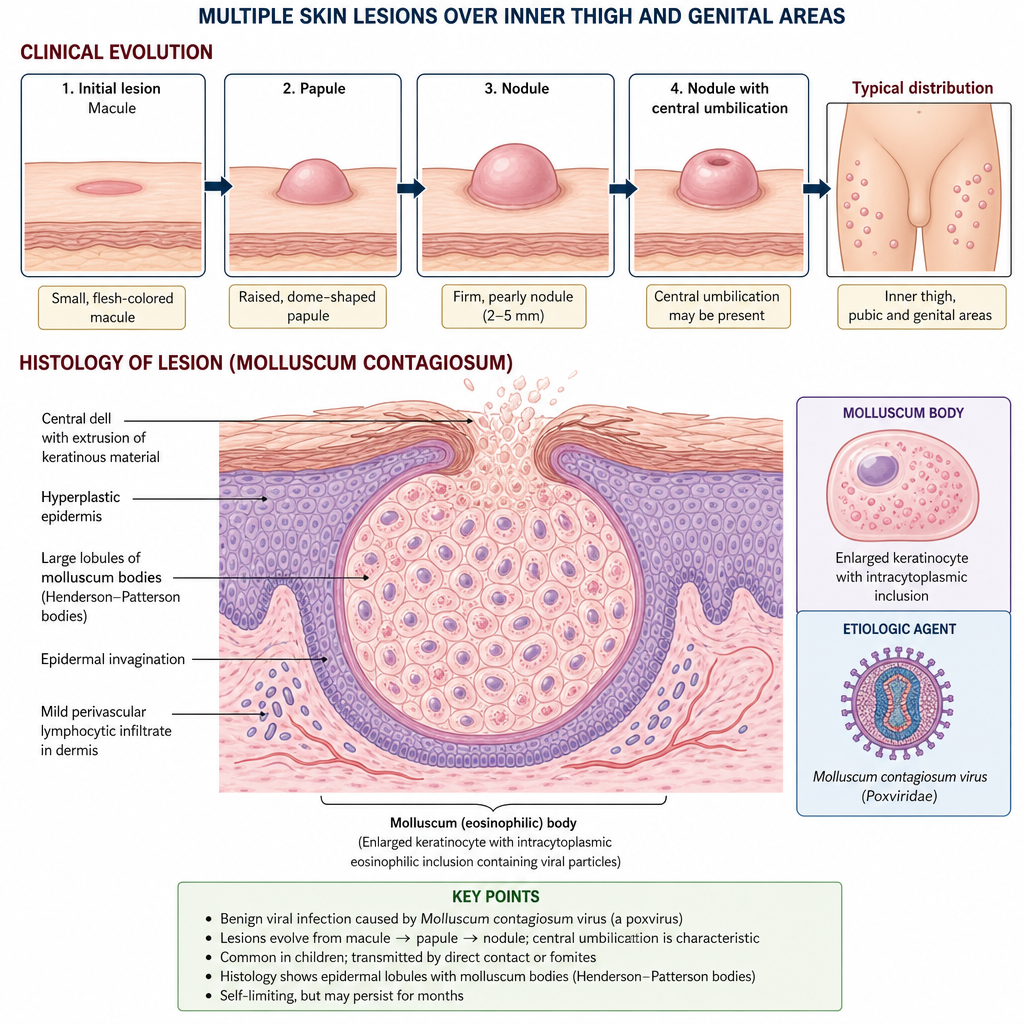
Molluscum contagiosum is caused by a:
Multinucleated giant cell on Tzanck smear is not seen in?
Which pox virus does Variola belong to?
Which of the following characteristics can be used to differentiate the rash of chickenpox from the rash of smallpox?
What is the primary disease associated with Enterovirus 71?
Herpangina is caused by the virus -
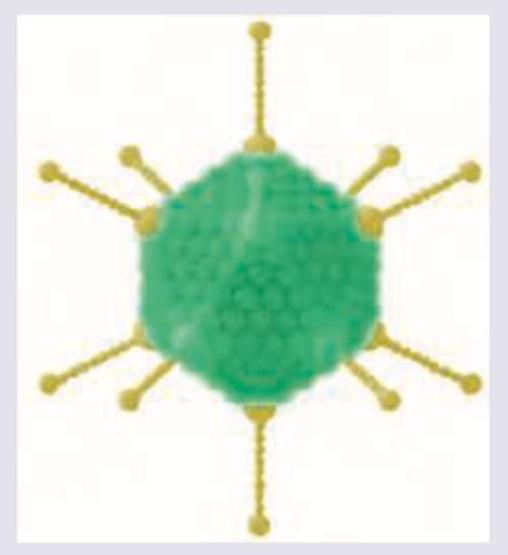
Which of the following diseases is caused by the virus shown below?
EBV is most strongly associated with which of the following?
Which of the following is not a poxvirus?
Which of the following is an RNA oncogenic virus?
Explanation: ***Pox virus*** - **Molluscum contagiosum** is a common **cutaneous viral infection** caused by the **Molluscum Contagiosum Virus (MCV)**. - MCV belongs to the **Poxviridae family**, which are known for causing characteristic skin lesions. *Flavi virus* - **Flaviviruses** are a genus of RNA viruses, which cause diseases like **Dengue fever**, **Yellow fever**, and **Zika virus infection**. - They typically cause **systemic illnesses** with fever and rash, rather than localized skin lesions like molluscum contagiosum. *Adenovirus* - **Adenoviruses** are DNA viruses primarily associated with **respiratory infections** (e.g., common cold, bronchitis) and **conjunctivitis**. - They are not known to cause the characteristic **umbilicated papules** seen in molluscum contagiosum. *Rubivirus* - **Rubivirus** is a genus that includes the **Rubella virus**, which causes **German measles** (Rubella). - Rubella is characterized by a **maculopapular rash** and **lymphadenopathy**, which is distinct from the **umbilicated papules** seen in molluscum contagiosum.
Explanation: **Molluscum contagiosum** - Tzanck smear typically reveals **Henderson-Paterson bodies**, which are large eosinophilic intracytoplasmic inclusions within epithelial cells. - **Multinucleated giant cells** are not characteristic findings in lesions caused by the molluscum contagiosum virus (a poxvirus). *Herpes simplex* - Tzanck smear often shows **multinucleated giant cells** and **acantholytic cells**, which are specific cytopathic effects of HSV. - The presence of these cells helps in the rapid diagnosis of **herpes simplex viral infections**. *Varicella* - Similar to herpes simplex, **varicella-zoster virus (VZV)** infection also produces **multinucleated giant cells** on Tzanck smear. - These cells are a hallmark of **herpesvirus infections**, indicating viral cytopathic effects in epithelial cells. *Herpes zoster* - Herpes zoster, caused by the **reactivation of VZV**, also presents with **multinucleated giant cells** on Tzanck smear. - This finding aids in confirming the diagnosis of **shingles**, distinguishing it from other vesicular rashes.
Explanation: ***Orthopoxvirus*** - **Variola virus**, the causative agent of **smallpox**, is a member of the **Orthopoxvirus genus**. - Other notable members of this genus include **vaccinia virus** (used in smallpox vaccine) and **monkeypox virus**. *Parapoxvirus* - This genus includes viruses such as **Orf virus**, which causes contagious pustular dermatitis in sheep and goats, occasionally transmitted to humans. - Parapoxviruses typically cause localized skin lesions and are not associated with **smallpox**. *Yatapox virus* - The **Yatapox virus genus** includes the **Tanapox virus** and **Yabapox virus**, which primarily affect monkeys but can cause mild, self-limiting skin lesions in humans. - They are distinct from the **Variola virus** and do not cause smallpox. *Molluscipox virus* - This genus contains **Molluscum contagiosum virus**, which causes **molluscum contagiosum**, a common skin infection characterized by small, flesh-colored, dome-shaped papules. - It is genetically and clinically distinct from **Variola virus**.
Explanation: ***Pleomorphic*** - The rash of **chickenpox** is **pleomorphic**, meaning lesions at various stages of development (macules, papules, vesicles, scabs) are present simultaneously in the same body area. - In contrast, a **smallpox** rash is **monomorphic**, with all lesions in a given area appearing at the same stage of development. *Centrifugal* - A **centrifugal distribution** (lesions more concentrated on the face and extremities) is characteristic of **smallpox**. - **Chickenpox** typically has a **centripetal distribution**, with lesions more concentrated on the trunk. *Deep-seated* - **Smallpox** lesions are described as **deep-seated** and feel like "shot under the skin," often associated with significant scarring. - **Chickenpox** lesions are superficial and less likely to cause scarring unless secondarily infected. *Multilocular* - **Smallpox** vesicles and pustules are typically **multilocular**, meaning they have internal septations and do not collapse when punctured. - **Chickenpox** vesicles are unilocular, appearing as a single compartment, and collapse when punctured.
Explanation: ***Hand, foot, and mouth disease*** - **Enterovirus 71** is a major causative agent of **hand, foot, and mouth disease (HFMD)**, especially in severe cases involving neurological complications. - HFMD is characterized by **fever**, **oral lesions**, and a **rash** on the hands and feet, particularly common in young children. *Hepatitis E* - **Hepatitis E** is caused by the **Hepatitis E virus (HEV)**, a distinct RNA virus, not an enterovirus. - It primarily causes **acute viral hepatitis**, particularly transmitted via the fecal-oral route. *Hepatitis G* - **Hepatitis G virus (HGV)**, also known as **GBV-C**, is a flavivirus, which is distinct from enteroviruses. - Its clinical significance and role in causing hepatitis are still debated, and it's not a primary cause of symptomatic liver disease. *Hepatitis C* - **Hepatitis C** is caused by the **Hepatitis C virus (HCV)**, an RNA virus belonging to the *Flaviviridae* family, genetically distinct from enteroviruses. - HCV is a major cause of **chronic hepatitis**, cirrhosis, and hepatocellular carcinoma.
Explanation: ***Group A Coxsackie*** - Herpangina is a common viral illness characterized by small, painful ulcers on the **soft palate** and tonsillar pillars, predominantly caused by various serotypes of **Coxsackievirus group A**, particularly A1-A10, A16, and A22. - This **enterovirus** infection is highly contagious and often seen in infants and young children, especially during summer and fall. *Group B Coxsackie* - **Group B Coxsackieviruses** are primarily associated with diseases like **pleurodynia** (**Bornholm disease**), myocarditis, and pericarditis, rather than herpangina. - While both Group A and B Coxsackieviruses are enteroviruses, their typical clinical manifestations differ significantly. *Adenovirus* - **Adenoviruses** are known to cause a range of illnesses, including respiratory infections (**pharyngitis**, pneumonia), conjunctivitis, and gastroenteritis. - They are not typically implicated in the etiology of herpangina, which is characterized by specific oral lesions. *Measles* - **Measles virus** (a paramyxovirus) causes measles, a highly contagious systemic illness characterized by a generalized maculopapular rash, cough, coryza, and conjunctivitis, along with **Koplik spots** in the mouth. - Measles does not cause the vesicular and ulcerative lesions seen in herpangina; Koplik spots are distinct enanthem findings.
Explanation: ***Swimming pool conjunctivitis*** - The image displays an **adenovirus**, characterized by its **icosahedral shape** and distinct **fiber proteins** projecting from the vertices. - Adenoviruses are a common cause of **pharyngoconjunctival fever**, often referred to as "swimming pool conjunctivitis" due to its spread in **inadequately chlorinated swimming pools**. - This is the **most characteristic disease** associated with adenovirus infection, particularly serotypes **3, 4, and 7**. *Neurodegenerative disorder* - Adenoviruses are **not associated** with neurodegenerative disorders. - Neurodegenerative conditions are typically linked to **prions, misfolded proteins**, or other viral agents like **JC virus** (progressive multifocal leukoencephalopathy). - Adenoviruses cause **acute infections**, not chronic neurodegeneration. *Solid organ graft infection* - While adenoviruses can cause severe infections in **immunocompromised patients**, including transplant recipients, this is not their most characteristic presentation. - In transplant patients, adenovirus may cause **colitis, hepatitis, or nephritis**, but these are **opportunistic infections** rather than the typical disease association. - The characteristic disease remains **conjunctivitis and respiratory infections** in immunocompetent hosts. *Solid organ graft rejection* - **Graft rejection** is an **immunological process** where the recipient's immune system attacks the transplanted organ, not a viral infection. - Adenovirus does not directly cause the mechanism of graft rejection. - While viral infections may complicate graft outcomes, rejection itself is **immune-mediated**, not infectious.
Explanation: ***Nasopharyngeal carcinoma*** - **Epstein-Barr virus (EBV)** is strongly and consistently associated with the development of **nasopharyngeal carcinoma**, particularly the undifferentiated (endemic) type. - EBV DNA is found in virtually **100% of undifferentiated nasopharyngeal carcinomas**, highlighting its critical role in the pathogenesis of this cancer. - This represents one of the strongest virus-cancer associations in human medicine. *Gastric cancer* - While EBV is linked to a specific subtype of **EBV-associated gastric adenocarcinoma**, it accounts for only about **10% of gastric cancers**. - This makes it a less strong and less prevalent association compared to nasopharyngeal carcinoma. *Esophageal cancer* - **Esophageal cancer** (adenocarcinoma and squamous cell carcinoma) has various risk factors such as GERD, smoking, and alcohol consumption. - **EBV is not a significant etiologic factor** for esophageal cancer. - There is no strong, consistent evidence linking EBV as a primary cause of esophageal malignancy. *Hepatocellular carcinoma* - **Hepatocellular carcinoma** is primarily associated with **hepatitis B virus (HBV)** and **hepatitis C virus (HCV)**, not EBV. - Other risk factors include chronic liver disease, cirrhosis, aflatoxin exposure, and alcohol abuse. - EBV does not play a significant role in hepatocellular carcinoma pathogenesis.
Explanation: ***Coxsackie virus*** - The **Coxsackie virus** belongs to the family **Picornaviridae**, not Poxviridae. - It is known for causing diseases such as **hand, foot, and mouth disease**, herpangina, and myocarditis. *Vaccinia virus* - **Vaccinia virus** is a well-known member of the **Poxviridae** family, historically used in the smallpox vaccine. - It is a **large, complex DNA virus** that replicates in the cytoplasm of infected cells. *Molluscum contagiosum* - **Molluscum contagiosum virus (MCV)** is a **poxvirus** that causes a mild skin infection characterized by raised, pearly, umbilicated lesions. - It primarily infects **humans**, causing localized lesions that are spread through direct contact. *Orf virus* - **Orf virus**, also known as contagious pustular dermatitis virus, is a **poxvirus** that primarily affects sheep and goats. - It can be transmitted to humans, causing single papular or nodular lesions, usually on the fingers, hands, or forearms.
Explanation: ***Human T-lymphotropic Virus (HTLV)*** - **HTLV-1** is a well-established **RNA oncogenic virus** that causes Adult T-cell Leukemia/Lymphoma (ATLL). - It utilizes **reverse transcriptase** to convert its RNA genome into DNA, which then integrates into the host cell's genome, leading to malignant transformation. *Cytomegalovirus (CMV)* - CMV is a **DNA virus** and belongs to the Herpesviridae family. - While it can cause disease, it is not primarily classified as an **oncogenic virus**, although some studies suggest associations with certain cancers. *Hepatitis B Virus (HBV)* - HBV is a **DNA virus** that primarily causes acute and chronic hepatitis. - It is a major risk factor for **hepatocellular carcinoma (HCC)**, but it itself is a DNA virus, not an RNA virus. *Human Immunodeficiency Virus (HIV)* - HIV is an **RNA retrovirus**, but it is generally considered **non-oncogenic** in the direct sense. - While HIV-infected individuals have an increased risk of certain cancers (e.g., Kaposi's sarcoma, non-Hodgkin lymphoma), these are usually due to **immunosuppression** allowing co-infecting oncogenic viruses (like HHV-8 or EBV) to proliferate, rather than direct oncogenic action of HIV itself.
Get full access to all questions, explanations, and performance tracking.
Start For Free