Which of the following is detected in a peripheral blood smear?
A boy presented with a fever and chills. Rapid test was positive for specific antigen HRP-2. Which of the following species of Plasmodium is the most likely causative agent?
Which of the following is the most appropriate treatment for a child with severe falciparum malaria with high parasitemia?
Which of the following is a chronic complication of malaria?
A person wants to visit a malaria endemic area of low level chloroquine resistant falciparum malaria. The best chemoprophylaxis is -
Which of the following statements about malaria transmission is correct?
Chemoprophylaxis of malaria can be done by all except:
Peripheral blood smear in Plasmodium falciparum infection may show all of the following except -
All of the following are seen in cerebral malaria, except:
Identify the organism related to the blood smear image.
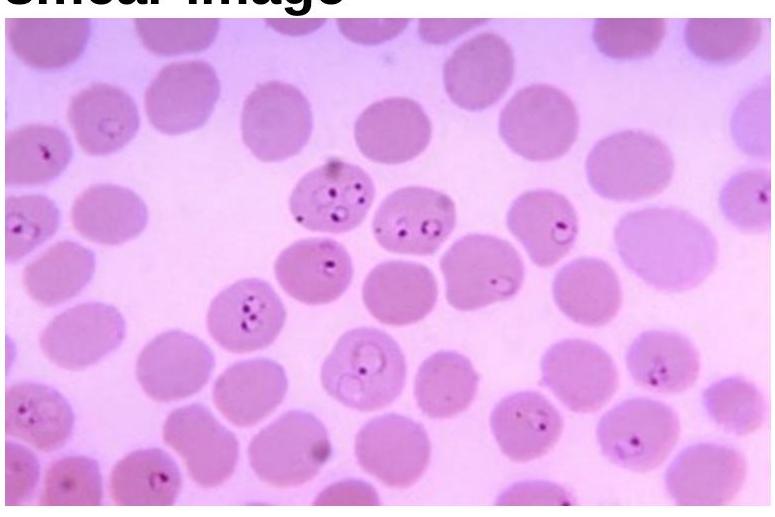
Explanation: ***Malaria*** - Malaria parasites, specifically **Plasmodium species**, infect **red blood cells** and can be directly observed in a **peripheral blood smear** using Giemsa stain. - Identification of different stages (ring forms, trophozoites, schizonts, gametocytes) within red blood cells helps in species identification and quantification of parasitemia. *Toxoplasma* - **Toxoplasma gondii** is an intracellular parasite primarily identified through **serological tests** (detecting antibodies) or **molecular methods** like PCR on tissue samples or body fluids. - It is not typically detected in a routine peripheral blood smear as it does not infect red blood cells or circulate freely in high numbers. *Leishmania* - **Leishmania parasites** are typically found within **macrophages** and **monocytes** in tissues such as bone marrow, spleen, liver, or skin biopsies. - While they can be observed in **bone marrow aspirates** or **tissue smears**, they are generally not seen in peripheral blood smears, except rarely in severe visceral leishmaniasis where heavily parasitized monocytes might be present. *Brucella* - **Brucella** is a **bacterium** that causes brucellosis, a systemic infection. - Diagnosis is primarily made through **blood cultures** (bacteremia) or **serological tests** to detect specific antibodies, not by direct visualization in a peripheral blood smear.
Explanation: ***Plasmodium falciparum*** - The **histidine-rich protein 2 (HRP-2)** antigen is specifically produced by **P. falciparum** and is targeted by most rapid diagnostic tests for malaria. - A positive HRP-2 test in a patient with fever and chills indicates a high likelihood of **P. falciparum** infection, which is often the most severe form of malaria. *Plasmodium malariae* - **P. malariae** does not produce **HRP-2 antigen**, therefore, a rapid diagnostic test targeting HRP-2 would be negative for this species. - This species can cause a **quartan fever pattern** (fever every 72 hours) and usually presents with less severe symptoms compared to P. falciparum. *Plasmodium vivax* - **P. vivax** produces **_Plasmodium_ lactate dehydrogenase (pLDH)** and **aldolase antigens**, but not HRP-2. Some rapid tests combine detection of HRP-2 with pLDH to identify both *P. falciparum* and *P. vivax*. - While *P. vivax* causes fever and chills, its presence would not be indicated by a positive HRP-2 specific test alone. *Plasmodium ovale* - **P. ovale** also produces **pLDH and aldolase antigens**, similar to *P. vivax*, and does not produce **HRP-2**. - Infections with *P. ovale* are relatively rare and generally cause milder disease than *P. falciparum*, often with a **tertian fever pattern**.
Explanation: ***Artesunate injection*** - **Artesunate** is the drug of choice for severe malaria due to its rapid action and high efficacy in reducing parasite load and mortality. - It is recommended by the **WHO** for initial treatment of severe malaria in both children and adults. *Hyperbaric oxygen* - This treatment is primarily used for conditions like **carbon monoxide poisoning** or **decompression sickness**, not malaria. - It does not directly target the **Plasmodium falciparum** parasite or its pathophysiology. *Exchange transfusion* - While sometimes considered in very severe cases with extremely high parasitemia (>10%) and multiple organ dysfunction, it is an **invasive procedure** with risks and is not the primary treatment. - Its efficacy in improving outcomes in severe malaria is **not definitively established** and it is often reserved for situations where standard antimalarials are failing or unavailable. *IV corticosteroids* - **Corticosteroids** are generally contraindicated in severe malaria as they can worsen the outcome, especially in **cerebral malaria**. - They have been shown to have **no benefit** and may increase the risk of complications such as infections and gastrointestinal bleeding.
Explanation: Splenomegaly - Chronic malaria, especially Plasmodium falciparum infections, leads to persistent erythrocytic sequestration in the spleen. - This prolonged immune response and destruction of infected red blood cells contribute to significant and often palpable enlargement of the spleen [1]. Nephrotic syndrome - While malaria can cause kidney complications, nephrotic syndrome is more commonly associated with specific types of malaria, particularly Plasmodium malariae, and is often considered a direct acute or subacute complication rather than a widespread chronic sequela of all malaria types. - The primary chronic complication that affects a broader range of malaria cases is splenomegaly. Pneumonia - Pneumonia is an acute respiratory infection that can occur as a co-infection or complication in severely ill malaria patients. - It is not considered a chronic complication of malaria itself, but rather an acute opportunistic infection or secondary issue. Hodgkin's disease - There is no direct, established link between chronic malaria infection and the development of Hodgkin's disease [2]. - While other infections (e.g., EBV) are associated with certain lymphomas, malaria is not known to be a direct causative agent or chronic complication leading to Hodgkin's lymphoma [2].
Explanation: ***Atovaquone + Proguanil*** - **Atovaquone + Proguanil (Malarone)** is the **preferred first-line chemoprophylaxis** for areas with **chloroquine-resistant *P. falciparum***, including low-level resistance. - It has **excellent efficacy** against resistant strains with minimal documented resistance, and is **well-tolerated** with fewer side effects compared to mefloquine. - Approved by WHO and CDC as a **primary option** for travelers to chloroquine-resistant malaria areas. - The daily dosing regimen, while requiring more frequent administration, actually allows for a **shorter pre-travel start time** (1-2 days before vs. 1-2 weeks for mefloquine) and **shorter post-travel duration** (7 days vs. 4 weeks). *Mefloquine* - While **effective against chloroquine-resistant *P. falciparum***, mefloquine is increasingly used as a **second-line option** due to significant **neuropsychiatric side effects** (anxiety, depression, vivid dreams, rarely psychosis). - It requires weekly dosing starting 2 weeks before travel and continuing 4 weeks after, making the total prophylaxis period longer. - **Contraindicated** in individuals with psychiatric disorders, seizure disorders, or cardiac conduction abnormalities. *Sulfadoxine + Pyrimethamine* - This combination is primarily used for **intermittent preventive treatment (IPT)** in pregnant women and infants in endemic areas, **not for travel prophylaxis**. - Widespread **parasitic resistance** to both components has made it unreliable for chemoprophylaxis in most regions. - Not recommended by international guidelines for routine traveler prophylaxis. *Chloroquine* - **Completely ineffective** in areas with **chloroquine-resistant *P. falciparum*** as stated in the question. - Would provide **no protection** and lead to treatment failure if infection occurs.
Explanation: ***Individuals harboring gametocytes can transmit malaria.*** - **Gametocytes** are the sexual stage of the malaria parasite that circulate in the human bloodstream and are infectious to mosquitos. - When an *Anopheles* mosquito feeds on an infected human, it ingests these gametocytes, allowing the parasite's life cycle to continue in the mosquito vector, leading to transmission. *P. vivax always completely fills the infected RBC with schizonts.* - While *P. vivax* does infect **reticulocytes** (young RBCs) and can enlarge them, the **schizonts** typically occupy a significant portion but not always completely fill the host cell. - The infected RBCs are often enlarged to about 1.5 to 2 times their normal size and contain numerous **Schüffner's dots**. *Malaria can only be transmitted through blood transfusions.* - The primary mode of malaria transmission is through the bite of an **infected female *Anopheles* mosquito**. - While **blood transfusions** can transmit malaria, it is a less common and secondary route compared to vector-borne transmission. *All stages of P. falciparum are commonly seen in peripheral blood smears.* - In *P. falciparum* infections, only the **ring forms** and **gametocytes** are commonly observed in the peripheral blood smear. - The more mature asexual stages (trophozoites and schizonts) typically sequester in the capillaries of internal organs, where they are not readily visible in peripheral circulation.
Explanation: ***Primaquine*** - Primaquine is primarily used for **radical cure** of *P. vivax* and *P. ovale* malaria by targeting **hypnozoites** in the liver, and for **terminal prophylaxis (PART)** after exposure ends. - While it can be used for primary prophylaxis in special circumstances, it is **not a first-line choice** for routine traveler chemoprophylaxis due to its short half-life requiring daily dosing, and the risk of **hemolysis in G6PD-deficient individuals**. - Unlike other options listed, primaquine is not routinely recommended as a standard prophylactic agent. *Chloroquine* - Chloroquine remains an effective prophylactic agent for malaria in areas with **chloroquine-sensitive strains**. - Its use has become limited due to widespread **chloroquine resistance**, especially to *P. falciparum*, but it is still used for prophylaxis in sensitive regions. *Proguanil* - Proguanil is commonly used in combination with **atovaquone** (as Malarone) or **chloroquine** for malaria prophylaxis in many regions. - It acts by inhibiting **dihydrofolate reductase**, disrupting parasite DNA synthesis and replication. *Mefloquine* - Mefloquine is an effective prophylactic agent for areas with **multi-drug resistant *P. falciparum***. - It is typically taken once weekly, but its use can be limited by potential **neuropsychiatric side effects**.
Explanation: ***Schizont*** - While schizonts are a stage in the *Plasmodium falciparum* life cycle, **mature schizonts** (containing merozoites) are typically not seen in peripheral blood smears of infected patients. - They tend to **sequester in deep capillaries** of organs, making their detection in circulating blood extremely rare. *Female gametocyte* - **Crescent-shaped gametocytes** (both male and female) are a characteristic feature of *Plasmodium falciparum* infection that are readily identified in peripheral blood smears. - These forms are responsible for transmission to the mosquito vector. *Trophozoite* - **Ring-form trophozoites** are the most commonly seen stage of *P. falciparum* in peripheral blood smears. - They are typically thin, delicate rings, often with **double chromatin dots** or appliqué forms. *Male gametocyte* - Similar to female gametocytes, **crescent-shaped male gametocytes** are routinely observed in peripheral blood smears of *Plasmodium falciparum* infected individuals. - They are essential for sexual reproduction within the mosquito.
Explanation: All of the following are seen in cerebral malaria, except: ***Hyperglycaemia*** - **Hypoglycemia**, not hyperglycemia, is a common complication of cerebral malaria, especially in children and pregnant women, due to increased glucose consumption by red blood cells with high parasitic load and quinine treatment. - While extremely rare, **hyperglycemia** is an atypical finding in severe malaria and would warrant investigation for co-existing conditions, as it is not directly caused by the disease pathophysiology. *Thrombocytopaenia* - **Thrombocytopaenia** is a very common hematologic abnormality in both uncomplicated and severe malaria, including cerebral malaria. - It is thought to occur due to increased platelet destruction, splenic sequestration, and bone marrow suppression. *Acute respiratory distress syndrome* - **Acute respiratory distress syndrome (ARDS)** is a severe pulmonary complication that can occur in cerebral malaria, particularly in adults. - It is often associated with fluid overload, inflammation, and pulmonary edema. *Heavy parasitemia* - **Heavy parasitemia** (high parasitic load) is a hallmark of severe malaria, including cerebral malaria [1]. - It involves a significant percentage of red blood cells being infected, leading to widespread microvascular obstruction and organ dysfunction [1].
Explanation: ***Plasmodium falciparum*** - The image clearly displays multiple **ring-form trophozoites** within red blood cells, some of which are *appliqué* or *accolade* forms (rings on the periphery of the red blood cell) and **multiple rings per red blood cell**, which are characteristic of *P. falciparum*. - Presence of **multiple parasites per red blood cell** and various developmental stages including occasional **banana-shaped gametocytes**, though not prominent in this specific field, are key indicators of *P. falciparum* infection, differentiating it from other malarial species. - *P. falciparum* is the most dangerous malarial species and can cause **cerebral malaria** and other severe complications. *Salmonella Typhi* - This bacterium causes **typhoid fever** and is typically identified through **blood culture** or serological tests (Widal test), not by direct visualization within red blood cells on a peripheral blood smear. - *Salmonella Typhi* is an **intracellular bacterium** that primarily infects phagocytic cells (macrophages), not erythrocytes, and does not present as ring forms or other parasitic stages in blood smears. *Toxoplasma gondii* - This parasite causes **toxoplasmosis** and is typically found as **tachyzoites** or **bradyzoites** (within cysts) in tissue samples or less commonly in macrophages in disseminated disease, but not as ring forms within red blood cells on a peripheral blood smear. - Diagnosis usually involves **serological testing** for IgM/IgG antibodies or PCR, as opposed to direct visualization of unique forms in blood smears. *Treponema pallidum* - This is the spirochete responsible for **syphilis** and is too small and thin (0.1-0.2 μm diameter) to be seen with standard light microscopy on routine blood smears. - It is best identified using **dark-field microscopy** or serological tests (VDRL, RPR, TPPA, FTA-ABS) and does not infect red blood cells in the manner shown.
Get full access to all questions, explanations, and performance tracking.
Start For Free