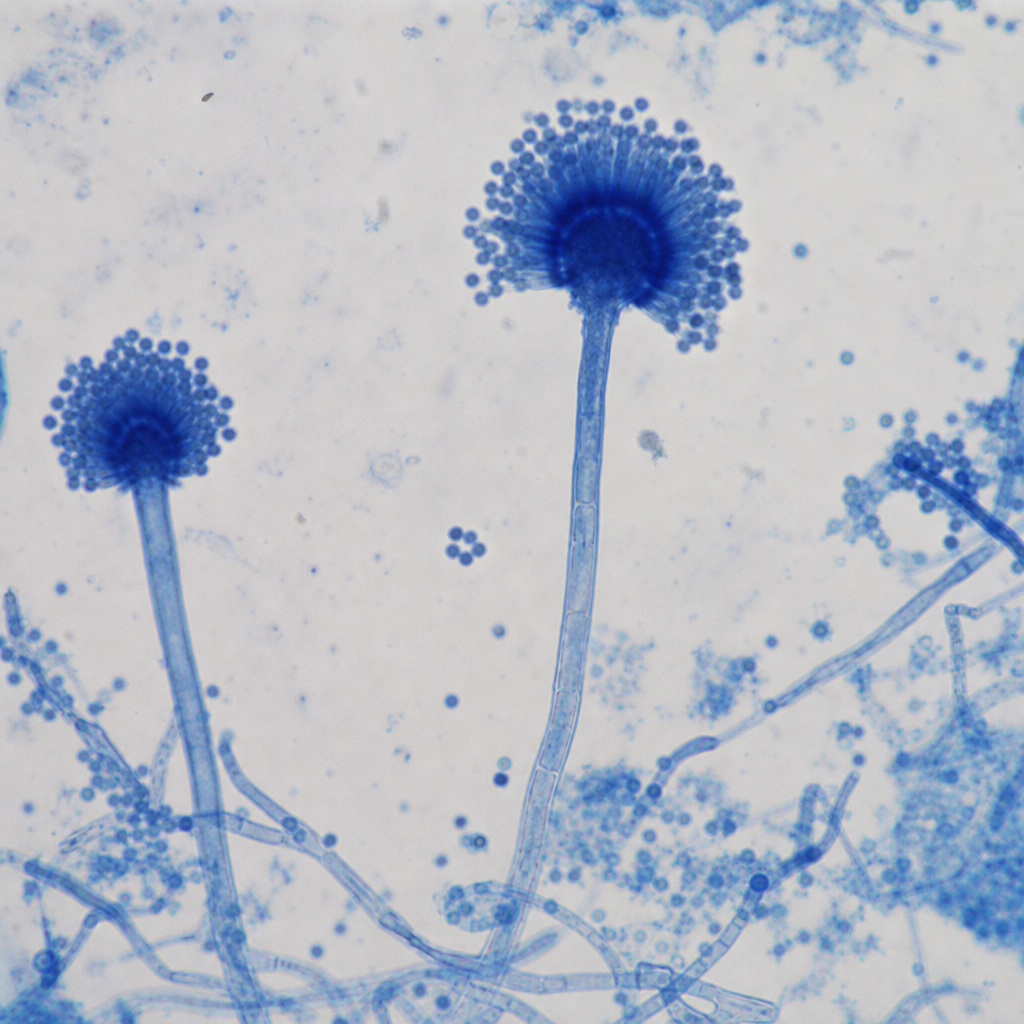
Which of the following organisms cannot be cultured?
A patient self-diagnosed with Tinea pedis and used an over-the-counter product, which partially improved the condition. A dermatologist was consulted, and a skin scraping was sent for fungal culture. The culture yielded a slow-growing colony that produces abundant microconidia. This is consistent with the isolation of a dermatophyte from which genus?
All of the following regarding histoplasmosis are true except?
A 28-year-old HIV patient presents with non-productive cough and progressively increasing difficulty in breathing. Chest X-ray shows diffuse bilateral interstitial infiltrates along with pneumatocele. Gomori's methenamine silver staining of the bronchoalveolar lavage shows a characteristic oval yeast. The most probable causative organism is?
Mature spherules in a sputum sample are seen in which of the following fungal infections?
A diabetic patient presents with pus from the eye. Colonies of isolated organisms are black with microscopic features of non-septate hyphae and obtuse branching. What is the diagnosis?
A vitreous aspirate from a case of metastatic endophthalmitis on culture yields Gram-positive round to oval cells, 12-14 µm in size. The aspirate on Gram staining shows the presence of pseudohyphae. Which of the following is the most likely aetiological agent?
Aspergillosis can present with which of the following manifestations, except?
Chromoblastomycosis is associated with which type of bodies?
Tuberculate macroconidia is characteristic of which of the following conditions?
Explanation: **Explanation:** The correct answer is **Rhinosporidium seeberi**. Despite its name and historical classification, *Rhinosporidium seeberi* is not a true fungus but an aquatic protist (Mesomycetozoea). A defining characteristic of this organism is that it **cannot be grown on artificial culture media** or in cell lines. Diagnosis relies exclusively on histopathology. **Why the other options are incorrect:** * **Klebsiella rhinoscleromatis & Klebsiella ozaenae:** These are subspecies of *Klebsiella pneumoniae*. As Gram-negative bacilli, they grow readily on standard laboratory media like Blood Agar and MacConkey Agar (forming large, mucoid colonies). * **Aspergillus fumigatus:** This is a common filamentous fungus that grows easily on Sabouraud Dextrose Agar (SDA) at both 25°C and 37°C, typically appearing as smoky-green colonies. **High-Yield Clinical Pearls for NEET-PG:** * **Disease:** Rhinosporidiosis presents as friable, leafy, strawberry-like vascular polyps, usually in the nose or nasopharynx. * **Transmission:** Associated with bathing in stagnant freshwater (ponds/tanks). * **Diagnosis:** Identification of **sporangia** in tissue sections. These are large (up to 350 µm), thick-walled structures containing thousands of **endospores**. * **Staining:** Sporangia can be visualized with H&E, GMS, or PAS stains. * **Treatment:** Surgical excision with wide-base cauterization is the treatment of choice; medical therapy (Dapsone) has limited efficacy.
Explanation: ### Explanation **1. Why Trichophyton is Correct:** The diagnosis is based on the morphological characteristics of the fungal culture. Dermatophytes are classified into three genera based on their macroconidia and microconidia. **Trichophyton** species are characterized by the production of **abundant microconidia** (which can be teardrop, pyriform, or spherical) and relatively few, thin-walled, smooth macroconidia. Clinically, *Trichophyton rubrum* is the most common cause of Tinea pedis worldwide and is notorious for being slow-growing in culture. **2. Why the Other Options are Incorrect:** * **Microsporum:** These species are characterized by **abundant, thick-walled, spindle-shaped macroconidia** with rough (echinulate) surfaces. Microconidia are typically scarce. * **Epidermophyton:** This genus (specifically *E. floccosum*) produces **only macroconidia**, which are smooth-walled and club-shaped (often in clusters). It **never produces microconidia**. * **Trichosporon:** This is not a dermatophyte; it is a yeast-like fungus responsible for White Piedra and opportunistic systemic infections. It produces arthroconidia and blastoconidia, not the typical conidia of dermatophytes. **3. NEET-PG High-Yield Pearls:** * **Tissue Involvement:** * *Trichophyton:* Infects Hair, Skin, and Nails. * *Microsporum:* Infects Hair and Skin (rarely nails). * *Epidermophyton:* Infects Skin and Nails (never hair). * **Tinea Pedis (Athlete’s Foot):** Most commonly caused by *T. rubrum* (anthropophilic). * **Culture Medium:** Sabouraud Dextrose Agar (SDA) is standard, but **Actidione (Cycloheximide)** is added to inhibit saprophytic fungi. * **Macroconidia Shape Mnemonic:** * **M**icrosporum: **M**ace/Spindle-shaped. * **E**pidermophyton: **E**gg/Club-shaped. * **T**richophyton: **T**ubular/Cigarette-shaped (though rare).
Explanation: **Explanation:** The question asks for the "except" statement regarding **Histoplasmosis** (caused by *Histoplasma capsulatum*). **1. Why Option A is the correct answer (The False Statement):** While Histoplasmosis is an opportunistic infection in immunocompromised individuals, it is **not** considered "very common" in AIDS patients globally compared to other fungal infections like *Candidiasis* or *Pneumocystis jirovecii* pneumonia. In the context of NEET-PG, this is a "relative" truth; while it occurs in AIDS patients (usually when CD4 <150 cells/µL), it is geographically restricted to endemic areas (like the Ohio and Mississippi River valleys in the US or parts of the Ganges valley in India). **2. Analysis of other options:** * **Option B (Bone marrow involvement):** In disseminated histoplasmosis (the form usually seen in immunocompromised hosts), the fungus targets the reticuloendothelial system. It is commonly found within macrophages in the **bone marrow**, liver, and spleen. Bone marrow biopsy is a high-yield diagnostic step. * **Option C (GMS Stain):** *Histoplasma* is difficult to see on routine H&E stains. **Gomori Methenamine Silver (GMS)** and PAS stains are the gold standards to visualize the characteristic small, oval yeast cells. * **Option D (Dimorphic fungus):** *Histoplasma* is a classic **systemic dimorphic fungus** (Mold in the environment/25°C, Yeast in the tissue/37°C). **Clinical Pearls for NEET-PG:** * **Source:** Soil enriched with bird or **bat droppings** (guano); often associated with **spelunking** (cave exploring). * **Morphology:** Small intracellular yeasts (2-4 µm) with a "narrow base" bud, often seen inside **macrophages**. * **Differential Diagnosis:** Must be distinguished from *Leishmania donovani* (LD bodies have a kinetoplast, *Histoplasma* does not). * **Key Sign:** Can cause **palatal/oral ulcers** and **adrenal insufficiency** (Addisonian crisis) in disseminated cases.
Explanation: ### Explanation **Correct Option: B. Pneumocystis jirovecii** The clinical presentation is classic for **Pneumocystis Pneumonia (PCP)**, an opportunistic infection typically seen in HIV patients with CD4 counts <200 cells/mm³. * **Clinical Features:** Patients present with a triad of dyspnea, non-productive cough, and fever. * **Radiology:** Chest X-ray characteristically shows **diffuse bilateral perihilar interstitial infiltrates** (ground-glass opacities). The presence of **pneumatoceles** (thin-walled air-filled cysts) is a high-yield radiological marker for PCP. * **Microscopy:** *P. jirovecii* cannot be cultured. Diagnosis relies on staining (BAL or induced sputum). **Gomori’s Methenamine Silver (GMS)** stain highlights the characteristic **crushed-ping-pong ball** or oval-shaped cysts (yeast-like forms) with central dark spots. --- ### Why Other Options are Incorrect: * **A. Histoplasma capsulatum:** While it causes pulmonary symptoms in HIV, it typically presents with miliary nodules or hilar lymphadenopathy. On staining, it appears as small intracellular yeasts within macrophages, not as extracellular cysts in BAL. * **C. Rhinosporidium seeberi:** This causes rhinosporidiosis, characterized by friable, leafy nasal polyps. It is not a respiratory pathogen and is identified by large sporangia containing endospores. * **D. Cryptococcus neoformans:** Usually presents as meningitis in HIV. Pulmonary involvement shows well-defined nodules or consolidation. It is best identified by India Ink (capsule) or Mucicarmine stain. --- ### NEET-PG High-Yield Pearls: * **Drug of Choice:** Trimethoprim-Sulfamethoxazole (Cotrimoxazole). * **Prophylaxis:** Started in HIV patients when CD4 count falls below **200 cells/mm³**. * **Stains:** GMS (best for cysts), Giemsa (highlights trophic forms), and Toluidine blue O. * **Biomarker:** Elevated **Serum Beta-D-Glucan** is a sensitive but non-specific marker for PCP.
Explanation: ### Explanation **Correct Answer: C. Coccidioidomycosis** **Why it is correct:** *Coccidioides immitis* and *C. posadasii* are dimorphic fungi characterized by a unique life cycle. In the environment (soil), they exist as hyphae with infectious **arthroconidia**. Once inhaled into the lungs, these arthroconidia transform into **spherules** (20–100 µm in diameter). As the spherule matures, its contents undergo progressive cleavage to form hundreds of **endospores**. The presence of these thick-walled, endospore-containing spherules in sputum, biopsy, or KOH mounts is pathognomonic for Coccidioidomycosis. **Why the other options are incorrect:** * **Options A & B (Staphylococcus and Streptococcus):** These are Gram-positive bacteria, not fungi. They appear as cocci in clusters or chains, respectively, and do not form spherules. * **Option D (Aspergillus):** This is an opportunistic filamentous fungus. In clinical samples, it typically presents as **septate hyphae** with acute-angle (45°) branching. It does not form spherules. **High-Yield Clinical Pearls for NEET-PG:** * **Geographic Niche:** Often called "Valley Fever" or "Desert Rheumatism"; endemic to the Southwestern USA (Arizona, California) and Central/South America. * **Morphology:** Remember the phrase **"Spherules with endospores"** for tissue/sputum samples. * **Culture Warning:** Arthroconidia are highly infectious; laboratory personnel must handle cultures with extreme caution (Biosafety Level 3). * **Clinical Triad:** Fever, joint pain (arthralgia), and erythema nodosum (Desert Rheumatism). * **Diagnosis:** Silver stains (GMS) or PAS stains are excellent for visualizing the spherule wall.
Explanation: **Explanation:** The clinical presentation and microscopic findings are classic for **Mucormycosis**, a life-threatening opportunistic fungal infection. **Why Mucormycosis is correct:** 1. **Clinical Context:** Diabetes mellitus (especially with ketoacidosis) is the most significant risk factor. The "pus from the eye" suggests **Rhinocerebral Mucormycosis**, where the fungus spreads from the sinuses to the orbit. 2. **Microscopic Features:** The hallmark of Mucorales (e.g., *Rhizopus*, *Mucor*) is **broad, non-septate (coenocytic) hyphae** with **obtuse-angled (90°) branching**. 3. **Gross Morphology:** These fungi grow rapidly as "lid-lifters" with a cottony appearance that turns **black/grey** due to sporangia formation. **Why other options are incorrect:** * **Aspergillosis:** Characterized by **septate hyphae** with **acute-angled (45°) branching**. While it can cause orbital cellulitis, the branching pattern is the key differentiator. * **Candidiasis:** Typically presents as budding yeast cells and **pseudohyphae**. It does not produce non-septate hyphae or black colonies in this context. * **Histoplasmosis:** A dimorphic fungus that appears as small, intracellular yeast cells within macrophages. It is primarily a systemic/pulmonary infection. **High-Yield NEET-PG Pearls:** * **Angioinvasion:** Mucorales have a predilection for invading blood vessels, leading to thrombosis and tissue necrosis (black eschar). * **Treatment:** Surgical debridement + **Liposomal Amphotericin B** (Drug of choice). * **Culture:** Sabouraud Dextrose Agar (SDA) shows rapid growth (2–3 days). * **Stains:** Best visualized with KOH mount, PAS, or GMS stains.
Explanation: **Explanation:** The correct answer is **Candida**. The diagnosis is based on the morphological description provided in the clinical scenario. **1. Why Candida is correct:** * **Morphology:** *Candida* species are characterized by **Gram-positive, oval budding yeast cells** (4–6 µm, though they can appear larger in clinical samples) and the formation of **pseudohyphae**. Pseudohyphae are chains of elongated blastoconidia that remain attached, showing distinct constrictions at the septations (unlike true hyphae). * **Clinical Context:** **Metastatic endophthalmitis** (endogenous endophthalmitis) typically occurs via hematogenous spread. *Candida albicans* is the most common fungal cause of endogenous endophthalmitis, especially in immunocompromised patients, IV drug users, or those with long-term indwelling catheters. **2. Why other options are incorrect:** * **Aspergillus:** These are filamentous fungi characterized by **septate hyphae** that branch at **acute angles (45°)**. They do not produce yeast cells or pseudohyphae. * **Rhizopus:** These belong to Mucormycetes and show **broad, ribbon-like, non-septate (coenocytic) hyphae** with wide-angle branching (90°). * **Fusarium:** While a common cause of keratitis, it presents as septate hyphae and produces characteristic sickle-shaped macroconidia. It does not form budding yeast cells. **High-Yield NEET-PG Pearls:** * **Germ Tube Test (Reynolds-Braude Phenomenon):** The specific gold standard for identifying *C. albicans*. * **Culture:** Grows on Sabouraud Dextrose Agar (SDA) as creamy white, smooth colonies with a "yeasty" odor. * **Chlamydospores:** *C. albicans* produces thick-walled terminal chlamydospores on Cornmeal Agar. * **Drug of Choice:** For *Candida* endophthalmitis, systemic Fluconazole or Voriconazole is used, often with intravitreal Amphotericin B.
Explanation: **Explanation:** The correct answer is **D. Rhinocerebral involvement**. This is because rhinocerebral infection is the classic hallmark of **Mucormycosis** (caused by *Rhizopus* or *Mucor*), particularly in patients with diabetic ketoacidosis or severe neutropenia. While *Aspergillus* can cause sinusitis, the aggressive, angioinvasive rhinocerebral syndrome involving the palate, orbit, and brain is characteristic of the Zygomycetes family, not *Aspergillus*. **Analysis of other options:** * **A. Lung cavity:** *Aspergillus* commonly colonizes pre-existing lung cavities (e.g., from old TB) to form an **Aspergilloma** (fungus ball). It can also cause cavitary lesions in Chronic Pulmonary Aspergillosis (CPA). * **B. Ear infection:** *Aspergillus niger* is the most common cause of **Otomycosis** (fungal otitis externa), typically presenting with black spores and itching. * **C. Normal component in sputum:** *Aspergillus* spores are ubiquitous in the environment. Finding them in a sputum sample does not necessarily indicate disease; it often represents transient inhalation or laboratory contamination, making it a "normal" or non-pathogenic finding in healthy individuals. **High-Yield Clinical Pearls for NEET-PG:** * **Aspergilloma:** Shows the **"Monod Sign"** or **"Air Crescent Sign"** on X-ray/CT (air surrounding the fungus ball). * **ABPA (Allergic Bronchopulmonary Aspergillosis):** Associated with asthma, central bronchiectasis, and high IgE levels. * **Morphology:** *Aspergillus* shows **septate hyphae** with **acute-angle (45°) branching**, whereas *Mucor* shows non-septate hyphae with right-angle (90°) branching. * **Drug of Choice:** Voriconazole is the gold standard for Invasive Aspergillosis.
Explanation: **Explanation:** **Chromoblastomycosis** is a chronic fungal infection of the skin and subcutaneous tissue caused by dematiaceous (pigmented) fungi, most commonly *Fonsecaea pedrosoi*. **Why Medlar Bodies are correct:** The hallmark histopathological feature of Chromoblastomycosis is the presence of **Medlar bodies** (also known as **sclerotic bodies**, **muriform bodies**, or "copper pennies"). These are thick-walled, dark brown, globe-shaped fungal cells that divide by binary fission (septation) rather than budding. Their presence in skin scrapings (KOH mount) or tissue biopsy is pathognomonic for the diagnosis. **Analysis of Incorrect Options:** * **Russel bodies:** These are eosinophilic, large inclusions found in plasma cells undergoing excessive synthesis of immunoglobulins (seen in chronic inflammation and Multiple Myeloma). * **Councilman bodies:** These are eosinophilic globules representing apoptotic hepatocytes, classically seen in **Yellow Fever** and Viral Hepatitis. * **Psammoma bodies:** These are concentric laminated calcifications seen in specific tumors like Papillary carcinoma of the thyroid, Serous cystadenocarcinoma of the ovary, and Meningioma. **High-Yield Clinical Pearls for NEET-PG:** * **Clinical Presentation:** Characterized by "cauliflower-like" verrucous (warty) lesions, usually on the lower limbs of barefoot workers. * **Etiology:** Caused by traumatic inoculation of soil fungi (*Fonsecaea, Phialophora, Cladophialophora*). * **Diagnosis:** Look for "copper penny" appearance in biopsy. * **Treatment:** Ittraconazole or Terbinafine; surgical excision for small lesions.
Explanation: **Explanation:** The presence of **tuberculate macroconidia** is the pathognomonic diagnostic feature of ***Histoplasma capsulatum***. These are large (8–15 µm), thick-walled, spherical spores with finger-like projections (tubercles) seen in the mold phase (at 25°C). 1. **Why Option A is Correct:** **Darling’s disease** is the eponym for **Histoplasmosis**. It is caused by the dimorphic fungus *Histoplasma capsulatum*. In the environment (soil enriched with bird/bat guano), it grows as a mold producing characteristic tuberculate macroconidia. In the human body (37°C), it exists as small intracellular yeasts within macrophages. 2. **Why Other Options are Incorrect:** * **Options B & C (Gilchrist’s disease / Chicago disease):** Both are eponyms for **Blastomycosis** (*Blastomyces dermatitidis*). Microscopically, it is characterized by "Broad-Based Budding" yeasts at 37°C and "lollipop-shaped" microconidia at 25°C. * **Option D (Desert rheumatism):** This is a clinical manifestation of **Coccidioidomycosis** (*Coccidioides immitis*). Its diagnostic feature is the presence of **spherules containing endospores** in tissue samples and "barrel-shaped arthroconidia" in culture. **High-Yield Clinical Pearls for NEET-PG:** * **Histoplasmosis:** Often mimics Tuberculosis (hilar lymphadenopathy, calcifications). It is the only fungus that is an **obligate intracellular parasite** of the reticuloendothelial system (macrophages). * **Culture:** Grows on Sabouraud Dextrose Agar (SDA); tuberculate macroconidia are best visualized with Lactophenol Cotton Blue (LPCB) mount. * **Geography:** While common in the Ohio-Mississippi Valley (USA), in India, it is endemic in the **Gangetic plains** (West Bengal).
Classification of Fungi
Practice Questions
Superficial Mycoses
Practice Questions
Dermatophytes
Practice Questions
Subcutaneous Mycoses
Practice Questions
Candidiasis
Practice Questions
Aspergillosis
Practice Questions
Cryptococcosis
Practice Questions
Zygomycosis
Practice Questions
Endemic Mycoses
Practice Questions
Opportunistic Fungal Infections
Practice Questions
Antifungal Agents
Practice Questions
Laboratory Diagnosis of Fungal Infections
Practice Questions
Get full access to all questions, explanations, and performance tracking.
Start For Free