A person came with the H/o thorn prick a week ago. A few days later, he developed ulcers along lymphatic drainage. Choose the correct organism.
A 39-year-old patient with HIV and a CD4 count of 139 cells/μL presents with altered sensorium and impaired consciousness. CSF examination using an India ink preparation reveals a positive result. Which organism is most likely responsible?
Which of the following dimorphic fungi causes subcutaneous mycosis?
The stain used for identifying Cryptococcus is
A 35-year-old female presents with vaginal discharge and vulvar itching. Wet mount examination shows budding yeast cells with pseudohyphae. Vaginal pH is 4.5. What is the most likely causative organism?
All of the following are dimorphic fungi except:
A white patch is observed in the oral cavity of an immunocompromised patient. Which of the following findings is most likely on microscopy?
A patient presents with low-grade fever, chronic cough, and weight loss. Fungal culture from respiratory secretions shows the following organism with characteristic tuberculate macroconidia on microscopy. What is the most likely diagnosis?
A patient presents with irregular swelling over the foot, multiple discharging sinuses, and black granules. A KOH mount is performed on the discharge. What is the most likely observation?
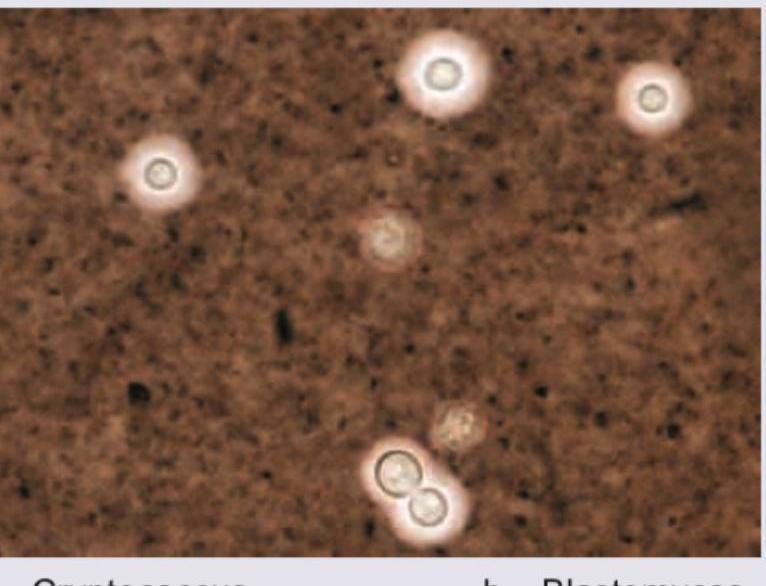
A patient presented with headache and projectile vomiting and altered sensorium. The following organism was demonstrated on India ink staining. What is the likely diagnosis?
Explanation: ***Sporothrix schenckii*** - This dimorphic fungus is introduced via cutaneous trauma, classically associated with exposure to vegetation (e.g., **thorn prick**, sphagnum moss), leading to the term **Gardener's disease**. - The characteristic presentation of a primary nodule followed by secondary subcutaneous nodules or ulcers tracking along the proximal lymphatic drainage is diagnostic of **lymphocutaneous sporotrichosis**. *Coccidioides immitis* - This fungus causes **Coccidioidomycosis** (Valley fever), generally acquired by inhaling arthroconidia, leading primarily to pulmonary infection. - While disseminated infection can involve the skin, it does not typically present as a localized inoculation lesion with subsequent **ascending lymphangitis** from a thorn prick. *Aspergillus flavus* - **Aspergillus** species usually cause infections in immunocompromised patients (e.g., invasive pulmonary aspergillosis) or superficial infections such as fungal keratitis. - It is not the organism characteristically associated with traumatic inoculation from plant material causing a **sporotrichoid pattern** of lymphatic spread. *Trichophyton rubrum* - This is a common **dermatophyte** that causes superficial cutaneous infections of the keratin layer, such as tinea (ringworm) of the skin, hair, or nails. - It lacks the invasive capability to establish a deep infection followed by **lymphatic involvement** and ulceration after subcutaneous inoculation.
Explanation: ***Cryptococcus neoformans***- The classic finding of a positive **India ink preparation** upon CSF examination indicates the large polysaccharide **capsule** characteristic of this yeast.- In patients with advanced HIV (**CD4 <200** cells/μL), *C. neoformans* is the most common cause of **fungal meningoencephalitis** presenting with altered mental status.*Aspergillus fumigatus*- CNS infection with *Aspergillus* usually manifests as **focal cerebral lesions** (abscesses) or hemorrhagic infarction due to angioinvasion, not typically diffuse meningitis.- Diagnosis generally relies on culturing the fungus, **histopathology** showing septate hyphae, or detecting **galactomannan antigen** in the serum or CSF.*Histoplasma capsulatum*- While it can cause disseminated infection in patients with AIDS, CNS involvement is less frequent than *Cryptococcus* and the yeast is **intracellular** (within macrophages).- Detection typically utilizes **Histoplasma antigen testing** in urine or serum, as the small yeasts do not possess the large capsule highlighted by India ink.*Candida albicans*- *Candida* is a common cause of superficial or disseminated infection, but isolated **Candida meningitis** is rare, usually seen after neurosurgery or hematogenous seeding.- *Candida* **lacks the prominent capsule** that would produce a positive result on an India ink preparation.
Explanation: ***Sporothrix schenckii***- This dimorphic fungus is the classic causative agent of **sporotrichosis**, which is classified as a **subcutaneous mycosis** associated with inoculation injuries (e.g., from roses or hay).- Infection often presents as a primary skin lesion followed by characteristic **lymphocutaneous spread** along lymphatic channels.*Histoplasma capsulatum*- It causes **histoplasmosis**, which is primarily classified as a **systemic or deep mycosis** that is acquired by inhaling microconidia from bird or bat droppings.- Although dissemination can occur, it is not categorized as a primary subcutaneous mycosis initiated by direct wound inoculation.*Blastomyces dermatitidis*- This fungus causes **blastomycosis**, which is considered a **systemic mycosis** primarily affecting the lungs following inhalation of spores.- While disseminated disease frequently involves the skin, causing sharply demarcated verrucous lesions, the infection route remains systemic rather than purely subcutaneous.*Penicilliosis marneffei*- Now known as *Talaromyces marneffei*, it causes **talaromycosis**, which is an **opportunistic systemic mycosis** predominantly affecting immunocompromised individuals in Southeast Asia.- Though it causes diverse skin manifestations (e.g., papules, nodules), the overall clinical picture is one of deep, disseminated infection, not a localized subcutaneous mycosis like sporotrichosis.
Explanation: ***India ink stain***- This stain is a **negative staining** method primarily used for rapid detection of the large **polysaccharide capsule** of *Cryptococcus neoformans*, especially in cerebrospinal fluid (CSF) samples. - The surrounding ink particles are excluded by the capsule, resulting in a characteristic **clear halo** around the yeast cell against a dark background.*Albert's stain*- Albert's stain is specialized for bacterial cytology, specifically used to demonstrate **metachromatic granules** (or volutin granules) in **Corynebacterium diphtheriae**.- It uses a mixture of **toluidine blue** and **malachite green** and is not applicable for fungal identification.*Silver staining*- **Grocott's methenamine silver (GMS) stain** is a histological silver stain used often in pathology to visualize fungal elements, staining the cell walls brown to black.- While effective for detecting *Cryptococcus* in **tissue biopsies**, it is not the standard rapid method for fluid samples like CSF.*Auramine-rhodamine stain*- This is a **fluorescent staining technique** used to identify **acid-fast bacilli (AFB)**, particularly species of **Mycobacterium**.- The stain binds to the **mycolic acid** in the cell wall, a component absent in fungal organisms like *Cryptococcus*.
Explanation: ***Candida albicans*** - The microscopic finding of **budding yeast cells** and **pseudohyphae** on the wet mount is pathognomonic for **Vulvovaginal Candidiasis (VVC)**. - The characteristic symptoms include intense **vulvar pruritus** (itching) and thick, white, **curd-like discharge**, often associated with an acidic vaginal pH (usually 4.0 to 4.5). *Gardnerella vaginalis* - This organism is the key agent in **Bacterial Vaginosis (BV)**, which is characterized by a thin, grey, homogenous discharge with a **fishy odor**. - BV is diagnosed by the presence of **clue cells** on wet mount and a high vaginal pH (typically >4.5, often 5.0–6.0). *Trichomonas vaginalis* - This protozoan causes **trichomoniasis**, which commonly presents with a **profuse, frothy, greenish-yellow discharge** and often causes inflammatory symptoms like a "strawberry cervix." - Wet mount examination would reveal motile, **flagellated trichomonads**, and the vaginal pH is usually elevated (>5.0). *Neisseria gonorrhoeae* - This bacterium is primarily a cause of **cervicitis** and **urethritis**, often presenting asymptomatically or with mucopurulent discharge, but rarely causing significant vulvar itching. - Diagnosis is based on identifying Gram-negative **intracellular diplococci** on Gram stain or using **NAAT**, not yeast forms.
Explanation: ***Cryptococcus*** - *Cryptococcus neoformans* is a **monomorphic yeast** and does NOT exhibit thermal dimorphism - It exists as an **encapsulated budding yeast** at both room temperature (25°C) and body temperature (37°C) - Unlike dimorphic fungi, it does **not transform between mold and yeast forms** based on temperature - Causes **meningitis** and pulmonary infections, especially in immunocompromised patients - This is the **correct answer** as it is the only non-dimorphic fungus in the list *Incorrect - Coccidioides* - Classic dimorphic fungus showing **mold-to-spherule conversion** - In environment (25°C): filamentous mold with infectious **arthroconidia** - In tissue (37°C): transforms into large, thick-walled **spherules** containing endospores - Endemic to southwestern USA and parts of Central/South America *Incorrect - Histoplasma* - Classic dimorphic fungus showing **mold-to-yeast conversion** - In environment (25°C): filamentous mold in soil enriched with bird/bat droppings - In tissue (37°C): small, narrow-based **budding yeast** forms within macrophages - *Histoplasma capsulatum* is endemic to Mississippi and Ohio river valleys *Incorrect - Talaromyces* - *Talaromyces marneffei* (formerly *Penicillium marneffei*) is a **dimorphic fungus** - In environment (25°C): grows as mold producing red pigment - In tissue (37°C): exists as yeast-like cells dividing by **fission** (not budding) - Endemic to **Southeast Asia** and associated with HIV/AIDS patients
Explanation: ***Pseudo-hyphae*** - The clinical presentation of a white patch in an immunocompromised patient is highly suggestive of **oral candidiasis** (thrush), typically caused by *Candida albicans*. - In tissue samples (like oral scrapings), *Candida albicans* characteristically appears as **budding yeast** cells along with distinct chains of elongated yeast cells known as **pseudo-hyphae**. ***Branching septate hyphae*** - These structures are characteristic of filamentous fungi, such as **Aspergillus** species or dermatophytes (e.g., *Tinea* infections). - While *Candida* can form true hyphae under certain conditions, **pseudo-hyphae** are the hallmark feature observed in routine smear microscopy for oral candidiasis. ***Budding yeast with capsule*** - This microscopic finding is pathognomonic for **Cryptococcus neoformans**, which causes cryptococcosis. - The capsule is often visualized using special stains like mucicarmine or India ink, and *Cryptococcus* typically causes systemic disease or **meningoencephalitis**, not simple oral thrush. ***Sulfur granules*** - **Sulfur granules** are characteristic aggregates of filamentous bacteria seen in infections caused by **Actinomyces israelii**, leading to **Actinomycosis**. - Actinomycosis usually presents as chronic, indolent abscesses that drain sinus tracts, most commonly in the cervicofacial region.
Explanation: ***Histoplasmosis*** - The image displayed shows characteristic large, spiny, thick-walled structures known as **tuberculate macroconidia**, which are pathognomonic for the mold phase of ***Histoplasma capsulatum*** grown at 25°C. - The clinical presentation of chronic cough, low-grade fever, and weight loss is typical of chronic pulmonary **Histoplasmosis** in immunocompetent individuals and often mimics tuberculosis. *Blastomycosis* - The yeast form of *Blastomyces dermatitidis* is characterized by having distinctive **broad-based budding** and large size (8-15 µm). - The mold phase of *Blastomyces* produces oval to pear-shaped microconidia on short or long stalks, not the tuberculate macroconidia seen in the picture. *Cryptococcosis* - *Cryptococcus neoformans* is a yeast encapsulated with a polysaccharide capsule and typically demonstrates smooth, **narrow-based budding** without forming true hyphae or macroconidia in culture. - Although it can cause pulmonary disease, its yeast morphology and lack of dimorphism differentiate it from the organism shown. *Coccidioidomycosis* - The mold form of *Coccidioides immitis* produces thin-walled, barrel-shaped structures called **arthroconidia**, which are highly infectious. - The tissue phase is defined by large **spherules containing endospores**, a morphology that is distinctly different from the tuberculate macroconidia shown.
Explanation: ***Slender dematiaceous fungi*** - The clinical triad of irregular swelling, multiple discharging sinuses, and the presence of **black granules** strongly suggests **black-grained eumycetoma** (e.g., caused by *Madurella mycetomatis*). - KOH mount of the black granule reveals densely packed, brown-to-black pigmented (**dematiaceous**) septate hyphal elements and chlamydospores, consistent with slender dematiaceous fungi. *Arthrospores* - Arthrospores are typically seen in superficial infections like **dermatophytosis** (e.g., Tinea capitis, *Trichophyton*) or are characteristic of the parasitic phase of *Coccidioides immitis*. - They are not the primary microscopic finding within the tissue granule of mycetoma. *Yeast* - Yeast forms are characteristic of systemic infections like **Candidiasis**, Cryptococcosis, or Histoplasmosis, or are seen as sclerotic (Medlar) bodies in **Chromoblastomycosis**. - Mycetoma granules are formed by highly organized masses of filamentous hyphae, not unicellular yeast. *Septate hyphae 4-5* - This describes the general morphology and width of hyphae seen in common molds like **Aspergillus** or *Fusarium*. - This description is incomplete for black-grained mycetoma as it omits the distinctive feature of the fungus being pigmented (**dematiaceous**), which is critical for identifying the organism within the black granule.
Explanation: ***Cryptococcus*** - The image displays encapsulated yeast cells, characteristic of **_Cryptococcus neoformans_** or **_Cryptococcus gattii_**, which are commonly highlighted by **India ink staining** due to their large polysaccharide capsule. - The clinical presentation of headache, projectile vomiting, and altered sensorium strongly suggests **cryptococcal meningitis**, especially in immunocompromised individuals. *Blastomyces* - **_Blastomyces dermatitidis_** appears as large, broad-based budding yeast, which is distinct from the encapsulated yeasts seen in the image. - While it can cause CNS infection, its morphological characteristics under microscopy are different, and India ink is not its primary diagnostic stain. *Histoplasma* - **_Histoplasma capsulatum_** is a small, intracellular yeast, often seen within macrophages, and does not possess a prominent capsule that would be stained by India ink. - Neurological involvement is less common than with _Cryptococcus_ and the microscopic appearance is different. *Coccidioides* - **_Coccidioides immitis_** forms **spherules** containing **endospores** in tissue samples, a distinct morphology not seen in the provided image. - Although it can cause meningitis, its microscopic identification relies on finding these spherules, not encapsulated yeasts with India ink.
Classification of Fungi
Practice Questions
Superficial Mycoses
Practice Questions
Dermatophytes
Practice Questions
Subcutaneous Mycoses
Practice Questions
Candidiasis
Practice Questions
Aspergillosis
Practice Questions
Cryptococcosis
Practice Questions
Zygomycosis
Practice Questions
Endemic Mycoses
Practice Questions
Opportunistic Fungal Infections
Practice Questions
Antifungal Agents
Practice Questions
Laboratory Diagnosis of Fungal Infections
Practice Questions
Get full access to all questions, explanations, and performance tracking.
Start For Free