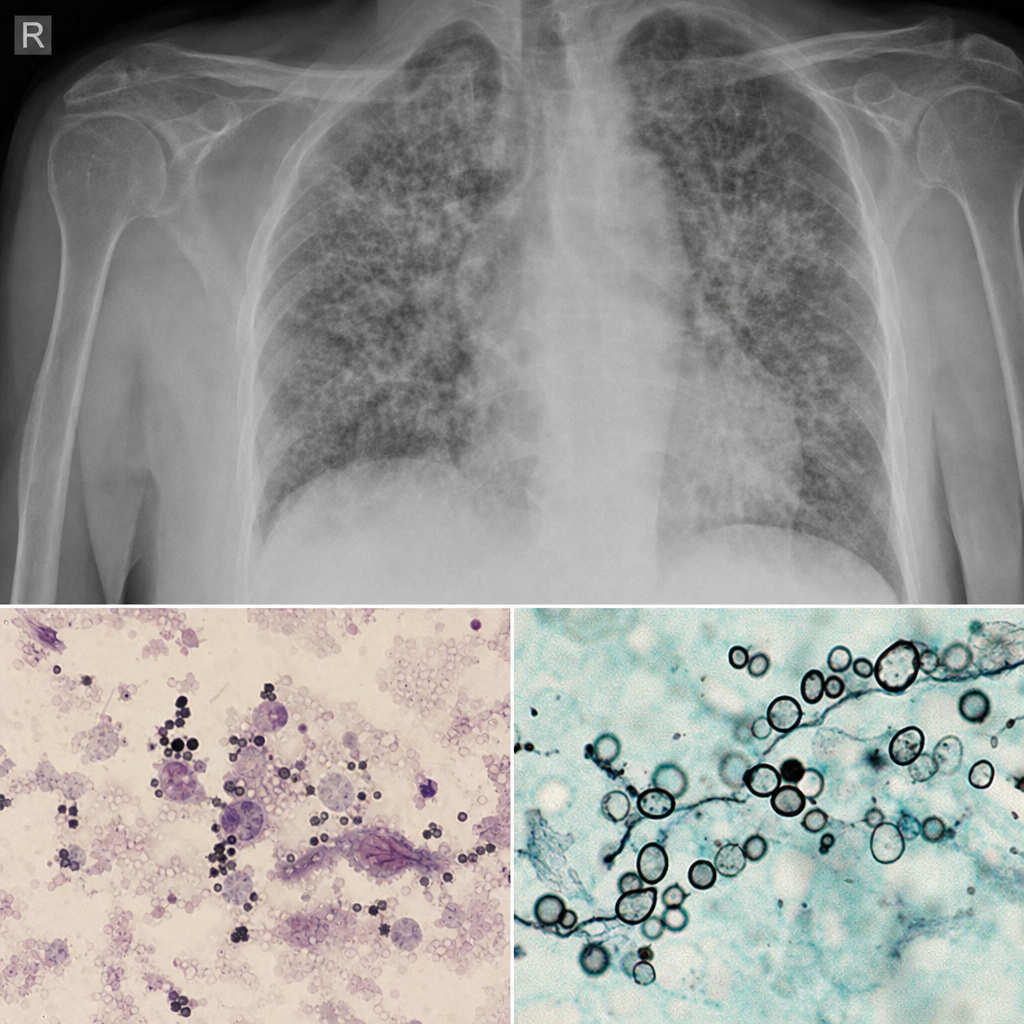
Which stain is used for visualizing fungal elements?
Opportunistic infections are most commonly caused by which of the following types of fungi?
A 26-year-old male presents with a circular, itchy, inflamed, slightly raised skin lesion. He reports his pet dog sleeps with him and has localized areas of hair loss. The patient has no other symptoms. What would be expected on a KOH preparation of skin scrapings?
Which of the following is an aseptate fungus?
Which of the following is not a yeast-like fungus?
Which of the following is a dimorphic fungus?
Which infection is not common in HIV patients?
Infected tissues demonstrating budding fungal cells are seen in which of the following conditions?
Which structures can be infected by Trichophyton species?
Ova in stool are not of diagnostic significance in which of the following helminthic infections?
Explanation: **Explanation:** **Gomori Methenamine Silver (GMS)** is considered the gold standard stain for visualizing fungal elements in histological sections. The underlying principle is an oxidation-reduction reaction: chromic acid oxidizes the carbohydrates (polysaccharides) present in the fungal cell wall to form aldehydes. These aldehydes then reduce the silver nitrate in the methenamine silver solution to metallic silver, staining the fungi **black or dark brown** against a green background. **Analysis of Incorrect Options:** * **A. Acid-fast stain (Ziehl-Neelsen):** Primarily used for Mycobacteria. While some fungi like *Nocardia* (technically a bacterium) and *Cryptosporidium* are acid-fast, it is not a general fungal stain. * **B. Mucicarmine:** This is a specific stain used to highlight **acid mucopolysaccharides**. In mycology, its primary use is the specific identification of ***Cryptococcus neoformans***, highlighting its thick polysaccharide capsule (staining it bright red). It does not stain the cell walls of other fungi. * **D. Gram stain:** While some fungi (like *Candida*) appear Gram-positive (purple), it is unreliable for most filamentous fungi and does not provide the structural detail required for definitive fungal diagnosis. **High-Yield Clinical Pearls for NEET-PG:** * **PAS (Periodic Acid-Schiff):** Another vital fungal stain; it stains fungal cell walls **bright pink/magenta**. * **India Ink:** Used for rapid identification of *Cryptococcus* in CSF (shows a clear halo/negative staining). * **Calcofluor White:** A fluorescent stain that binds to chitin; it is the most sensitive method for direct microscopic examination. * **Lactophenol Cotton Blue (LPCB):** The standard mounting medium used for fungal colonies in the laboratory.
Explanation: **Explanation:** Opportunistic fungal infections occur primarily in immunocompromised individuals (e.g., those with HIV/AIDS, uncontrolled diabetes, neutropenia, or those on prolonged steroid therapy). Unlike primary pathogens, these fungi take advantage of a weakened host immune system. **Why "All of the above" is correct:** All three genera listed are classic examples of opportunistic molds found ubiquitously in the environment (soil, air, decaying matter). * **Aspergillus:** The most common opportunistic filamentous fungus. It causes a spectrum of diseases (Aspergillosis) ranging from allergic reactions to invasive systemic infections, particularly in neutropenic patients. * **Mucor:** A member of the Zygomycetes family, it causes **Mucormycosis**. It is notorious for causing rhinocerebral infections in patients with **Diabetic Ketoacidosis (DKA)** due to its affinity for high glucose and acidic environments. * **Penicillium:** While many species are common laboratory contaminants, *Talaromyces (formerly Penicillium) marneffei* is a significant opportunistic pathogen, especially in HIV-positive patients in Southeast Asia. **Clinical Pearls for NEET-PG:** 1. **Aspergillus:** Characterized by **septate hyphae** with **acute-angle (45°) branching**. Look for "Halo sign" or "Air crescent sign" on CT scans. 2. **Mucor:** Characterized by **aseptate (coenocytic) hyphae** with **wide-angle (90°) branching**. It is highly angioinvasive, leading to tissue necrosis. 3. **Candida albicans:** Though not in the options, it remains the **most common** opportunistic fungal pathogen overall (yeast). 4. **Risk Factor Association:** Always associate **Mucor with Diabetes** and **Aspergillus with Neutropenia**.
Explanation: ### Explanation **Clinical Diagnosis: Dermatophytosis (Tinea Corporis)** The clinical presentation of a circular, itchy, inflamed lesion (ringworm) combined with a history of contact with a symptomatic pet (zoonotic transmission) is classic for a dermatophyte infection, likely *Microsporum canis* or *Trichophyton* species. **1. Why Option B is Correct:** Dermatophytes are filamentous fungi that infect keratinized tissues (skin, hair, nails). On a **KOH (Potassium Hydroxide) mount**, they characteristically appear as **septate, branching hyphae**. As the infection progresses, these hyphae often fragment into chains of spores known as **arthroconidia**. This "breaking up" into arthroconidia is a hallmark diagnostic feature of dermatophytes in clinical specimens. **2. Analysis of Incorrect Options:** * **Option A:** Describes the "Spaghetti and Meatballs" appearance characteristic of **Pityriasis versicolor** (caused by *Malassezia furfur*). * **Option C:** Filariform larvae are the infective stage of helminths like **Hookworms** or *Strongyloides stercoralis*, typically associated with Cutaneous Larva Migrans, not fungal rings. * **Option D:** Describes **Candida albicans**. While *Candida* can cause skin lesions (intertrigo), it typically presents with satellite lesions and prefers moist folds, showing budding yeasts and pseudohyphae on KOH. **3. High-Yield NEET-PG Pearls:** * **Transmission:** Zoonotic dermatophytosis (from pets) often causes more severe inflammation than anthropophilic (human-to-human) types. * **Wood’s Lamp:** *Microsporum canis* (common in dogs) shows a **bright green fluorescence**. * **Culture:** Sabouraud Dextrose Agar (SDA) is the standard medium; Dermatophyte Test Medium (DTM) changes color from yellow to red due to alkaline metabolites. * **Ectothrix vs. Endothrix:** In hair infections, *Microsporum* typically forms spores on the outside of the hair shaft (Ectothrix), while *Trichophyton tonsurans* forms them inside (Endothrix).
Explanation: **Explanation:** The correct answer is **Rhizopus**. In medical mycology, fungi are broadly classified based on their hyphal morphology into **septate** (possessing cross-walls) and **aseptate** (lacking cross-walls, also known as **coenocytic**). **1. Why Rhizopus is correct:** Rhizopus belongs to the class **Zygomycetes** (Mucormycetes). These fungi are characterized by broad, ribbon-like, **aseptate** or sparsely septate hyphae that branch at wide angles (90°). This lack of septation allows for rapid cytoplasmic streaming, contributing to their aggressive, angioinvasive nature. **2. Why the other options are incorrect:** * **Aspergillus:** This is a filamentous fungus characterized by thin, **septate** hyphae that branch at acute angles (45°). This is a classic "distractor" often paired with Rhizopus in exams. * **Candida:** This is primarily a **yeast**. While it can form pseudohyphae (elongated buds) or true hyphae (in *C. albicans*), these structures are septate. * **Nocardia:** This is not a fungus; it is a Gram-positive, aerobic, filamentous **bacterium** (Actinomycete). While it appears branching, it does not follow fungal septation patterns. **Clinical Pearls for NEET-PG:** * **Zygomycetes (Rhizopus, Mucor, Lichtheimia):** Broad, aseptate hyphae; 90° branching; associated with **Rhinocerebral Mucormycosis** in uncontrolled diabetics (DKA). * **Aspergillus:** Narrow, septate hyphae; 45° (dichotomous) branching; associated with ABPA, Aspergilloma, and Invasive Aspergillosis. * **Mnemonic:** "A" for **A**spergillus = **A**cute angles + **A**septate is **FALSE** (it is septate). Remember: **Z**ygomycetes are **Z**ero-septate (Aseptate).
Explanation: ### Explanation The classification of fungi based on morphology is a high-yield topic for NEET-PG. Fungi are broadly classified into four morphological groups: **Yeasts, Yeast-like fungi, Molds (Filamentous), and Dimorphic fungi.** **1. Why Trichophyton is the correct answer:** **Trichophyton** is a **Mold (Filamentous fungus)**. It belongs to the group of Dermatophytes. Molds grow as branching filaments called hyphae, which intertwine to form a mass known as mycelium. Trichophyton specifically produces microconidia and macroconidia and is responsible for superficial infections of the skin, hair, and nails (Tinea/Ringworm). It does not exhibit a yeast phase. **2. Analysis of incorrect options:** * **Candida (Option B):** This is the classic example of a **Yeast-like fungus**. Unlike true yeasts, yeast-like fungi grow partly as yeasts and partly as elongated cells joined end-to-end, resembling hyphae; these are called **pseudohyphae**. * **Cryptococcus (Option A):** This is a **True Yeast**. It exists as a unicellular budding cell and does not form pseudohyphae. (Note: While the question asks for "not a yeast-like fungus," in many MCQ contexts, "yeast-like" and "yeast" are grouped together to distinguish them from filamentous molds). **3. High-Yield Clinical Pearls for NEET-PG:** * **True Yeasts:** *Cryptococcus neoformans* (Capsulated, identified by India Ink), *Saccharomyces*. * **Yeast-like:** *Candida albicans* (Forms Germ tubes/Chlamydospores). * **Molds:** Dermatophytes (*Trichophyton, Microsporum, Epidermophyton*), *Aspergillus*, *Zygomycetes* (Rhizopus, Mucor). * **Dimorphic Fungi:** Exist as yeast in tissues (37°C) and molds in nature (25°C). Mnemonic: **"Body Heat is Probably Mutating Histoplasma"** (*Blastomyces, Histo, Paracoccidioides, Coccidioides, Sporothrix, Talaromyces*).
Explanation: **Explanation:** **Dimorphic fungi** are unique pathogens that exist in two distinct morphological forms depending on environmental conditions, primarily temperature (**Thermal Dimorphism**). They exist as **molds** (hyphae) in the cold/environment (25°C) and as **yeasts** in the warm host tissue (37°C). **Why Sporothrix schenckii is correct:** *Sporothrix schenckii* is a classic dimorphic fungus. In the environment (on decaying vegetation or thorns), it grows as a mold with septate hyphae and "rosette-like" conidia. Once inoculated into the human body, it converts into a **cigar-shaped yeast**. **Analysis of Incorrect Options:** * **Rhizopus (Option A):** This is a **Zygomycete** (Phycomycete). It is a monomorphic mold characterized by broad, non-septate hyphae and is not dimorphic. * **Tinea versicolor (Option B):** Caused by *Malassezia furfur*, this is a **dimorphic-like** yeast that is part of normal skin flora. However, in medical microbiology, it is classified as a yeast that produces short hyphae (spaghetti and meatballs appearance) under specific conditions, but it is not categorized under the "classic systemic dimorphic fungi." * **Microsporum (Option D):** This is a **Dermatophyte**. Dermatophytes are monomorphic filamentous fungi (molds) that infect keratinized tissues (skin, hair, nails). **NEET-PG High-Yield Pearls:** 1. **Mnemonic for Dimorphic Fungi:** "**B**ody **H**eat **P**robably **S**hapes **C**occidioides" (**B**lastomyces, **H**istoplasma, **P**aracoccidioides, **S**porothrix, **C**occidioides). *Note: Penicillium (Talaromyces) marneffei is also dimorphic.* 2. **Sporothrix Clinical Presentation:** Known as **"Rose Gardener’s Disease,"** it typically presents as linear nodules along lymphatic channels (lymphocutaneous sporotrichosis) following a traumatic thorn prick. 3. **Treatment:** Oral **Itraconazole** is the drug of choice; historically, saturated solution of potassium iodide (SSKI) was used.
Explanation: ### Explanation The correct answer is **Aspergillosis**. **1. Why Aspergillosis is the correct answer:** While *Aspergillus* is an opportunistic fungus, it is primarily seen in patients with **severe neutropenia** (e.g., leukemia, bone marrow transplant) or those on high-dose corticosteroids. In HIV/AIDS patients, the primary immune deficit is **Cell-Mediated Immunity (CD4+ T-cell depletion)** rather than neutrophil dysfunction. Therefore, unless an HIV patient is also neutropenic or has advanced structural lung disease, invasive aspergillosis is significantly less common compared to the other listed infections. **2. Why the other options are incorrect:** * **Cryptosporidiosis (Option A):** This is a classic AIDS-defining illness. It causes chronic, profuse watery diarrhea in patients with CD4 counts typically below 100 cells/mm³. * **Atypical Mycobacterial Infection (Option B):** Specifically *Mycobacterium avium complex* (MAC), this is very common in late-stage AIDS (CD4 < 50 cells/mm³), presenting as disseminated disease with fever and lymphadenopathy. * **Candidiasis (Option D):** Oropharyngeal candidiasis (thrush) is the most common opportunistic fungal infection in HIV patients and often serves as an early clinical sign of disease progression. **3. NEET-PG High-Yield Pearls:** * **Most common fungal infection in HIV:** Candidiasis (Mucosal). * **Most common opportunistic infection (overall) in HIV:** *Pneumocystis jirovecii* pneumonia (PCP). * **Most common CNS mass lesion in HIV:** Toxoplasmosis. * **Aspergillus Risk Factor:** Remember "Neutropenia" for *Aspergillus* and "CD4 count" for the others. * **Diagnostic Clue:** *Aspergillus* shows septate hyphae with acute-angle (45°) branching.
Explanation: **Explanation** The presence of **budding yeast cells** in tissue is a hallmark of specific fungal infections, primarily those caused by yeasts or dimorphic fungi in their parasitic phase. **Why Option D is Correct:** * **Candidiasis:** *Candida albicans* typically shows budding yeast cells (blastoconidia) along with pseudohyphae in tissue. * **Cryptococcosis:** *Cryptococcus neoformans* is an obligate yeast characterized by narrow-based budding cells surrounded by a thick polysaccharide capsule (visualized with India ink or Mucicarmine). * **Sporotrichosis:** *Sporothrix schenckii* is a dimorphic fungus. In infected tissue (the yeast phase), it appears as small, oval, "cigar-shaped" budding cells. **Why Other Options are Incorrect:** * **Option A:** **Aspergillosis** presents as septate hyphae with acute-angle branching, not budding cells. **Coccidioidomycosis** is characterized by large **spherules** filled with endospores. * **Option B:** **Tinea versicolor** shows a "spaghetti and meatballs" appearance (short hyphae + yeast clusters), but **Tinea nigra** presents as branched, septate dematiaceous hyphae. * **Option C:** **Dermatophytosis** (Ringworm) is characterized by septate hyphae and arthroconidia in skin/hair/nails, never budding yeast cells. **High-Yield NEET-PG Pearls:** 1. **Paracoccidioidomycosis:** Look for "Pilot’s wheel" or "Mickey Mouse" appearance (multiple budding). 2. **Blastomycosis:** Characterized by large, **broad-based budding** yeast. 3. **Histoplasmosis:** Small intracellular budding yeasts within macrophages (resembles *Leishmania* but lacks a kinetoplast). 4. **Chromomycosis:** Look for **Sclerotic bodies** (Medlar bodies/copper pennies), not budding cells.
Explanation: This question tests your knowledge of **Dermatophytosis**, a group of fungal infections caused by molds that require keratin for growth. These fungi are collectively known as dermatophytes and are categorized into three main genera: *Trichophyton*, *Microsporum*, and *Epidermophyton*. ### 1. Why Option A is Correct The genus **Trichophyton** is unique among dermatophytes because it possesses the enzymatic machinery to break down keratin in all three keratinized tissues. Therefore, it can infect the **skin, hair, and nails**. Common species include *T. rubrum* (the most common cause of athlete's foot) and *T. mentagrophytes*. ### 2. Why Other Options are Incorrect To differentiate the three genera, remember the tissues they **cannot** infect: * **Microsporum:** Infects **Skin and Hair**, but rarely nails. (Incorrect: Options B and C) * **Epidermophyton:** Infects **Skin and Nails**, but never hair. (Incorrect: Options C and D) ### 3. High-Yield Clinical Pearls for NEET-PG * **The "Rule of Three":** * *Trichophyton*: 3 structures (Skin, Hair, Nails) * *Microsporum*: 2 structures (Skin, Hair) * *Epidermophyton*: 2 structures (Skin, Nails) * **Tinea Capitis:** Most commonly caused by *Trichophyton* and *Microsporum*. *Epidermophyton* **never** causes Tinea Capitis because it does not infect hair. * **Most Common Dermatophyte:** *Trichophyton rubrum* is the most frequent cause of dermatophytosis worldwide. * **Diagnosis:** KOH mount showing branching hyphae and Wood’s lamp examination (Microsporum species typically fluoresce, while most Trichophyton species do not).
Explanation: ### Explanation The diagnostic hallmark of **Strongyloides stercoralis** (Threadworm) infection is the presence of **rhabditiform larvae** in the stool, not eggs (ova). **Why Strongyloides is the correct answer:** In the life cycle of *Strongyloides stercoralis*, the adult female lives in the submucosa of the small intestine and lays eggs. These eggs hatch almost immediately within the intestinal mucosa. Therefore, by the time the parasite is excreted in the feces, it is already in the **larval stage**. Finding eggs in the stool is extremely rare and usually only occurs in cases of severe hyperinfection or heavy purgation. **Analysis of Incorrect Options:** * **Ankylostoma duodenale (Hookworm):** Diagnosis is primarily made by identifying characteristic **non-bile stained, segmented eggs** (usually at the 4-8 cell stage) in the stool. * **Enterobius vermicularis (Pinworm):** While the NIH swab/Scotch tape test is the gold standard (detecting eggs on the perianal skin), the diagnostic stage is the **planoconvex egg**. These are occasionally seen in routine stool exams, though less frequently than other helminths. * **Trichuris trichiura (Whipworm):** Diagnosis is confirmed by finding the characteristic **barrel-shaped eggs** with bipolar mucus plugs in the stool. **High-Yield Clinical Pearls for NEET-PG:** * **Strongyloides** is unique because it can cause **autoinfection**, where rhabditiform larvae transform into filariform larvae within the gut and re-penetrate the intestinal wall or perianal skin. * **Hyperinfection syndrome** is a life-threatening complication seen in immunocompromised patients (especially those on steroids). * **Larva Currens:** A rapidly moving, serpiginous cutaneous eruption is pathognomonic for Strongyloides. * **Drug of Choice:** Ivermectin is the preferred treatment for Strongyloidiasis.
Classification of Fungi
Practice Questions
Superficial Mycoses
Practice Questions
Dermatophytes
Practice Questions
Subcutaneous Mycoses
Practice Questions
Candidiasis
Practice Questions
Aspergillosis
Practice Questions
Cryptococcosis
Practice Questions
Zygomycosis
Practice Questions
Endemic Mycoses
Practice Questions
Opportunistic Fungal Infections
Practice Questions
Antifungal Agents
Practice Questions
Laboratory Diagnosis of Fungal Infections
Practice Questions
Get full access to all questions, explanations, and performance tracking.
Start For Free