Which of the following is the most common etiological agent in paranasal sinus mycosis?
As a coordinator for the construction of a bone marrow transplant unit (BMTU), you are overseeing extensive modifications including the removal of walls and floors to install laminar flow rooms. Considering both frequency and lethality, which of the following fungi should be the primary concern?
A diabetic patient presents with bloody nasal discharge, orbital swelling, and pain. Culture of periorbital pus shows branching septate hyphae. Which of the following is the most probable organism involved?
Pneumocystis carinii is classified as a fungus because of which of the following characteristics?
A series of ulcers in lower extremities in sub-Himalayan areas is often caused by which of the following?
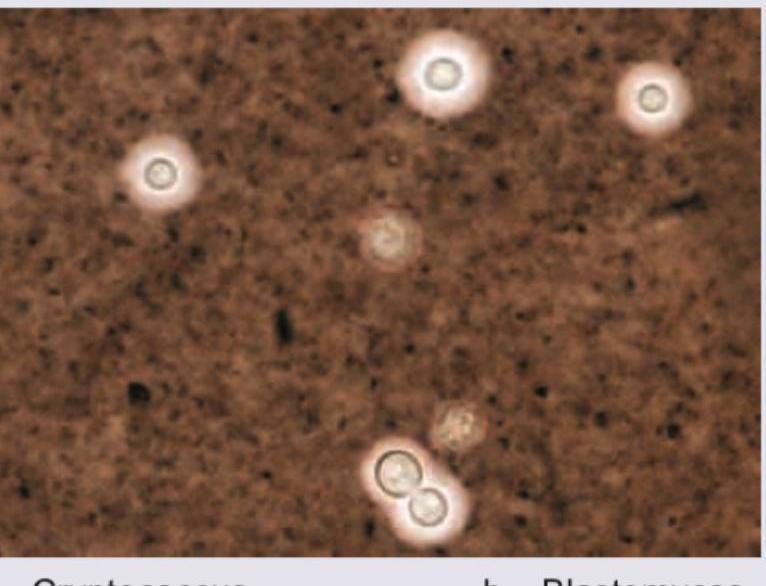
Which of the following is exclusively a yeast?
Which of the following can cause systemic fungal infections?
Orbital mucormycosis is a complication of which of the following conditions?
Which of the following is a dimorphic fungus?
Which type of fungi infect only superficial keratinized tissues?
Explanation: **Explanation:** **Aspergillus fumigatus** is the most common etiological agent of paranasal sinus mycosis (Fungal Rhinosinusitis). This is due to the ubiquitous nature of its spores in the environment and their small size (2–3 µm), which allows them to be easily inhaled and deposited in the paranasal sinuses. It can manifest in several forms, ranging from non-invasive (Fungal Ball or Allergic Fungal Rhinosinusitis) to life-threatening invasive disease, especially in immunocompromised patients. **Analysis of Incorrect Options:** * **Histoplasma:** While *Histoplasma capsulatum* is a systemic dimorphic fungus, it primarily causes pulmonary infections. Sinus involvement is rare and usually occurs only as part of a disseminated infection in severely immunocompromised individuals. * **Conidiobolus coronatus:** This is the agent of **Entomophthoromycosis**. While it causes chronic subcutaneous swelling of the nose and facial soft tissues (rhinofacial zygomycosis), it is much less common than Aspergillosis and typically restricted to tropical climates. * **Candida albicans:** Although a common human commensal, *Candida* is an infrequent cause of primary fungal sinusitis. It is more commonly associated with oral thrush or systemic candidiasis. **High-Yield Clinical Pearls for NEET-PG:** * **Allergic Fungal Rhinosinusitis (AFRS):** The most common form of fungal sinusitis; characterized by "peanut butter" like thick mucus (allergic mucin) containing Charcot-Leyden crystals. * **Morphology:** On microscopy, *Aspergillus* shows **septate hyphae** with **dichotomous branching at acute angles (45°)**. * **Mucormycosis:** A critical differential in diabetics; characterized by broad, **aseptate hyphae** with **right-angle branching (90°)**.
Explanation: **Explanation:** The correct answer is **Aspergillus species**. **1. Why Aspergillus is the primary concern:** The scenario describes a high-risk environment (Bone Marrow Transplant Unit) undergoing **construction and renovation**. *Aspergillus* spores (conidia) are ubiquitous in the environment, particularly in dust, soil, and decomposing organic matter. Construction activities like removing walls and floors aerosolize these spores. Immunocompromised patients, especially those with prolonged neutropenia following a BMT, are at extreme risk of **Invasive Aspergillosis (IA)** via inhalation. IA has a high mortality rate (lethality) in this population, making environmental control (HEPA filters and laminar airflow) mandatory. **2. Why other options are incorrect:** * **Candida species:** While *Candida* is a frequent cause of nosocomial fungal infections, it is typically **endogenous** (part of the patient's own flora) or transmitted via direct contact/catheters. It is not an airborne fungus associated with construction dust. * **Cryptococcus species:** *Cryptococcus neoformans* is typically associated with pigeon droppings and primarily affects HIV/AIDS patients (meningitis). It is not the leading concern during hospital renovations. * **Penicillium species:** While common in the environment, most species are non-pathogenic contaminants. *Talaromyces (Penicillium) marneffei* is a pathogen but is geographically restricted and not specifically linked to construction-related outbreaks in BMTUs. **Clinical Pearls for NEET-PG:** * **High-yield trigger:** Construction/Renovation + Immunocompromised patient = **Aspergillus**. * **Prevention:** HEPA (High-Efficiency Particulate Air) filters are the gold standard for preventing IA in BMTUs. * **Diagnosis:** Look for "Dichotomous branching at 45° angles" and "Septate hyphae" on microscopy. * **Biomarker:** Galactomannan assay (cell wall component).
Explanation: ### Explanation The clinical presentation of a diabetic patient with bloody nasal discharge, orbital swelling, and pain strongly suggests **Rhino-orbital-cerebral fungal infection**. The key to distinguishing the causative agent lies in the microscopic morphology. **1. Why Aspergillus is correct:** The definitive clue is the description of **"branching septate hyphae."** *Aspergillus* species are characterized by narrow, septate hyphae that branch at **acute angles (approximately 45°)**. While *Mucor* and *Rhizopus* are more common causes of rhino-orbital infections in uncontrolled diabetics (especially during ketoacidosis), they possess distinct morphology (non-septate). *Aspergillus* can also cause invasive rhinosinusitis in immunocompromised or diabetic individuals. **2. Why the other options are incorrect:** * **Mucor and Rhizopus (Options A & D):** These belong to the order Mucorales. They are characterized by **broad, ribbon-like, aseptate (non-septate) hyphae** that branch at **right angles (90°)**. Although the clinical scenario (diabetes) highly favors these organisms, the microscopic description of "septate hyphae" rules them out. * **Candida (Option B):** *Candida* typically presents as budding yeast cells and **pseudohyphae** (constrictions at septa). It does not typically cause the acute, invasive rhino-orbital clinical picture described. **Clinical Pearls for NEET-PG:** * **Aspergillus:** Septate hyphae, 45° branching, Fruiting bodies (in aerobic conditions), Conidiophores. * **Mucormycosis:** Aseptate hyphae, 90° branching, associated with **Diabetic Ketoacidosis (DKA)** due to the organism's ketone reductase enzyme. * **Treatment:** Amphotericin B is the drug of choice for invasive Mucormycosis, while Voriconazole is preferred for Invasive Aspergillosis. * **Silver Stain (GMS):** Used to highlight fungal morphology in tissue sections.
Explanation: ### Explanation *Pneumocystis jirovecii* (formerly *P. carinii*) was historically classified as a protozoan due to its morphology (trophozoites and cysts) and lack of response to standard antifungals like Amphotericin B. However, modern molecular techniques have definitively reclassified it as a **fungus**. **1. Why Option A is Correct:** The reclassification is primarily based on **molecular and genetic analysis**: * **rRNA Sequence:** Analysis of the 18S ribosomal RNA shows a closer phylogenetic relationship to fungi (specifically Ascomycetes) than to protozoa. * **Mitochondrial Proteins:** The gene sequences for mitochondrial enzymes are fungal in nature. * **Thymidylate Synthase:** In *Pneumocystis*, thymidylate synthase and dihydrofolate reductase (DHFR) are encoded by **separate genes**, a characteristic of fungi. In protozoa, these are typically found on a single bifunctional protein. **2. Why the Other Options are Incorrect:** * **Option B:** While the cell wall contains glucans (like fungi), it **lacks ergosterol** (the hallmark of most fungi), which is why it was misclassified for decades. * **Option C:** This is factually incorrect. *Pneumocystis* is **resistant** to most common antifungals (like Azoles and Amphotericin B) because it lacks ergosterol. It is treated with Co-trimoxazole (anti-protozoal/antibiotic profile). * **Option D:** This is a clinical epidemiological fact, not a biological basis for taxonomic classification. **High-Yield Clinical Pearls for NEET-PG:** * **Stain of Choice:** Gomori Methenamine Silver (GMS) stain—highlights the "crushed ping-pong ball" appearance of cysts. * **Treatment of Choice:** Trimethoprim-Sulfamethoxazole (TMP-SMX). * **Prophylaxis:** Started in HIV patients when CD4 count falls below **200 cells/mm³**. * **Radiology:** Characterized by bilateral perihilar "ground-glass" opacities.
Explanation: **Explanation:** The clinical presentation of a series of ulcers along the lower extremities, particularly in the sub-Himalayan region, is a classic description of **Sporotrichosis**, caused by the dimorphic fungus ***Sporothrix schenckii***. **Why Sporothrix schenckii is correct:** * **Mechanism:** It is a subcutaneous mycosis typically introduced via traumatic inoculation (e.g., thorn pricks, splinters). * **Clinical Pattern:** It exhibits **"Sporotrichoid spread"** (nodular lymphangitis), where a primary nodule at the site of entry ulcerates, followed by a linear chain of secondary nodules/ulcers along the draining lymphatics. * **Epidemiology:** In India, the **sub-Himalayan tract** (Himachal Pradesh, Assam, West Bengal) is a well-known endemic belt due to the humid climate and vegetation. **Why other options are incorrect:** * **Trichophyton rubrum:** A dermatophyte causing superficial infections (Tinea). It presents as itchy, scaly annular plaques, not deep lymphatic ulcers. * **Pseudallescheria boydii:** A common cause of **Eumycetoma** (Madura foot). This presents as chronic swelling, multiple discharging sinuses, and "grains," rather than a linear series of ulcers. * **Cladosporium species:** Associated with **Chromoblastomycosis**. It typically presents as slow-growing, "cauliflower-like" verrucous lesions, characterized by sclerotic bodies (Medlar bodies) on histology. **High-Yield NEET-PG Pearls:** * **Morphology:** At 25°C (mold), it shows "flower-like" or **rosette-like** conidia. At 37°C (yeast), it shows **cigar-shaped** bodies. * **Histology:** Look for **Asteroid bodies** (Splendore-Hoeppli phenomenon). * **Treatment:** **Itraconazole** is the drug of choice. Historically, Saturated Solution of Potassium Iodide (SSKI) was used.
Explanation: **Explanation:** The classification of fungi based on morphology is a high-yield topic for NEET-PG. Fungi are generally categorized into yeasts, molds, and dimorphic fungi. **Why Cryptococcus is the correct answer:** **Cryptococcus neoformans** is a **true yeast**. It exists exclusively in the yeast form (unicellular) both in the environment and in human tissues at $37^\circ\text{C}$. It reproduces by narrow-based budding and is characterized by a prominent polysaccharide capsule, which is its primary virulence factor. Unlike many other pathogenic fungi, it never forms true hyphae or pseudohyphae in clinical specimens. **Analysis of Incorrect Options:** * **Candida (Option A):** While often referred to as a yeast, *Candida albicans* is technically a **yeast-like fungus**. It is polymorphic, meaning it can form budding yeast cells, **pseudohyphae**, and true hyphae (germ tubes) depending on environmental conditions. * **Mucor and Rhizopus (Options B & C):** These belong to the class Zygomycetes. They are **molds** (filamentous fungi) characterized by broad, aseptate (coenocytic) hyphae that branch at right angles ($90^\circ$). They do not have a yeast phase. **Clinical Pearls for NEET-PG:** * **Cryptococcus:** Best visualized using **India Ink** (negative staining) to show the halo of the capsule. The most sensitive screening test is the **Cryptococcal Antigen (CrAg)** lateral flow assay. * **Culture:** Cryptococcus grows on Sabouraud Dextrose Agar (SDA) as creamy, mucoid colonies. It is **urease positive**. * **Bird Droppings:** Classically associated with pigeon droppings; infection is acquired via inhalation. * **Drug of Choice:** Induction therapy for Cryptococcal meningitis is **Amphotericin B + Flucytosine**, followed by Fluconazole.
Explanation: ### Explanation The correct answer is **D. Naegleria fowleri**. **Why it is the correct answer:** The question asks which of the following can cause **systemic** infections. While the other options are fungi, **Naegleria fowleri** is actually a **free-living amoeba (protozoa)**, not a fungus. However, in the context of this specific question (often found in older medical entrance papers), it is categorized as a systemic pathogen because it causes **Primary Amoebic Meningoencephalitis (PAM)**, a rapidly fatal infection of the central nervous system. *Note: In a strictly taxonomic sense, Naegleria is a parasite. If the question implies "Which of these is NOT a fungus but causes systemic disease," or if it is a "Select the odd one out" type, Naegleria stands out. If the question asks for systemic fungal infections, A, B, and C are all correct. However, based on the provided key, the focus is on identifying the non-fungal systemic pathogen.* **Analysis of Incorrect Options:** * **A. Cryptococcus neoformans:** An opportunistic yeast that causes systemic infection (Cryptococcosis), primarily meningitis in immunocompromised patients. * **B. Histoplasma capsulatum:** A dimorphic fungus causing systemic mycosis (Histoplasmosis), often involving the lungs and reticuloendothelial system. * **C. Paracoccidioides brasiliensis:** A dimorphic fungus causing South American Blastomycosis, a systemic infection characterized by pulmonary lesions and mucosal ulcerations. **High-Yield NEET-PG Pearls:** * **Naegleria fowleri:** Known as the "brain-eating amoeba." It enters via the **cribriform plate** after exposure to warm fresh water. * **Dimorphic Fungi:** Remember the mnemonic "Body Heat Is Probably Mutating" (**B**lastomyces, **H**istoplasma, **I**mmitis/Coccidioides, **P**aracoccidioides, **M**arnerffei/Talaromyces). * **Cryptococcus:** Identified by **India Ink** preparation (capsule visualization) and **Latex Agglutination** for polysaccharide antigen.
Explanation: **Explanation:** **1. Why Diabetic Ketoacidosis (DKA) is the correct answer:** Mucormycosis (caused by fungi like *Rhizopus*, *Mucor*, and *Lichtheimia*) is an opportunistic, angioinvasive infection. DKA is the most significant risk factor for **Rhinocerebral Mucormycosis**. The underlying mechanism involves: * **Acidosis:** The fungus produces the enzyme **ketone reductase**, which allows it to thrive in acidic, glucose-rich environments. * **Iron Availability:** Acidosis causes dissociation of iron from sequestering proteins (like transferrin). Free iron acts as a potent growth factor for these fungi, enhancing their virulence and ability to invade blood vessels. **2. Why the other options are incorrect:** * **A. AIDS:** While AIDS patients are prone to fungal infections like *Cryptococcus* or *Pneumocystis*, Mucormycosis is less common unless there is concurrent neutropenia or IV drug use. * **B. Steroid therapy:** Prolonged steroid use is a risk factor for many fungal infections (including Mucormycosis), but **DKA** is the classic, most high-yield association specifically linked to the orbital/rhinocerebral presentation in exam vignettes. * **C. Cushing’s disease:** While it causes endogenous hypercortisolism, it is not as acutely associated with the metabolic derangements (acidosis/ketosis) required for rapid Mucor proliferation compared to DKA. **3. High-Yield Clinical Pearls for NEET-PG:** * **Hallmark Pathology:** Broad, **non-septate** hyphae with **right-angled (90°)** branching. * **Clinical Sign:** Presence of a **black necrotic eschar** on the nasal turbinates or palate due to tissue infarction (angioinvasion). * **Diagnosis:** KOH mount of tissue biopsy is the rapid diagnostic method of choice. * **Treatment:** Surgical debridement + **Liposomal Amphotericin B** (Drug of choice). Posaconazole/Isavuconazole are used as salvage therapy.
Explanation: **Explanation:** **1. Why Histoplasma is correct:** Dimorphic fungi are characterized by their ability to exist in two distinct morphological forms depending on environmental conditions (primarily temperature). They exist as **molds (hyphae)** in the environment/soil at 25°C and as **yeasts** within the human body at 37°C. *Histoplasma capsulatum* is a classic example of a systemic dimorphic fungus. It is typically associated with bird or bat droppings and causes Histoplasmosis, which often mimics tuberculosis clinically. **2. Why the other options are incorrect:** * **Candida:** While often called "dimorphic" in older texts, it is more accurately described as **polymorphic**. It exists primarily as yeast and pseudohyphae, but uniquely forms true hyphae (germ tubes) at 37°C (the opposite of true dimorphism). * **Rhizopus and Mucor:** These belong to the class Zygomycetes. They are **monomorphic molds** characterized by broad, aseptate (non-septate) hyphae with right-angle branching. They do not have a yeast phase. **3. NEET-PG High-Yield Pearls:** * **Mnemonic for Dimorphic Fungi:** "**B**ody **H**eats **P**robably **C**ause **S**hapes" (**B**lastomyces, **H**istoplasma, **P**aracoccidioides, **C**occidioides, **S**porothrix). Note: *Talaromyces (Penicillium) marneffei* is also dimorphic. * **Coccidioides Exception:** It is dimorphic but forms **spherules** (not yeasts) in the tissue at 37°C. * **Histoplasma Morphology:** Inside the body, it appears as small intracellular yeasts within macrophages (best seen on Giemsa or PAS stain). * **Culture:** Dimorphic fungi are slow growers; *Histoplasma* can take 2–6 weeks to grow on Sabouraud Dextrose Agar (SDA).
Explanation: **Explanation:** **Dermatophytes** are the correct answer because they are uniquely **keratinophilic**. They possess the enzyme **keratinase**, which allows them to metabolize and survive on keratinized tissues such as the stratum corneum of the skin, hair, and nails. Crucially, they do not invade deeper tissues because they are inhibited by serum factors (like transferrin) and cannot grow at body temperature (37°C). **Analysis of Incorrect Options:** * **Dimorphic fungi:** These exist as molds in the environment and yeasts in the body. They cause **systemic mycoses** (e.g., Histoplasmosis) involving deep organs like the lungs. * **Mucormycosis:** Caused by opportunistic molds (e.g., *Rhizopus*), these are highly invasive and **angioinvasive**, leading to deep tissue necrosis, especially in immunocompromised or diabetic patients. * **Candida:** While it can cause superficial infections (thrush, intertrigo), it is not restricted to keratinized tissue. It is a yeast that can cause **deep-seated candidiasis** and fungemia. **High-Yield NEET-PG Pearls:** * **The Three Genera:** Dermatophytes include *Trichophyton* (infects skin, hair, nails), *Microsporum* (skin, hair), and *Epidermophyton* (skin, nails). * **Diagnosis:** The gold standard screening is **KOH mount**, which shows branching septate hyphae. * **Culture:** They are typically grown on **Sabouraud Dextrose Agar (SDA)**; *Trichophyton rubrum* is the most common cause of dermatophytosis worldwide. * **Wood’s Lamp:** *Microsporum* species often show a characteristic bright green fluorescence.
Classification of Fungi
Practice Questions
Superficial Mycoses
Practice Questions
Dermatophytes
Practice Questions
Subcutaneous Mycoses
Practice Questions
Candidiasis
Practice Questions
Aspergillosis
Practice Questions
Cryptococcosis
Practice Questions
Zygomycosis
Practice Questions
Endemic Mycoses
Practice Questions
Opportunistic Fungal Infections
Practice Questions
Antifungal Agents
Practice Questions
Laboratory Diagnosis of Fungal Infections
Practice Questions
Get full access to all questions, explanations, and performance tracking.
Start For Free