Which of the following fungi infects hair, skin, and nails?
What does a sporangium contain?
Which of the following is NOT true about Histoplasma capsulatum?
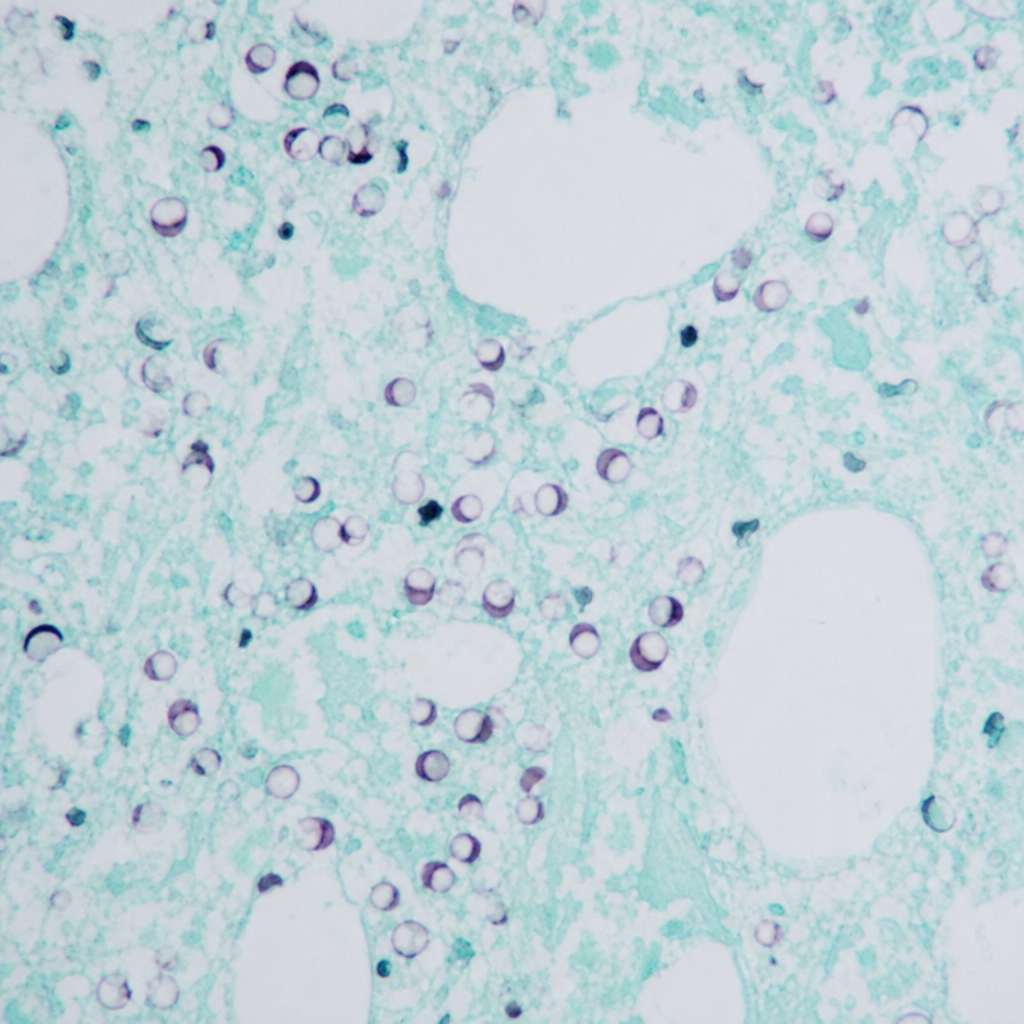
Which of the following microorganisms presents as capsulated yeast?
A woman who pricked her finger while pruning rose bushes develops a local pustule that progressed to an ulcer. Several nodules then developed along the local lymphatic drainage. What is the most likely etiological agent?
Microscopic examination of a specimen shows dimorphic fungi. All of the following are examples of dimorphic fungi, EXCEPT?
Reynolds Braude phenomenon is seen in which of the following?
Which of the following is NOT a dimorphic fungi?
Which of the following is NOT true of Candida albicans?
All of the following are associated with zygomycosis except?
Explanation: **Explanation:** The question pertains to **Dermatophytosis**, a group of superficial fungal infections caused by dermatophytes. These fungi are unique because they possess **keratinase**, an enzyme that allows them to metabolize keratin as a nutrient source. The three primary genera of dermatophytes are distinguished by the tissues they infect: 1. **Trichophyton (Correct Answer):** This genus is the most versatile. It is the only one among the three that infects all three keratinized tissues: **Hair, Skin, and Nails**. A common example is *Trichophyton rubrum*, the most frequent cause of athlete's foot and nail infections worldwide. 2. **Microsporum (Option C):** This genus typically infects **Hair and Skin** but rarely involves the nails. 3. **Epidermophyton (Option D):** This genus infects **Skin and Nails** but does **not** infect hair. *Epidermophyton floccosum* is the clinically relevant species here. 4. **Trichosporon (Option A):** This is not a dermatophyte. It is a yeast-like fungus responsible for **White Piedra** (a superficial infection of the hair shaft) and can cause systemic opportunistic infections in immunocompromised patients. **High-Yield NEET-PG Pearls:** * **Macroconidia Characteristics:** * *Microsporum:* Spindle-shaped, thick-walled with pitted surfaces. * *Trichophyton:* Pencil-shaped, thin-walled, and smooth. * *Epidermophyton:* Club-shaped (pyriform), smooth-walled, arranged in clusters (birds on a wire). * **Wood’s Lamp:** Useful for diagnosing *Microsporum* (fluoresces bright green), whereas most *Trichophyton* species (except *T. schoenleinii*) do not fluoresce. * **Tinea Unguium:** Refers specifically to dermatophyte infection of the nails; *Trichophyton rubrum* is the leading cause.
Explanation: ### Explanation **1. Why the Correct Answer is Right:** In medical mycology, fungi are classified based on their morphology and mode of reproduction. A **sporangium** is a specialized sac-like structure found in the **Zygomycetes** (e.g., *Rhizopus*, *Mucor*). It is produced at the tip of a hypha called a sporangiophore. Inside this sac, asexual spores are produced via cleavage of the cytoplasm; these internal spores are called **sporangiospores**. When the sporangium matures and ruptures, these spores are released into the environment. **2. Why the Incorrect Options are Wrong:** * **Spherules (A):** These are large, thick-walled structures found in the tissue phase of *Coccidioides immitis*. Spherules contain **endospores**, not sporangiospores. * **Chlamydospores (C):** These are thick-walled, resting survival spores formed by the rounding up of hyphal segments. They are characteristic of *Candida albicans* (specifically terminal chlamydospores on Cornmeal agar). * **Conidia (D):** These are asexual spores that are **borne naked** (not enclosed in a sac) on specialized structures called conidiophores. They are typical of *Aspergillus* and *Penicillium*. **3. NEET-PG Clinical Pearls:** * **Aseptate Hyphae:** Zygomycetes (which produce sporangiospores) are characterized by broad, ribbon-like, non-septate hyphae with wide-angled branching. * **Mucormycosis:** Clinically associated with uncontrolled Diabetes Mellitus (Ketoacidosis) and neutropenia. It is notorious for angioinvasion leading to black eschars (Rhinocerebral mucormycosis). * **High-Yield Distinction:** Remember: **Sporangiospores = Enclosed** (in a sac); **Conidia = Naked** (exposed).
Explanation: The correct answer is **C (It is capsulated)**. ### **Explanation** Despite its name, *Histoplasma capsulatum* is **not a capsulated fungus**. The name is a historical misnomer; when first discovered, the clear halo seen around the yeast cells in tissue sections was mistaken for a capsule. In reality, this halo is an artifact caused by the shrinkage of the cytoplasm away from the cell wall during fixation. The only clinically significant fungus that is truly capsulated is *Cryptococcus neoformans*. ### **Analysis of Other Options** * **A. It is a dimorphic fungus:** This is true. It exists as a **mold** in the environment (soil enriched with bird/bat droppings) and as an **intracellular yeast** at body temperature (37°C). * **B. It may mimic Tuberculosis:** This is true. Chronic pulmonary histoplasmosis presents with cough, fever, night sweats, and cavitary lesions in the upper lobes of the lungs, making it clinically and radiologically indistinguishable from TB. * **C. It is mostly asymptomatic:** This is true. In endemic areas, the majority of infections in immunocompetent individuals are subclinical or present as a self-limiting flu-like illness. ### **High-Yield Clinical Pearls for NEET-PG** * **Habitat:** Soil enriched with **bird (starling) or bat droppings** (caves/chicken coops). * **Microscopy:** Look for **tuberculate macroconidia** (thick-walled with finger-like projections) in the mold form. * **Intracellular nature:** It is an obligate intracellular parasite of **macrophages**. * **Diagnosis:** Skin test (Histoplasmin) is used for epidemiological studies; Antigen detection (Urinary/Serum) is best for disseminated cases. * **Treatment:** Itraconazole for mild cases; Amphotericin B for severe/disseminated disease.
Explanation: ### Explanation **Correct Answer: C. Cryptococcus** The defining characteristic of *Cryptococcus neoformans* is its **prominent polysaccharide capsule** (composed of glucuronoxylomannan). In medical mycology, it is the only medically important fungus that exists as a **capsulated yeast** both in the environment and in host tissues. This capsule is a major virulence factor as it inhibits phagocytosis. On microscopy, it appears as a round-to-oval budding yeast; the capsule is best visualized using **India Ink** (negative staining), where it appears as a clear halo against a dark background. **Analysis of Incorrect Options:** * **A. Histoplasma:** This is a **dimorphic fungus**. In tissue, it presents as small, intracellular yeast cells (found within macrophages). While it may appear to have a "halo" due to shrinkage during staining, it lacks a true capsule (hence the name *Histoplasma capsulatum* is a misnomer). * **B. Candida:** This is a **yeast-like fungus** that produces pseudohyphae and blastoconidia. It is non-capsulated. The most common species, *C. albicans*, is identified by the Germ Tube test. * **C. Sporothrix:** Another **dimorphic fungus** (causing "Rose gardener’s disease"). In tissue, it appears as cigar-shaped yeast cells, not capsulated forms. **NEET-PG High-Yield Pearls:** * **Stains for Capsule:** India Ink (screening), Nigrosin, and **Mucicarmine** (specific stain that colors the capsule red). * **Antigen Detection:** Latex Agglutination test for cryptococcal polysaccharide antigen (CrAg) is more sensitive than India Ink for CSF diagnosis. * **Culture:** Grows on Sabouraud Dextrose Agar (SDA) as creamy white mucoid colonies. It is **Urease positive**. * **Clinical Association:** Most common cause of fungal meningitis in HIV/AIDS patients (CD4 count <100 cells/µL).
Explanation: ### Explanation **Correct Option: D. Sporothrix schenkii** The clinical presentation described is a classic case of **Sporotrichosis**, often referred to as **"Rose Gardener’s Disease."** * **Mechanism:** *Sporothrix schenkii* is a **dimorphic fungus** found in soil, moss, and decaying vegetation (like rose bushes). Infection occurs via **traumatic inoculation** (e.g., a thorn prick). * **Clinical Progression:** It typically begins as a painless papule or pustule at the site of injury, which eventually ulcerates. The hallmark of this infection is **lymphocutaneous spread**, where secondary nodules develop sequentially along the lines of lymphatic drainage (sporotrichoid spread). **Why other options are incorrect:** * **A. Aspergillus fumigatus:** Primarily causes respiratory infections (Allergic Bronchopulmonary Aspergillosis or Aspergilloma) in immunocompromised hosts; it does not typically present with lymphocutaneous nodules. * **B. Candida albicans:** Usually causes opportunistic infections like oral thrush, vaginal candidiasis, or intertrigo. It does not follow a lymphatic distribution after skin trauma. * **C. Histoplasma capsulatum:** A systemic dimorphic fungus primarily acquired through inhalation of bird/bat droppings. It causes pulmonary disease and does not typically present with localized lymphatic nodules following a skin prick. **High-Yield NEET-PG Pearls:** 1. **Morphology:** It is a **dimorphic fungus**. At 25°C (mold), it shows "daisy-wheel" or **flower-like sporulation**. At 37°C (yeast), it appears as **cigar-shaped bodies**. 2. **Histopathology:** May show **Asteroid bodies** (Splendore-Hoeppli phenomenon). 3. **Treatment:** The drug of choice is **Itraconazole**. Historically, saturated solution of potassium iodide (SSKI) was used. 4. **Differential Diagnosis:** Other causes of "sporotrichoid spread" include *Mycobacterium marinum*, *Nocardia*, and *Leishmania brasiliensis*.
Explanation: **Explanation:** The core concept tested here is the classification of fungi based on morphology. **Dimorphic fungi** are those that exist in two distinct forms: as **molds** (hyphae) in the environment/cold (25°C) and as **yeasts** in host tissues/heat (37°C). **Why Candida is the correct answer:** * **Candida albicans** is technically classified as a **yeast-like fungus**, not a true dimorphic fungus. * Unlike true dimorphs (which switch between mold and yeast), *Candida* exists primarily as a yeast but can form **pseudohyphae** and **true hyphae** (germ tubes) at body temperature. This is often referred to as "phenotypic switching" or "polymorphism," but in the context of standard medical microbiology exams, it is excluded from the list of classic systemic dimorphic fungi. **Analysis of Incorrect Options:** * **A, B, and D (Coccidioides, Blastomyces, Histoplasma):** These are classic **Systemic Dimorphic Fungi**. They follow the rule: *"Mold in the Cold, Yeast in the Beast."* * *Histoplasma:* Intracellular yeasts in macrophages. * *Blastomyces:* Large, thick-walled yeasts with broad-based budding. * *Coccidioides:* Unique because it forms **spherules** containing endospores in tissue (rather than simple yeast cells). **NEET-PG High-Yield Pearls:** * **Mnemonic for Dimorphic Fungi:** "**B**ody **C**avities **H**ave **S**pore **P**roliferation" (**B**lastomyces, **C**occidioides, **H**istoplasma, **S**porothrix, **P**aracoccidioides). * **Penicillium marneffei** (Talaromyces) is the only dimorphic fungus that divides by fission. * **Candida** is unique because it forms germ tubes (true hyphae) when incubated in serum at 37°C (Reynolds-Braude phenomenon).
Explanation: **Explanation:** The **Reynolds-Braude phenomenon**, more commonly known as the **Germ Tube Test**, is the gold standard rapid diagnostic test for the identification of ***Candida albicans***. 1. **Why it is correct:** When *Candida albicans* is incubated in human or rabbit serum at 37°C for 2–3 hours, it produces short, lateral hyphal extensions called **germ tubes**. These are characterized by the absence of constriction at their point of origin from the parent yeast cell. This morphological transition from yeast to hyphal form is a key virulence factor and a definitive diagnostic marker for *C. albicans* and *C. dubliniensis*. 2. **Analysis of Incorrect Options:** * **Candida psittaci:** This is not a recognized human fungal pathogen (Psittacosis is caused by the bacterium *Chlamydia psittaci*). Other non-albicans *Candida* species (except *C. dubliniensis*) are germ tube negative. * **Histoplasma:** This is a dimorphic fungus that exists as mold in nature and yeast in host tissue. It is identified by the presence of tuberculate macroconidia in culture, not germ tubes. * **Cryptococcus:** This is an encapsulated yeast. It is identified by **India Ink** preparation (showing a halo), Urease positivity, and Mucicarmine staining. It does not form germ tubes. **High-Yield Clinical Pearls for NEET-PG:** * **Chlamydospore formation:** *C. albicans* also produces thick-walled chlamydospores on **Cornmeal Agar**. * **Culture:** Grows as creamy white colonies on Sabouraud Dextrose Agar (SDA). * **Differentiation:** *C. dubliniensis* is also germ tube positive but can be differentiated by its inability to grow at 45°C. * **Pseudohyphae:** In tissue or smears, *Candida* typically shows budding yeast cells and pseudohyphae (which, unlike true germ tubes, *do* have constrictions).
Explanation: **Explanation:** The core concept tested here is the classification of fungi based on morphology. **Dimorphic fungi** are those that exist in two forms: a **Yeast** form (at 37°C in the body) and a **Mold** form (at 25°C in the environment/culture). **Why Pneumocystis jirovecii is the correct answer:** * **Pneumocystis jirovecii** is an atypical fungus that lacks ergosterol in its cell membrane and cannot be grown in standard fungal culture media. * It is **not dimorphic**; it exists in specific life-cycle stages (trophozoite, precyst, and cyst) within the host lungs. It is primarily an opportunistic pathogen causing pneumonia (PCP) in immunocompromised individuals (e.g., HIV/AIDS). **Analysis of Incorrect Options (Dimorphic Fungi):** * **Histoplasma capsulatum:** A classic systemic dimorphic fungus. It is found in soil enriched with bird or bat droppings. In the body, it is seen as small intracellular yeasts within macrophages. * **Sporothrix schenckii:** The causative agent of "Rose gardener’s disease." It is a **subcutaneous** dimorphic fungus. It shows a characteristic "cigar-shaped" yeast form in tissue. * **Blastomyces dermatitidis:** A systemic dimorphic fungus. It is characterized by "Broad-Based Budding" yeasts in clinical samples. **NEET-PG High-Yield Pearls:** * **Mnemonic for Dimorphic Fungi:** "**B**ody **H**as **C**apsule **S**haped **P**aracoccidioides" (**B**lastomyces, **H**istoplasma, **C**occidioides, **S**porothrix, **P**aracoccidioides). Note: *Talaromyces (Penicillium) marneffei* is also dimorphic. * **Pneumocystis jirovecii** is best visualized using **Gomori Methenamine Silver (GMS)** stain, appearing as crushed ping-pong ball-shaped cysts. * **Drug of choice for PCP:** Trimethoprim-Sulfamethoxazole (TMP-SMX), not standard antifungals.
Explanation: This question tests your ability to distinguish between the universal characteristics of the genus *Candida* and the specific diagnostic features of *Candida albicans*. ### **Explanation of the Correct Answer** The statement **"Blastoconidia are seen in isolates"** is technically **not a distinguishing feature** for *Candida albicans* because blastoconidia (budding yeast cells) are seen in **all** *Candida* species and many other yeasts. In the context of NEET-PG questions, when a specific diagnostic feature is sought, we look for unique identifiers. While *C. albicans* does produce blastoconidia, the more accurate diagnostic markers are **Germ tubes** (Reynolds-Braude phenomenon) and **Chlamydospores**. *Note: In some exam patterns, this option is considered "not true" because it is a general fungal trait rather than a specific isolate identifier for C. albicans specifically.* ### **Analysis of Other Options** * **A. Yeast-like fungus:** This is **true**. *Candida* is termed "yeast-like" because it exists primarily as unicellular budding cells but can also form pseudohyphae and true hyphae (polymorphism). * **B. Forms chlamydospores:** This is **true**. On specific media like **Cornmeal Agar**, *C. albicans* produces thick-walled, resting spores called chlamydospores. This is a key laboratory identification test. * **D. Causes meningitis:** This is **true**. While *Cryptococcus* is the most common fungal cause of meningitis, *Candida* species can cause CNS infections, especially in neonates, post-neurosurgery patients, or severely immunocompromised individuals. ### **High-Yield Clinical Pearls for NEET-PG** * **Germ Tube Test:** The most rapid identification test for *C. albicans* (positive within 2-3 hours in serum). * **Culture:** Grows on Sabouraud Dextrose Agar (SDA) as creamy white, smooth colonies with a characteristic "yeasty" odor. * **ChromAgar:** *C. albicans* produces **light green** colonies. * **Morphology:** It is unique because it can form **True Hyphae** (at 37°C) and **Pseudohyphae** (at 25°C).
Explanation: **Explanation:** Zygomycosis (now more commonly referred to as **Mucormycosis**) is a life-threatening opportunistic infection caused by fungi belonging to the order **Mucorales** (Class: Zygomycetes). **1. Why Candida is the correct answer:** **Candida** is a yeast-like fungus belonging to the Phylum Ascomycota. It causes Candidiasis, not zygomycosis. Unlike the Mucorales group, Candida typically presents as budding yeast cells and pseudohyphae on microscopy. **2. Why the other options are incorrect:** * **Rhizopus:** The most common genus causing human mucormycosis (especially the rhino-cerebral form in diabetics). It is characterized by the presence of rhizoids (root-like structures) located directly opposite the sporangiophores. * **Mucor:** A classic genus of the Mucorales order. Unlike Rhizopus, it lacks rhizoids. * **Lichtheimia (formerly Absidia):** Another significant cause of zygomycosis. It is distinguished by having rhizoids located between the sporangiophores (internodal). **Clinical Pearls for NEET-PG:** * **Microscopy:** Zygomycetes are characterized by **broad, ribbon-like, aseptate (or sparsely septate) hyphae** with **wide-angled (90°) branching**. (Contrast this with *Aspergillus*, which has narrow, septate hyphae with acute-angled branching). * **Risk Factors:** Uncontrolled Diabetes Mellitus (Diabetic Ketoacidosis), neutropenia, and iron overload (deferoxamine therapy). * **Clinical Hallmark:** Tissue infarction and necrosis due to **angioinvasion**. * **Treatment:** Surgical debridement and **Liposomal Amphotericin B** are the treatments of choice. Posaconazole or Isavuconazole are used as step-down or salvage therapy.
Classification of Fungi
Practice Questions
Superficial Mycoses
Practice Questions
Dermatophytes
Practice Questions
Subcutaneous Mycoses
Practice Questions
Candidiasis
Practice Questions
Aspergillosis
Practice Questions
Cryptococcosis
Practice Questions
Zygomycosis
Practice Questions
Endemic Mycoses
Practice Questions
Opportunistic Fungal Infections
Practice Questions
Antifungal Agents
Practice Questions
Laboratory Diagnosis of Fungal Infections
Practice Questions
Get full access to all questions, explanations, and performance tracking.
Start For Free