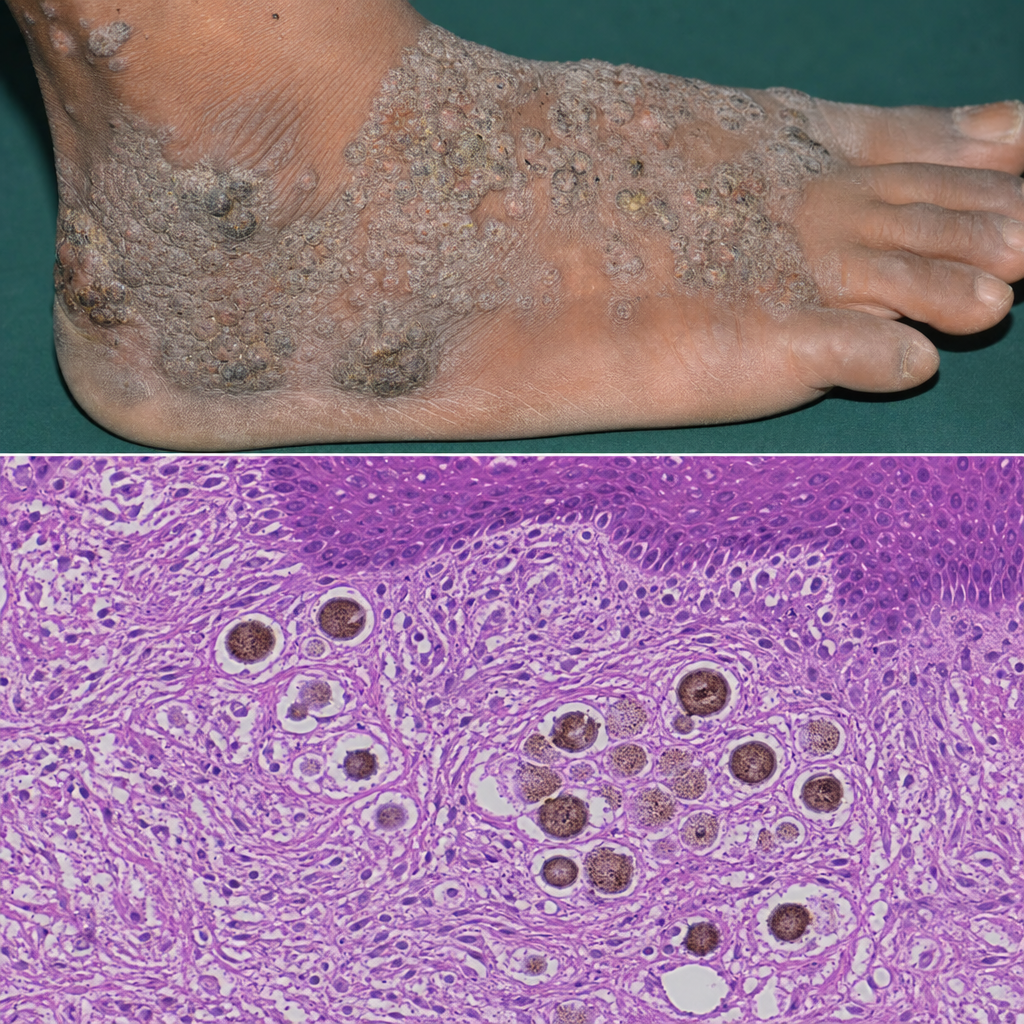
Which of the following is an ovoid, budding yeast which is 3-5 microns in diameter and contains elongated filamentous cells joined end to end?
Soap bubble appearance is seen in which meningoencephalitis?
An HIV-positive female presents with an indurated ulcer on her tongue. Laboratory findings reveal growth in cornmeal agar at 20 degrees Celsius, microscopy showing hyphae, and growth of budding yeasts in human serum at 37 degrees Celsius. What is the probable causative organism?
Which of the following statements is FALSE regarding dimorphic fungi?
Malassezia furfur causes which type of mycosis?
Cryptococcus is least likely to cause infection of which organ?
Which of the following organisms can be detected by an agglutination test in a CSF sample?
Which fungus is considered neurotropic?
Which of the following stains is used to study fungal morphology in tissue sections?
What is the most sensitive and rapid test for the diagnosis of cryptococcal meningitis?
Explanation: **Explanation:** The description provided in the question—**ovoid, budding yeast (3-5 µm)** and **elongated filamentous cells joined end to end**—is a classic morphological description of ***Candida albicans***. 1. **Why Candida albicans is correct:** * *Candida* is a dimorphic fungus that primarily exists as an ovoid budding yeast. * The "elongated filamentous cells joined end to end" refers to **pseudohyphae**. These are formed when buds fail to detach after septation, creating a chain-like appearance with constricted points at the septa (unlike true hyphae). * *C. albicans* is also unique for producing **germ tubes** (true hyphae) when incubated in serum at 37°C and **chlamydospores** on cornmeal agar. 2. **Why other options are incorrect:** * **Aspergillus:** This is a filamentous mold characterized by **septate hyphae** that show **dichotomous branching** at acute angles (45°). It does not form yeast cells or pseudohyphae. * **Rhizopus:** This belongs to the Mucormycetes group. It features broad, **non-septate (coenocytic) hyphae** that branch at right angles (90°). * **Sporothrix:** While it is a dimorphic fungus, its yeast form is typically described as **"cigar-shaped"** rather than ovoid, and its mold form consists of thin hyphae with "rosette-like" conidia. **High-Yield Clinical Pearls for NEET-PG:** * **Gram Stain:** *Candida* is Gram-positive and much larger than bacteria. * **Culture:** Grows on Sabouraud Dextrose Agar (SDA) as creamy white, smooth colonies with a "yeasty" odor. * **Germ Tube Test (Reynolds-Braude Phenomenon):** The gold standard rapid diagnostic test for *C. albicans*. * **Key Differentiation:** True hyphae (parallel walls, no constriction) vs. Pseudohyphae (constricted at septa).
Explanation: **Explanation:** **Cryptococcus neoformans** is the correct answer. The "soap bubble appearance" is a classic radiological and pathological hallmark of Cryptococcal meningoencephalitis. This occurs when the fungus spreads from the subarachnoid space into the brain parenchyma via the Virchow-Robin (perivascular) spaces. The thick, gelatinous polysaccharide capsules of the organisms prevent a strong inflammatory response, leading to the formation of cystic clusters that resemble soap bubbles on MRI (T2-weighted images) or gross pathology. **Analysis of Incorrect Options:** * **Mucormycosis:** Typically presents with angioinvasion leading to hemorrhagic infarction and necrosis (rhinocerebral involvement), rather than cystic "soap bubble" lesions. * **Tubercular Meningitis:** Characteristically shows thick basal exudates, hydrocephalus, and tuberculomas (ring-enhancing lesions), but not the soap bubble pattern. * **HSV Encephalitis:** Classically involves the temporal lobes, presenting with edema, hemorrhage, and necrosis on imaging. **High-Yield Clinical Pearls for NEET-PG:** * **Stains:** India Ink (negative staining for capsule), Mucicarmine (stains capsule red), and PAS/GMS. * **Antigen Detection:** Lateral Flow Assay (LFA) or CrAg (Cryptococcal Antigen) in CSF/Serum is the most sensitive rapid test. * **Source:** Associated with pigeon droppings; infection is acquired via inhalation. * **Patient Profile:** Most common fungal meningitis in HIV/AIDS patients (CD4 <100 cells/µL). * **Treatment:** Induction with Amphotericin B + Flucytosine, followed by Fluconazole.
Explanation: ### Explanation The clinical presentation and laboratory findings are classic for **Candida albicans**, a common opportunistic fungal pathogen in immunocompromised patients (e.g., HIV-positive). **Why Candida albicans is correct:** The diagnosis is confirmed by two specific diagnostic tests mentioned in the question: 1. **Germ Tube Test:** The "growth of budding yeasts in human serum at 37°C" refers to the formation of germ tubes (projections from the yeast cell without constriction). This is a rapid diagnostic test for *C. albicans*. 2. **Cornmeal Agar (Dalmau Method):** At 20-25°C on cornmeal agar, *C. albicans* produces characteristic **chlamydospores** (thick-walled resting spores), pseudohyphae, and true hyphae. 3. **Clinical Context:** Oral candidiasis (thrush) or ulcers are frequent in HIV patients when CD4 counts drop. **Why the other options are incorrect:** * **Histoplasmosis:** While it can cause oral ulcers in HIV patients, it is a dimorphic fungus that appears as small intracellular yeasts within macrophages, not as hyphae/germ tubes in serum. * **Blastomycosis:** Characterized by large, "broad-based budding" yeasts. It typically presents with pulmonary or skin lesions rather than isolated tongue ulcers in this laboratory context. * **Coccidioidomycosis:** Identified by the presence of large **spherules** filled with endospores in tissue samples, not by germ tube formation or chlamydospores. **High-Yield NEET-PG Pearls:** * **Germ Tube Test (Reynolds-Braude Phenomenon):** Positive for *C. albicans* and *C. dubliniensis*. * **Culture:** Grows on Sabouraud Dextrose Agar (SDA) as creamy white, smooth colonies with a "yeasty" odor. * **Morphology on Cornmeal Agar:** *C. albicans* produces terminal, thick-walled chlamydospores. * **HIV Correlation:** Oral candidiasis is an AIDS-defining illness when it involves the esophagus.
Explanation: ### Explanation **Why Option C is the Correct Answer (The False Statement):** *Cryptococcus neoformans* is a **monomorphic yeast**, not a dimorphic fungus. It exists exclusively in the yeast form (encapsulated budding yeast) both in the environment (soil/pigeon droppings) and within human tissues at 37°C. Dimorphism refers to the ability of a fungus to exist in two distinct forms: a **mold** (at 25°C/ambient temperature) and a **yeast** (at 37°C/body temperature). **Analysis of Other Options:** * **Option A (True):** Dimorphic fungi are characterized by their "thermal dimorphism"—growing as multicellular hyphae (molds) in nature and as unicellular yeasts in the host. * **Option B (True):** Most dimorphic fungi (e.g., *Histoplasma*, *Blastomyces*) are primary pathogens that cause systemic infections, often starting as pulmonary infections after spore inhalation. * **Option C (True):** *Coccidioides immitis* is a classic dimorphic fungus. Note its unique morphology: it forms **spherules** containing endospores in the tissue, rather than typical budding yeasts. **High-Yield Clinical Pearls for NEET-PG:** * **Mnemonic for Dimorphic Fungi:** "**B**ody **H**eat **P**robably **C**hanges **S**hape" (**B**lastomyces, **H**istoplasma, **P**aracoccidioides, **C**occidioides, **S**porothrix, and *Talaromyces marneffei*). * **Exception:** *Candida albicans* is "reverse dimorphic"—it forms pseudohyphae/germ tubes at 37°C and yeast at lower temperatures. * **Cryptococcus Key Feature:** It is the only medically important fungus with a **polysaccharide capsule**, best visualized using **India Ink** (negative staining) or Mucicarmine stain.
Explanation: **Explanation:** **1. Why Option B is Correct:** *Malassezia furfur* is a lipophilic yeast that belongs to the category of **Superficial Mycoses**. These infections are limited to the outermost layers of the skin (stratum corneum) and hair, without penetrating the deeper tissues or eliciting a significant inflammatory response from the host. *M. furfur* is the causative agent of **Pityriasis (Tinea) versicolor**, characterized by hypo- or hyperpigmented macules. **2. Why Other Options are Incorrect:** * **Option A (Subcutaneous mycoses):** These involve the dermis, subcutaneous tissues, and muscle (e.g., Mycetoma, Sporotrichosis). They usually follow traumatic inoculation, unlike the surface colonization seen in *Malassezia*. * **Option C (Opportunistic mycoses):** While *Malassezia* can occasionally cause systemic infections (fungemia) in neonates receiving parenteral lipid infusions, its primary classification and most common clinical presentation is as a superficial mycosis. Standard opportunistic pathogens include *Candida*, *Aspergillus*, and *Cryptococcus*. **3. NEET-PG High-Yield Clinical Pearls:** * **Microscopy:** Classic **"Spaghetti and Meatball"** appearance (short, curved hyphae and thick-walled yeast cells) on KOH mount. * **Culture:** Requires enrichment with lipids (e.g., **Olive oil overlay**) on Sabouraud Dextrose Agar (SDA) because it is lipophilic. * **Wood’s Lamp:** Lesions show a characteristic **yellowish-golden fluorescence**. * **Clinical Presentation:** It causes Pityriasis versicolor and is also associated with Seborrheic dermatitis and Dandruff.
Explanation: **Explanation:** *Cryptococcus neoformans* is an encapsulated opportunistic fungus primarily acquired through the inhalation of basidiospores from the environment (often associated with pigeon droppings). **Why Kidney is the Correct Answer:** While *Cryptococcus* can disseminate hematogenously to almost any organ in immunocompromised patients (especially those with HIV/AIDS), the **kidney** is the least common site among the options provided. While renal involvement can occur as part of multi-organ failure in terminal stages, it is clinically rare compared to the predilection of the fungus for the CNS, skin, and skeletal system. **Analysis of Incorrect Options:** * **Brain (Option C):** This is the **most common** site of clinical manifestation. *Cryptococcus* has a high neurotropism, leading to fungal meningitis or "soap-bubble" lesions (cryptococcomas) in the basal ganglia. * **Skin (Option A):** Cutaneous cryptococcosis is the second or third most common site of dissemination. It often presents as umbilicated papules resembling *Molluscum contagiosum*, especially in AIDS patients. * **Bone (Option B):** Osteolytic lesions occur in approximately 5-10% of disseminated cases. It commonly affects the vertebrae and long bones, making it a recognized site of infection. **High-Yield Clinical Pearls for NEET-PG:** * **Virulence Factor:** The **polysaccharide capsule** (Glucuronoxylomannan) is the most important virulence factor; it inhibits phagocytosis. * **Stains:** **India Ink** (negative staining) shows a clear halo; **Mucicarmine** specifically stains the capsule red. * **Antigen Detection:** **CrAg (Cryptococcal Antigen)** via Latex Agglutination is the most sensitive screening test. * **Culture:** Grows on **Sabouraud Dextrose Agar (SDA)**; produces urease (Urease positive) and forms brown/black colonies on **Niger Seed/Bird Seed Agar** due to melanin production.
Explanation: **Explanation:** The correct answer is **Cryptococcus neoformans**. **1. Why Cryptococcus is correct:** The diagnosis of Cryptococcal meningitis relies on the detection of its thick **polysaccharide capsule** (Glucuronoxylomannan). The **Latex Agglutination Test (LAT)** is a highly sensitive and specific rapid diagnostic tool used to detect this capsular antigen in the Cerebrospinal Fluid (CSF) or serum. In this test, latex beads coated with specific antibodies clump together (agglutinate) in the presence of the fungal antigen. It is superior to India Ink staining, which can be negative in patients with low fungal loads. **2. Why the other options are incorrect:** * **Streptococcus:** While *S. pneumoniae* can be detected via latex agglutination for capsular antigens, it is a bacterium. In the context of Mycology and standard NEET-PG patterns, Cryptococcus is the classic association for this test. * **Candida:** Diagnosis typically relies on direct microscopy (pseudohyphae), culture, or the Beta-D-Glucan assay. Agglutination tests are not standard for CSF diagnosis of Candidiasis. * **Histoplasma:** This is a dimorphic fungus diagnosed primarily through urinary antigen assays (EIA) or bone marrow/biopsy cultures. It rarely presents as isolated meningitis detectable by CSF agglutination. **High-Yield Clinical Pearls for NEET-PG:** * **India Ink:** Shows a "negative staining" effect (clear halo against a dark background). * **Culture:** Sabouraud Dextrose Agar (SDA) produces creamy mucoid colonies; **Niger Seed Agar** (Bird Seed Agar) produces brown/black colonies due to phenoloxidase activity. * **Stains:** Mucicarmine, PAS, and Masson-Fontana are used to highlight the capsule or melanin in tissue sections. * **Association:** Strongly associated with HIV/AIDS (CD4 count <100 cells/µL).
Explanation: **Explanation:** **Cryptococcus neoformans** is the correct answer because it is a classic **neurotropic fungus**, meaning it has a specific predilection for the central nervous system (CNS). The primary reason for its neurotropism is its ability to cross the blood-brain barrier (via the "Trojan horse" mechanism inside macrophages) and its utilization of compounds like **epinephrine and dopamine** in the brain to synthesize melanin. Melanin acts as a virulence factor, protecting the fungus from oxidative stress. Clinically, it is the most common cause of fungal meningitis, especially in immunocompromised patients (HIV/AIDS). **Why the other options are incorrect:** * **Trichophyton & Microsporum (Options A & B):** These are **Dermatophytes**. They are "keratinophilic" rather than neurotropic, meaning they only infect keratinized tissues like skin, hair, and nails. They do not invade deeper tissues or the CNS. * **Sporothrix schenckii (Option D):** This is a dimorphic fungus causing **"Rose gardener’s disease."** It typically causes lymphocutaneous infections following traumatic inoculation. While disseminated disease can occur in rare cases, it is not primarily neurotropic. **High-Yield NEET-PG Pearls for Cryptococcus:** * **Source:** Found in soil enriched with **pigeon droppings**. * **Staining:** Visualized by **India Ink** (shows a clear halo due to the thick polysaccharide capsule) or **Mucicarmine** (stains the capsule red). * **Biochemical test:** Urease positive. * **Pathology:** Causes "Soap bubble lesions" in the brain parenchyma. * **Diagnosis:** **CrAg (Cryptococcal Antigen)** detection via Latex Agglutination is the most sensitive screening test.
Explanation: **Explanation:** **Periodic Acid-Schiff (PAS)** is the correct answer because it is one of the most widely used special stains for demonstrating fungi in tissue sections. * **Mechanism:** Fungal cell walls are rich in polysaccharides (like chitin and glucan). Periodic acid oxidizes these carbohydrates to form aldehydes, which then react with the Schiff reagent to produce a brilliant **magenta/purplish-red** color. This provides excellent contrast against the tissue background, allowing for the identification of hyphae, spores, and yeast forms. **Analysis of Incorrect Options:** * **Von Kossa:** This stain is used to detect **calcium deposits** (mineralization) in tissues. It stains calcium salts black. * **Alizarin Red S:** Another specialized stain for **calcium**, often used to identify calcium oxalate crystals or bone mineralization. It produces an orange-red lake. * **Masson’s Trichrome:** This is a connective tissue stain used to differentiate between **collagen fibers** (blue/green) and muscle/cytoplasm (red). It is commonly used in liver and kidney biopsies to assess fibrosis. **High-Yield Clinical Pearls for NEET-PG:** * **Gomori Methenamine Silver (GMS):** Considered the "Gold Standard" for fungi; it stains fungal elements **black** against a green background. * **Mucicarmine:** Specifically used to identify *Cryptococcus neoformans* by staining its polysaccharide capsule **bright red**. * **India Ink:** Used for rapid identification of *Cryptococcus* in CSF (negative staining). * **Calcofluor White:** A fluorescent stain that binds to chitin; it is the most sensitive method for direct microscopic examination of fungal elements.
Explanation: **Explanation:** The diagnosis of Cryptococcal meningitis, caused by the encapsulated yeast *Cryptococcus neoformans*, relies on identifying the organism or its capsular polysaccharide antigen. **Why Latex Agglutination (LAT) is the Correct Answer:** LAT is the most **sensitive (>90-100%)** and **rapid** test for diagnosing cryptococcal meningitis. It detects the circulating capsular polysaccharide antigen (GXM) in the cerebrospinal fluid (CSF) or serum. It is superior to microscopy because it can detect infection even when the fungal load is low, and it provides results within minutes, making it the gold standard for rapid screening. **Analysis of Incorrect Options:** * **India Ink Preparation:** While very specific and rapid, its sensitivity is low (~50%), especially in non-HIV patients or those with low fungal burdens. It requires a high concentration of organisms to be positive. * **Culture on SDA:** This is the **definitive (Gold Standard)** method for diagnosis. However, it is **not rapid**, as *Cryptococcus* can take 48 hours to a week to grow. * **Culture on Bird Seed Agar (Niger Seed Agar):** This is a selective medium used to demonstrate phenol oxidase activity (producing brown-pigmented colonies). Like SDA, it is a culture method and therefore slower than antigen detection. **High-Yield Clinical Pearls for NEET-PG:** * **Most sensitive screening test:** Lateral Flow Assay (LFA) or Latex Agglutination (LAT). * **Definitive diagnosis:** Culture (SDA). * **Virulence factor:** Polysaccharide capsule (antiphagocytic). * **Biochemical marker:** Urease positive. * **Stains:** Mucicarmine, Alcian blue, and Masson-Fontana (stains melanin in the cell wall). * **CSF Finding:** High opening pressure is characteristic.
Classification of Fungi
Practice Questions
Superficial Mycoses
Practice Questions
Dermatophytes
Practice Questions
Subcutaneous Mycoses
Practice Questions
Candidiasis
Practice Questions
Aspergillosis
Practice Questions
Cryptococcosis
Practice Questions
Zygomycosis
Practice Questions
Endemic Mycoses
Practice Questions
Opportunistic Fungal Infections
Practice Questions
Antifungal Agents
Practice Questions
Laboratory Diagnosis of Fungal Infections
Practice Questions
Get full access to all questions, explanations, and performance tracking.
Start For Free