Sulphur granules are composed of which of the following?
A clinical diagnosis of meningitis is confirmed with a latex agglutination test on CSF for the capsular polysaccharide of the organism. What is the most likely causative agent?
Farmer's lung is caused by what agent?
Absence of rhizoids is a characteristic feature of which of the following?
Which among the following is the most common fungal infection seen in immunocompetent patients?
Which of the following features is used for the identification of Cryptococcus neoformans?
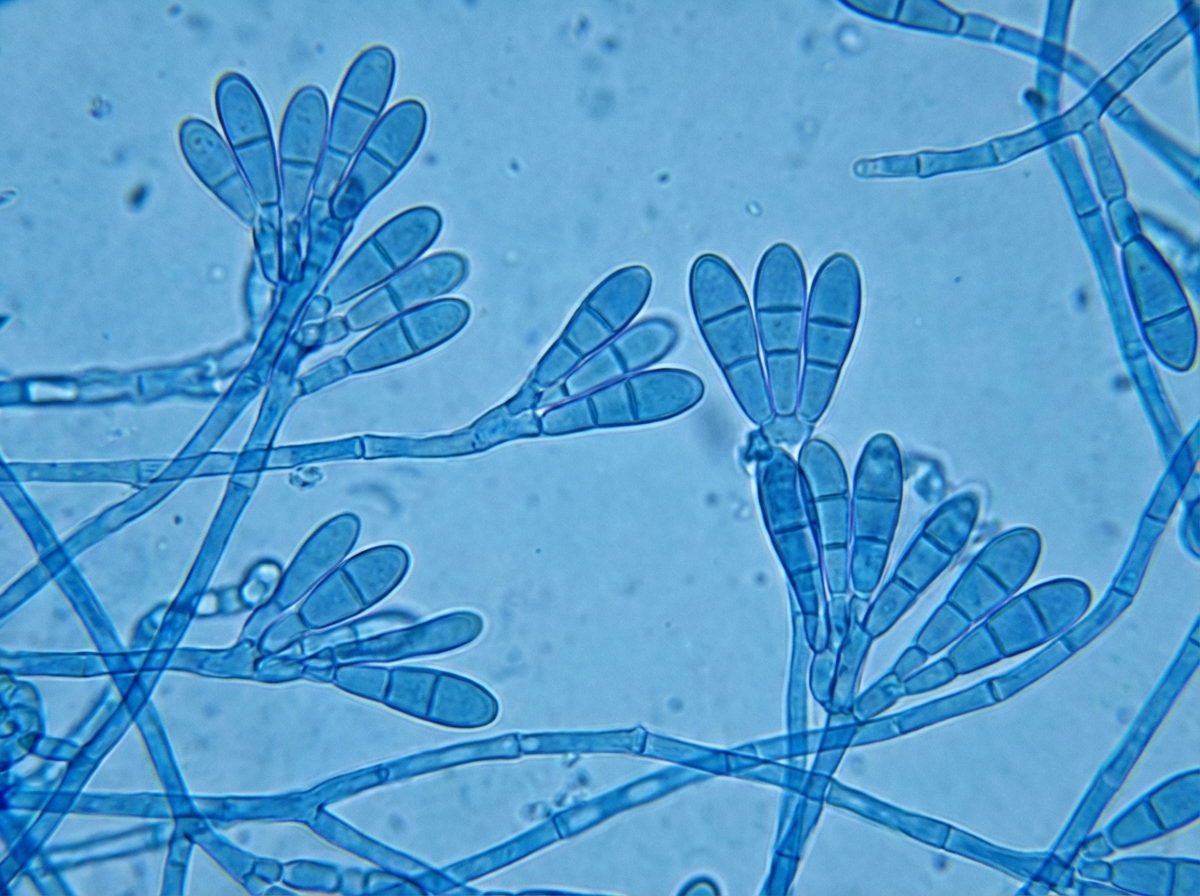
Which of the following is produced sexually?
A 25-year-old female complains of recurrent rhinitis, nasal discharge, and bilateral nasal blockage for one year. She has a history of asthma and allergies. On examination, multiple ethmoidal polyps are noted with mucosal thickening and impacted secretions in both nasal cavities. Biopsy material cultured shows growth of hyphae and pseudohyphae with dichotomous branching typically at 45 degrees. Which of the following is the most likely responsible organism?
A patient presented with complaints of dysphagia. On UGI Endoscopy, a diagnosis of esophageal candidiasis was made. Microscopy of a cultured sample (incubated in serum at 37°C for 3 hours) revealed a characteristic finding used to identify the causative organism. What phenomenon is demonstrated by this test?
Cheeser's lung is caused by which organism?
Explanation: **Explanation:** **Sulphur granules** are the hallmark clinical finding in **Actinomycosis**, most commonly caused by *Actinomyces israelii*. Despite the name, these granules do not contain actual sulphur; they are named for their characteristic yellow, sand-like appearance. 1. **Why "Organisms" is correct:** Sulphur granules are essentially **microcolonies of the bacteria**. Histologically, they consist of a central dense mass of tangled, branching Gram-positive filamentous bacilli. These filaments are surrounded by a peripheral "Splendore-Hoeppli phenomenon"—an eosinophilic material representing an antigen-antibody complex. Therefore, the core of the granule is composed of the infecting organisms themselves. 2. **Why the other options are incorrect:** * **Leukocytes:** While pus surrounding the granule contains abundant neutrophils (forming abscesses), the granule itself is a bacterial colony, not a collection of white blood cells. * **Erythrocytes:** Red blood cells are not a structural component of these granules. * **Keratinocytes:** These are skin cells and have no role in the formation of actinomycotic colonies. **High-Yield Clinical Pearls for NEET-PG:** * **Actinomyces israelii:** An anaerobic, Gram-positive, non-acid-fast, branching filamentous bacterium (not a fungus). * **Clinical Presentation:** "Lumpy jaw" (cervicofacial actinomycosis) following dental trauma or poor oral hygiene. * **Diagnosis:** Crushing a sulphur granule between two slides reveals the characteristic Gram-positive branching filaments. * **Treatment:** High-dose **Penicillin G** is the drug of choice. * **Differential:** *Nocardia* also shows branching filaments but is **aerobic** and **acid-fast**, and it does *not* typically form sulphur granules in systemic infections (though it may in mycetomas).
Explanation: **Explanation:** The correct answer is **Cryptococcus**. The clinical scenario describes a patient with meningitis where the diagnosis is confirmed using a **Latex Agglutination Test (LAT)** to detect the **capsular polysaccharide antigen** (Glucuronoxylomannan) in the Cerebrospinal Fluid (CSF). **Why Cryptococcus is correct:** * *Cryptococcus neoformans* is an encapsulated yeast. Its polysaccharide capsule is its primary virulence factor. * The LAT is highly sensitive (>90%) and specific, often preferred over India Ink because it can detect the antigen even when the fungal load is low. * It is a classic cause of subacute or chronic meningitis, especially in immunocompromised individuals (e.g., HIV/AIDS). **Why other options are incorrect:** * **Candida albicans:** While it can cause meningitis (usually iatrogenic or in neonates), it does not possess a polysaccharide capsule, and LAT for capsular antigen is not a standard diagnostic tool for it. * **Paracoccidioides brasiliensis:** This is a dimorphic fungus causing systemic mycosis (South American Blastomycosis), typically presenting with pulmonary or mucocutaneous lesions, not primary meningitis. * **Histoplasma capsulatum:** This is an intracellular fungus. While it can cause CNS histoplasmosis, it is diagnosed via urinary antigen or bone marrow biopsy; it lacks the specific capsule targeted by the LAT described. **High-Yield Clinical Pearls for NEET-PG:** * **Gold Standard Diagnosis:** Fungal culture (Sabouraud Dextrose Agar). * **Rapid Bedside Test:** India Ink preparation (shows a "halo" due to capsule exclusion). * **Stains:** Mucicarmine (specifically stains the capsule red), PAS, and Gomori Methenamine Silver (GMS). * **Treatment:** Induction with Amphotericin B + Flucytosine, followed by Fluconazole for maintenance.
Explanation: **Explanation:** **Farmer’s Lung** is a classic example of **Hypersensitivity Pneumonitis (Type III and Type IV hypersensitivity)**. It occurs due to the inhalation of organic dust containing thermophilic actinomycetes, typically found in moldy hay or grain stored in humid conditions. 1. **Why Option A is Correct:** The primary causative agents of Farmer’s Lung are thermophilic actinomycetes. **_Micromonospora faeni_** (now often reclassified as *Saccharopolyspora rectivirgula*) is the most common offending agent. These organisms thrive at high temperatures (45-60°C) generated during the fermentation of damp hay. 2. **Why Other Options are Incorrect:** * **Aspergillosis (Option B):** While *Aspergillus fumigatus* can cause various lung pathologies (like ABPA or Aspergilloma), it is not the primary agent for Farmer's Lung. However, it can cause a similar condition called "Malt worker’s lung." * **Histoplasma capsulatum (Option C):** This is a dimorphic fungus found in soil enriched with bird or bat droppings. It causes Histoplasmosis (a systemic mycosis), not hypersensitivity pneumonitis. * **Option D:** Incorrect because the etiology is specific to thermophilic actinomycetes. **High-Yield Clinical Pearls for NEET-PG:** * **Other HP Agents:** *Thermoactinomyces vulgaris* is another common cause of Farmer's Lung. * **Sugar Cane Workers:** "Bagassosis" is caused by *Thermoactinomyces sacchari*. * **Air Conditioner/Humidifier Lung:** Caused by *Thermoactinomyces candidus*. * **Diagnosis:** Characterized by "ground-glass opacities" on HRCT and restrictive lung disease patterns. * **Management:** The most crucial step is the avoidance of exposure to the allergen; steroids are used for acute symptoms.
Explanation: This question tests your ability to differentiate between the genera of the order **Mucorales**, which are common causes of zygomycosis (mucormycosis). The presence and position of **rhizoids** (root-like hyphal structures) are the primary morphological features used to distinguish them under microscopy. ### **Explanation of the Correct Answer** **C. Mucor:** This genus is characterized by the **complete absence of rhizoids**. Morphologically, it presents with broad, non-septate (coenocytic) hyphae and sporangiophores that arise directly from the mycelium without any root-like attachments. This "naked" appearance of the hyphae is the hallmark of *Mucor*. ### **Analysis of Incorrect Options** * **A. Rhizopus:** In *Rhizopus*, rhizoids are present and are located **directly opposite** the point where the sporangiophore originates (nodal position). This is the most common genus causing human mucormycosis. * **B. Absidia (Lichtheimia):** In *Absidia*, rhizoids are present but are located **between** the sporangiophores (internodal position). The sporangiophores are typically branched. * **D. All the above:** Incorrect, as only *Mucor* lacks these structures. ### **High-Yield Clinical Pearls for NEET-PG** * **Morphology:** All Mucorales show broad, **ribbon-like**, non-septate hyphae with **right-angle (90°)** branching. (Contrast with *Aspergillus*, which has narrow, septate hyphae with acute-angle branching). * **Risk Factors:** Poorly controlled **Diabetes Mellitus** (especially DKA) and neutropenia. * **Clinical Presentation:** Rhinocerebral mucormycosis is the most common form; look for "black eschar" on the palate or nasal septum. * **Treatment:** Surgical debridement + **Liposomal Amphotericin B** (Drug of choice). Isavuconazole or Posaconazole are alternatives.
Explanation: **Explanation:** **Candida** is the correct answer because it is a commensal organism found in the normal flora of the gastrointestinal tract, skin, and female genital tract. In **immunocompetent** individuals, it frequently causes superficial infections such as oral thrush (in infants), vulvovaginal candidiasis, and diaper dermatitis. While systemic candidiasis is usually seen in the immunocompromised, superficial Candida infections are the most prevalent fungal clinical presentations in the general healthy population. **Analysis of Incorrect Options:** * **Aspergillus:** This is an environmental mold. While it can cause Allergic Bronchopulmonary Aspergillosis (ABPA) or Aspergilloma in those with prior lung cavities, invasive disease is almost exclusively seen in severely immunocompromised patients (e.g., neutropenic patients). * **Cryptococcus:** *Cryptococcus neoformans* is a classic opportunistic pathogen, primarily causing meningitis in HIV/AIDS patients (CD4 <100). While *C. gattii* can infect the immunocompetent, it is far less common than Candida. * **Penicillium marneffei (Talaromyces marneffei):** This is an **AIDS-defining illness** endemic to Southeast Asia. It rarely, if ever, causes infection in individuals with a healthy immune system. **High-Yield Clinical Pearls for NEET-PG:** * **Candida albicans** is the most common species; it is identified by **Germ tube test positive** (Reynolds-Braude phenomenon) and **Chlamydospore formation** on Cornmeal agar. * **Most common opportunistic infection in AIDS:** *Pneumocystis jirovecii*. * **Most common fungal meningitis in AIDS:** *Cryptococcus neoformans*. * **Drug of choice for mucosal Candidiasis:** Fluconazole. * **Drug of choice for systemic Candidiasis:** Echinocandins (e.g., Caspofungin) or Amphotericin B.
Explanation: ### Explanation **Correct Option: C (Hydrolyzes urea)** *Cryptococcus neoformans* is a basidiomycetous yeast characterized by the presence of a prominent polysaccharide capsule. A key biochemical hallmark used for its identification in the laboratory is the production of the enzyme **urease**. When cultured on Christensen’s urea agar, *Cryptococcus* species hydrolyze urea to ammonia, increasing the pH and changing the indicator color from yellow to pink/magenta. This test helps differentiate *Cryptococcus* from other yeasts like *Candida albicans* (which is typically urease negative). **Analysis of Incorrect Options:** * **A. Oxidase positive:** This test is primarily used to identify bacteria (e.g., *Pseudomonas*, *Neisseria*). It is not a standard diagnostic feature for fungi. * **B. Dextran fermentation:** *Cryptococcus* is an obligate aerobe; it does **not** ferment sugars. It utilizes carbohydrates through oxidative pathways only. * **D. Ability to grow at 42°C:** While *C. neoformans* grows well at 37°C (human body temperature), it generally fails to grow at 42°C. In contrast, *Candida albicans* can often tolerate higher temperatures. **High-Yield Clinical Pearls for NEET-PG:** * **Phenol Oxidase Enzyme:** *C. neoformans* produces this enzyme, which converts phenolic compounds into **melanin**. This is demonstrated on **Niger Seed Agar (Birdseed Agar)**, where colonies appear brown/black. * **Microscopy:** **India Ink** preparation is used to visualize the "negative staining" of the capsule (halo appearance). * **Antigen Detection:** Latex Agglutination Test (LAT) for the capsular polysaccharide antigen is more sensitive than India Ink for diagnosing Cryptococcal meningitis. * **Association:** Strongly associated with immunocompromised states (HIV/AIDS) and pigeon droppings.
Explanation: In medical mycology, fungi reproduce through both sexual and asexual processes. Understanding the classification of spores is high-yield for NEET-PG. **Correct Answer: A. Ascospore** Sexual reproduction involves the fusion of two nuclei (karyogamy) and meiosis. **Ascospores** are sexual spores produced within a sac-like structure called an **ascus**. Other examples of sexual spores include **Zygospores** (formed by the fusion of two similar hyphae) and **Basidiospores** (formed on a club-shaped basidium). **Explanation of Incorrect Options:** * **B. Conidium:** These are asexual spores formed at the tips or sides of specialized hyphae called conidiophores. They are the most common form of asexual reproduction in medically important fungi like *Aspergillus* and *Penicillium*. * **C. Blastoconidia:** These are asexual spores produced by a "budding" process. They are characteristic of yeasts and are formed by the blowing out of the parent cell wall. * **D. Yeast buds:** Budding is the primary method of **asexual** vegetative reproduction in yeasts (e.g., *Candida*, *Saccharomyces*). **High-Yield Clinical Pearls for NEET-PG:** * **Perfect Fungi:** Fungi that exhibit both sexual and asexual phases (e.g., *Ascomycetes*, *Basidiomycetes*). * **Fungi Imperfecti (Deuteromycetes):** Fungi that lack a known sexual stage. Most human pathogens were traditionally placed in this category. * **Arthrospores:** Asexual spores formed by the fragmentation of hyphae (e.g., *Coccidioides immitis*, *Dermatophytes*). * **Chlamydospores:** Thick-walled resting asexual spores (e.g., *Candida albicans*).
Explanation: ### Explanation The clinical presentation of recurrent rhinitis, nasal polyposis, and asthma in a young patient is highly suggestive of **Allergic Fungal Rhinosinusitis (AFRS)**, a form of hypersensitivity to fungal antigens. **Why Aspergillus fumigatus is correct:** The definitive clue lies in the morphological description. *Aspergillus* species are characterized by **septate hyphae** that exhibit **dichotomous branching at acute angles (typically 45 degrees)**. While the question mentions "pseudohyphae" (likely a distractor or referring to the elongated appearance of hyphal elements in mucus), the specific mention of 45-degree dichotomous branching is the pathognomonic "buzzword" for *Aspergillus* in medical exams. *Aspergillus fumigatus* is the most common species isolated in fungal sinusitis and ABPA (Allergic Bronchopulmonary Aspergillosis). **Why the other options are incorrect:** * **Rhizopus & Mucor (Zygomycetes):** These fungi present with **broad, ribbon-like, non-septate (coenocytic) hyphae** that branch at **obtuse or right angles (90 degrees)**. Clinically, they cause invasive, necrotic "Rhinocerebral Mucormycosis," typically in diabetic or immunocompromised patients, rather than chronic allergic polyposis. * **Candida:** This yeast typically shows **budding yeast cells** and **pseudohyphae** (constrictions at septa), but it does not exhibit true dichotomous 45-degree branching. It is an uncommon cause of nasal polyposis. **High-Yield Pearls for NEET-PG:** * **Aspergillus:** Septate, 45° branching, Fruiting bodies (conidiophores). * **Mucor/Rhizopus:** Non-septate, 90° branching, associated with DKA. * **Allergic Fungal Sinusitis:** Characterized by "peanut butter" like inspissated mucus (allergic mucin) containing Charcot-Leyden crystals and eosinophils. * **Culture:** Sabouraud Dextrose Agar (SDA) is the standard medium; *Aspergillus* colonies often appear smoky-green.
Explanation: ***Germ tube formation*** - **Germ tube formation** (Reynolds-Braude phenomenon) is the hallmark identifying feature of **Candida albicans**, the most common cause of esophageal candidiasis. - This involves formation of **short, non-constricted hyphal projections** from yeast cells when incubated in serum at 37°C for 2-3 hours, distinguishing it from **pseudohyphae** which have constrictions. *Spore formation* - **Spore formation** is not a characteristic feature of Candida species during routine laboratory identification procedures. - Candida reproduces primarily through **budding** and hyphal formation, not through spore production like other fungi such as **Aspergillus**. *Mould to yeast formation* - **Dimorphic transformation** from mould to yeast form occurs in fungi like **Histoplasma** and **Blastomyces**, not in Candida albicans. - Candida albicans exists primarily in **yeast form** with ability to form **pseudohyphae** and **true hyphae**, but doesn't exhibit classic dimorphism. *Budding* - While **budding** is a normal reproductive mechanism of Candida species, it is not the specific diagnostic phenomenon being demonstrated. - Budding produces **daughter cells** attached to parent yeast cells but lacks the diagnostic specificity of **germ tube formation** for identifying C. albicans.
Explanation: **Explanation:** **Cheese-washer's lung** (or Cheeser's lung) is a form of **Hypersensitivity Pneumonitis (Extrinsic Allergic Alveolitis)**. It is caused by an immune-mediated inflammatory response in the lungs following the inhalation of fungal spores found on the surface of moldy cheese. 1. **Why D is correct:** The primary causative agent is **Penicillium caseioculum** (also known as *Penicillium camemberti*). Workers involved in the aging and cleaning of cheese are exposed to these spores, leading to a Type III and Type IV hypersensitivity reaction. 2. **Analysis of Incorrect Options:** * **Aspergillus clavatus:** This is the causative agent of **Malt worker’s lung**, associated with exposure to moldy barley. * **Aspergillus niger:** While a common cause of Otomycosis (fungal ear infection) and occasionally aspergillomas, it is not the classic cause of Cheeser's lung. * **Penicillium marneffei (Talaromyces marneffei):** This is a dimorphic fungus that causes systemic infections (Talaromycosis), particularly in HIV-positive patients in Southeast Asia. It is not associated with hypersensitivity pneumonitis from cheese. **High-Yield Clinical Pearls for NEET-PG:** * **Hypersensitivity Pneumonitis (HP) Table:** * **Farmer’s Lung:** *Saccharopolyspora rectivirgula* (formerly *Micropolyspora faeni*). * **Bagassosis:** *Thermoactinomyces sacchari* (moldy sugar cane). * **Bird Fancier’s Lung:** Avian proteins (droppings/feathers). * **Byssinosis:** Cotton dust ("Monday morning fever"). * **Diagnosis:** Characterized by "ground-glass opacities" on HRCT and restrictive lung disease patterns. * **Management:** The most crucial step is the **avoidance of the offending antigen**, followed by corticosteroids in severe cases.
Classification of Fungi
Practice Questions
Superficial Mycoses
Practice Questions
Dermatophytes
Practice Questions
Subcutaneous Mycoses
Practice Questions
Candidiasis
Practice Questions
Aspergillosis
Practice Questions
Cryptococcosis
Practice Questions
Zygomycosis
Practice Questions
Endemic Mycoses
Practice Questions
Opportunistic Fungal Infections
Practice Questions
Antifungal Agents
Practice Questions
Laboratory Diagnosis of Fungal Infections
Practice Questions
Get full access to all questions, explanations, and performance tracking.
Start For Free