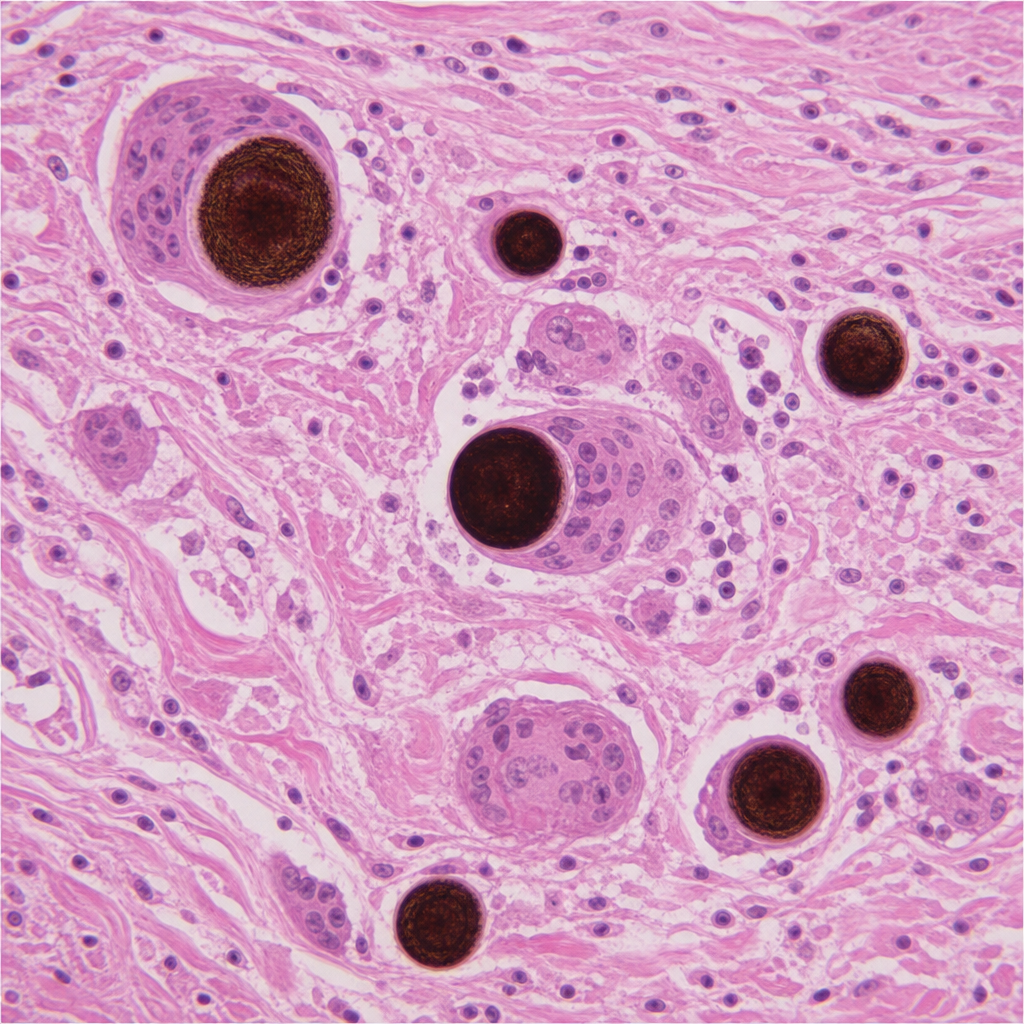
Sclerotic bodies 3-15 microns in size, multiseptate, and chestnut brown in colour are seen in which condition?
Which of the following is the commonest cause of farmer's lung?
The organism most frequently related to mediastinal fibrosis is?
For examination of fungus from a sample, which stain is uniformly used?
A section of tissue from the foot of a person with Eumycotic mycetoma shows a white, lobulated granule composed of fungal hyphae. What is the most common etiologic agent of this condition?
A KOH wet mount is prepared for which of the following?
Discharging sinus is seen in which of the following conditions?
All are true regarding filariasis EXCEPT?
All of the following are bacterial diseases except:
The organism shown below is:

Explanation: ### Explanation **Correct Answer: B. Chromoblastomycosis** The presence of **Sclerotic bodies** (also known as **Medlar bodies**, **Muriform bodies**, or "copper pennies") is the pathognomonic histological hallmark of Chromoblastomycosis. These are thick-walled, dark brown (chestnut brown), multiseptate fungal cells measuring 5–12 µm in diameter. They represent an intermediate vegetative stage where the fungus divides by internal septation (binary fission) rather than budding. This condition is a chronic subcutaneous mycosis caused by dematiaceous (pigmented) fungi like *Fonsecaea pedrosoi* and *Phialophora verrucosa*, typically following traumatic inoculation. **Why other options are incorrect:** * **Rhinosporidiosis:** Characterized by large **sporangia** (up to 300 µm) containing thousands of tiny endospores. It typically presents as friable, leafy polyps in the nasal mucosa. * **Phaeohyphomycosis:** While also caused by pigmented fungi, it presents histologically as **pigmented hyphae** or yeast-like cells in tissue, but **never** forms sclerotic bodies. * **Histoplasmosis:** Characterized by small (2–4 µm), oval, budding yeast cells found **intracellularly** within macrophages. They are not brown and do not show multiseptation. **High-Yield Clinical Pearls for NEET-PG:** * **Appearance:** Clinically presents as "cauliflower-like" or verrucous (warty) lesions, most commonly on the lower limbs. * **Diagnosis:** KOH mount of skin scrapings shows the same dark, septate sclerotic bodies. * **Key Term:** "Copper penny" appearance is a frequent buzzword in exams for Medlar bodies. * **Treatment:** Itraconazole or Terbinafine; surgical excision or cryotherapy for small lesions.
Explanation: **Explanation:** **Farmer’s Lung** is a type of **Hypersensitivity Pneumonitis (Type III and IV hypersensitivity)** caused by the inhalation of organic dust containing thermophilic actinomycetes. It typically occurs in individuals exposed to moldy hay or grain. * **Micropolyspora faeni (Option A):** This is the **most common** causative agent of Farmer’s Lung. It is a thermophilic actinomycete that thrives in damp, decomposing hay where temperatures reach 40–60°C. Inhalation of its spores leads to an inflammatory response in the alveoli and distal airways. Note: In modern taxonomy, this organism is often referred to as *Saccharopolyspora rectivirgula*. **Why other options are incorrect:** * **Thermoactinomyces sacchari (Option B):** This organism is the primary cause of **Bagassosis**, a similar hypersensitivity pneumonitis caused by exposure to moldy sugarcane residue (bagasse). * **Mycobacterium bovis (Option C):** This is a bacterium belonging to the *M. tuberculosis* complex, primarily causing bovine tuberculosis and occasionally human tuberculosis through unpasteurized milk; it is not associated with hypersensitivity pneumonitis. **High-Yield Clinical Pearls for NEET-PG:** * **Bagassosis:** Moldy sugarcane (*T. sacchari*). * **Byssinosis:** Cotton fibers ("Monday Morning Fever"). * **Bird Fancier’s Lung:** Avian proteins (pigeon/parrot droppings). * **Malt Worker’s Lung:** *Aspergillus fumigatus*. * **Diagnosis:** Characterized by "ground-glass opacities" on HRCT and restrictive lung function. Management primarily involves avoidance of the allergen and corticosteroids for acute cases.
Explanation: **Explanation:** **Histoplasma capsulatum** is the most common cause of **fibrosing mediastinitis** (also known as mediastinal fibrosis). This condition is a rare but severe complication of histoplasmosis, occurring when an exaggerated, persistent fibroinflammatory response to the fungus develops within the mediastinal lymph nodes. Over time, this dense fibrous tissue can encroach upon and compress vital structures such as the superior vena cava (SVC syndrome), pulmonary arteries, and esophagus. **Analysis of Options:** * **Histoplasma (Correct):** It is a dimorphic fungus endemic in river valleys (e.g., Ohio/Mississippi in the US; Ganges in India). While most infections are asymptomatic, the chronic granulomatous response in the mediastinum leads to the characteristic "woody" fibrosis. * **Actinomycosis:** While it can cause thoracic infections, it typically presents with "sulfur granules," multiple abscesses, and sinus tracts that cross anatomical planes (e.g., chest wall involvement), rather than isolated mediastinal fibrosis. * **Hansen’s Bacillus (M. leprae):** This causes Leprosy, primarily affecting the skin and peripheral nerves. It does not involve the mediastinum. * **Staphylococcus:** This is a pyogenic bacterium causing acute infections like pneumonia or acute mediastinitis (usually post-surgical), characterized by pus formation rather than chronic progressive fibrosis. **NEET-PG High-Yield Pearls:** * **Morphology:** Histoplasma is seen as small, oval yeast cells within **macrophages** (intracellular). * **Source:** Associated with **bird or bat droppings** (guano). * **Imaging:** May show calcified "buckshot" granulomas in the lungs or spleen. * **Differential:** Other causes of mediastinal fibrosis include Tuberculosis, Sarcoidosis, and IgG4-related disease, but *Histoplasma* remains the classic fungal association.
Explanation: **Explanation:** **Periodic Acid-Schiff (PAS)** is the gold standard and most uniformly used stain for the histological identification of fungi. The underlying principle lies in the chemical composition of the fungal cell wall, which is rich in polysaccharides like **chitin and glucan**. The periodic acid oxidizes these carbohydrates to form aldehydes, which then react with the Schiff reagent to produce a brilliant **magenta or purplish-red color**. This provides a sharp contrast against the background, making fungal hyphae and yeast cells easily identifiable. **Analysis of Incorrect Options:** * **Alizarin (Red):** This is a specialized stain used primarily to identify **calcium deposits** (e.g., in calcified tissues or synovial fluid for pseudogout) and is not used for fungal identification. * **Masson’s Trichrome:** This is a connective tissue stain used to differentiate between **collagen (blue/green)** and muscle fibers (red). It is commonly used in liver and kidney biopsies to assess fibrosis. * **Giemsa:** While Giemsa can detect certain intracellular fungi like *Histoplasma capsulatum* or *Pneumocystis jirovecii*, it is primarily used for peripheral blood smears (malaria, leishmania) and bone marrow cytology. It does not stain the fungal cell wall as uniformly as PAS. **High-Yield Clinical Pearls for NEET-PG:** * **Gomori Methenamine Silver (GMS):** Another superior fungal stain; it stains fungi **black** and is often considered more sensitive than PAS for screening. * **Calcofluor White:** A fluorescent stain that binds to chitin; it is the fastest method for direct microscopic examination (requires a fluorescent microscope). * **Mucicarmine:** Specifically used to identify the polysaccharide capsule of ***Cryptococcus neoformans*** (stains it bright red). * **India Ink:** Used for rapid identification of *Cryptococcus* in CSF (negative staining technique).
Explanation: ### Explanation **1. Why the Correct Answer is Right:** Mycetoma is a chronic, granulomatous infection characterized by a triad of **localized swelling, underlying sinus tracts, and the discharge of grains (granules)**. It is classified into two types based on the causative agent: **Actinomycotic** (bacteria) and **Eumycotic** (fungi). The question specifies a **white, lobulated granule** composed of fungal hyphae. **_Pseudoallescheria boydii_** (and its asexual form *Scedosporium apiospermum*) is the most common cause of **white-grain eumycetoma** worldwide. The presence of fungal hyphae (broad, septate) confirms the eumycotic nature, and the white color of the granule is a diagnostic hallmark for this specific pathogen. **2. Why the Other Options are Wrong:** * **Options A & B (Nocardia & Actinomadura):** These are causes of **Actinomycotic mycetoma**. While they produce granules, these granules are composed of thin, branching bacterial filaments (0.5–1 μm), not fungal hyphae. *Actinomadura pelletieri* specifically produces characteristic red granules. * **Option C (Madurella):** *Madurella mycetomatis* is the most common cause of eumycetoma globally, but it characteristically produces **black granules** (melanized hyphae), not white ones. **3. NEET-PG High-Yield Pearls:** * **Triad of Mycetoma:** Tumefaction (swelling), Sinus tracts, and Grains. * **Granule Color Coding:** * **Black Grains (Eumycotic):** *Madurella mycetomatis*, *Exophiala jeanselmei*. * **White Grains (Eumycotic):** *Pseudoallescheria boydii*, *Acremonium* spp. * **Red Grains (Actinomycotic):** *Actinomadura pelletieri*. * **Yellow/White Grains (Actinomycotic):** *Nocardia* spp., *Streptomyces somaliensis*. * **Diagnosis:** Grains should be examined with 10% KOH (for hyphae) and Gram stain (for bacterial filaments). * **Treatment:** Eumycetoma usually requires surgical debridement plus long-term antifungals (Itraconazole), whereas Actinomycetoma responds well to antibiotics (Welsh regimen: Amikacin + Cotrimoxazole).
Explanation: **Explanation:** **1. Why Candida is the Correct Answer:** Potassium Hydroxide (KOH) is a strong alkali used in the laboratory to dissolve keratin and cellular debris (like skin scales, hair, and nails) in clinical specimens. Fungi, including **Candida**, have a cell wall composed of chitin, which is resistant to KOH. When a KOH wet mount is prepared, the background material clears, allowing for the clear visualization of fungal elements such as **budding yeast cells and pseudohyphae**. This makes it the gold-standard bedside test for diagnosing candidiasis (e.g., vaginal thrush or oral candidiasis). **2. Why Other Options are Incorrect:** * **Herpes Zoster:** This is a viral infection. Diagnosis is typically clinical or confirmed via a **Tzanck smear** (looking for multinucleated giant cells) or PCR. * **Gonorrhea:** Caused by *Neisseria gonorrhoeae* (bacteria). Diagnosis requires **Gram stain** (showing Gram-negative intracellular diplococci) or culture on Thayer-Martin medium. * **Trichomonas vaginalis:** This is a motile protozoan. It is best identified using a **Saline Wet Mount** to observe its characteristic "jerky" or "twitching" motility. **3. High-Yield Clinical Pearls for NEET-PG:** * **10% KOH:** Used for skin and hair samples. * **20% KOH:** Used for thicker specimens like nail clippings. * **Dimethyl Sulfoxide (DMSO):** Often added to KOH to speed up the clearing process without requiring heat. * **Calcofluor White:** A fluorescent stain that can be added to KOH; it binds to cellulose and chitin, making fungi fluoresce under UV light (highly sensitive). * **"Spaghetti and Meatballs" appearance:** Classic KOH finding for *Tinea versicolor* (*Malassezia furfur*).
Explanation: **Explanation:** **Mycetoma** is the correct answer because it is clinically characterized by a classic triad: **localized chronic swelling (tumefaction), multiple interconnecting discharging sinuses, and the presence of grains** (colonies of the causative agent) in the discharge. It can be caused by fungi (Eumycetoma) or filamentous bacteria (Actinomycetoma). The infection typically occurs via traumatic inoculation, usually on the foot (Madura foot). **Analysis of Incorrect Options:** * **Sporotrichosis (Option A):** Known as "Rose gardener’s disease," it typically presents as a **linear chain of nodules** following lymphatic drainage (lymphocutaneous spread). While ulcers may form, discharging sinuses with grains are not a feature. * **Cryptococcosis (Option B):** Primarily a pulmonary or meningeal infection (Cryptococcal meningitis). Cutaneous manifestations are rare and usually present as umbilicated papules (resembling Molluscum contagiosum) in immunocompromised patients. * **Histoplasmosis (Option C):** A systemic fungal infection that primarily affects the lungs and the Reticuloendothelial system (liver, spleen, bone marrow). Cutaneous lesions, if present, are usually oropharyngeal ulcers or granulomatous nodules, not discharging sinuses. **High-Yield Clinical Pearls for NEET-PG:** * **Actinomycetoma vs. Eumycetoma:** Actinomycetoma (bacterial) progresses faster and is more invasive than Eumycetoma (fungal). * **Grains:** The color of the grain can hint at the etiology. For example, **black grains** are diagnostic of Eumycetoma (e.g., *Madurella mycetomatis*), while **yellow/white grains** can be seen in both. * **Diagnosis:** The most definitive diagnostic step is the macroscopic and microscopic examination of the grains. * **Other conditions with discharging sinuses:** Actinomycosis (lumpy jaw) and Chronic Osteomyelitis.
Explanation: **Explanation:** The correct answer is **C (Man is an intermediate host)** because, in the life cycle of filarial parasites like *Wuchereria bancrofti*, **humans serve as the definitive host**, not the intermediate host. 1. **Why Option C is correct (The Concept):** In parasitology, the **definitive host** is where the parasite reaches sexual maturity and undergoes sexual reproduction. For *W. bancrofti*, adult worms reside and mate in the human lymphatics. The **intermediate host** (the vector, such as the *Culex* mosquito) is where larval development (L1 to L3 stage) occurs without sexual reproduction. 2. **Why other options are incorrect:** * **Option A:** Filariasis primarily involves the **lymphatic system**, where adult worms cause inflammation, fibrosis, and eventual obstruction, leading to lymphedema and elephantiasis. * **Option B:** *Wuchereria bancrofti* is the most common causative agent (responsible for ~90% of cases), followed by *Brugia malayi* and *B. timori*. * **Option D:** **Diethylcarbamazine (DEC)** is the drug of choice. It is microfilaricidal and also kills a percentage of adult worms. **High-Yield Clinical Pearls for NEET-PG:** * **Vector:** *Culex quinquefasciatus* is the most common vector for *W. bancrofti* in India. * **Infective Stage:** Third-stage larvae (**L3**) introduced via mosquito bite. * **Diagnostic Gold Standard:** Demonstration of **microfilariae** in a peripheral blood smear (collected at night, usually 10 PM – 2 AM, due to nocturnal periodicity). * **Tropical Pulmonary Eosinophilia (TPE):** A hypersensitivity reaction to filarial antigens characterized by nocturnal cough, wheezing, and high peripheral eosinophilia. * **Drug of Choice for TPE:** DEC for 14–21 days.
Explanation: **Explanation:** The correct answer is **Oral hairy leukoplakia (OHL)** because it is a **viral infection**, not a bacterial one. It is caused by the **Epstein-Barr Virus (EBV)** and typically presents as white, corrugated (hairy) patches on the lateral borders of the tongue. It is a significant clinical marker of immunosuppression, most commonly seen in patients with HIV/AIDS. **Analysis of Incorrect Options:** * **Lymphogranuloma venereum (LGV):** This is a bacterial sexually transmitted infection caused by **Chlamydia trachomatis** (serotypes L1, L2, and L3). It is characterized by a painless primary lesion followed by painful regional lymphadenopathy (buboes). * **Donovanosis (Granuloma Inguinale):** This is a chronic bacterial infection caused by **Klebsiella granulomatis** (formerly *Calymmatobacterium granulomatis*). It presents as painless, beefy-red ulcerative lesions that bleed easily on contact. * **Chancroid:** This is an acute bacterial infection caused by **Haemophilus ducreyi**. Unlike LGV or Syphilis, the primary ulcer in Chancroid is characteristically **painful** (Soft Chancre). **High-Yield Clinical Pearls for NEET-PG:** * **Donovanosis Diagnosis:** Look for **Donovan bodies** (safety-pin appearance) within macrophages on a Giemsa or Wright stain. * **Chancroid Diagnosis:** Look for the **"School of fish"** or "railroad track" appearance of Gram-negative coccobacilli. * **Oral Hairy Leukoplakia:** Unlike Oral Candidiasis, the white patches in OHL **cannot be scraped off**. * **LGV:** The **"Groove sign"** (Poupart’s ligament dividing enlarged lymph nodes) is a classic clinical finding.
Explanation: ***Aspergillus*** - Characterized by **septate hyphae** that branch at **45-degree angles**, with distinctive **conidiophores** bearing a **vesicle** at the tip. - Shows **phialides** arranged around the vesicle and **chains of conidia** (spores), creating a characteristic "aspergillum" or brush-like appearance. *Candida* - Displays **pseudohyphae** with **constrictions at septa** and characteristic **budding yeast cells**. - Lacks the **septate branching hyphae** and **conidiophore structures** seen in Aspergillus. *Histoplasma* - Appears as **small intracellular yeast** (2-4 μm) found within **macrophages** in tissue samples. - Does not form **hyphae** or **conidiophores** in tissue, unlike the branching hyphal structure of Aspergillus. *Paracoccidiomycosis* - Shows **large yeast cells** (10-60 μm) with **multiple peripheral budding**, creating a distinctive **"steering wheel" appearance**. - Lacks the **septate hyphae** and **conidiophore structures** characteristic of Aspergillus species.
Classification of Fungi
Practice Questions
Superficial Mycoses
Practice Questions
Dermatophytes
Practice Questions
Subcutaneous Mycoses
Practice Questions
Candidiasis
Practice Questions
Aspergillosis
Practice Questions
Cryptococcosis
Practice Questions
Zygomycosis
Practice Questions
Endemic Mycoses
Practice Questions
Opportunistic Fungal Infections
Practice Questions
Antifungal Agents
Practice Questions
Laboratory Diagnosis of Fungal Infections
Practice Questions
Get full access to all questions, explanations, and performance tracking.
Start For Free