A 6-year-old boy presents with fever and chills, cough, rapid breathing, difficulty breathing, and chest pain. A culture from a respiratory sample shows Gram-positive bacteria. What is the most likely organism causing this infection?
Which pathogen is most commonly associated with a productive cough in chronic bronchitis?
A patient with a cavitary lung lesion who coughs up sputum containing thin, acid-fast positive rods. Which of the following features would most likely be associated with these bacteria?
Which is the MOST COMMON cause of atypical pneumonia in the community setting?
A 12-year-old girl presents with fever, shortness of breath, and cough. A chest X-ray reveals complete consolidation of the left lower lung lobe. What is the most probable organism?
Which of the following bacteria is microaerophilic?
NOT a cause of bacterial community acquired pneumonia:
Which is the most common bacterial organism causing bacterial upper respiratory tract infections (including sinusitis, otitis media, and pharyngitis) in adults?
Brain abscess in immunodeficient person is due to :
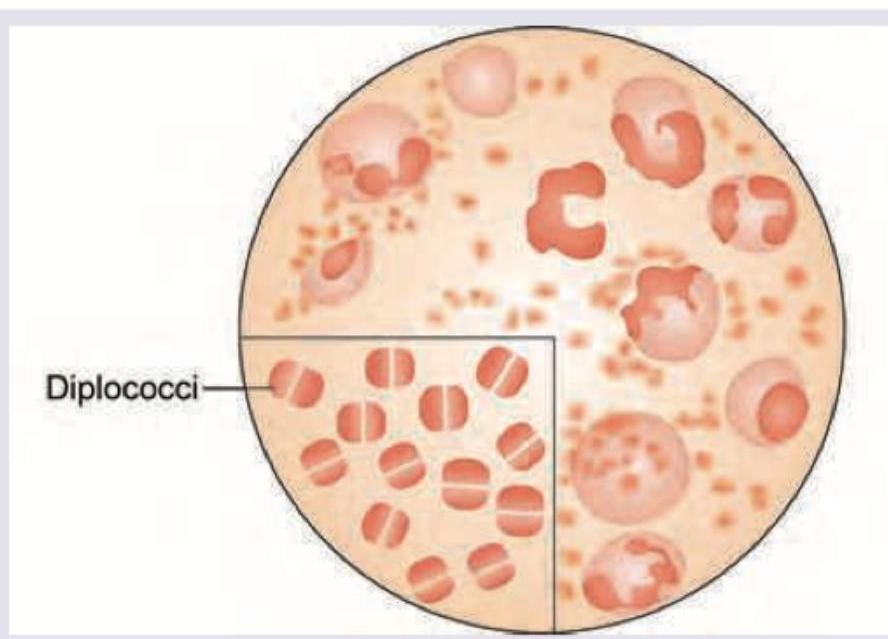
All are true about the bacteria shown in the figure except: (Recent NEET Pattern 2016-17)
Explanation: ***Streptococcus pneumoniae*** - This clinical picture describes typical symptoms of **pneumonia** in a child, including fever, cough, rapid and difficult breathing, and chest pain. - **_Streptococcus pneumoniae_** is the most common bacterial cause of community-acquired pneumonia in children. The respiratory sample showing gram-positive bacteria further supports this. *Staphylococcus aureus* - While **_Staphylococcus aureus_** can cause pneumonia, it is less common than _Streptococcus pneumoniae_ in community-acquired cases in healthy children and often associated with more severe, necrotizing forms or post-viral infections. - While it is a **Gram-positive bacterium**, its clinical presentation would not be the most likely first choice for typical pneumonia symptoms in this age group. *Propionibacterium acnes* - **_Propionibacterium acnes_** (now *Cutibacterium acnes*) is primarily associated with **acne vulgaris** and, less commonly, opportunistic infections related to implanted devices or some rare soft tissue infections. - It is not a typical cause of primary respiratory infections like pneumonia. *Streptococcus pyogenes* - **_Streptococcus pyogenes_** (Group A Streptococcus) is known for causing **pharyngitis** (strep throat), skin infections (impetigo, cellulitis), and scarlet fever. - While it can rarely cause pneumonia, it is not a common cause, and the constellation of symptoms points more strongly to _Streptococcus pneumoniae_.
Explanation: ***Haemophilus influenzae*** - This bacterium is a common cause of exacerbations in patients with **chronic bronchitis**, leading to increased sputum production and cough. - It frequently colonizes the airways of individuals with pre-existing lung disease, including **COPD**, making them susceptible to infection. [2] *Legionella pneumophila* - This pathogen typically causes **Legionnaires' disease**, a severe form of pneumonia, often presenting with systemic symptoms and atypical features rather than a straightforward exacerbation of chronic bronchitis. [1] - Infection is usually linked to exposure to contaminated water sources, and while it causes cough, it's not the most common cause of a productive cough in established chronic bronchitis. [2] *Streptococcus pneumoniae* - While *Streptococcus pneumoniae* is a common cause of **community-acquired pneumonia** and can infect individuals with chronic bronchitis, *Haemophilus influenzae* is more frequently isolated in exacerbations presenting predominantly with a productive cough. [1] - *S. pneumoniae* infections often present with more severe symptoms, including high fever and lobar consolidation. *Mycoplasma pneumoniae* - This pathogen is known for causing **"walking pneumonia"**, which typically presents with a persistent, non-productive cough, along with headache and malaise. - It is not commonly associated with the copious, productive cough characteristic of an acute exacerbation of chronic bronchitis.
Explanation: ***Waxy envelope*** - The presence of a **waxy envelope**, primarily due to high mycolic acid content in the cell wall, is a hallmark of **Mycobacterium tuberculosis**, which causes the described cavitary lung lesion and acid-fast rods. - This waxy layer contributes to the bacterium's **acid-fastness** and resistance to many antibiotics and host defenses. *Nutritional requirement for factors V and X (related to Haemophilus influenzae)* - This describes the growth requirements for **Haemophilus influenzae**, a common cause of respiratory infections but not typically associated with cavitary lung lesions or acid-fast rods. - *Haemophilus influenzae* is a **Gram-negative coccobacillus** and does not exhibit acid-fast staining properties. *Streptokinase (produced by Streptococci)* - **Streptokinase** is an enzyme produced by certain **Streptococcus species** that helps dissolve blood clots. - *Streptococci* are Gram-positive cocci and do not cause cavitary lung lesions with acid-fast rods; they are more commonly associated with pharyngitis, skin infections, and pneumonia (e.g., *Streptococcus pneumoniae*). *Toxic shock syndrome toxin (produced by Staphylococcus aureus)* - **Toxic shock syndrome toxin-1 (TSST-1)** is a superantigen produced by some strains of **Staphylococcus aureus**, leading to toxic shock syndrome. - *Staphylococcus aureus* is a **Gram-positive coccus** that can cause pneumonia and abscesses, but it does not produce acid-fast rods or typically form cavitary lung lesions with the specific characteristics mentioned.
Explanation: ***Mycoplasma pneumoniae*** - *Mycoplasma pneumoniae* is the **most common cause of community-acquired atypical pneumonia**, particularly in children and young adults. - It causes "walking pneumonia" with **gradual onset**, low-grade fever, and **prominent dry cough** that is disproportionate to physical findings. - Lacks a **cell wall**, making it resistant to beta-lactam antibiotics; treatment is with macrolides or tetracyclines. - Characterized by **cold agglutinins** and extrapulmonary manifestations (hemolytic anemia, neurologic complications). *Chlamydophila pneumoniae* - A significant cause of atypical pneumonia, but **less common** than *M. pneumoniae* overall. - More common in **older adults** and causes a similar clinical picture with prolonged cough. - Also lacks a cell wall and responds to macrolides or tetracyclines. *Legionella pneumophila* - Causes **Legionnaires' disease**, a severe form of atypical pneumonia. - Less common overall, associated with **contaminated water sources** (cooling towers, hot tubs). - Presents with **high fever, gastrointestinal symptoms**, and hyponatremia; requires specific antibiotics like fluoroquinolones or macrolides. *Chlamydophila psittaci* - Causes **psittacosis** (ornithosis), a rare form of atypical pneumonia. - Acquired through exposure to **infected birds** (parrots, pigeons). - Much **less common** than *M. pneumoniae* in the general community setting.
Explanation: ***Streptococcus pneumoniae*** - This is the most common bacterial cause of **community-acquired pneumonia** in children and adults, and symptoms perfectly align with lobar consolidation. - **Lobar pneumonia**, as suggested by complete consolidation of a lung lobe on chest X-ray, is a classic presentation of *Streptococcus pneumoniae* infection. *Staphylococcus aureus* - While *Staphylococcus aureus* can cause pneumonia, it often leads to **necrotizing pneumonia** or **empyema**, and is more common in hospitalized patients or those with predisposing factors like cystic fibrosis or influenza. - Its presentation is typically more severe and less frequently causes simple lobar consolidation in an otherwise healthy child. *Klebsiella pneumoniae* - *Klebsiella pneumoniae* typically causes **severe, necrotizing pneumonia** often seen in individuals with chronic alcohol abuse, diabetes, or immunocompromised states. - It characteristically produces a **"currant jelly" sputum** and is less common in healthy children with classic lobar pneumonia. *Pseudomonas aeruginosa* - *Pseudomonas aeruginosa* pneumonia is primarily associated with **hospital-acquired infections**, **ventilator-associated pneumonia**, or in patients with underlying lung disease like **cystic fibrosis** or bronchiectasis. - It is highly unlikely to be the causative organism in an otherwise healthy 12-year-old presenting with typical community-acquired pneumonia.
Explanation: ***Campylobacter*** - **Campylobacter jejuni** is a classic example of a microaerophilic bacterium, thriving in environments with **reduced oxygen (5-10% O2)** and **increased CO2 (5-10%)**. - This specific atmospheric requirement is crucial for its **growth** and **virulence**, often leading to gastroenteritis. *Vibrio cholerae* - **Vibrio cholerae** is a **facultative anaerobe**, meaning it can grow in both the presence and absence of oxygen. - It does not require low oxygen environments; optimal growth occurs **aerobically**. *Pseudomonas* - **Pseudomonas aeruginosa** is an **obligate aerobe**; it requires oxygen for respiration and growth. - It uses oxygen as the **final electron acceptor** in its electron transport chain. *Salmonella* - **Salmonella enterica** is a **facultative anaerobe**, capable of switching between aerobic and anaerobic respiration. - It can grow in the presence of oxygen, as well as in **anaerobic conditions** by fermenting sugars.
Explanation: ***Blastomyces*** - *Blastomyces*, a **dimorphic fungus**, causes **blastomycosis**, which is a **fungal infection**, not a bacterial infection. - While it can cause community-acquired pneumonia with pulmonary symptoms, it is **NOT a bacterial pathogen** and therefore not a cause of **bacterial community-acquired pneumonia**. - The question asks specifically about bacterial causes, making this the correct answer. *Streptococcus pneumoniae* - **_Streptococcus pneumoniae_** is the **most common bacterial cause** of **community-acquired pneumonia (CAP)**. - Infection typically presents with **acute onset** of fever, chills, productive cough, and lobar consolidation on chest X-ray. *Mycoplasma pneumoniae* - **_Mycoplasma pneumoniae_** is a common cause of **atypical bacterial community-acquired pneumonia**, often referred to as "**walking pneumonia**". - It typically causes milder symptoms, including a **persistent dry cough** and malaise, and is prevalent in younger adults and children. *Moraxella catarrhalis* - **_Moraxella catarrhalis_** is a **bacterial pathogen** that causes **community-acquired pneumonia**, especially in patients with **chronic obstructive pulmonary disease (COPD)**. - It can also cause **bronchitis**, otitis media, and sinusitis.
Explanation: ***Streptococcus pneumoniae*** - *Streptococcus pneumoniae* is the **most common bacterial pathogen** causing upper respiratory tract infections overall, including **bacterial sinusitis**, **otitis media**, and **community-acquired pneumonia**. - It is a frequent colonizer of the nasopharynx and leads to infection when host immunity is compromised. - Accounts for the highest burden of bacterial URTIs when considering all anatomical sites. *Haemophilus influenzae* - *Haemophilus influenzae* (particularly non-typeable strains) is the **second most common** cause of bacterial sinusitis and otitis media in adults. - While significant, it is less prevalent overall than *S. pneumoniae* across all URTI types. *Staphylococcus aureus* - *Staphylococcus aureus* primarily causes **skin and soft tissue infections** and device-related infections. - It is **not a common primary pathogen** in typical acute bacterial URTIs, though it may cause secondary infections or colonize the anterior nares. *Streptococcus pyogenes* - *Streptococcus pyogenes* (Group A Streptococcus) is the **most common cause of bacterial pharyngitis** (strep throat) in adults. - However, when considering the **full spectrum of bacterial URTIs** (pharyngitis, sinusitis, otitis media), *S. pneumoniae* has a broader overall impact and higher prevalence across multiple sites.
Explanation: ***Toxoplasma gondii*** - **Toxoplasma gondii** is a very common cause of **brain abscesses** (cerebral toxoplasmosis) in individuals with compromised immune systems, especially those with AIDS. - The parasite is usually latent in many people and reactivates when the immune system weakens. *Aspergillus* - While *Aspergillus* can cause central nervous system infections, including brain abscesses, this is usually seen in severely **neutropenic** or transplant patients. - *Aspergillus* typically invades via **hematogenous spread** from a primary pulmonary infection or directly from sinusitis. *Cryptococcus* - *Cryptococcus neoformans* is a significant cause of **meningitis** in immunocompromised patients, particularly those with HIV/AIDS. - While it can cause **cryptococcomas** (focal lesions), pure abscess formation is less common than with *Toxoplasma*. *Candida* - *Candida* species can cause **brain microabscesses** or multifocal lesions, especially in patients with disseminated candidiasis originating from prolonged hospitalization or indwelling catheters. - However, large, solitary brain abscesses are less typical for *Candida* compared to *Toxoplasma gondii*.
Explanation: ***Resistant to heat, alteration in pH and disinfectants*** - The bacteria shown in the figure are **Gram-negative diplococci**, characteristic of **Neisseria gonorrhoeae** or **Neisseria meningitidis**. These bacteria are known to be **sensitive to drying, heat, cold, and disinfectants**, not resistant. - Their delicate nature makes them difficult to cultivate outside specific laboratory conditions and contributes to their typical mode of transmission through close contact. *Commensal in the upper respiratory tract of humans* - **Neisseria meningitidis**, a type of diplococci shown and inferred, is a common **commensal** in the nasopharynx of up to 10% of the population. - This colonization can be entirely asymptomatic, but it also serves as a reservoir for potential invasive disease. *Kovac's method results in the formation of a deep purple color* - **Neisseria** species are **oxidase-positive**, meaning they produce cytochrome c oxidase. - The **Kovac's oxidase test** uses N,N,N',N'-tetramethyl-p-phenylenediamine dihydrochloride, which, in the presence of cytochrome c oxidase, gets oxidized to a **deep purple color**. *Nonhemolytic, gray translucent colonies* - Both *Neisseria gonorrhoeae* and *Neisseria meningitidis* typically form **nonhemolytic** colonies on blood agar. - The colonies are often described as **grayish-white or translucent** with smooth edges, especially after 24-48 hours of incubation.
Get full access to all questions, explanations, and performance tracking.
Start For Free