Which genetic material possesses the dual capacity to exist as a chromosomal and extrachromosomal entity?
Drug resistance in Mycobacterium tuberculosis is due to:
Bacterial transduction occurs by:
What term describes the segment of DNA that can exist both integrated within chromosomal DNA and independently within the cell?
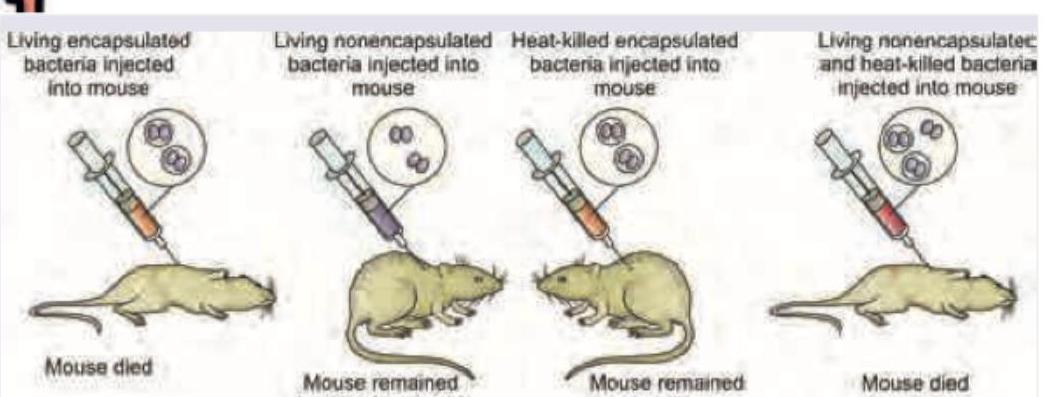
The Griffith experiment, which demonstrated bacterial transformation, was performed on which bacterium?
Which of the following would form the basis for karyotyping studies in females?
Bacteria can acquire new characteristics through several mechanisms. Which of the following is NOT a way bacteria gain new traits?
Which of the following statements is true when comparing E. coli chromosomal DNA with eukaryotic chromosomal DNA?
What does ORF stand for?
The bacterial genome has been completely sequenced for which one of the following agents?
Explanation: **Explanation:** The correct answer is **Episome**. An **episome** is a specific type of plasmid that possesses the unique genetic flexibility to exist in two states: independently as an extrachromosomal element within the cytoplasm, or integrated into the bacterial chromosome. When integrated, it replicates along with the host genome. The most classic example is the **F-plasmid (Fertility factor)** in *E. coli*; when it integrates into the chromosome, the bacterium is designated as an **Hfr (High-frequency recombination) cell**. **Analysis of Incorrect Options:** * **Autosome:** These are non-sex chromosomes found in eukaryotic cells. They are permanent structural components of the nuclear genome and do not exist as extrachromosomal entities. * **Endosome:** This is a membrane-bound compartment inside eukaryotic cells involved in the endocytic pathway (sorting material internalized from the cell surface). It is a structural organelle, not genetic material. * **Mesosome:** These are invaginations of the bacterial plasma membrane. While once thought to play a role in DNA replication or cell wall synthesis, they are now largely considered artifacts of chemical fixation for electron microscopy. **High-Yield Clinical Pearls for NEET-PG:** * **Hfr Cells:** Formed when an episome (F-factor) integrates into the bacterial chromosome via insertion sequences. * **Temperate Phages:** Certain viruses (like Lambda phage) act as episomes; they can either replicate lytically or integrate into the host DNA as a **prophage** (Lysogenic cycle). * **Drug Resistance:** While many R-plasmids are independent, some can behave as episomes, facilitating the rapid spread of multi-drug resistance through conjugation.
Explanation: **Explanation:** The development of drug resistance in *Mycobacterium tuberculosis* (MTB) is fundamentally different from many other bacteria. **Why Mutation is Correct:** In *M. tuberculosis*, drug resistance occurs exclusively due to **spontaneous chromosomal mutations**. Unlike many enteric bacteria, MTB does not possess horizontal gene transfer mechanisms like plasmids or transposons. These random mutations occur at a predictable frequency (e.g., 1 in $10^6$ to $10^8$ cell divisions). When a patient is treated with inadequate monotherapy or irregular dosing, these pre-existing mutant strains are "selected" for survival while sensitive bacilli are killed, leading to **acquired resistance**. **Why Other Options are Incorrect:** * **Conjugation:** This involves the transfer of genetic material (usually plasmids) through direct cell-to-cell contact. MTB does not utilize conjugation for clinical drug resistance. * **Transduction:** This is the transfer of bacterial DNA via a bacteriophage. While mycobacteriophages exist in research, they are not a mechanism for spreading drug resistance in clinical tuberculosis. * **Transformation:** (Not listed, but relevant) This involves the uptake of naked DNA from the environment, which also does not occur in MTB. **High-Yield Clinical Pearls for NEET-PG:** * **Target Genes:** Resistance to **Rifampicin** is primarily due to mutations in the **rpoB gene** (beta-subunit of RNA polymerase). This is the basis for the CBNAAT/GeneXpert test. * **Isoniazid (INH) Resistance:** Most commonly associated with mutations in the **katG gene** (catalase-peroxidase enzyme) or the **inhA promoter** region. * **Multi-Drug Resistant TB (MDR-TB):** Defined as resistance to at least Isoniazid and Rifampicin. * **Key Concept:** Because resistance is mutational and not plasmid-mediated, the risk of developing resistance to two drugs simultaneously is the product of individual mutation rates ($10^{-6} \times 10^{-8} = 10^{-14}$), which is why **combination therapy** is the gold standard for TB treatment.
Explanation: **Explanation:** **Bacterial Transduction** is the process by which DNA is transferred from one bacterium to another via a **Bacteriophage** (a virus that infects bacteria). During the viral replication cycle, a segment of bacterial DNA is accidentally packaged into the viral capsid instead of the viral genome. When this phage infects a new bacterium, it injects the donor DNA, which then integrates into the recipient’s genome. * **Generalized Transduction:** Occurs during the lytic cycle; any part of the bacterial genome can be transferred. * **Specialized Transduction:** Occurs during the lysogenic cycle; only specific genes adjacent to the prophage insertion site are transferred (e.g., Shiga-like toxin, Diphtheria toxin). **Analysis of Incorrect Options:** * **A & B (Plasmids/Sex Pili):** These are associated with **Conjugation**. This process requires direct cell-to-cell contact through a sex pilus (encoded by the F-plasmid) to transfer genetic material. * **D (Uptake of genetic material):** This describes **Transformation**, where a "competent" bacterium takes up naked DNA fragments directly from the surrounding environment (e.g., *S. pneumoniae, H. influenzae, Neisseria*). **High-Yield Clinical Pearls for NEET-PG:** 1. **Lysogenic Conversion:** This is a clinical consequence of specialized transduction where non-pathogenic bacteria become virulent by acquiring toxin genes (Mnemonic: **ABCD'S** – **A**ntigenic variation in *Salmonella*, **B**otulinum toxin, **C**holera toxin, **D**iphtheria toxin, **S**higa toxin). 2. **Drug Resistance:** While conjugation is the most common method for spreading multi-drug resistance, transduction is a significant mechanism for the spread of resistance in *Staphylococcus aureus*.
Explanation: ### Explanation **Correct Answer: A. Transposons** **Why it is correct:** Transposons, often called "jumping genes," are sequences of DNA that can move from one location to another within the genome. They possess the unique ability to exist either **integrated** within the chromosomal DNA or as independent segments during the process of transposition (moving to plasmids or other chromosomal sites). They carry the enzyme **transposase**, which facilitates their excision and integration. In medical microbiology, they are critical because they often carry antibiotic resistance genes (e.g., *vanA* in VRSA). **Why the other options are incorrect:** * **B. Cosmid:** These are hybrid vectors containing phage *lambda* cohesive (cos) sites and plasmid DNA. They are used in genetic engineering to clone large DNA fragments but do not naturally "jump" between integrated and independent states in the context of this definition. * **C. Plasmid:** These are extrachromosomal, circular DNA molecules that replicate independently. While some plasmids (like the F-plasmid) can integrate, the term "plasmid" primarily refers to the independent state. * **D. Episomes:** This is a common distractor. An episome is a type of plasmid that *can* integrate into the chromosome (e.g., the F-factor in Hfr cells). However, in the context of modern NEET-PG questions, **Transposons** are the specific "segments of DNA" defined by their mobility between integrated and independent genomic locations. **High-Yield Clinical Pearls for NEET-PG:** * **Transposons** do not have a self-replication origin; they must be part of a replicon (chromosome or plasmid) to be copied. * **Phase Variation:** Transposons can turn genes "on" or "off," a mechanism used by *Salmonella* to change flagellar antigens to evade the immune system. * **Medical Importance:** They are the primary drivers for the rapid spread of **Multi-Drug Resistance (MDR)** among bacterial populations.
Explanation: **Explanation:** The correct answer is **Streptococcus pneumoniae** (Option B). In 1928, Frederick Griffith conducted a landmark experiment that provided the first evidence of **bacterial transformation**. He used two strains of *Streptococcus pneumoniae* (Pneumococcus): the virulent **S-strain** (Smooth, encapsulated) and the non-virulent **R-strain** (Rough, non-encapsulated). Griffith observed that when heat-killed S-strain bacteria were mixed with live R-strain bacteria and injected into mice, the mice died. He concluded that a "transforming principle" had transferred from the dead S-strain to the live R-strain, enabling the latter to produce a capsule and become virulent. This "principle" was later identified as DNA by Avery, MacLeod, and McCarty. **Why other options are incorrect:** * **Streptococcus (Option A):** While *S. pneumoniae* belongs to this genus, the option is too broad. NEET-PG requires specificity, as other species like *S. pyogenes* were not part of this discovery. * **Enterococcus (Option C):** Formerly classified as Group D Streptococci, these are distinct organisms primarily known for vancomycin resistance (VRE), not the discovery of transformation. * **Staphylococcus (Option D):** These are Gram-positive cocci in clusters. While clinically significant for causing skin and soft tissue infections, they were not used in Griffith’s experiments. **High-Yield Clinical Pearls for NEET-PG:** * **Transformation** is the uptake of "naked" DNA from the environment by a competent bacterium. * *S. pneumoniae* is a classic example of a **naturally competent** bacterium. * **Capsule** is the primary virulence factor of *S. pneumoniae*; it inhibits phagocytosis. * **Quellung Reaction:** Used for serotyping *S. pneumoniae* based on capsular swelling.
Explanation: **Explanation:** The correct answer is **Barr body**. This question explores the intersection of microbial genetics and human cytogenetics, specifically the concept of **X-inactivation (Lyonization)**. **Why Barr body is correct:** A Barr body is a condensed, inactivated X chromosome found in the somatic cells of females. According to the Lyon hypothesis, in individuals with more than one X chromosome, all except one are randomly inactivated during early embryonic development to ensure dosage compensation. In a normal female (46, XX), one Barr body is visible under a microscope (calculated as *Number of X chromosomes minus 1*). Identifying a Barr body in a buccal smear or neutrophils (as a "drumstick" appearance) serves as a rapid screening tool for sex determination and chromosomal abnormalities before formal karyotyping. **Why other options are incorrect:** * **Phenotypic abnormality:** While clinical features (e.g., short stature in Turner syndrome) may prompt a karyotype study, they are the *reason* for the test, not the *basis* of the genetic identification itself. * **Testosterone quantity:** Hormonal levels are biochemical markers. While they may be altered in conditions like Kleinfelter syndrome, they do not provide information regarding chromosomal structure or number. * **Not applicable:** This is incorrect as the Barr body is a well-established cytogenetic marker. **High-Yield Clinical Pearls for NEET-PG:** * **Formula:** Number of Barr bodies = (Total X chromosomes – 1). * **Turner Syndrome (45, XO):** 0 Barr bodies. * **Klinefelter Syndrome (47, XXY):** 1 Barr body (despite being phenotypically male). * **Super-female (47, XXX):** 2 Barr bodies. * **Stain used:** Barr bodies are best visualized using **Feulgen stain** or **Papanicolaou stain**.
Explanation: ### Explanation The primary mechanisms of horizontal gene transfer (HGT) in bacteria are **Transformation, Transduction, and Conjugation**. These processes allow for the rapid spread of antibiotic resistance and virulence factors. **Why Option B is the Correct Answer (The "NOT" factor):** While bacteria frequently exchange DNA with other bacteria or viruses, they do **not** typically incorporate fragments of eukaryotic host DNA (e.g., human DNA) into their functional genome as a standard mechanism for gaining traits. While rare instances of inter-domain transfer exist in evolutionary history, it is not a recognized clinical mechanism for bacterial adaptation or pathogenesis in medical microbiology. **Analysis of Incorrect Options:** * **A. Transformation:** This involves the uptake of "naked" or soluble DNA from the environment by **competent** bacteria (e.g., *Streptococcus pneumoniae*, *Haemophilus influenzae*, *Neisseria*). Griffith’s experiment famously demonstrated this. * **C. Transduction:** Genetic transfer mediated by **bacteriophages** (viruses). It can be *Generalized* (any gene, via lytic cycle) or *Specialized* (specific genes, via lysogenic cycle). * **D. Conjugation:** Often called "bacterial sex," it requires direct cell-to-cell contact via a **sex pilus**. It is the most common method for spreading multi-drug resistance (R-plasmids). **High-Yield Clinical Pearls for NEET-PG:** * **Competence:** Only certain bacteria are naturally competent for transformation. * **Lysogenic Conversion:** A form of specialized transduction where a non-pathogenic bacterium becomes virulent (e.g., **COBEDS**: **C**holera toxin, **O** antigen of Salmonella, **B**otulinum toxin, **E**rythrogenic toxin of S. pyogenes, **D**iphtheria toxin, and **S**higa toxin). * **Hfr Cells:** High-frequency recombination occurs when an F-plasmid integrates into the bacterial chromosome. * **Transposons:** Known as "jumping genes," these move DNA within a cell (from plasmid to chromosome) but cannot move between cells on their own.
Explanation: **Explanation:** The correct answer is **D (All of these)** because *E. coli* (a prokaryote) and eukaryotes share specific fundamental structural characteristics in their DNA organization, despite significant differences in compartmentalization. 1. **Circular DNA:** While eukaryotic nuclear DNA is linear, eukaryotes possess **mitochondrial DNA (mtDNA)**, which is circular, just like the *E. coli* chromosome. This supports the endosymbiotic theory. 2. **Negatively Supercoiled:** Both *E. coli* and eukaryotic DNA are maintained in a negatively supercoiled state. This underwinding of the helix is essential because it stores energy that facilitates the "unzipping" of DNA strands during replication and transcription. In *E. coli*, this is managed by **DNA Gyrase** (Topoisomerase II), while eukaryotes use various topoisomerases and histone wrapping. 3. **Nucleoid/Nucleoid-like structures:** In *E. coli*, the DNA is concentrated in a non-membrane-bound region called the **nucleoid**. Similarly, the circular DNA within the eukaryotic mitochondria is also organized into structures called **nucleoids**. **Why other options are considered "correct" in this context:** The question asks for features true for *both*. Since circularity (via mitochondria), negative supercoiling (universal), and nucleoid presence (mitochondrial) apply to both systems, "All of these" is the most accurate choice. **High-Yield Clinical Pearls for NEET-PG:** * **DNA Gyrase:** The target of **Fluoroquinolones** (e.g., Ciprofloxacin). It is unique to bacteria, making it an ideal target for selective toxicity. * **Histones:** *E. coli* lacks true histones; it uses **Histone-like proteins (HU proteins)** to package DNA. * **Extrachromosomal DNA:** In *E. coli*, these are **Plasmids** (often carrying antibiotic resistance genes like NDM-1). In eukaryotes, this refers to mitochondrial or chloroplast DNA.
Explanation: **Explanation:** **Open Reading Frame (ORF)** is a fundamental concept in microbial genetics and bioinformatics. It refers to a continuous stretch of DNA sequence that has the potential to be translated into a protein. An ORF begins with a **start codon** (typically AUG), is followed by a series of codons representing amino acids, and ends with a **stop codon** (UAA, UAG, or UGA) in the same reading frame. In prokaryotes, identifying ORFs is the primary method for gene prediction because their genomes lack introns. **Analysis of Options:** * **Option A (Correct):** An ORF is defined by its ability to be "read" by ribosomes without encountering a premature stop signal, thus potentially encoding a polypeptide. * **Option B (Incorrect):** This is a fabricated term. While oncogenes are relevant in microbiology (e.g., HPV, EBV), "removing frequency" is not a standard genetic parameter. * **Option C (Incorrect):** This relates to biochemistry or environmental microbiology (bioremediation) but has no relevance to genetic sequencing or translation. * **Option D (Incorrect):** This is a distractor from Orthopedics (**ORIF** stands for Open Reduction Internal Fixation). It is unrelated to genetics. **High-Yield Clinical Pearls for NEET-PG:** * **Genomic Mapping:** In viruses like HIV or SARS-CoV-2, the genome is organized into multiple ORFs (e.g., ORF1a, ORF1b) which are translated into polyproteins and later cleaved by proteases. * **Overlapping Genes:** In many viruses and bacteria, ORFs can overlap to maximize the coding capacity of a small genome. * **Bioinformatics:** A sequence is generally considered a functional ORF if it exceeds a certain length (usually >100 codons) to minimize the chance of it occurring randomly.
Explanation: **Explanation:** The correct answer is **Helicobacter pylori**. The sequencing of bacterial genomes was a landmark achievement in microbiology during the late 1990s. *Helicobacter pylori* (Strain 26695) was one of the earliest human pathogens to have its entire genome completely sequenced and published in **1997**. This was clinically significant because it revealed the genetic basis for its survival in the acidic gastric environment, including genes for urease production and virulence factors like CagA and VacA. **Analysis of Options:** * **Helicobacter pylori (Correct):** Sequenced in 1997. It was a priority for researchers due to its strong association with peptic ulcer disease and gastric carcinoma. * **Campylobacter jejuni:** Its genome was completed later, in the year **2000**. * **Streptococcus pneumoniae:** The complete genome sequence was published in **2001**. * **Yersinia enterocolitica:** While related species like *Yersinia pestis* were sequenced early (2001), the full sequence for *Y. enterocolitica* was not completed until **2006**. **High-Yield Clinical Pearls for NEET-PG:** * **First-ever genome sequenced:** Bacteriophage **φX174** (1977). * **First free-living organism/bacterium sequenced:** *Haemophilus influenzae* (1995). * **First Eukaryote sequenced:** *Saccharomyces cerevisiae* (Yeast). * **First Multicellular organism:** *Caenorhabditis elegans*. * **H. pylori Key Fact:** It is a Gram-negative, microaerophilic, flagellated spiral rod. It is the only bacterium classified as a **Type 1 Carcinogen** by the WHO.
Bacterial Genome Organization
Practice Questions
Plasmids and Mobile Genetic Elements
Practice Questions
Bacterial Gene Expression
Practice Questions
Mutation and Mutagenesis
Practice Questions
Gene Transfer in Bacteria
Practice Questions
Transposons and Insertion Sequences
Practice Questions
Bacterial Genetic Recombination
Practice Questions
Regulation of Gene Expression
Practice Questions
CRISPR-Cas Systems
Practice Questions
Bacterial Stress Responses
Practice Questions
Genetics of Antimicrobial Resistance
Practice Questions
Genetic Basis of Bacterial Virulence
Practice Questions
Get full access to all questions, explanations, and performance tracking.
Start For Free