A frequent traveler presented with 4 days of continuous fever, abdominal pain, and bradycardia. What is the best diagnostic test to confirm the pathogen?
What is the best investigation for identifying malaria species?
A child presented with bloody stools and abdominal pain. Which enrichment medium should be used for processing the fecal sample?
Species identification is done by:
A farmer presents to the emergency department with painful inguinal lymphadenopathy and a history of fever and flu-like symptoms. Clinical examination reveals an ulcer on the leg. Which of the following stains should be used to detect suspected bipolar-stained organisms?
A farmer presents with pustules that show Gram-positive cocci on smear. The culture shows beta hemolysis, and the organisms are catalase-negative. To confirm that the identified organism is group A streptococcus, which of the following tests should be performed?
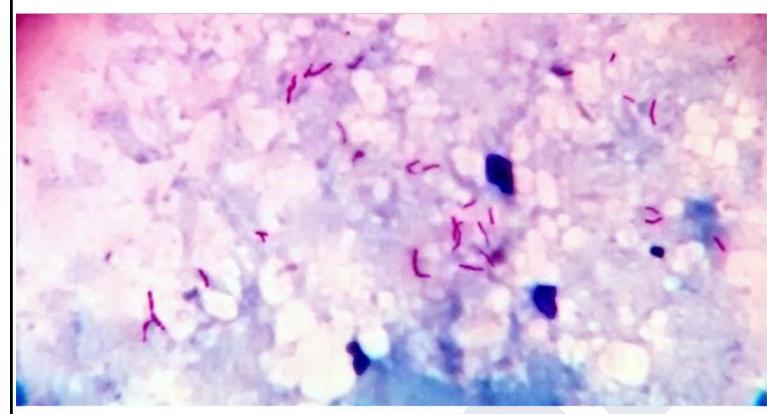
A 32 year old laborer working at a construction site presented with fever and hemoptysis. The sputum sample collected for examination showed the following. The smear will be stained by which of the following sequences?
A patient presented with meningitis, and the CSF sample shows Gram-negative diplococci on Gram staining and microscopy. Which of the following features/tests will be characteristic of the organism?
Most sensitive test for detecting microfilariae?
A female patient presents with dysuria and frequency. A coagulase-negative, novobiocin-resistant Staphylococcus species (>10^4 CFU/mL) was grown in urine culture. What does this indicate?
Explanation: ***Blood culture*** - **Blood culture** is the most sensitive and specific test for confirming **typhoid fever** in the first week of illness. - The presence of **continuous fever** (step-ladder pattern), **abdominal pain**, and **relative bradycardia** in a traveler strongly suggests typhoid fever caused by *Salmonella Typhi*. *Widal test* - The **Widal test** detects antibodies against *Salmonella Typhi* antigens and is often positive later in the disease course. - It has **limited sensitivity and specificity**, especially in endemic areas or with prior vaccination, leading to false positives and negatives. *Urine culture* - **Urine culture** has a low yield for *Salmonella Typhi*, as bacteria are intermittently shed in urine, usually later in the disease. - It's primarily useful for diagnosing **urinary tract infections** or in chronic carriers of typhoid. *Stool culture* - **Stool culture** yield is higher in the later stages of typhoid fever, as *Salmonella Typhi* is shed in feces. - Its sensitivity is lower than blood culture in the early acute phase when bacteremia is most prominent.
Explanation: ***Thin smear with Giemsa*** - A **thin smear** allows for the visualization of **parasite morphology** within red blood cells, which is crucial for distinguishing between species of *Plasmodium*. - **Giemsa stain** provides optimal contrast for identifying characteristic features such as **merozoites**, **trophozoites**, **schizonts**, and **gametocytes** of different malaria species. *Thick smear* - A **thick smear** is primarily used for **detecting the presence of malaria parasites** and for quantifying parasite density due to its higher sensitivity. - However, because red blood cells are lysed, it **does not preserve parasite morphology** well, making species identification difficult. *QBC* - **Quantitative Buffy Coat (QBC) analysis** is a rapid method for detecting malaria parasites based on their fluorescence under UV light. - While sensitive for detection, it generally **does not allow for precise species identification** due to the lack of clear morphological detail. *Thin smear with acridine orange* - A **thin smear stained with acridine orange** is used for rapid detection of parasites by fluorescence microscopy. - Similar to QBC, it is **less effective for detailed morphological examination** and specific species identification compared to Giemsa-stained thin smears.
Explanation: ***Selenite F broth*** - This **enrichment medium** is specifically designed to isolate **Salmonella** and some species of **Shigella**, which are common causes of bloody stools and abdominal pain in children. - It inhibits the growth of commensal gut flora, allowing pathogenic bacteria to proliferate and be subsequently identified on selective media. *Blood agar* - Blood agar is a **general-purpose enrichment medium** that supports the growth of a wide range of bacteria but does not selectively enrich for specific pathogens. - It would be ineffective in outcompeting the normal fecal flora to isolate rarer enteric pathogens causing the symptoms. *Alkaline peptone water* - This medium is primarily used for the enrichment of **Vibrio cholerae** species, which typically cause watery diarrhea, not bloody stools. - While it helps in the isolation of *Vibrio* species, it is not suitable for the suspected pathogens in this clinical scenario. *Muller Hinton Broth* - Muller-Hinton media are primarily used for **antimicrobial susceptibility testing** (antibiotic sensitivity testing) and are not designed for the primary isolation or enrichment of specific pathogens from clinical samples. - It would not provide a selective advantage for the recovery of organisms causing bloody diarrhea from a fecal sample.
Explanation: ***Precipitin test*** - The **precipitin test** is the **gold standard method for species identification** in forensic serology. - It is based on the principle of **antigen-antibody reaction**, where species-specific antisera (e.g., anti-human serum) react with corresponding antigens in the biological sample. - When positive, a visible **precipitate forms at the interface**, confirming the species origin of the bloodstain or bodily fluid. - This test is **highly specific** and can differentiate human blood from animal blood. *Benzidine test* - The **benzidine test** is a **presumptive test for blood** that detects the presence of hemoglobin through a color change reaction. - It is **not species-specific** and cannot differentiate between human and animal blood. - It only indicates the **likely presence of blood**, requiring further confirmatory testing. *Spectroscopy* - **Spectroscopy** involves analyzing the interaction of electromagnetic radiation with matter to identify chemical composition. - While useful for identifying various compounds, it is **not the standard method for species identification of biological samples** in forensic practice. - Other specialized techniques are preferred for determining species origin. *Takayama test* - The **Takayama test** (haemochromogen crystal test) is a **confirmatory test for blood** that detects hemoglobin derivatives by forming characteristic pink crystals. - Like the benzidine test, it confirms blood presence but **does not determine species origin**. - It is used to confirm that a stain is blood, not to identify whether it is human or animal.
Explanation: ***Wayson's stain*** - This stain is specifically used for the detection of **Yersinia pestis**, the causative agent of **plague**, which often presents with **bipolar staining**. - Clinical features like **painful inguinal lymphadenopathy** (buboes), fever, flu-like symptoms, and an ulcer (possibly an inoculation site) are highly suggestive of **plague**. *Albe's stain* - **Albe's stain** is used for demonstrating **bacterial capsules**, not for bipolar-stained organisms. - It would not specifically identify **Yersinia pestis** in this context. *Mc Fayden's stain* - **McFadyen's stain** is primarily used to detect the capsule of **Bacillus anthracis** (anthrax) from smears. - While helpful for anthrax, it is not the specific stain for bipolar staining of **Yersinia pestis**. *Ziehl Nelson stain* - **Ziehl-Neelsen stain** is an **acid-fast stain** used to identify organisms with high mycolic acid content in their cell walls, such as **Mycobacterium tuberculosis**. - It is not suitable for visualizing gram-negative bacteria like **Yersinia pestis** or their bipolar staining characteristics.
Explanation: ***Bacitracin sensitivity*** - **Group A Streptococcus (GAS)** is uniquely sensitive to bacitracin, distinguishing it from most other beta-hemolytic streptococci. - A definitive zone of inhibition around a **bacitracin disk** on a blood agar plate indicates GAS. *Optochin sensitivity* - This test is used to identify **Streptococcus pneumoniae**, which is alpha-hemolytic, not beta-hemolytic like the organism described. - *S. pneumoniae* is **sensitive to optochin**, while other alpha-hemolytic streptococci are resistant. *Novobiocin sensitivity* - This test is primarily used to differentiate coagulase-negative staphylococci, specifically to identify **Staphylococcus saprophyticus** (resistant) from other coagulase-negative staphylococci (sensitive). - It is not applicable to the identification of streptococci. *Bile solubility* - This test is used to differentiate **Streptococcus pneumoniae** (bile soluble) from other alpha-hemolytic streptococci. - The described organism is **beta-hemolytic**, making this test inappropriate for its identification.
Explanation: ***Carbol fuchsin - acid - alcohol- methylene blue*** - The image displays thin, red, rod-shaped bacteria against a blue background, characteristic of **acid-fast bacilli** stained using the **Ziehl-Neelsen (ZN) method**. This staining sequence identifies *Mycobacterium tuberculosis*. - The ZN stain involves **carbol fuchsin** as the primary stain, followed by **acid-alcohol** as a decolorizer, and then **methylene blue** as a counterstain. *Methylene blue- malachite green-acetic acid - water* - This sequence is not a standard microbiological staining procedure for identifying common pathogens or acid-fast bacteria. - It does not contain the necessary components to achieve **acid-fast staining**, which is crucial for identifying mycobacteria. *Gentian violet - iodine - alcohol saffranin* - This sequence describes the reagents used in a **Gram stain**, which differentiates bacteria based on their cell wall composition. - Gram staining would show either purple (Gram-positive) or pink (Gram-negative) bacteria, not the red acid-fast bacilli seen in the image. *Methanol - methylene blue-acid - water* - While methylene blue is a counterstain in ZN, this sequence is incomplete and incorrect for standard acid-fast staining or other common bacterial stains. - It lacks **carbol fuchsin** as the primary stain, which is essential for acid-fast bacteria to retain the stain after destaining.
Explanation: ***Oxidase positive, catalase positive, ferments glucose and maltose*** - The CSF findings show **Gram-negative diplococci**, characteristic of *Neisseria meningitidis*, a major cause of bacterial meningitis. - *N. meningitidis* is definitively identified by being **oxidase positive, catalase positive**, and able to **ferment both glucose and maltose**. *Catalase negative, optochin sensitive, alpha-hemolytic* - These are characteristic features of *Streptococcus pneumoniae*, which appears as **Gram-positive lancet-shaped diplococci**, not the Gram-negative diplococci seen in this case. - *S. pneumoniae* is **catalase negative** and shows **alpha-hemolysis** on blood agar, distinguishing it from Neisseria species. *Oxidase negative, catalase positive, coagulase positive* - These biochemical properties describe *Staphylococcus aureus*, which appears as **Gram-positive cocci in clusters** on microscopy. - *S. aureus* is **oxidase negative** and **coagulase positive**, completely different from the organism characteristics shown in the CSF sample. *Catalase positive, urease positive, does not ferment glucose* - This combination suggests organisms like **Enterobacteriaceae** or *Cryptococcus neoformans*, which have different morphological appearances. - The **urease positivity** and **lack of glucose fermentation** are inconsistent with *N. meningitidis*, which readily ferments glucose.
Explanation: ***Membrane filtration technique*** - The **membrane filtration technique** is considered the most sensitive test for detecting **microfilariae** because it concentrates microfilariae from a larger volume of blood (typically 1 mL or more) onto a filter membrane, increasing detection rates, especially in low-parasite density infections. - This method physically traps the microfilariae, allowing for microscopic examination of the concentrated sample after staining, which enhances visualization. *Diethylcarbamazine (DEC) challenge test* - The **DEC challenge test** uses **diethylcarbamazine** to provoke the release of microfilariae into the peripheral blood, especially in cases of occult filariasis or when microfilaria numbers are low. - While it can be useful in certain diagnostic situations, it is **less sensitive** than membrane filtration for directly detecting circulating microfilariae and carries the risk of inducing severe adverse reactions due to rapid parasite killing. *Fluorescence-based immunoassay* - **Fluorescence-based immunoassays** detect **antigens** or **antibodies** related to filarial infection, providing evidence of exposure or active infection. - While valuable for diagnosis, especially in antibody detection for chronic or occult infections, they do not directly detect live microfilariae and thus are not the most sensitive method for *detecting microfilariae themselves*. *Thick blood smear* - A **thick blood smear** is a common and quick method for detecting microfilariae by examining a drop of blood for their presence. - However, it is **less sensitive** than the membrane filtration technique, particularly in persons with low microfilaremia, as it examines a much smaller volume of blood.
Explanation: ***UTI*** - The isolation of a **coagulase-negative, novobiocin-resistant Staphylococcus** in a patient with UTI symptoms suggests **_Staphylococcus saprophyticus_**, a common cause of UTIs in young women. - A bacterial count of **>10^4 CFU/mL** is generally considered significant for diagnosing a UTI, indicating active infection rather than contamination. - _S. saprophyticus_ accounts for 10-20% of UTIs in sexually active young women and is the second most common cause after _E. coli_. *Commensal* - While some coagulase-negative staphylococci can be commensals, **_S. saprophyticus_** is an important pathogen, especially in UTIs. - The combination of **novobiocin resistance** and a significant bacterial count in a symptomatic patient strongly points away from a commensal role. *Contamination* - **Contamination** usually involves lower bacterial counts (<10^4 CFU/mL) or the isolation of multiple different organisms. - The presence of **>10^4 CFU/mL** of a pure culture of a known urinary pathogen (_S. saprophyticus_) in a symptomatic patient makes contamination unlikely. *Repeat culture needed* - Repeat cultures are indicated when initial results are equivocal (e.g., low counts, mixed flora, or asymptomatic bacteriuria). - For symptomatic UTI with **>10^4 CFU/mL** of a known pathogen, a single culture is sufficient for diagnosis and treatment initiation. - Multiple consecutive samples are primarily used for diagnosing **bacteremia** or **endocarditis**, not routine UTI.
Get full access to all questions, explanations, and performance tracking.
Start For Free