An advanced diagnostic technique that has been suggested as an alternative to culture methods is:
Which of the following is best for ante-mortem diagnosis of rabies?
A female patient presents with dysuria and frequency. A coagulase-negative, novobiocin-resistant Staphylococcus species (>10^4 CFU/mL) was grown in urine culture. What does this indicate?
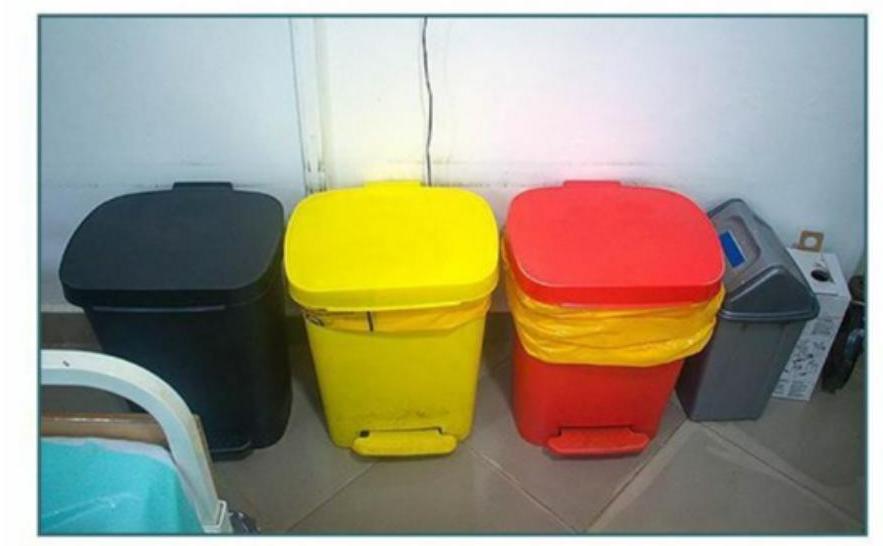
A nurse keeps the bins as shown in the image in the hospital ward. Which of the following items would go into the black bin?
A Giemsa stain of a thin peripheral blood smear is prepared. Which of the following cannot be diagnosed?
A farmer presents to the emergency department with painful inguinal lymphadenopathy and a history of fever and flu-like symptoms. Clinical examination reveals an ulcer on the leg. Which of the following stains should be used to detect suspected bipolar-stained organisms?
Staphylococcus is a type of:
Category A bioterrorism agent is:
Which of the following is classified as a Category A bioterrorism agent?
Targeted critical agents used in a bioterrorist event are except?
Explanation: ***Direct immunofluorescence*** - **Direct immunofluorescence** (DIF) uses fluorescently labeled antibodies to directly bind to and detect antigens in a sample, providing a rapid alternative to culture for identifying pathogens. - This method offers high **specificity and sensitivity**, reducing turnaround time compared to traditional culture. *Phase contrast microscopy* - **Phase contrast microscopy** enhances the contrast of unstained, live biological samples, making transparent specimens visible. - While useful for observing cell morphology and motility, it does not directly identify specific pathogens based on antigenic properties in the way culture or antibody-based methods do. *Latex agglutination* - **Latex agglutination** assays detect antigens or antibodies by observing the clumping of latex beads coated with specific reagents. - It is a rapid diagnostic test but is generally less sensitive than immunofluorescence and relies on visible agglutination, which can sometimes be subjective. *Indirect immunofluorescent assays* - **Indirect immunofluorescent assays** (IFA) involve two steps: primary unlabeled antibodies bind to antigens, followed by fluorescently labeled secondary antibodies that bind to the primary antibodies. - While IFA is a sensitive method for detecting antibodies or antigens, it is a two-step process, making **direct immunofluorescence** a more "direct" and often faster alternative to culture.
Explanation: ***Immunofluorescence of skin biopsy*** - This method involves taking a **skin biopsy** from the **nuchal area** (nape of the neck) and staining it with **fluorescently labeled antibodies** to detect **rabies viral antigens** in cutaneous nerves. - It is considered the most reliable ante-mortem diagnostic test for rabies due to its high specificity and sensitivity in detecting viral nucleocapsid protein. *Immunofluorescence of corneal impressions* - While this method can detect rabies antigens, it generally has **lower sensitivity** compared to skin biopsy. - The procedure can be technically challenging and may yield **false negatives**, especially in early stages of the disease. *Isolation of virus from saliva* - **Viral isolation from saliva** is a possible method, but it is **less sensitive** and **more time-consuming** than immunological detection. - The shedding of rabies virus in saliva can be **intermittent**, leading to potential false negatives. *Antirabies antibodies in blood* - The presence of **antirabies antibodies in the blood** usually indicates either prior vaccination or a late stage of infection where the immune system has begun to respond. - These antibodies are often **undetectable in the early stages** of rabies infection, making this test unreliable for early ante-mortem diagnosis.
Explanation: ***UTI*** - The isolation of a **coagulase-negative, novobiocin-resistant Staphylococcus** in a patient with UTI symptoms suggests **_Staphylococcus saprophyticus_**, a common cause of UTIs in young women. - A bacterial count of **>10^4 CFU/mL** is generally considered significant for diagnosing a UTI, indicating active infection rather than contamination. - _S. saprophyticus_ accounts for 10-20% of UTIs in sexually active young women and is the second most common cause after _E. coli_. *Commensal* - While some coagulase-negative staphylococci can be commensals, **_S. saprophyticus_** is an important pathogen, especially in UTIs. - The combination of **novobiocin resistance** and a significant bacterial count in a symptomatic patient strongly points away from a commensal role. *Contamination* - **Contamination** usually involves lower bacterial counts (<10^4 CFU/mL) or the isolation of multiple different organisms. - The presence of **>10^4 CFU/mL** of a pure culture of a known urinary pathogen (_S. saprophyticus_) in a symptomatic patient makes contamination unlikely. *Repeat culture needed* - Repeat cultures are indicated when initial results are equivocal (e.g., low counts, mixed flora, or asymptomatic bacteriuria). - For symptomatic UTI with **>10^4 CFU/mL** of a known pathogen, a single culture is sufficient for diagnosis and treatment initiation. - Multiple consecutive samples are primarily used for diagnosing **bacteremia** or **endocarditis**, not routine UTI.
Explanation: ***Glove paper cover*** - The black bin is typically designated for **general waste** that is neither infectious nor sharp. - A glove paper cover is considered **non-hazardous**, non-recyclable waste and would be appropriately disposed of in a black bin. *Gloves* - **Used gloves**, even if not obviously contaminated with bodily fluids, are considered potentially infectious waste and should not be placed in the black bin. - These should generally be disposed of in a **yellow bag or bin** (infectious waste) to prevent cross-contamination. *Soiled linen bedsheet* - A soiled linen bedsheet is considered **infectious waste**, as it may contain bodily fluids or pathogens. - This type of waste requires specific handling and disposal, usually in **red bags or bins**, not general waste. *Contaminated gloves* - **Contaminated gloves** are classified as infectious waste and must be disposed of in designated containers for biohazard materials. - Placing them in a black bin would pose a **risk of infection** to waste handlers and is against standard medical waste disposal protocols.
Explanation: ***Coxiella burnettii*** - *Coxiella burnettii* causes **Q fever** and is an **obligate intracellular bacterium** that resides primarily in **tissue macrophages** (lungs, liver, bone marrow), not in circulating blood cells. - It is **not found in peripheral blood smears** because it does not infect circulating leukocytes in significant numbers that would allow microscopic visualization. - Diagnosis requires **serology** (most common), **PCR**, or specialized culture in BSL-3 facilities—direct microscopic visualization in blood smears is not possible. *Bartonella henselae* - Causes **Cat scratch disease** and can invade **red blood cells**, making it potentially visible on Giemsa-stained blood smears, particularly in immunocompromised patients with bacillary angiomatosis or bacteremia. - While difficult and not the primary diagnostic method, it *can* be visualized in peripheral blood, unlike *Coxiella*. *Ehrlichia chaffeensis* - Causes **human monocytotropic ehrlichiosis (HME)** and forms characteristic **morulae** (berry-like clusters) within the cytoplasm of **monocytes**. - These morulae are readily visible on **Giemsa-stained peripheral blood smears** and are a key diagnostic finding, making this condition easily diagnosed by this method. *Toxoplasma gondii* - An **intracellular parasite** whose **tachyzoites** can occasionally be found in **peripheral blood leukocytes** during acute infection, especially in immunocompromised patients. - While rare and not the primary diagnostic method (serology/PCR preferred), tachyzoites *can* be observed in blood smears during active parasitemia.
Explanation: ***Wayson's stain*** - This stain is specifically used for the detection of **Yersinia pestis**, the causative agent of **plague**, which often presents with **bipolar staining**. - Clinical features like **painful inguinal lymphadenopathy** (buboes), fever, flu-like symptoms, and an ulcer (possibly an inoculation site) are highly suggestive of **plague**. *Albe's stain* - **Albe's stain** is used for demonstrating **bacterial capsules**, not for bipolar-stained organisms. - It would not specifically identify **Yersinia pestis** in this context. *Mc Fayden's stain* - **McFadyen's stain** is primarily used to detect the capsule of **Bacillus anthracis** (anthrax) from smears. - While helpful for anthrax, it is not the specific stain for bipolar staining of **Yersinia pestis**. *Ziehl Nelson stain* - **Ziehl-Neelsen stain** is an **acid-fast stain** used to identify organisms with high mycolic acid content in their cell walls, such as **Mycobacterium tuberculosis**. - It is not suitable for visualizing gram-negative bacteria like **Yersinia pestis** or their bipolar staining characteristics.
Explanation: ***Gram-positive cocci*** - **Staphylococcus** bacteria are characterized by their **spherical shape** (cocci) and their ability to retain crystal violet stain due to a thick **peptidoglycan layer** in their cell wall, classifying them as Gram-positive. - They typically arrange in **grape-like clusters**. *Gram-negative cocci* - **Gram-negative cocci** do not retain the crystal violet stain, appearing red or pink, and have a thin peptidoglycan layer along with an **outer membrane**. - Examples include species like **Neisseria gonorrhoeae** and **Neisseria meningitidis**, which are distinct from Staphylococcus. *Gram-positive bacillus* - **Gram-positive bacilli** are rod-shaped bacteria that retain the crystal violet stain. - Examples include **Bacillus anthracis** and **Clostridium difficile**, which have a different morphology and staining characteristic than Staphylococcus. *Gram-negative bacillus* - **Gram-negative bacilli** are rod-shaped bacteria that appear red or pink after Gram staining due to their inability to retain crystal violet. - Examples include **Escherichia coli** and **Salmonella species**, sharing neither the morphology nor the Gram staining result of Staphylococcus.
Explanation: **Anthrax** - **Anthrax** is classified as a Category A bioterrorism agent due to its high mortality rate, ease of dissemination, and potential for major public health impact. - Caused by **Bacillus anthracis**, it can be spread through spores, leading to cutaneous, gastrointestinal, or inhalational forms, the latter being the most lethal. *Influenza* - While seasonal **influenza** can cause widespread illness and significant morbidity/mortality, it is typically considered a naturally occurring public health threat rather than a primary bioterrorism agent. - The rapid mutation of influenza viruses makes vaccine development challenging, but it doesn't meet the criteria for a Category A agent's specific risk profile. *Hendra* - **Hendra virus** is a zoonotic virus primarily found in Australia, transmitted from bats to horses and then potentially to humans. - It causes severe, often fatal, respiratory and neurological disease, but its limited geographic range and difficulty in human-to-human transmission exclude it from the highest bioterrorism category. *Chikungunya* - **Chikungunya virus** is a mosquito-borne illness causing fever and severe joint pain, primarily in tropical and subtropical regions. - While it can cause significant public health issues due to outbreaks, it typically has a low mortality rate and is not easily aerosolized or engineered for mass casualties, thus not classified as a Category A agent.
Explanation: ***Bacillus anthracis*** - **Anthrax**, caused by *Bacillus anthracis*, is a prime example of a Category A bioterrorism agent due to its high mortality, ease of dissemination, and potential for major public health impact. - Category A agents pose the **greatest threat** to public health and national security. *Clostridium perfringens* - *Clostridium perfringens* is classified as a **Category B bioterrorism agent**. - While it causes **gas gangrene** and food poisoning with moderate severity, it lacks the **high transmissibility** and widespread impact characteristic of Category A agents. *NIPAH virus* - **Nipah virus** is classified as a Category C priority pathogen. - It has the potential for high morbidity and mortality, but its **epidemiological characteristics** (e.g., lower transmissibility than Category A agents) preclude its inclusion in Category A. *Coxiella burnetii* - *Coxiella burnetii*, the causative agent of **Q fever**, is classified as a Category B bioterrorism agent. - Category B agents are moderately easy to disseminate and can cause **moderate morbidity** and low mortality, which is less severe than Category A agents.
Explanation: ***Coxiella burnetii*** - This is the **correct answer** as it is classified as a **Category B biological agent**, not a Category A critical agent. - While *C. burnetii* causes **Q fever** and has high infectivity with potential for widespread illness, it typically has **lower mortality rates** compared to Category A agents. - Category B agents are second-priority because they are moderately easy to disseminate but cause lower mortality than Category A agents. *Ricinus communis* - This refers to **ricin toxin** derived from castor beans, classified as a **Category B agent**. - However, ricin is considered more dangerous than Q fever due to its potent toxicity and lack of antidote. - Can cause severe multi-organ damage upon inhalation or ingestion, though less lethal than Category A agents. *Smallpox* - Caused by **variola virus**, classified as a **Category A critical agent**. - High infectivity, severe illness, high mortality rate, and lack of natural immunity in most populations. - Historical use as a bioweapon and potential for rapid global spread make it a top-tier threat. *Viral hemorrhagic fevers - Junin virus* - **Category A critical agent** due to high infectivity, severe disease presentation, and high mortality rates. - Includes agents like Ebola, Marburg, Lassa, and Junin viruses that cause severe multi-system disease. - Person-to-person transmission potential and lack of effective treatments make these priority threats.
Get full access to all questions, explanations, and performance tracking.
Start For Free