In an accident case, after the arrival of medical team, all should be done in early management except;
Which of the following diseases is classified under category-B of bioterrorism?
Bioterrorism is associated with all, except:
Targeted critical agents used in a bioterrorist event are except?
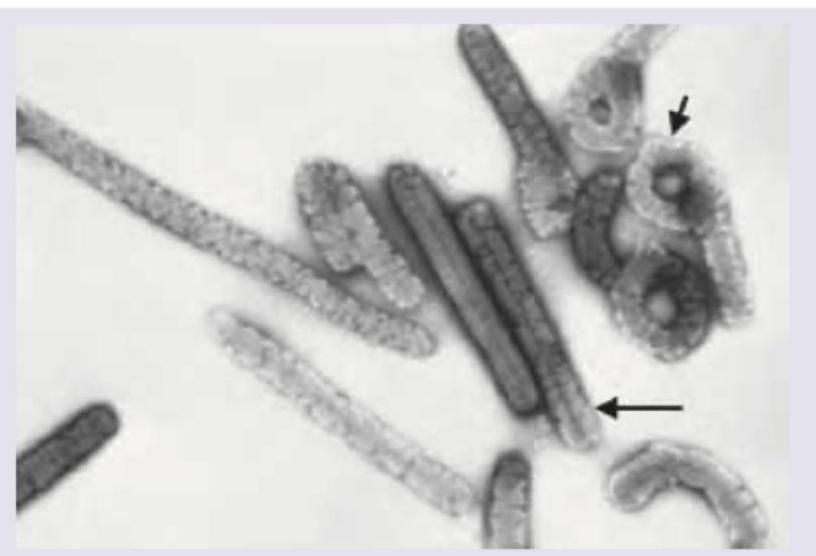
The following electron microscope image shows presence of:
All of the following statements about Glanders are false except?
Which is the most important and potential agent that can be used in bioterrorism?
Which of the following is not a Group A bioterrorism agent?
Which of the following are Category A bioterrorism agents?
Which of the following is NOT included under category A Bioterrorism agents?
Explanation: ***Check BP*** - In the **immediate/early management** of trauma (primary survey), while circulation assessment is crucial, the **initial assessment of circulation** focuses on: - **Pulse rate and quality** (radial, carotid) - **Capillary refill time** - **Skin color and temperature** - **Active hemorrhage control** - **Formal blood pressure measurement** with a cuff, while important, is typically recorded during or after these rapid initial assessments, as it takes more time to obtain an accurate reading. - In the context of this question, among the four options listed, BP measurement is relatively less immediate compared to the other life-saving priorities (airway protection, breathing assessment, C-spine stabilization, and GCS). - **Note:** This is a nuanced distinction - BP is assessed during primary survey, but the other three options have more immediate life-threatening implications if not addressed. *Glasgow coma scale* - **GCS assessment** is part of the **"D" (Disability)** step in the ATLS primary survey. - It is performed early to assess neurological status and level of consciousness. - GCS <8 indicates need for **definitive airway protection** (intubation). - This is a critical early assessment that guides immediate management decisions. *Stabilization of cervical vertebrae* - **C-spine immobilization** is part of the **"A" (Airway)** step - "Airway with cervical spine protection." - It is performed **simultaneously** with airway assessment using a **rigid cervical collar**. - This is the **first priority** in trauma management to prevent secondary spinal cord injury. - All trauma patients should be assumed to have C-spine injury until proven otherwise. *Check Respiration* - **Respiratory assessment** is part of the **"B" (Breathing)** step in the ATLS primary survey. - This involves checking: - **Respiratory rate and pattern** - **Chest wall movement** - **Air entry bilaterally** - **Signs of tension pneumothorax or flail chest** - This is an immediate life-saving priority and must be assessed early.
Explanation: ***Cholera*** - **Cholera** is classified under **Category B** agents due to its moderate ease of dissemination, moderate morbidity rates, and low mortality rates. - While it can cause severe diarrheal disease, its treatment is relatively straightforward with **rehydration therapy**, and it poses a lower risk of mass casualties compared to Category A agents. *Anthrax* - **Anthrax** is a **Category A** bioterrorism agent, characterized by its high mortality rate, ease of dissemination, and potential for major public health impact. - It poses a significant threat due to its ability to form **spores** that are highly resistant and can cause severe lung infection. *Plague* - **Plague** is designated as a **Category A** agent because of its high potential for mass dissemination, high mortality if untreated, and potential to cause widespread panic. - It can be spread via **aerosols** and can lead to severe systemic illness. *Botulism* - **Botulism** is classified as a **Category A** agent due to the extreme potency of the **botulinum toxin**, even in minute quantities, which can cause severe flaccid paralysis and death. - It has a high potential for causing severe public health impact and requires complex medical interventions.
Explanation: ***Chicken pox*** - While contagious, **chickenpox (varicella-zoster virus)** is generally a mild childhood illness with widespread vaccination available. - It does not possess the high morbidity, mortality, or widespread panic potential that would make it a primary agent for **bioterrorism**. *Plague* - **Plague**, caused by *Yersinia pestis*, has historically been used as a bioterrorism agent due to its high mortality rate, especially the pneumonic form. - It can be easily disseminated and is capable of causing **widespread infection** in a susceptible population, leading to significant public health emergencies. *Clostridia* - **Clostridia** species, particularly *Clostridium botulinum* (producing botulinum toxin), are considered significant bioterrorism threats. - **Botulinum toxin** is one of the most potent neurotoxins known, capable of causing severe **paralysis and death** with minute quantities. *Ebola virus* - The **Ebola virus** causes severe hemorrhagic fever with a high fatality rate. - Its high transmissibility, severe symptoms, and lack of readily available treatments or vaccines make it a potent biological weapon.
Explanation: ***Coxiella burnetii*** - This is the **correct answer** as it is classified as a **Category B biological agent**, not a Category A critical agent. - While *C. burnetii* causes **Q fever** and has high infectivity with potential for widespread illness, it typically has **lower mortality rates** compared to Category A agents. - Category B agents are second-priority because they are moderately easy to disseminate but cause lower mortality than Category A agents. *Ricinus communis* - This refers to **ricin toxin** derived from castor beans, classified as a **Category B agent**. - However, ricin is considered more dangerous than Q fever due to its potent toxicity and lack of antidote. - Can cause severe multi-organ damage upon inhalation or ingestion, though less lethal than Category A agents. *Smallpox* - Caused by **variola virus**, classified as a **Category A critical agent**. - High infectivity, severe illness, high mortality rate, and lack of natural immunity in most populations. - Historical use as a bioweapon and potential for rapid global spread make it a top-tier threat. *Viral hemorrhagic fevers - Junin virus* - **Category A critical agent** due to high infectivity, severe disease presentation, and high mortality rates. - Includes agents like Ebola, Marburg, Lassa, and Junin viruses that cause severe multi-system disease. - Person-to-person transmission potential and lack of effective treatments make these priority threats.
Explanation: ***Ebola virus*** - The electron micrograph clearly shows characteristic **filamentous, long, and pleomorphic viral particles**, some displaying coiled or branched structures, which are hallmarks of the **Filoviridae family**, to which Ebola belongs. - The presence of distinct, elongated forms, often appearing as "shepherd's crook" shapes or U-shaped structures (as indicated by the arrows), is highly indicative of the **Ebola virus morphology**. *Swine flu virus* - Swine flu, caused by influenza viruses, typically presents as **spherical or pleomorphic virions**, but not in the distinct elongated filamentous forms seen in the image. - Influenza viruses have a segmented RNA genome enclosed within a spherical capsid and an outer envelope, giving them a more rounded appearance. *Rabies virus* - Rabies virus has a classical **bullet-shaped morphology**, which is distinctly different from the long, filamentous structures observed in the image. - Its unique shape is a key identifying feature in electron microscopy. *Polio virus* - Poliovirus is a non-enveloped RNA virus with an **icosahedral (spherical) capsid structure**, much smaller and more geometrically regular than the filamentous particles shown. - It does not exhibit the elongated, flexible morphology characteristic of filoviruses.
Explanation: **Explanation:** **Glanders** is a serious zoonotic disease caused by the Gram-negative bacterium ***Burkholderia mallei***. It primarily affects horses, mules, and donkeys. **Why Option D is Correct:** The CDC categorizes bioterrorism agents into three classes (A, B, and C) based on their potential for dissemination and severity. **Class B agents** are the second highest priority; they are moderately easy to disseminate, result in moderate morbidity rates, and low mortality rates. *Burkholderia mallei* (Glanders) and *Burkholderia pseudomallei* (Melioidosis) are both classified as **Category B** agents. **Why the other options are Incorrect:** * **Option A:** Glanders is **not** a mild, self-limited illness. It is a severe, often fatal disease characterized by pneumonia, bloodstream infections (sepsis), and chronic localized infections in the skin and muscle. * **Option B:** Glanders is caused by ***Burkholderia mallei***, not *Brucella*. *Brucella* causes Brucellosis (undulant fever). * **Option C:** Human infection **can** be acquired from infected animals. It is a zoonosis transmitted through direct contact with infected animal tissues, secretions, or inhalation of infectious aerosols. **High-Yield NEET-PG Pearls:** * **Causative Agent:** *Burkholderia mallei* (Non-motile, unlike *B. pseudomallei* which is motile). * **Strauss Reaction:** A classic diagnostic test where intraperitoneal inoculation of infected material into male guinea pigs causes severe orchitis (scrotal swelling). * **Mallein Test:** A skin test used in veterinary medicine to detect Glanders in horses. * **Category A Agents (The "Big Six"):** Anthrax, Botulism, Plague, Smallpox, Tularemia, and Viral Hemorrhagic Fevers (Ebola/Marburg). Remember these for contrast!
Explanation: **Explanation:** The Centers for Disease Control and Prevention (CDC) classifies bioterrorism agents into three categories (A, B, and C) based on their risk to national security. **Smallpox (Variola major)** is considered the most significant potential agent because it fulfills all criteria for a **Category A agent**: it is easily disseminated (person-to-person via aerosols), has a high mortality rate (approx. 30%), and carries the potential for major public health impact and social disruption. Since routine vaccination ceased in 1980, the global population has negligible immunity, making it a devastating biological weapon. **Analysis of Options:** * **Plague (*Yersinia pestis*):** Also a Category A agent. While highly lethal (especially pneumonic plague), it is treatable with antibiotics (e.g., Streptomycin, Doxycycline), making it slightly less "ideal" as a permanent threat compared to the viral nature of Smallpox. * **C. botulinum:** The botulinum toxin is the most potent lethal substance known and is a Category A agent. However, it is not contagious (no person-to-person spread), which limits its potential for a widespread pandemic compared to Smallpox. * **Tuberculosis:** Not classified as a primary bioterrorism agent. While serious, its slow incubation period and chronic nature make it ineffective for the rapid, mass-casualty goals of bioterrorism. **High-Yield Clinical Pearls for NEET-PG:** * **Category A Agents (Mnemonic: "6 Ps"):** **P**lague, **P**ox (Smallpox), **P**hantastic (Anthrax), **P**otent Toxin (Botulism), **P**ulmonic (Tularemia), and **P**yretic (Viral Hemorrhagic Fevers like Ebola). * **Smallpox vs. Chickenpox:** Smallpox rashes are **centrifugal** (more on limbs/face), in the **same stage** of development, and involve **palms/soles**. Chickenpox is centripetal, pleomorphic (different stages), and spares palms/soles. * **Anthrax:** The most likely agent for "postal" bioterrorism (spores).
Explanation: **Explanation:** The CDC categorizes bioterrorism agents into three groups (A, B, and C) based on their potential for mass dissemination, mortality rates, and public health impact. **Why Salmonella is the correct answer:** *Salmonella* species (specifically food safety threats) are classified as **Category B** agents. Category B agents are the second highest priority; they are moderately easy to disseminate, result in moderate morbidity rates, and low mortality rates. While they still pose a threat, they do not have the same catastrophic potential as Category A agents. **Why the other options are incorrect:** Category A agents are high-priority pathogens that pose the highest risk to national security because they can be easily transmitted from person to person, result in high mortality rates, and might cause public panic. * **Smallpox (*Variola major*):** A classic Category A agent due to its high infectivity and historical severity. * **Hemorrhagic fever viruses:** This includes Ebola, Marburg, Lassa, and Machupo. These are Category A due to high fatality rates and specialized laboratory requirements. * **Botulism (*Clostridium botulinum* toxin):** Though not contagious, the extreme potency of the toxin makes it a Category A threat. **High-Yield NEET-PG Pearls:** * **Mnemonic for Category A Agents:** "**ABC** **S**ure **P**ay" * **A**nthrax (*Bacillus anthracis*) * **B**otulism (*Clostridium botulinum*) * **C**holera is NOT here (Note: *Vibrio* is Category B) — The 'C' stands for **C**yclical/Viral Hemorrhagic Fevers. * **S**mallpox * **P**lague (*Yersinia pestis*) * **T**ularemia (*Francisella tularensis*) * **Category C:** Emerging pathogens that could be engineered for mass dissemination (e.g., Nipah virus, Hantavirus, MDR-TB).
Explanation: The CDC classifies bioterrorism agents into three categories (A, B, and C) based on their potential for public health impact, ease of dissemination, and requirement for special public health preparedness. **Explanation of the Correct Answer:** **Category A** agents are high-priority pathogens because they are easily disseminated or transmitted from person to person, result in high mortality rates, and might cause public panic. The "Big Six" Category A agents are: 1. **Anthrax** (*Bacillus anthracis*) 2. **Botulism** (*Clostridium botulinum* toxin) 3. **Plague** (*Yersinia pestis*) 4. **Smallpox** (*Variola major*) 5. **Tularemia** (*Francisella tularensis*) 6. **Viral Hemorrhagic Fevers** (e.g., **Ebola**, Marburg, Lassa) Option A is correct as it includes Ebola, *Yersinia*, and *Clostridium botulinum*, all of which belong to this highest-risk group. **Analysis of Incorrect Options:** * **Option B:** Includes **Rickettsia** (*Rickettsia prowazekii*), which is a **Category B** agent. Category B agents are moderately easy to disseminate and have lower mortality rates. * **Option D:** Includes **Cholera** (*Vibrio cholerae*), which is a **Category B** agent (specifically categorized under water safety threats). **High-Yield Clinical Pearls for NEET-PG:** * **Category B Agents:** Include *Brucella*, *Burkholderia mallei* (Glanders), *Coxiella burnetii* (Q fever), and food safety threats (e.g., *Salmonella*, *Shigella*). * **Category C Agents:** These are emerging pathogens that could be engineered for mass dissemination in the future due to availability and ease of production (e.g., **Hantavirus**, **Nipah virus**, and **Yellow Fever**). * **Mnemonic for Category A:** "**A**ll **B**ad **P**eople **S**teal **F**rom **V**ictims" (Anthrax, Botulism, Plague, Smallpox, Francisella, Viral hemorrhagic fevers).
Explanation: The CDC classifies bioterrorism agents into three categories (A, B, and C) based on their risk to national security, ease of dissemination, and potential for public health impact. **Why Burkholderia mallei is the correct answer:** *Burkholderia mallei* (the causative agent of Glanders) and *Burkholderia pseudomallei* (Melioidosis) are classified as **Category B** agents. While they are significant threats, they have lower morbidity and mortality rates and are less easily disseminated than Category A agents. **Why the other options are incorrect:** Category A agents are the highest priority because they are easily transmitted from person to person or disseminated, result in high mortality rates, and require special action for public health preparedness. * **Bacillus anthracis (Anthrax):** A classic Category A agent due to its highly resilient spores. * **Yersinia pestis (Plague):** Category A; significant due to its potential for aerosolization and rapid person-to-person spread (pneumonic plague). * **Clostridium botulinum (Botulism):** Category A; its toxin is one of the most potent lethal substances known. **NEET-PG High-Yield Pearls:** * **Category A Mnemonic (6 agents):** "**ABC** **P**osted **S**mall **V**ideos" * **A**nthrax (*B. anthracis*) * **B**otulism (*C. botulinum* toxin) * **C**holera is NOT here (Common trap: It's Category B) * **P**lague (*Y. pestis*) * **S**mallpox (Variola major) * **V**iral Hemorrhagic Fevers (Ebola, Marburg, Lassa) * **T**ularemia (*Francisella tularensis*) * **Category B:** Includes *Brucella*, *Burkholderia*, *Coxiella burnetii* (Q fever), and food safety threats like *Salmonella* and *Shigella*. * **Category C:** Emerging pathogens with potential for mass dissemination, such as **Nipah virus** and **Hantavirus**.
Get full access to all questions, explanations, and performance tracking.
Start For Free