Heating a bacterial sample at 60°C for 30 minutes would isolate which of the following?
Virulence or pathogenicity of pneumococcus depends on
A patient with colorectal cancer develops septicemia complicated by endocarditis. You would expect the blood cultures to grow?
Which of the following organisms is considered the classic example of polysaccharide capsular resistance to phagocytosis?
Which of the following is TRUE regarding bacterial vaginosis?
Drug of choice for Enterococcus infection in a patient allergic to penicillin?
HACEK group of organisms includes all, except:
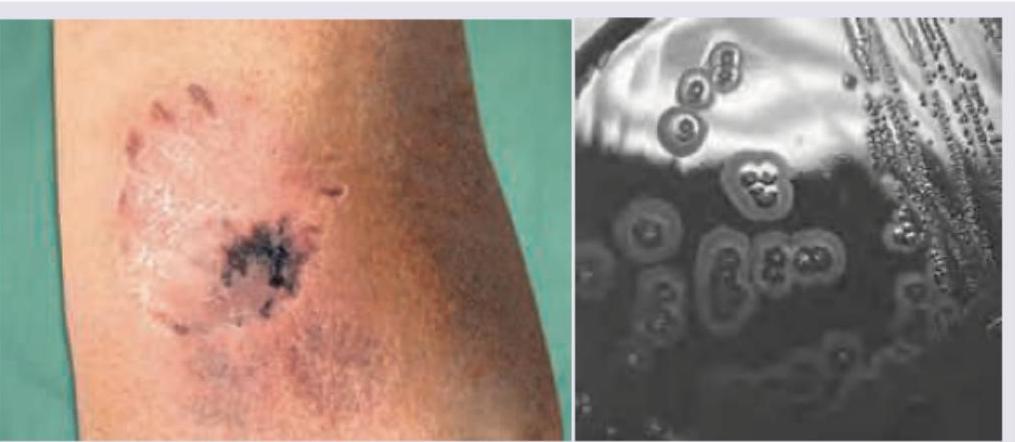
A 35-year-old patient presents to the OPD 24 hours after a fight with a stranger in which he was bitten. GCS is 15/15 and following injury is noted on left forearm. He complains of extreme pain and tenderness in the injury. Swab from the injury was plated in chocolate agar and incubated in 10% carbon dioxide for 48 hours. Small colonies with pitting appearance were noted. Which of the following organism is responsible?
After 5 days of birth, a baby developed poor feeding, convulsions, fever, high protein, low sugar, and low chloride levels in the cerebrospinal fluid. This is most likely due to what?
An 80-year-old woman, a retirement home resident, has multiple bouts of pneumonia caused by Streptococcus pneumoniae. In an attempt to prevent such infections, polyvalent vaccines directed at multiple serotypes of the organism have been administered but have not elicited long-acting immunity. Which of the following is the probable explanation for this phenomenon?
Explanation: ***Enterococcus species*** - **Enterococcus species** are known for their ability to survive harsh conditions, including temperatures of **60°C for at least 30 minutes**. - This characteristic is often used in laboratories for selective isolation and differentiation from other bacteria like streptococci and staphylococci. *Staphylococci* - While some staphylococci are quite hardy, most species, including *Staphylococcus aureus*, typically do not tolerate **60°C for 30 minutes** as well as enterococci. - Exposure to this temperature would likely significantly reduce the viability of most staphylococcal species, making their isolation difficult. *Micrococci* - **Micrococci** are generally less heat-tolerant than enterococci and would likely be killed or severely inhibited by exposure to **60°C for 30 minutes**. - They are generally susceptible to temperatures that would be survivable for thermoduric bacteria. *Streptococci* - Most **streptococcal species** are not highly resistant to heat and would be inactivated by prolonged exposure to **60°C**. - This heat treatment is often used in laboratory procedures to differentiate enterococci from other streptococci, as enterococci were historically classified as Group D streptococci.
Explanation: ***Capsular polysaccharide*** - The **polysaccharide capsule** is the primary virulence factor of *Streptococcus pneumoniae*, protecting it from phagocytosis by host immune cells. - Its presence allows the bacterium to evade host defenses and establish infection, leading to diseases like **pneumonia**, **meningitis**, and **otitis media**. *Cell wall antigen* - While present in *S. pneumoniae*, the **cell wall antigens** (like teichoic acid and peptidoglycan) are involved in inducing inflammation and host response, they are not the primary determinant of **virulence** in terms of evading phagocytosis. - They also serve as adherence factors but lack the direct anti-phagocytic role of the capsule. *Flagellar antigen* - *Streptococcus pneumoniae* is a **non-motile bacterium** and therefore does not possess flagella. - Thus, **flagellar antigens** cannot contribute to its virulence or pathogenicity. *Fimbrial antigen* - **Fimbriae (pili)** are involved in adherence to host cells for many bacteria, but they are not the primary determinant of **virulence** for *S. pneumoniae*. - Although some strains may possess pilus-like structures, the **capsule** remains the most critical factor for evading the immune system.
Explanation: ***Streptococcus bovis*** - **Streptococcus bovis** (now often referred to as *Streptococcus gallolyticus subsp. gallolyticus*) is strongly associated with **colorectal cancer** and can cause **bacteremia** and **infective endocarditis**. - Its presence in blood cultures, particularly in cases of endocarditis, should prompt a workup for underlying colorectal malignancy. *Streptococcus agalactiae* - This organism, also known as **Group B Streptococcus (GBS)**, is a common cause of **neonatal sepsis** and meningitis, and can cause infections in immunocompromised adults, but it does not have a specific association with colorectal cancer. - While it can cause endocarditis, it is not the most likely causative agent in a patient with colorectal cancer. *Streptococcus pyogenes* - **Streptococcus pyogenes** (Group A Streptococcus or **GAS**) is known for causing **pharyngitis** ("strep throat"), **scarlet fever**, **rheumatic fever**, and **necrotizing fasciitis**. - It is not typically associated with chronic conditions like colorectal cancer or with endocarditis in this specific context. *Streptococcus pneumoniae* - **Streptococcus pneumoniae** is a leading cause of **pneumonia**, **otitis media**, **meningitis**, and **sepsis**, particularly in young children and the elderly. - While it can cause endocarditis, there is no direct link between *S. pneumoniae* infection and underlying colorectal cancer.
Explanation: ***Streptococcus pneumoniae*** - It possesses a thick **polysaccharide capsule** that is a primary virulence factor, interfering with **phagocytosis** by preventing the binding of phagocytes. - This organism is the **classic textbook example** of capsular resistance to phagocytosis, with over 90 capsular serotypes that determine virulence. - It is a major cause of pneumonia, meningitis, and otitis media, with its capsular resistance being key to its pathogenesis. *Neisseria meningitidis* - While *N. meningitidis* also has an important **polysaccharide capsule** that contributes to its virulence and resistance to phagocytosis, **Streptococcus pneumoniae** is more widely recognized as the classic example for this mechanism in bacterial pathogenesis. - It causes **meningitis** and **meningococcemia**, and its capsule helps it evade immune surveillance in the bloodstream. *Cryptococcus neoformans* - This is an **encapsulated yeast** with a prominent **polysaccharide capsule** (primarily glucuronoxylomannan) that aids in resistance to phagocytosis. - However, when discussing the **classic example** of capsular resistance to phagocytosis in microbiology, **bacterial capsules**, particularly that of *Streptococcus pneumoniae*, are the primary focus. - *C. neoformans* causes meningitis, especially in immunocompromised patients, and its capsule is visualized with India ink staining. *Klebsiella pneumoniae* - *K. pneumoniae* is known for its prominent **polysaccharide capsule**, which is a significant virulence factor, contributing to its resistance to phagocytosis and making it a common cause of healthcare-associated infections. - However, *Streptococcus pneumoniae* is historically and clinically considered the classic prototype when discussing polysaccharide capsules and their role in evading phagocytosis.
Explanation: ***It is associated with increased risk of preterm labor*** - **Bacterial vaginosis (BV)** is a common cause of **increased risk of preterm labor** and premature rupture of membranes in pregnant women due to the inflammatory response it triggers. - The imbalance of vaginal flora and presence of certain bacteria can lead to the production of **amniotic fluid-degrading enzymes**, contributing to adverse pregnancy outcomes. *Clue cells are epithelial cells covered with Lactobacilli* - **Clue cells** are in fact **vaginal epithelial cells** covered in **coccobacillary bacteria**, primarily *Gardnerella vaginalis*, not *Lactobacilli*. - The normal flora, largely composed of **Lactobacilli**, is typically **depleted** in bacterial vaginosis. *It is characterized by decreased vaginal pH* - Bacterial vaginosis is characterized by an **increased vaginal pH (typically >4.5)**, not a decreased pH. - The **normal acidic vaginal pH** is maintained by *Lactobacilli* which produce lactic acid; their decrease leads to a higher pH. *Metronidazole treatment should always include male partners* - **Treatment of male partners** for bacterial vaginosis is generally **not recommended**, as BV is not considered a sexually transmitted infection in the same way as chlamydia or gonorrhea. - Recurrence of BV is common, but treatment of male partners has not been shown to significantly prevent recurrence in women.
Explanation: ***Vancomycin*** - **Vancomycin** is a glycopeptide antibiotic that is effective against **Gram-positive bacteria**, including *Enterococcus*, especially in patients with a **penicillin allergy**. - It inhibits **cell wall synthesis** by binding to the D-Ala-D-Ala terminus of peptidoglycan precursors, a different mechanism from penicillins. *Streptomycin* - **Streptomycin** is an aminoglycoside that inhibits **protein synthesis** and is primarily used in **combination therapy** for serious *Enterococcal* infections, but typically alongside a cell-wall active agent (like penicillin or vancomycin) for synergistic killing in endocarditis or other severe infections. - It is not usually recommended as a **monotherapy** for *Enterococcus*, especially in the context of penicillin allergy, as it doesn't provide bactericidal activity on its own against all enterococcal strains. *Cephalosporin* - **Cephalosporins** are **not active** against *Enterococcus spp.* as these bacteria intrinsically lack the **penicillin-binding proteins (PBPs)** that cephalosporins target effectively. - This **intrinsic resistance** makes cephalosporins an inappropriate choice for treating *Enterococcal* infections, regardless of penicillin allergy status. *Rifampicin* - **Rifampicin** is an antibiotic primarily used for **Mycobacterial infections** (e.g., tuberculosis) and some **Staphylococcal infections**, often in combination to prevent resistance. - It has **poor activity** against *Enterococcus* and is not a recommended treatment for *Enterococcal* infections.
Explanation: ***Haemophilus ducreyi*** - *Haemophilus ducreyi* is the causative agent of **chancroid**, a sexually transmitted infection, and is not considered part of the HACEK group. - The **HACEK group** consists of fastidious, gram-negative bacteria known for causing **endocarditis**. *Haemophilus parainfluenzae* - *Haemophilus parainfluenzae* is one of the five genera included in the **HACEK group** acronym, specifically the 'H'. - This organism is a known cause of **infective endocarditis**, particularly in patients with pre-existing valvular disease. *Cardiobacterium hominis* - *Cardiobacterium hominis* is represented by the 'C' in the **HACEK group** acronym. - It is a significant cause of **culture-negative endocarditis** due to its fastidious nature and slow growth. *Eikenella corrodens* - *Eikenella corrodens* is the 'E' in the **HACEK group** acronym. - It is often associated with **oral cavity infections**, human bite wounds, and can cause **endocarditis** in susceptible individuals.
Explanation: ***Eikenella corrodens*** - The context of a **human bite wound** and the characteristic **pitting of agar** by bacterial colonies are classic identifiers for *Eikenella corrodens*. - This organism is a common inhabitant of the **oral flora** and is frequently implicated in infections resulting from human bites. *Flavobacterium meningosepticum* - This organism is more commonly associated with **nosocomial infections**, particularly in newborns and immunocompromised patients, and severe infections like meningitis or sepsis, not typically human bite wounds. - While it can grow on chocolate agar, its colonial morphology does **not typically involve pitting** of the agar. *Capnocytophaga gingivalis* - This organism is also part of the normal oral flora and can cause infections related to human bites, especially in immunocompromised individuals. - However, while it can grow on chocolate agar, it characteristically exhibits **gliding motility** and ferments carbohydrates, but does not typically cause the striking **pitting** seen with *Eikenella corrodens*. *Streptobacillus moniliformis* - *Streptobacillus moniliformis* is associated with **rat bite fever** (Haverhill fever if contracted through contaminated food or water) and not typically human bite wounds. - It often produces **"fried egg" colonies** with a dense center and a lacy edge, which is distinct from the pitting observed here.
Explanation: ***Listeria monocytogenes infection*** - **Listeria meningitis** in neonates often presents with non-specific symptoms such as **poor feeding**, **convulsions**, and fever, typically in the **first week of life**. - The CSF profile of **high protein**, **low glucose**, and **low chloride** is characteristic of **bacterial meningitis**, which *Listeria* commonly causes in newborns. - *Listeria* is one of the leading causes of neonatal meningitis, particularly in early-onset sepsis (within 7 days of birth). *Tuberculosis infection* - **Tuberculous meningitis** typically has a more insidious onset and is less common in neonates unless there's significant maternal exposure. - While it can cause low glucose and high protein in CSF, the acute presentation in a 5-day-old neonate is atypical for TB. - TB meningitis has a longer incubation period and wouldn't typically present this early. *Leptospira infection* - **Leptospirosis** is rare in neonates and usually presents with symptoms like fever, headache, and muscle pain, sometimes leading to renal or hepatic involvement. - The CSF profile in leptospirosis would typically show **lymphocytic pleocytosis** with normal or slightly elevated protein, not the classic bacterial meningitis pattern. *Mycoplasma pneumoniae infection* - **Mycoplasma pneumoniae** is primarily a cause of **respiratory infections** (e.g., atypical pneumonia) in older children and adults. - It rarely causes meningitis in neonates, and neonatal infection is highly unusual. - When CNS involvement occurs, it's typically in older children with preceding respiratory symptoms.
Explanation: ***Correct: Memory T lymphocytes respond poorly to polysaccharide antigens.*** - T cells are activated by **peptide antigens** presented by MHC molecules; they do not recognize **polysaccharide antigens** directly. - Vaccines composed of purified polysaccharide antigens (like in the polyvalent *S. pneumoniae* vaccine) primarily stimulate a **T-cell-independent B-cell response**, which typically results in a weaker immune response, poor memory, and limited class switching, especially in older individuals. - This is why **conjugate vaccines** (polysaccharide linked to protein carriers) were developed—they convert the T-independent antigen into a T-dependent one, generating better memory responses. *Incorrect: S. pneumoniae evades host immune response by forming capsular coatings composed of host proteins and recognized as "self" antigens.* - The capsule of *S. pneumoniae* is composed of **polysaccharides**, not host proteins. - It evades the immune system by being poorly immunogenic and preventing phagocytosis, but not by mimicking "self" antigens. *Incorrect: The bacterial capsule binds C3b, facilitating activation of the alternative complement pathway, inducing complement-mediated lysis, and preventing immunization.* - The **capsule** of *S. pneumoniae* actually **inhibits C3b binding** and prevents activation of the alternative complement pathway, thereby *resisting* complement-mediated lysis and opsonization. - This resistance is a mechanism of immune evasion, not prevention of immunization. *Incorrect: The capsular polysaccharides of S. pneumoniae have limited hapten potential.* - While polysaccharide antigens can be considered haptens in a sense if they require a carrier protein to become fully immunogenic, the primary issue is their inability to activate T cells. - The limitation in hapten potential isn't the most direct or impactful explanation for the lack of long-lasting immunity compared to the T-cell dependence of memory responses.
Get full access to all questions, explanations, and performance tracking.
Start For Free