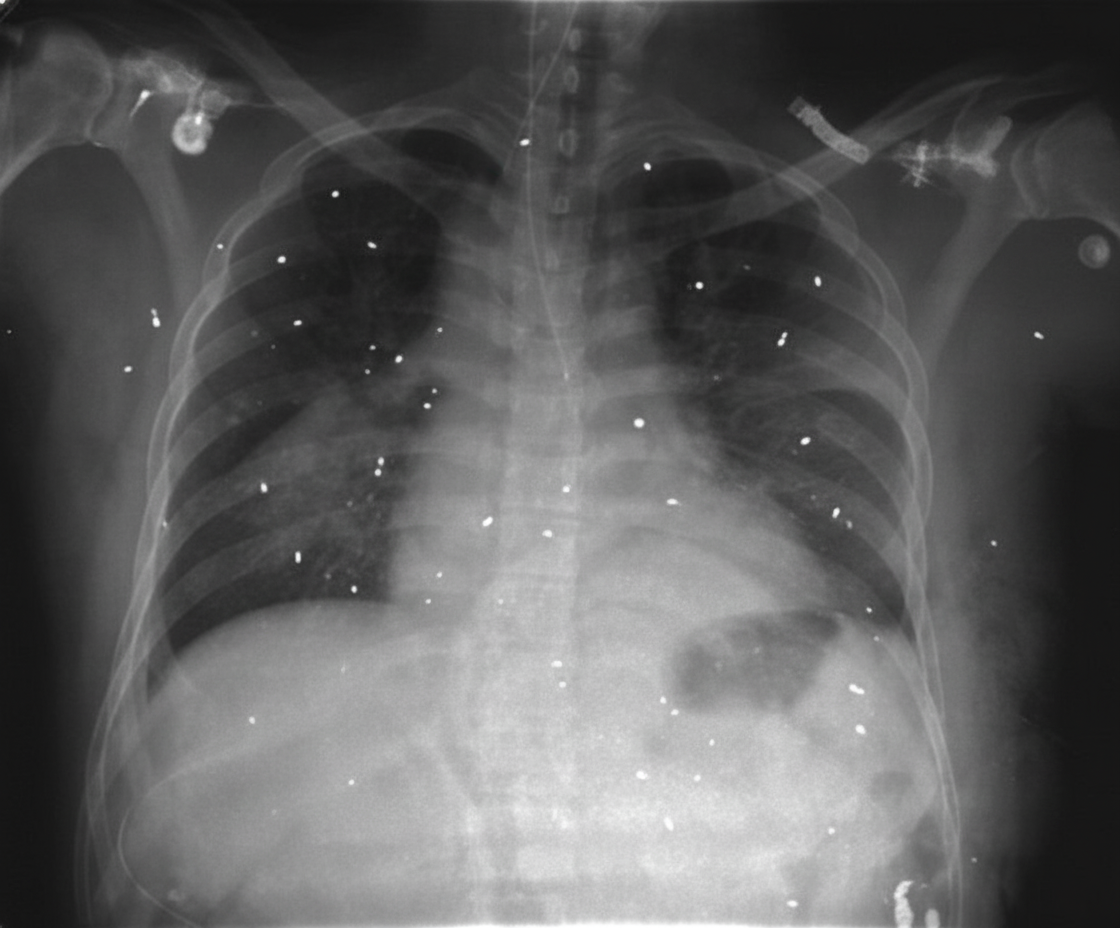
A troubled youth has a long history of gasoline sniffing. For this patient with a toxic ingestion or exposure, what is the most likely clinical effect?
Autopsy of the lung of an old man shows that the bronchi are lined by stratified squamous epithelium. What is this change?
All of the following are features of chronic lead poisoning except?
Laxative abuse is associated with which of the following electrolyte imbalances?
Cocaine overdose presents with all of the following except?
Fomepizole is used for the treatment of which type of poisoning?
Forced alkaline diuresis cannot be done in which poisoning?
A 42-year-old man presents with sudden-onset diarrhea and nausea after consuming fish at a barbeque. The following day, he develops a left wrist drop and bradycardia (pulse 56/min). His pupils are normal and he has no difficulty eating. What is the most appropriate management for this patient's condition?
All the following statements are true regarding methyl alcohol poisoning except?
Calcium oxalate crystals are found in urine in poisoning due to which of the following?
Explanation: The correct answer is **D. Bone marrow depression.** Gasoline is a complex mixture of hydrocarbons, but its chronic toxicity is primarily attributed to its **Benzene** content. Chronic exposure to benzene, especially through "sniffing" or inhalation, is notoriously toxic to the hematopoietic system. Benzene metabolites (like hydroquinone and catechol) cause oxidative stress and DNA damage in the bone marrow, leading to **aplastic anemia**, pancytopenia, and an increased risk of Acute Myeloid Leukemia (AML). **Analysis of Incorrect Options:** * **Option A:** This describes the mechanism of **Cyanide poisoning**. Cyanide binds to the ferric iron ($Fe^{3+}$) in cytochrome c oxidase (Complex IV), inhibiting the mitochondrial electron transport chain and causing cellular hypoxia. * **Option B:** Methemoglobinemia is typically caused by oxidizing agents such as **nitrites, sulfonamides, or aniline dyes**, which convert ferrous iron ($Fe^{2+}$) in hemoglobin to ferric iron ($Fe^{3+}$), impairing oxygen delivery. [1] * **Option C:** This is the classic "Salicylism" triad seen in **Aspirin (Salicylate) poisoning**. It results from direct stimulation of the respiratory center and vestibulocochlear nerve toxicity. **High-Yield Clinical Pearls for NEET-PG:** * **Acute Gasoline Inhalation:** Causes CNS depression (euphoria, dizziness) and can sensitize the myocardium to catecholamines, leading to fatal **ventricular arrhythmias** ("Sudden Sniffer’s Death"). * **Aspiration Risk:** Hydrocarbons have low viscosity and high volatility; if ingested, they pose a severe risk of **chemical pneumonitis**. Gastric lavage is generally contraindicated. [3] * **Benzene = Bone Marrow:** Always associate chronic benzene exposure with aplastic anemia and AML in toxicology questions. [2]
Explanation: The correct answer is Metaplasia. 1. Why Metaplasia is Correct: Metaplasia is a reversible change in which one adult cell type (epithelial or mesenchymal) is replaced by another adult cell type. It is an adaptive response to chronic irritation. In the respiratory tract of chronic smokers [1] or elderly individuals exposed to pollutants, the normal ciliated columnar epithelium of the bronchi is replaced by stratified squamous epithelium. While the squamous cells are more rugged and better able to survive the stress, the change results in the loss of vital functions like mucus secretion and ciliary clearance. 2. Why Other Options are Incorrect: * Dysplasia: This refers to disordered growth and maturation of an epithelium, characterized by loss of cellular uniformity and architectural orientation. While metaplasia can progress to dysplasia, the simple replacement of one cell type with another is metaplasia. * Hyperplasia: This is an increase in the number of cells in an organ or tissue, usually resulting in increased volume. It does not involve a change in cell type. * Hypertrophy: This is an increase in the size of individual cells, leading to an increase in the size of the organ. It occurs in cells with limited capacity to divide (e.g., cardiac muscle). 3. NEET-PG High-Yield Pearls: * Most common type: Squamous metaplasia (as seen in the lung/cervix). * Barrett’s Esophagus: A classic example of columnar metaplasia, where squamous epithelium of the esophagus changes to columnar (intestinal) epithelium due to acid reflux. * Vitamin A Deficiency: Can induce squamous metaplasia in the respiratory tract and ducts of glands. * Reversibility: Metaplasia is reversible if the stimulus (e.g., smoking) is removed; however, persistent metaplasia is a precursor to neoplasia (Squamous Cell Carcinoma) [1].
Explanation: **Explanation:** Chronic lead poisoning (Plumbism) affects multiple organ systems, primarily the hematologic, gastrointestinal, and neurological systems [1]. **Why "Cutaneous blisters" is the correct answer:** Cutaneous blisters are **not** a feature of lead poisoning [1]. They are classically associated with **Barbiturate overdose** (bullous lesions over pressure points) or **Porphyria Cutanea Tarda**. While lead interferes with heme synthesis [2], it does not typically manifest with the photosensitive bullous lesions seen in other porphyrias. **Analysis of incorrect options:** * **Encephalopathy:** This is a severe manifestation of lead toxicity [1], more common in children but seen in adults with high-level chronic exposure. It presents as irritability, memory loss, and cerebral edema [3]. * **Burtonian line:** This is a classic clinical sign consisting of a bluish-purple line on the gingival margins (gums) due to the reaction of circulating lead with sulfur-producing bacteria [1]. * **Constipation:** Gastrointestinal symptoms are the most common early signs of chronic lead poisoning. "Lead colic" presents as severe abdominal pain accompanied by stubborn constipation [1]. **High-Yield Clinical Pearls for NEET-PG:** * **Hematology:** Look for **Basophilic stippling** on peripheral smear (due to inhibition of 5'-nucleotidase) [3] and **Microcytic Hypochromic Anemia**. * **Neurology:** Characterized by **Wrist drop** and **Foot drop** (radial and peroneal nerve palsy). * **Radiology:** **Lead lines** (increased density) at the metaphyses of long bones in children [3]. * **Treatment:** First-line oral chelator is **Succimer (DMSA)**. For encephalopathy, use **BAL (Dimercaprol)** followed by **EDTA** [3].
Explanation: **Explanation:** Laxative abuse, often seen in patients with eating disorders or chronic constipation, leads to significant fluid and electrolyte disturbances. **Why Hypokalemia is the Correct Answer:** The primary mechanism for **hypokalemia** in laxative abuse is two-fold: 1. **Direct Loss:** Chronic diarrhea induced by laxatives leads to the direct loss of potassium-rich intestinal secretions [1]. 2. **Secondary Hyperaldosteronism:** Volume depletion caused by chronic diarrhea activates the Renin-Angiotensin-Aldosterone System (RAAS). Increased aldosterone levels act on the distal renal tubules to conserve sodium and water at the expense of secreting potassium into the urine, further exacerbating hypokalemia [1], [2]. **Analysis of Incorrect Options:** * **Hypomagnesemia:** While it can occur with certain osmotic laxatives (like magnesium citrate), it is not as classically or consistently associated with general laxative abuse as hypokalemia [1]. * **Hypoglycemia:** Laxative abuse does not directly interfere with glucose metabolism or insulin levels. * **Colonic Spasticity:** Chronic stimulant laxative use actually leads to the opposite—**"Cathartic Colon."** This is characterized by a dilated, atonic (aperistaltic) colon due to damage to the myenteric plexus (Auerbach's plexus). **High-Yield Clinical Pearls for NEET-PG:** * **Acid-Base Balance:** Laxative abuse typically causes **Metabolic Alkalosis** (due to volume depletion and contraction alkalosis), though some cases may present with metabolic acidosis if bicarbonate loss in stool is massive [1]. * **Melanosis Coli:** Chronic use of anthraquinone laxatives (e.g., Senna) causes a characteristic dark brown/black pigmentation of the colonic mucosa. * **Phenolphthalein Test:** If laxative abuse is suspected, adding an alkali (like NaOH) to a stool or urine sample may turn it **pink/red**, indicating the presence of phenolphthalein.
Explanation: Cocaine is a potent **indirect-acting sympathomimetic** agent. It works by inhibiting the reuptake of catecholamines (norepinephrine, epinephrine, and dopamine) at the synaptic cleft, leading to a state of sympathetic overactivity [1]. **Why "Constricted Pupils" is the correct answer:** Cocaine causes **Mydriasis (dilated pupils)** due to the stimulation of alpha-1 adrenergic receptors on the pupillary dilator muscle [1, 2]. **Constricted pupils (Miosis)** are characteristic of opioid overdose or cholinergic toxicity (e.g., organophosphates), not cocaine. **Analysis of Incorrect Options:** * **Diaphoresis (A):** Unlike anticholinergic toxicity (where the skin is dry), sympathomimetic toxicity like cocaine causes profuse sweating due to increased metabolic activity and thermogenesis [1]. * **Hypertension (B):** Increased norepinephrine levels lead to alpha-adrenergic mediated vasoconstriction and beta-1 mediated increase in heart rate and contractility, resulting in significant hypertension and tachycardia [1, 2]. * **Agitation (D):** Excess dopamine and norepinephrine in the CNS cause central nervous system stimulation, leading to agitation, euphoria, tremors, and potentially seizures [1, 2]. **High-Yield Clinical Pearls for NEET-PG:** * **Management Contraindication:** Never use **pure Beta-blockers (e.g., Propranolol)** in cocaine toxicity. This leads to "unopposed alpha-stimulation," causing a paradoxical, life-threatening increase in blood pressure and coronary vasoconstriction. * **Drug of Choice:** **Benzodiazepines** (e.g., Lorazepam) are the first-line treatment for agitation, hypertension, and tachycardia. * **Complication:** Cocaine is a major risk factor for **Prinzmetal (variant) angina** and acute myocardial infarction in young patients due to coronary artery vasospasm [2].
Explanation: **Explanation:** **Fomepizole** is a potent competitive inhibitor of the enzyme **Alcohol Dehydrogenase (ADH)** [1]. In the management of toxic alcohol ingestions, specifically **Ethylene glycol** and **Methanol**, Fomepizole prevents the conversion of these parent compounds into their toxic metabolites [1,4]. 1. **Ethylene Glycol:** ADH converts it into glycoaldehyde, which eventually becomes **oxalic acid**, leading to metabolic acidosis and acute tubular necrosis (renal failure) [4,5]. By inhibiting ADH, Fomepizole halts the production of these toxins, allowing the parent compound to be excreted unchanged by the kidneys. 2. **Methanol:** Similarly, Fomepizole prevents the conversion of methanol into **formic acid**, which causes optic nerve damage and blindness [1,4]. **Analysis of Incorrect Options:** * **B. Ethyl alcohol poisoning:** Ethanol itself has a higher affinity for ADH than ethylene glycol. In fact, ethanol was historically used as an antidote for ethylene glycol before Fomepizole became the gold standard [1]. Fomepizole is not used to treat ethanol overdose. * **C. Ether poisoning:** Ether is an anesthetic agent; its toxicity is managed supportively (respiratory and cardiovascular stabilization) and does not involve the ADH pathway. * **D. Type A lactic acidosis:** This is caused by tissue hypoperfusion/hypoxia. Treatment focuses on correcting the underlying cause (e.g., shock, sepsis) rather than enzyme inhibition. **High-Yield Clinical Pearls for NEET-PG:** * **Mechanism:** Fomepizole inhibits Alcohol Dehydrogenase (ADH) [1]. * **Indications:** Ethylene glycol and Methanol poisoning [2]. * **Advantage over Ethanol:** Fomepizole does not cause CNS depression or hypoglycemia and does not require constant blood level monitoring. * **Ethylene Glycol Hallmark:** Presence of **envelope-shaped calcium oxalate crystals** in urine and a high anion gap metabolic acidosis [4,5].
Explanation: Explanation: The principle of **Forced Alkaline Diuresis (FAD)** is based on the concept of **"Ion Trapping."** By alkalinizing the urine (typically using Sodium Bicarbonate to reach a pH of 7.5–8.5), weak acids become ionized [1]. Ionized molecules are lipid-insoluble and cannot be reabsorbed across the renal tubule back into the blood, thus increasing their renal clearance [1]. **Why Alcohol is the Correct Answer:** Alcohol (Ethanol) is a neutral molecule, not a weak acid. It is primarily metabolized by the liver (alcohol dehydrogenase) and is not significantly excreted unchanged by the kidneys. Therefore, altering urinary pH has no effect on its clearance. Furthermore, FAD carries risks of fluid overload and electrolyte imbalances, making it contraindicated when no benefit is expected. **Why the other options are incorrect:** * **Barbiturates:** Specifically **Phenobarbital** (long-acting), is a weak acid. FAD significantly enhances its elimination and is a standard treatment for toxicity [2]. * **Salicylates:** Aspirin is a weak acid ($pK_a \approx 3.5$). Alkalinization of urine is a cornerstone of management in moderate-to-severe salicylate poisoning [1]. * **Methotrexate:** This is a weak organic acid. Alkalinization is crucial here not only for excretion but also to prevent the precipitation of methotrexate crystals in the renal tubules, which causes acute kidney injury [1]. **High-Yield Clinical Pearls for NEET-PG:** 1. **Indications for FAD:** Remember the mnemonic **"M-S-P"** (Methotrexate, Salicylates, Phenobarbital). It is also used for **Chlorpropamide** and **2,4-D (Herbicide)** [1]. 2. **Prerequisite:** Always ensure the patient is not hypokalemic before starting FAD, as hypokalemia makes it difficult to achieve alkaline urine (due to H+/K+ exchange in the tubules). 3. **Forced Acidic Diuresis:** Historically used for weak bases (Amphetamines, Quinine), it is **no longer recommended** due to the risk of precipitating myoglobinuria and acute renal failure.
Explanation: ### Explanation The patient is presenting with **Ciguatera Fish Poisoning (CFP)**. This condition is caused by the ingestion of ciguatoxin, which is found in large reef fish (e.g., barracuda, snapper, grouper) that have consumed toxin-producing dinoflagellates. [1] **Why Conservative Management is Correct:** Ciguatoxin acts by opening voltage-gated sodium channels, leading to depolarization. The clinical course typically begins with gastrointestinal symptoms (nausea, diarrhea), followed by neurological symptoms. A hallmark of CFP is **temperature reversal** (cold items feeling hot) and **neurological deficits** like wrist drop or paresthesias. Bradycardia occurs due to the toxin's effect on cardiac sodium channels. Since there is no specific antidote for ciguatoxin, management is primarily **supportive/conservative**. Intravenous Mannitol may be used if administered early (within 48–72 hours) to reduce neurological symptoms, but the mainstay remains symptomatic care. [1] **Why Other Options are Incorrect:** * **A. Antihistamines:** These are the treatment of choice for **Scombroid poisoning** (histamine toxicity), which presents with flushing, headache, and wheezing shortly after eating spoiled dark-meat fish (tuna, mackerel). It does not cause focal neurological deficits like wrist drop. * **C. Gastric Lavage:** This is generally not indicated unless the patient presents within an hour of ingestion. By the time neurological symptoms (like wrist drop) appear the next day, the toxin has already been absorbed. * **D. Antibiotics:** CFP is caused by a heat-stable toxin, not a bacterial infection; therefore, antibiotics have no role. **NEET-PG High-Yield Pearls:** * **Ciguatera:** Temperature reversal (pathognomonic), neurological symptoms, bradycardia. Treatment: Supportive + Mannitol. * **Scombroid:** Histamine-like reaction (flushing, urticaria). Treatment: Antihistamines. * **Tetrodotoxin (Pufferfish):** Blocks sodium channels. Causes ascending paralysis and respiratory failure. Treatment: Supportive/Ventilation. * **Neurotoxic Shellfish Poisoning:** Similar to Ciguatera but milder; caused by brevetoxins.
Explanation: Methyl alcohol (methanol) poisoning is a critical medical emergency. The toxicity is not caused by methanol itself, but by its metabolite, **formic acid**, produced via the enzyme **alcohol dehydrogenase (ADH)** [1], [2]. **Why Option D is the correct answer (The False Statement):** Concurrent ethanol ingestion actually **improves** the clinical prognosis rather than worsening it. Ethanol has a much higher affinity (approx. 10–20 times) for the enzyme alcohol dehydrogenase than methanol [1]. By acting as a competitive inhibitor, ethanol prevents the conversion of methanol into its toxic metabolites (formaldehyde and formic acid), allowing methanol to be excreted unchanged by the kidneys. This is why ethanol (or Fomepizole) is used as an antidote. **Analysis of Incorrect Options (True Statements):** * **Option A:** Methanol metabolism leads to the accumulation of formic acid and lactic acid, resulting in a profound **High Anion Gap Metabolic Acidosis (HAGMA)** [1], [4]. * **Option B:** Formic acid specifically targets the optic nerve and retina, causing **optic papillitis**, retinal edema, and potentially permanent blindness ("snowstorm vision") [2], [4]. * **Option C:** Methanol is a low-molecular-weight substance. Its presence in the blood increases the measured serum osmolality, leading to a **High Osmolal Gap** (Difference between measured and calculated osmolality >10 mOsm/kg) [1], [4]. **High-Yield Clinical Pearls for NEET-PG:** * **Antidote of choice:** **Fomepizole** (inhibits ADH). If unavailable, use Ethanol. * **Putaminal Necrosis:** A characteristic finding on Head CT/MRI in severe methanol poisoning. * **Treatment of Acidosis:** Sodium bicarbonate is essential as it also promotes the ionization and clearance of formate. * **Dialysis Indications:** Serum methanol >50 mg/dL, severe acidosis, or visual impairment [3], [4].
Explanation: **Explanation:** **Ethylene glycol poisoning** is the correct answer because of its specific metabolic pathway [1]. Ethylene glycol (commonly found in antifreeze) is metabolized by alcohol dehydrogenase into glycoaldehyde, then glycolic acid, and finally **oxalic acid**. Oxalic acid precipitates with calcium to form **calcium oxalate crystals**, which are deposited in the renal tubules, leading to acute tubular necrosis and renal failure [1], [3]. These crystals are typically **envelope-shaped** (dihydrate) [2] or needle-shaped (monohydrate) and are a hallmark finding in the urine sediment. **Why other options are incorrect:** * **Ethanol:** Metabolism leads to acetaldehyde and acetic acid. It causes an increased anion gap and osmolar gap but does not produce oxalate crystals. * **Methanol:** Metabolism produces **formic acid**, which is toxic to the optic nerve (causing "snowfield vision" and retinal edema) but does not result in crystalluria [3]. * **Dhatura poisoning:** This is an anticholinergic toxidrome (dry mouth, dilated pupils, delirium). It does not involve metabolic acidosis or crystal formation in the urine. **High-Yield Clinical Pearls for NEET-PG:** * **The Triad of Ethylene Glycol:** High anion gap metabolic acidosis (HAGMA), increased osmolar gap, and calcium oxalate crystalluria [3]. * **Hypocalcemia:** Often seen in ethylene glycol poisoning because calcium is "consumed" to form the oxalate crystals [2], [3]. * **Wood’s Lamp Examination:** Urine may show **fluorescence** in ethylene glycol poisoning because fluorescein is often added to commercial antifreeze. * **Treatment:** Fomepizole (preferred) or Ethanol (competitive inhibitor of alcohol dehydrogenase) and Hemodialysis [3].
General Principles of Toxicology
Practice Questions
Antidotes and Specific Therapies
Practice Questions
Drug Overdose Management
Practice Questions
Heavy Metal Poisoning
Practice Questions
Pesticide and Insecticide Poisoning
Practice Questions
Plant and Food Toxins
Practice Questions
Household Chemical Exposure
Practice Questions
Environmental Toxins
Practice Questions
Occupational Exposures
Practice Questions
Toxicological Screening and Diagnosis
Practice Questions
Extracorporeal Removal Techniques
Practice Questions
Poisoning Prevention Strategies
Practice Questions
Get full access to all questions, explanations, and performance tracking.
Start For Free