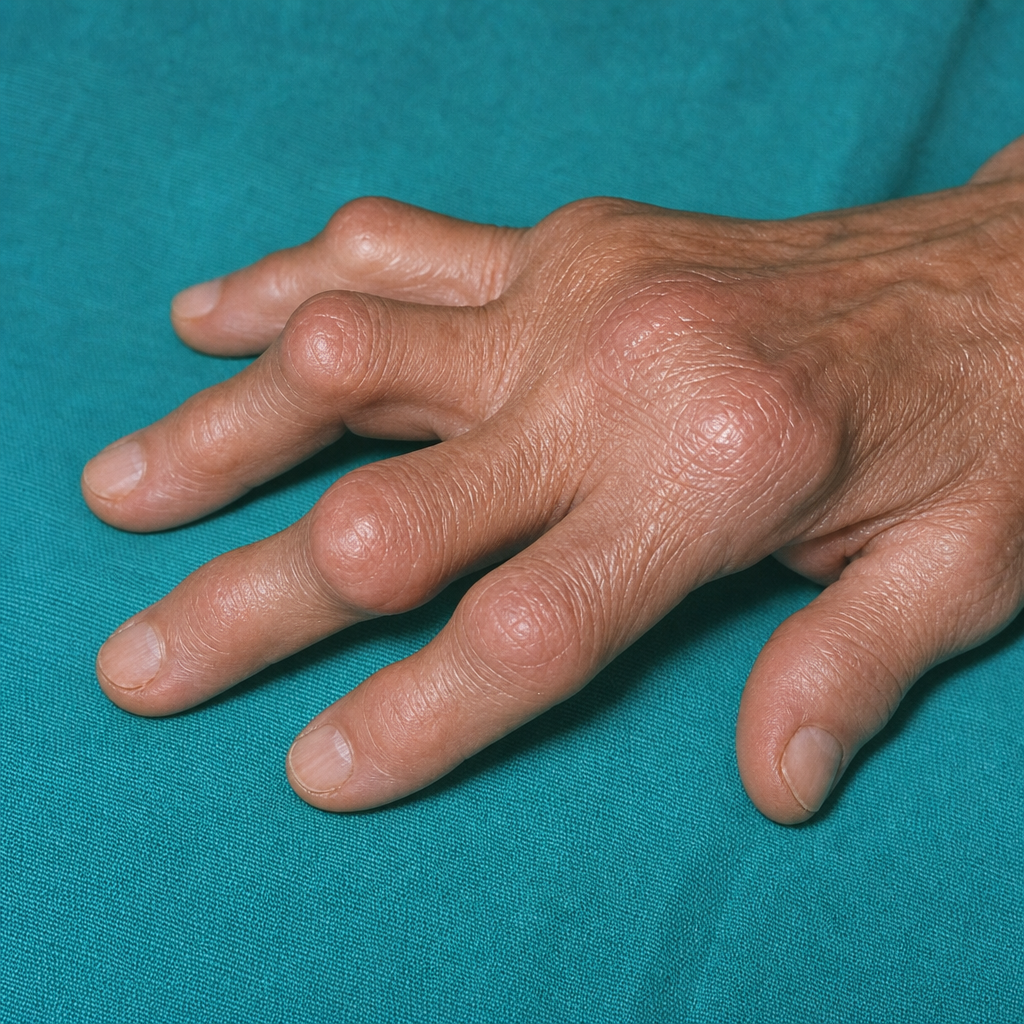
Most common form of psoriatic arthritis
Which arthritis is commonly associated with uveitis?
Poly arteritis nodosa does not involve
The common HLA type associated with Behcet disease is _________
Vasanti, 28-year-old, presents with complaints of tightness of fingers. There is also history of dysphagia. Which of the following is the probable diagnosis:
Bilateral hilar lymphadenopathy with non caseating granuloma is seen in
Which of the following is true about rheumatic fever
All are true about gout except:
Following are listed as (SpA) spondyloarthritis features except
Indications for use of cyclophosphamide in SLE are:
Explanation: Asymmetric oligoarthritis - This is the most common presentation of psoriatic arthritis, affecting fewer than five joints, often with an asymmetric pattern [1]. - It frequently involves the distal interphalangeal (DIP) joints of the hands and feet [1]. Symmetric oligoarthritis - While oligoarthritis (affecting 2-4 joints) can occur, a symmetric pattern is less common. - Symmetrical involvement is more typical of polyarticular forms or other types of inflammatory arthritis like rheumatoid arthritis [1]. Polyarthritis - Polyarticular psoriatic arthritis affects five or more joints, which can be symmetric or asymmetric [1]. - These forms are less frequent than oligoarticular presentations. Asymmetric polyarthritis - This form involves five or more joints in an asymmetric distribution [1]. - While it does occur, it is not the most prevalent type of psoriatic arthritis compared to asymmetric oligoarthritis.
Explanation: **Ankylosing spondylitis** - **Uveitis** is a common **extra-articular manifestation** of ankylosing spondylitis, occurring in up to 40% of patients. [1] - It typically presents as acute **anterior uveitis**, causing eye pain, redness, and photophobia. *Reiter's disease* - Also known as **reactive arthritis**, Reiter's disease is associated with **conjunctivitis** or **uveitis**, but ankylosing spondylitis has a higher prevalence of uveitis as a defining feature. [1] - Reiter's disease classically presents with the triad of **arthritis**, **urethritis**, and **conjunctivitis** (can't see, can't pee, can't climb a tree). [2] *Still's disease* - **Still's disease**, or systemic juvenile idiopathic arthritis, can be associated with **chronic anterior uveitis**, particularly in pauciarticular forms. [3] - However, the question asks about uveitis commonly associated with "arthritis" generally, and ankylosing spondylitis has a stronger, more direct association as an extra-articular manifestation. *RA* - **Rheumatoid arthritis** is rarely associated with uveitis. - Ocular manifestations in RA typically include **scleritis** or **episcleritis**, not primarily uveitis.
Explanation: ***Pulmonary artery*** - **Polyarteritis nodosa (PAN)** is a systemic necrotizing vasculitis that primarily affects **medium-sized arteries**, but characteristically spares the **pulmonary circulation** [1]. - While other forms of vasculitis can involve the lungs, significant **pulmonary artery** involvement is a key differentiating feature that excludes PAN [1]. *Bronchial artery* - The **bronchial arteries** are medium-sized arteries that supply the bronchi and lung parenchyma. - They can be involved in PAN, leading to symptoms like **hemoptysis** or pleuritic chest pain. *Cerebral artery* - PAN can affect arteries in the central nervous system, including the **cerebral arteries**, leading to neurological symptoms like stroke, seizures, or peripheral neuropathy [1]. - Neurological manifestations are common in PAN and can be severe [1]. *Renal artery* - **Renal artery** involvement is a classic and frequently severe manifestation of PAN, often leading to **hypertension**, renal infarction, and renal failure [1]. - Microaneurysms of the renal arteries are a characteristic angiographic finding.
Explanation: ***HLA B51*** - **HLA-B51** is the most common **HLA type strongly associated** with Behçet's disease, particularly in populations of the Silk Road region. - The presence of **HLA-B51** increases susceptibility and may correlate with a more severe disease course, including a higher risk of **ocular involvement**. *HLA DR4* - **HLA-DR4** is a genetic marker primarily associated with diseases like **Rheumatoid Arthritis** and certain types of juvenile idiopathic arthritis, not Behçet's disease. - It plays a role in presenting antigens to T-cells, but its link to Behçet's pathogenesis is not significant. *HLA B27* - **HLA-B27** is strongly associated with **spondyloarthropathies**, such as **ankylosing spondylitis**, reactive arthritis, and psoriatic arthritis, but not Behçet's disease [1]. - Its presence is a key diagnostic indicator for these specific rheumatic conditions [1]. *HLA CW6* - **HLA-Cw6** is primarily associated with **psoriasis vulgarisa**, particularly with early-onset and more severe forms of the condition. - It is not a known genetic marker for susceptibility to Behçet's disease.
Explanation: ***Scleroderma*** - **Tightening of fingers** (sclerodactyly) and **dysphagia** are hallmark symptoms of scleroderma, especially the systemic form [1]. - Dysphagia in scleroderma is often due to **esophageal dysmotility** caused by fibrosis. *Rheumatoid arthritis* - Primarily affects the **synovial joints**, leading to pain, swelling, and morning stiffness, but not typically finger tightness or dysphagia as a primary complaint. - While it can affect other organs, **cutaneous fibrosis** and **esophageal dysmotility** are not characteristic features. *Dermatomyositis* - Characterized by **muscle weakness** (especially proximal) and distinctive **skin rashes** (e.g., heliotrope rash, Gottron's papules). - While dysphagia can occur due to muscle involvement, **tightness of fingers** due to skin thickening is not a primary feature. *Polyarteritis nodosa* - A **necrotizing vasculitis** affecting medium-sized arteries, leading to symptoms related to organ ischemia (e.g., kidney, GI, neurological). - It does not typically cause **skin tightening of the fingers** or **dysphagia** as described.
Explanation: ***Sarcoidosis*** - **Bilateral hilar lymphadenopathy** is a classic radiographic finding in sarcoidosis, often representing hilar nodes involvement [1]. - The hallmark histological feature of sarcoidosis is the presence of **non-caseating granulomas** in affected tissues, which can be seen in the lymph nodes. *All of the options* - While other conditions can cause hilar lymphadenopathy, not all of them present with **non-caseating granulomas** specifically. - Granulomas in diseases like TB are typically **caseating**, which differentiates them from sarcoidosis. *TB* - Tuberculosis usually presents with **caseating granulomas**, characterized by a central area of necrosis, unlike the non-caseating granulomas of sarcoidosis. - While TB can cause hilar lymphadenopathy, the nature of the granuloma found on biopsy is typically different. *Lymphoma* - Lymphoma is a malignancy of lymphocytes and presents with **lymphadenopathy** due to proliferation of abnormal lymphoid cells, not granuloma formation. - The histological features of lymphoma involve effacement of normal lymph node architecture by malignant cells, rather than granulomas.
Explanation: ***Chorea occurs in the absence of other manifestations after prolonged latent period*** - **Sydenham's chorea** (rheumatic chorea) can appear months after the initial infection, often as the sole major manifestation of rheumatic fever [2]. - Its **delayed onset** and isolated nature can make it challenging to link directly to a preceding streptococcal infection [2]. *90% of the patients with acute rheumatic fever proceed to rheumatic heart disease* - While rheumatic fever can lead to **rheumatic heart disease (RHD)**, the percentage is not as high as 90%; it is estimated that **30-60%** of patients with recurrent episodes of acute rheumatic fever develop RHD. - The risk of developing RHD is higher with recurrent episodes and in individuals with more severe carditis during the initial attack [2]. *Characteristic manifestation of carditis in previously unaffected individuals is mitral stenosis* - The **initial characteristic lesion** of carditis in acute rheumatic fever is **valvulitis**, which more commonly presents as **mitral regurgitation** or **aortic regurgitation** due to inflammation and impaired coaptation [1], [2]. - **Mitral stenosis** is typically a **late complication** that develops years or decades after repeated episodes of rheumatic carditis, due to fibrotic changes and calcification. *Isolated aortic valve involvement is most common* - The **mitral valve** is the **most frequently affected** cardiac valve in rheumatic heart disease, either in isolation or in combination with other valves [2]. - **Isolated aortic valve involvement** is less common than mitral valve involvement; combined mitral and aortic valve disease is also common.
Explanation: *** Is directly related to alcohol consumption*** - While **alcohol consumption**, particularly beer and spirits, is a **risk factor** for gout flares by increasing uric acid production and inhibiting its excretion, it is not the direct cause of the underlying **purine metabolism disorder**. [1], [2] - Gout is primarily caused by **hyperuricemia**, which leads to the deposition of **monosodium urate crystals** in joints and tissues. [3], [4] *Is caused by purine metabolism disorder* - Gout is fundamentally caused by a **disorder of purine metabolism**, leading to either **overproduction of uric acid** or **underexcretion of uric acid** from the kidneys. [1], [2] - This imbalance results in elevated **serum uric acid levels** (hyperuricemia), which is a prerequisite for gout development. [1] *Causes tophi in the extraocular muscle tendon* - Gout can cause **tophi**, which are deposits of **monosodium urate crystals**, but they typically form in cooler peripheral areas like the **ear helix**, fingers, toes, and around joints. [4] - While rare, tophi can occur in unusual locations, deposition in **extraocular muscle tendons** is highly atypical and not a common manifestation of gout. *Causes podagra* - **Podagra** is a classic symptom of gout, referring specifically to acute inflammation and severe pain in the **first metatarsophalangeal joint** (big toe). [2] - It is one of the most common initial presentations of **gouty arthritis** and is highly characteristic of the disease. [2]
Explanation: **Cervical sprain** - A **cervical sprain** is an injury to the ligaments in the neck, typically caused by trauma or sudden movements, and is not a defining characteristic or feature of spondyloarthritis. - Sprains involve the stretching or tearing of soft tissues, whereas spondyloarthritis is a group of **inflammatory conditions** primarily affecting the spine and peripheral joints. *Dactylitis* - **Dactylitis**, or "sausage digits," refers to the **inflammation of an entire digit** (finger or toe) and is a characteristic feature of spondyloarthritis, particularly **psoriatic arthritis** and **reactive arthritis** [1]. - It results from inflammation of both the joints and the tendons within the affected digit [1]. *Enthesitis* - **Enthesitis** is the **inflammation of the entheses**, which are the sites where tendons or ligaments insert into bone [1]. - This is a hallmark feature of spondyloarthritis, commonly seen at sites like the **Achilles tendon insertion** or the plantar fascia [1]. *HLA B27* - **HLA-B27** is a human leukocyte antigen that is strongly associated with spondyloarthritis [1]. - Its presence is a significant genetic marker found in a high percentage of patients with **ankylosing spondylitis** and other forms of spondyloarthritis [1].
Explanation: Diffuse proliferative glomerulonephritis - **Cyclophosphamide** is a potent immunosuppressant often used in severe manifestations of **systemic lupus erythematosus (SLE)**, particularly **lupus nephritis**. - **Diffuse proliferative glomerulonephritis (class IV lupus nephritis)** is a severe form of kidney involvement in SLE, characterized by significant inflammation and immune complex deposition, for which cyclophosphamide is a first-line treatment due to its ability to induce remission and prevent progression to end-stage renal disease. *Arthritis* - **Arthritis** in SLE is typically managed with less aggressive therapies such as **NSAIDs**, **hydroxychloroquine**, or low-dose **corticosteroids** [1]. - Cyclophosphamide is generally reserved for life-threatening or organ-threatening manifestations due to its significant side effects. *Oral ulcers* - **Oral ulcers** in SLE are usually a mild cutaneous manifestation and are managed with topical treatments, **hydroxychloroquine**, or occasionally low-dose **systemic corticosteroids**. - The use of cyclophosphamide for oral ulcers would be inappropriate given its toxicity profile. *Anti D NA antibody +ive patients* - While **anti-dsDNA antibodies** are characteristic of SLE and often correlate with disease activity, particularly **lupus nephritis**, their presence alone does not indicate the need for cyclophosphamide [2]. - The decision to use cyclophosphamide is based on the presence of severe organ-threatening disease, not solely on antibody positivity.
Rheumatoid Arthritis
Practice Questions
Spondyloarthropathies
Practice Questions
Systemic Lupus Erythematosus
Practice Questions
Vasculitis Syndromes
Practice Questions
Scleroderma and Related Disorders
Practice Questions
Inflammatory Myopathies
Practice Questions
Crystal Arthropathies
Practice Questions
Osteoarthritis
Practice Questions
Primary Immunodeficiency Disorders
Practice Questions
Autoinflammatory Syndromes
Practice Questions
Sjögren's Syndrome
Practice Questions
Antiphospholipid Syndrome
Practice Questions
Get full access to all questions, explanations, and performance tracking.
Start For Free