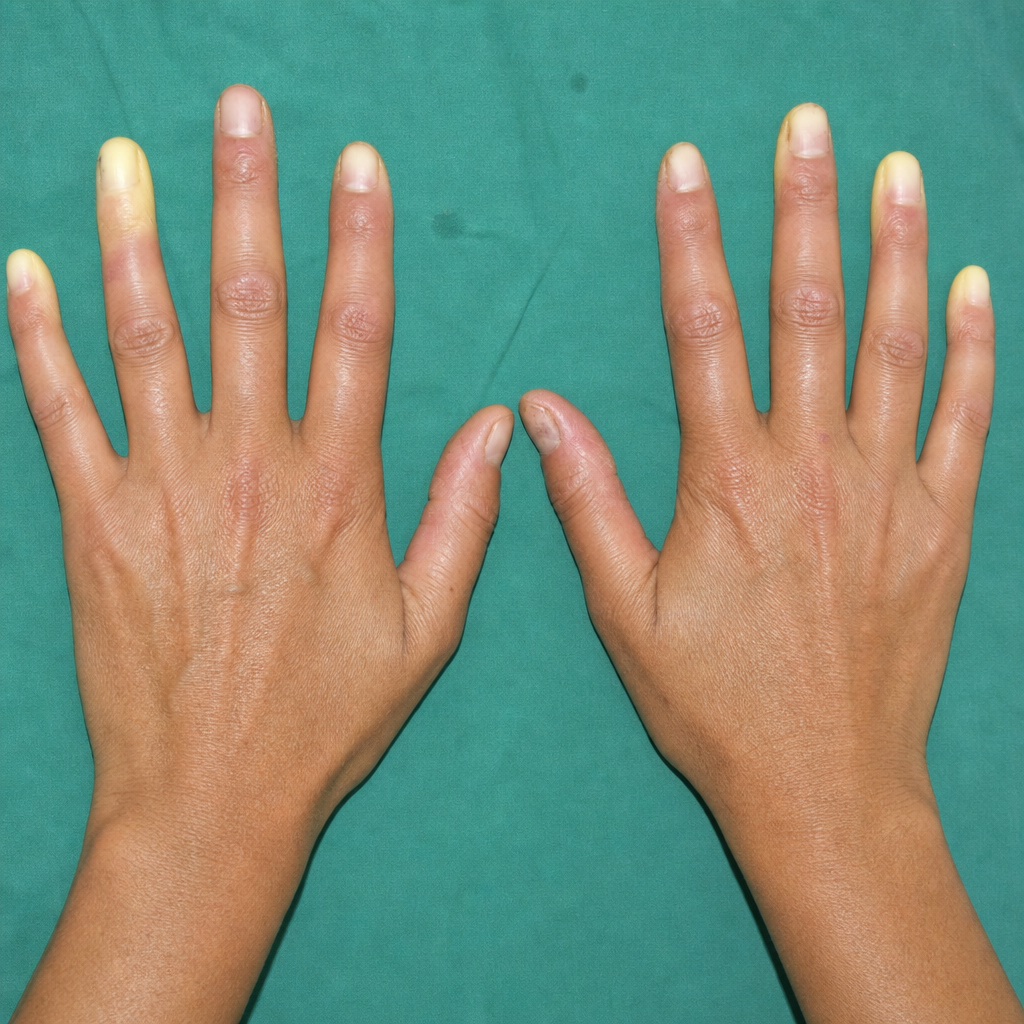
Which of the following extra-articular manifestations of Rheumatoid Arthritis is associated with an increased frequency of infections?
A patient presented with arthritis and purpura. Laboratory examination showed monoclonal and polyclonal cryoglobulins. Histopathology showed deposits of cryoglobulins around the vessels. The patient should be tested for which of the following infections?
Which of the following is NOT true about temporal arteritis?
Which HLA is associated with Reiter syndrome?
What is the eye manifestation seen in HLA B27-positive patients with ulcerative colitis?
A 35-year-old patient presents with colicky abdominal pain, joint pain, and palpable purpura. Urinalysis shows only red blood cells with no other significant findings. Which of the following is the likely diagnosis?
A 50-year-old woman presented with difficulty in activities like climbing stairs, getting up from a chair, and combing hair. Violaceous erythema of the upper eyelids was noted. What is the most probable diagnosis?
A 50-year-old female patient with a known case of ovarian cancer presents with difficulty in activities like climbing stairs, getting up from a chair, combing hair, etc. The following characteristic sign was found on examination. The most probable diagnosis is:
A 35-year-old female presents with symmetrical joint pain and morning stiffness lasting 2 hours involving small joints of hands for 6 months. Examination reveals swelling of metacarpophalangeal and proximal interphalangeal joints bilaterally. ESR is 55 mm/hr, CRP is elevated, and rheumatoid factor is positive. X-ray shows periarticular osteopenia. What is the most appropriate initial treatment?
A patient with rheumatoid arthritis presents with neck pain and clinical signs of myelopathy. What is the most likely diagnosis?
Explanation: **Explanation:** **Felty Syndrome (FS)** is the correct answer because it is characterized by the triad of **Rheumatoid Arthritis (RA), Splenomegaly, and Neutropenia.** [1] The profound neutropenia (absolute neutrophil count <2000/mm³) significantly impairs the body's primary defense against bacterial pathogens, leading to a high frequency of recurrent skin and respiratory infections. It typically occurs in patients with long-standing, seropositive, and erosive RA. [1] **Analysis of Incorrect Options:** * **Rheumatoid Vasculitis:** While a severe complication involving small-to-medium vessels (causing digital ischemia or ulcers), it is an inflammatory process rather than an infectious one. [2] * **Episcleritis:** This is a common, relatively benign ocular manifestation of RA. [2] It causes redness and irritation but does not predispose the patient to systemic or local infections. * **Sjogren Syndrome:** Secondary Sjogren’s is common in RA, leading to dry eyes (keratoconjunctivitis sicca) and dry mouth (xerostomia). [2] While it increases the risk of local dental caries or corneal abrasions, it does not carry the high systemic infection risk associated with the neutropenia of Felty syndrome. **High-Yield Clinical Pearls for NEET-PG:** * **Felty Syndrome Triad:** RA + Splenomegaly + Neutropenia. [1] * **Genetic Association:** Strongly linked with **HLA-DR4**. * **Large Granular Lymphocyte (LGL) Leukemia:** Often overlaps with Felty syndrome; both present with neutropenia and splenomegaly. * **Treatment:** Management of the underlying RA (usually with Methotrexate) often improves the neutrophil count. Granulocyte colony-stimulating factor (G-CSF) may be used in severe cases.
Explanation: The clinical presentation of arthritis, purpura, and the presence of both monoclonal and polyclonal cryoglobulins points directly to **Mixed Cryoglobulinemia (Type II).** 1. **Why HCV is correct:** Hepatitis C Virus (HCV) is the most common cause of Mixed Cryoglobulinemia, associated with over **90% of cases**. Chronic HCV infection leads to persistent immune stimulation, causing B-cell expansion and the production of cryoglobulins (immunoglobulins that precipitate at cold temperatures) [1]. These complexes deposit in small-to-medium vessels, leading to the classic triad of **Meltzer’s triad**: Palpable purpura, arthralgia, and asthenia (weakness). Histopathology typically reveals leukocytoclastic vasculitis with cryoglobulin deposits [1]. 2. **Why other options are incorrect:** * **HBV:** While HBV is strongly associated with **Polyarteritis Nodosa (PAN)**, it is a much less common cause of cryoglobulinemia compared to HCV. * **EBV:** EBV is associated with B-cell lymphomas and infectious mononucleosis, but not typically with symptomatic mixed cryoglobulinemia. * **Parvovirus B19:** This virus is famous for causing "slapped cheek" rash (Erythema infectiosum) and transient aplastic crisis. While it can cause acute arthritis mimicking RA, it does not cause cryoglobulinemic vasculitis. **High-Yield Clinical Pearls for NEET-PG:** * **Classification:** * **Type I:** Monoclonal (associated with Multiple Myeloma/Waldenström’s). * **Type II & III (Mixed):** Polyclonal IgG + Monoclonal/Polyclonal IgM (associated with HCV) [1]. * **Complement Levels:** Characteristically shows **low C4** levels with normal or slightly low C3. * **Renal Involvement:** Often presents as Membranoproliferative Glomerulonephritis (MPGN). * **Treatment:** Primarily involves treating the underlying HCV infection (Direct-acting antivirals) [1].
Explanation: Temporal Arteritis, also known as **Giant Cell Arteritis (GCA)**, is a large-vessel vasculitis that primarily involves the extracranial branches of the carotid artery. **Why Option C is the correct answer (False statement):** Temporal arteritis does **not** worsen with heat. In fact, patients often experience **scalp tenderness** so severe that they cannot brush their hair or lie on a pillow. A classic diagnostic sign is **jaw claudication** (pain while chewing), which is triggered by exertion of the masseter muscles, not by temperature changes. Heat sensitivity is more characteristic of conditions like Multiple Sclerosis (Uhthoff's phenomenon) or certain erythromelalgias. **Analysis of Incorrect Options (True statements):** * **Option A:** GCA is a medical emergency because it can cause **sudden, irreversible blindness** due to Anterior Ischemic Optic Neuropathy (AION). While it often starts unilaterally, it can rapidly become bilateral if untreated [1]. * **Option B:** There is a significant female predilection, with women being affected roughly 2–3 times more often than men. * **Option D:** It is almost exclusively a disease of the **elderly** (rarely seen before age 50), with the peak incidence occurring between ages 70 and 80. **Clinical Pearls for NEET-PG:** * **Association:** Strongly associated with **Polymyalgia Rheumatica (PMR)** in 50% of cases (proximal muscle pain/stiffness) [1]. * **Diagnosis:** Gold standard is **Temporal Artery Biopsy** (look for "skip lesions") [1]. * **Lab:** Characterized by a markedly elevated **ESR** (often >100 mm/hr) [1]. * **Management:** Do not wait for biopsy results; start **high-dose corticosteroids** immediately to prevent permanent vision loss [1].
Explanation: ***HLA-B27*** - **HLA-B27** is the major histocompatibility complex (MHC) class I allele strongly associated with **Reiter syndrome** (now termed **Reactive Arthritis**) a component of the **seronegative spondyloarthropathies** [1]. - Approximately 60-80% of patients with Reactive Arthritis who present with the classic triad (urethritis, conjunctivitis, arthritis) are positive for **HLA-B27** [1]. *HLA-DR3* - **HLA-DR3** is primarily associated with several autoimmune disorders, including **Celiac Disease**, **Graves' Disease**, and **Systemic Lupus Erythematosus** (SLE). - It is an MHC class II allele, distinguishing it from the MHC class I linkage observed in Reactive Arthritis. *HLA-DQ8* - **HLA-DQ8** (often with HLA-DQ2) is a key genetic risk factor for **Celiac Disease**, playing a role in presenting gliadin peptides to T cells. - This allele is also associated with **Type 1 Diabetes Mellitus** but lacks a significant established association with the pathogenesis of the spondyloarthropathies. *HLA-DR4* - **HLA-DR4** carries the strongest genetic risk for **Rheumatoid Arthritis** (RA), particularly in individuals prone to developing severe, erosive disease. - While associated with generalized autoimmunity, **HLA-DR4** is not the primary marker for the seronegative spondyloarthropathies like Reactive Arthritis [2].
Explanation: ***Uveitis***- **Anterior uveitis** (or iritis) is the most common ocular manifestation associated with **HLA-B27 positive spondyloarthropathies** (like ankylosing spondylitis), which frequently co-occur with **ulcerative colitis** (UC) [1].- This association highlights a shared inflammatory pathway between the gut, joints, and eyes, typical of **extra-intestinal manifestations of IBD** [2]. *Conjunctivitis*- **Conjunctivitis** is a non-specific, less severe eye manifestation sometimes seen in IBD, but it does not carry the strong, specific association with the **HLA-B27** genotype.- It typically involves inflammation of the conjunctiva and is generally self-limiting, unlike the vision-threatening nature of uveitis.*Scleritis*- **Scleritis** involves painful, severe inflammation of the sclera and is a less frequent, though severe, ocular complication of IBD.- While associated with UC, scleritis is clinically distinct from uveitis and is more strongly linked to systemic vasculitides like **Polyarteritis Nodosa** or **Rheumatoid Arthritis** rather than the primary HLA-B27/IBD link.*Iridocyclitis*- **Iridocyclitis** is anatomically synonymous with **anterior uveitis**, describing inflammation of the iris and ciliary body.- As **Uveitis** is the standard, encompassing term used in MCQs for the classic HLA-B27 associated ocular pathology, it is the best fit, even though iridocyclitis describes the pathology precisely.
Explanation: ***IgA vasculitis***- The presentation of **palpable purpura**, **colicky abdominal pain**, and **joint pain** (arthralgia/arthritis), along with evidence of renal disease (**hematuria**), is the classic tetrad of **IgA vasculitis** (Henoch-Schönlein purpura) [1]. - This condition involves deposits of **IgA-containing immune complexes** in the walls of small vessels across various organ systems, including the skin, joints, gastrointestinal tract, and kidneys [1]. *Granulomatosis with polyangiitis* - This primarily affects the **upper and lower respiratory tract** (e.g., sinus inflammation, pulmonary nodules/hemorrhage) and the kidneys, often presenting without classic palpable purpura. - It is strongly associated with circulating **c-ANCA** antibodies targeting proteinase 3 (PR3). *Microscopic polyangiitis* - This is a non-necrotizing small-vessel vasculitis [2] typically presenting with **rapidly progressive glomerulonephritis** and often pulmonary capillary involvement causing hemorrhage. - It is usually associated with **p-ANCA** antibodies targeting myeloperoxidase (MPO) and rarely causes the prominent skin and GI symptoms seen here. *Behçet's disease* - The cardinal features of Behçet’s disease are recurrent **oral aphthous ulcers**, **genital ulcers**, and **ocular inflammation** (uveitis). - While it can cause vasculitis, it primarily involves large veins and arteries, and the combination of palpable purpura and colicky pain strongly favors IgA vasculitis over this diagnosis.
Explanation: ***Dermatomyositis***- The combination of **proximal muscle weakness** (difficulty climbing stairs, rising from a chair, combing hair) and the pathognomonic **Heliotrope sign** (violaceous erythema of the upper eyelids) is highly indicative of **Dermatomyositis** [1], [2].- Dermatomyositis is a type of idiopathic inflammatory **myopathy** that also features characteristic skin findings like **Gottron papules** (over MCPs, PIPs, and elbows) [1], [2].*Inclusion body myositis*- Primarily affects men older than 50 and often involves **distal muscle weakness** (e.g., finger flexors) in addition to proximal muscles, which is not described here [3].- Characterized by early loss of **deep tendon reflexes** and may show **rimmed vacuoles** on muscle biopsy, features distinct from this presentation [3].*Polymyositis*- Presents with similar **proximal muscle weakness** but **lacks the characteristic skin manifestations** like the Heliotrope sign or Gottron papules [1].- Diagnosis is supported by elevated muscle enzymes (CK) and inflammatory changes on muscle biopsy, but the absence of skin findings rules it out in favor of dermatomyositis.*Scleroderma*- Characterized by **skin thickening** and **fibrosis**, often involving the hands and face, and potentially internal organs (lung, GI tract).- Muscle weakness, if present (**Myositis overlap**), is usually less prominent than the distinctive **cutaneous and systemic features** of scleroderma.
Explanation: ***Dermatomyositis*** - This diagnosis is strongly suggested by the combination of **symmetric proximal muscle weakness** (difficulty climbing stairs, combing hair) and the characteristic **Shawl sign**, an erythematous rash over the shoulders, neck, and upper back as shown in the image. - Dermatomyositis is a well-known **paraneoplastic syndrome**, frequently associated with underlying malignancies, particularly **ovarian cancer** in women, which aligns perfectly with the patient's history. *Systemic lupus erythematosus* - The classic cutaneous feature of SLE is a **malar rash** (butterfly rash) on the face; while other photosensitive rashes can occur, the Shawl sign is more specific to dermatomyositis. - Although SLE can present with myositis, the strong association with an underlying ovarian cancer makes dermatomyositis a more probable diagnosis. *Systemic sclerosis* - The primary feature of systemic sclerosis is **widespread fibrosis** and thickening of the skin (**scleroderma**), typically starting in the fingers (**sclerodactyly**), which is not described. - Muscle weakness in systemic sclerosis is usually due to disuse atrophy or fibrosis rather than a primary inflammatory myopathy, and it does not present with the rash seen. *Cushing syndrome* - While Cushing syndrome can cause **proximal muscle weakness** due to steroid myopathy, its characteristic skin findings include **violaceous striae**, easy bruising, and plethora, not a Shawl sign. - The inflammatory nature of the rash seen in the image is inconsistent with the endocrine and metabolic changes of Cushing syndrome.
Explanation: Detailed treatment strategies for Rheumatoid Arthritis (RA) include: *Methotrexate* - **Methotrexate (MTX)** is the **first-line anchor drug** for treating moderate-to-severe established **Rheumatoid Arthritis (RA)** due to its efficacy in controlling symptoms and preventing joint damage [1]. - It is a **Disease-Modifying Anti-Rheumatic Drug (DMARD)**, effective in managing the characteristic symmetrical polyarthritis and elevated inflammatory markers seen in this patient. *Prednisolone* - **Glucocorticoids** like Prednisolone are primarily used as **bridge therapy** to control acute inflammation and symptoms when initiating slower-acting DMARDs like MTX [1]. - They are not considered the most appropriate **initial definitive treatment** alone, as long-term use is associated with significant side effects. *Etanercept* - **Etanercept** (a TNF-alpha inhibitor) is a **biologic DMARD**, which is typically reserved for patients who have had an **inadequate response** (failure) to conventional DMARDs like methotrexate [1]. - Initiating biologics as the first line is usually not justified unless the disease is highly aggressive or there are contraindications to conventional DMARDs [1]. *Hydroxychloroquine* - **Hydroxychloroquine (HCQ)** is a milder DMARD, generally preferred for patients with **early, mild, non-erosive RA** or as a combination therapy. - It is less effective than methotrexate for established, seropositive RA with significant inflammation (ESR 55 mm/hr, positive RF) and radiographic changes (periarticular osteopenia).
Explanation: ***Atlantoaxial dislocation*** - **Rheumatoid arthritis (RA)** frequently affects the cervical spine, particularly the atlantoaxial joint, leading to **subsidence** of the atlas (C1) on the axis (C2). - **Atlantoaxial dislocation (AAD)** results in **spinal cord compression** (myelopathy) due to narrowing of the spinal canal, presenting as neck pain and neurological signs [1]. ***Osteoarthritis of vertebrae*** - While osteoarthritis causes neck pain, it is not the typical cause of **acute myelopathy** in RA patients. - Osteoarthritis usually affects the **lower cervical spine** and lacks the inflammatory destruction characteristic of RA involvement in the C1-C2 facets [2]. ***C2-C3 intervertebral stenosis*** - Stenosis typically involves the **lower cervical levels** (C5-C7) caused by osteophyte formation or disc disease, which is less common in RA [2]. - The hallmark **RA involvement** causing myelopathy is specifically **atlantoaxial subluxation** (dislocation). ***Disc herniation*** - Disc herniation is a common cause of radiculopathy and sometimes myelopathy in the general population, but it is **not the primary mechanism** of cervical myelopathy in RA. - The major instability and subsequent cord compression in RA patients occur due to **ligamentous laxity** and **pannus-related bone erosion** at the atlantoaxial joint.
Rheumatoid Arthritis
Practice Questions
Spondyloarthropathies
Practice Questions
Systemic Lupus Erythematosus
Practice Questions
Vasculitis Syndromes
Practice Questions
Scleroderma and Related Disorders
Practice Questions
Inflammatory Myopathies
Practice Questions
Crystal Arthropathies
Practice Questions
Osteoarthritis
Practice Questions
Primary Immunodeficiency Disorders
Practice Questions
Autoinflammatory Syndromes
Practice Questions
Sjögren's Syndrome
Practice Questions
Antiphospholipid Syndrome
Practice Questions
Get full access to all questions, explanations, and performance tracking.
Start For Free