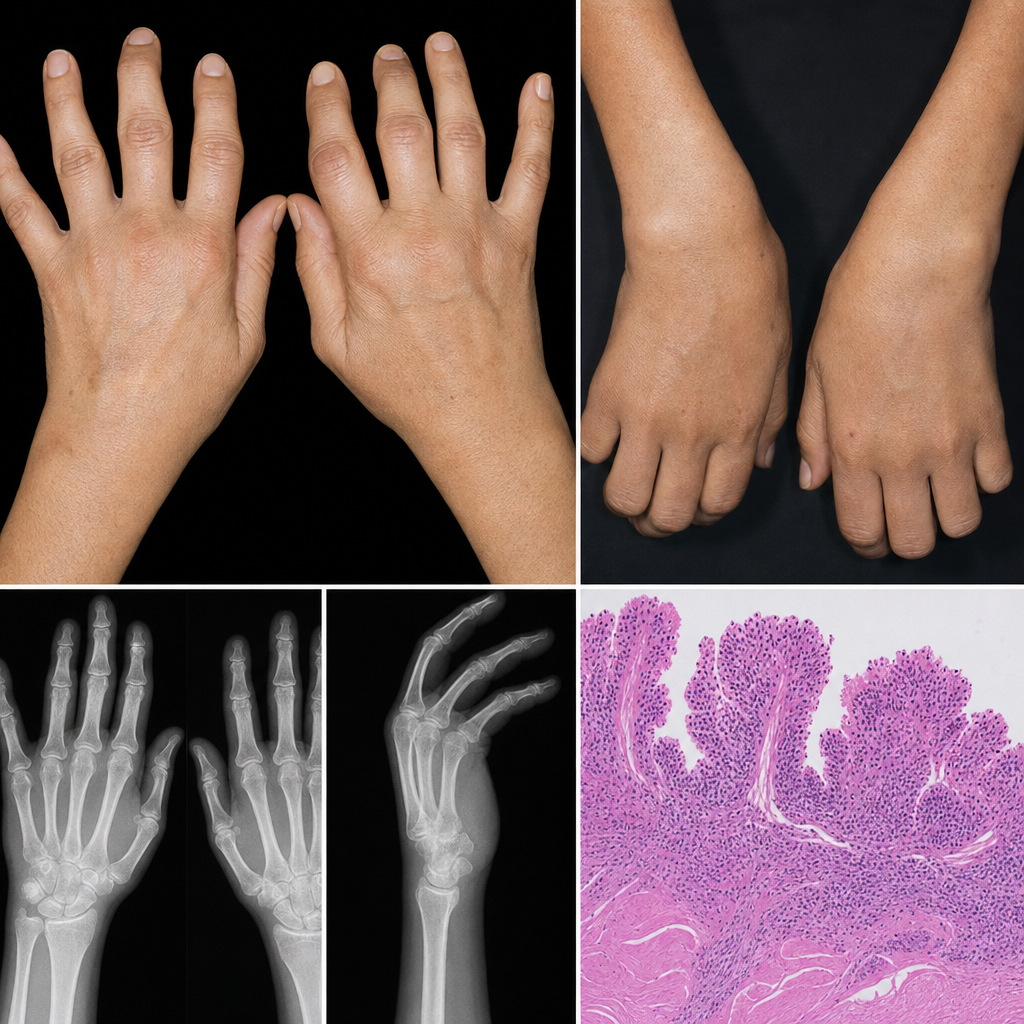
Anti-histone antibodies are characteristic of which condition?
A 54-year-old man with a history of smoking presents with fever, hemoptysis, weight loss, and oligoarthritis. Serial skiagrams show fleeting opacities. What is the diagnosis?
What is the most common cause of polymyositis?
Raynaud's phenomenon is seen in which of the following conditions?
Which of the following is the most specific test for rheumatoid arthritis?
Circinate balanitis is a feature of which of the following conditions?
Shrinking lung syndrome is seen in which of the following conditions?
A person suffers from HLA-B27 associated reactive arthritis, urethritis, and conjunctivitis. Which is the most likely organism involved in this case?
Which of the following is true about polymyositis?
Tophi in gout are found in all regions except?
Explanation: **Explanation:** **1. Why Drug-Induced Lupus (DIL) is correct:** Anti-histone antibodies are the hallmark of Drug-Induced Lupus. They are present in **>95%** of patients with DIL. While these antibodies can also be found in systemic lupus erythematosus (SLE), their presence in the absence of other SLE-specific markers (like anti-dsDNA [1]) in a patient taking culprit medications is highly suggestive of DIL. **2. Why other options are incorrect:** * **Cardiac Lupus (Neonatal Lupus):** This is primarily associated with **Anti-Ro (SS-A)** and **Anti-La (SS-B)** antibodies [1], which cross the placenta and can cause congenital heart block. * **Lupus Nephritis:** This is strongly associated with high titers of **Anti-dsDNA** antibodies and low complement levels (C3, C4) [1]. Anti-histone antibodies do not correlate with renal involvement. * **Mixed Connective Tissue Disease (MCTD):** The defining serological marker for MCTD is high titers of **Anti-U1 RNP** antibodies [1]. **3. High-Yield Clinical Pearls for NEET-PG:** * **Common Culprit Drugs:** Remember the mnemonic **SHIPP**: **S**ulfonamides, **H**ydralazine (highest risk), **I**soniazid, **P**rocainamide (highest frequency), and **P**henytoin. Anti-TNF agents and Minocycline are also modern causes. * **Key Differences from SLE:** DIL typically spares the CNS and Kidneys. Malar rash and discoid lesions are rare. * **Prognosis:** Symptoms and antibody titers usually resolve within weeks to months after discontinuing the offending drug. * **Complement levels:** Unlike idiopathic SLE [1], complement levels are usually **normal** in DIL.
Explanation: **Explanation:** The clinical presentation of fever, weight loss, hemoptysis, and oligoarthritis in an older male points toward a systemic vasculitis [1]. The hallmark finding here is **fleeting pulmonary opacities** (migratory infiltrates) on serial skiagrams, which is a classic radiologic feature of **Wegener’s Granulomatosis** (now known as Granulomatosis with Polyangiitis or GPA) [2]. **Why Wegener’s Granulomatosis is correct:** GPA is a small-vessel vasculitis characterized by a triad of upper respiratory tract (sinusitis, saddle nose), lower respiratory tract (hemoptysis, nodules, fleeting opacities), and renal involvement (pauci-immune glomerulonephritis) [2]. The "fleeting opacities" represent areas of pulmonary hemorrhage or inflammatory nodules that resolve in one area and appear in another. **Why the other options are incorrect:** * **Allergic Bronchopulmonary Aspergillosis (ABPA):** While it also features fleeting opacities, it typically occurs in patients with long-standing asthma or cystic fibrosis and does not present with systemic oligoarthritis. * **Sarcoidosis:** Usually presents with bilateral hilar lymphadenopathy and persistent (not fleeting) interstitial shadows. While it causes arthritis (Lofgren syndrome), the presence of hemoptysis is rare unless there is secondary aspergilloma. * **Tuberculosis:** A common cause of fever and hemoptysis in India; however, TB lesions are typically progressive and cavitary (often in the apices) rather than fleeting or migratory. **NEET-PG High-Yield Pearls:** * **Serology:** GPA is strongly associated with **c-ANCA (PR3-ANCA)**. * **Classic Triad:** Upper Respiratory + Lower Respiratory + Kidneys [2]. * **Biopsy:** Shows necrotizing granulomatous inflammation [2]. * **Fleeting Opacities Differential (Mnemonic: SPACE):** **S**arcoidosis (rarely), **P**I-E syndrome (Loeffler’s), **A**BPA, **C**hurg-Strauss, **E**osinophilic pneumonia. (Note: Wegener's is a key addition to this list in clinical vignettes).
Explanation: ### Explanation **Concept Overview:** The question refers to **Pyomyositis** (infectious myositis), which is a primary bacterial infection of the skeletal muscle. While "Polymyositis" is typically an idiopathic inflammatory dermatomyopathy [1], in the context of infectious etiologies and the provided options, the question focuses on **Tropical Pyomyositis**. **Why Staphylococcus is Correct:** * **Staphylococcus aureus** is the most common causative organism, responsible for **70–90%** of all cases. * The pathogenesis usually involves transient bacteremia leading to the seeding of a large muscle group (most commonly the quadriceps, glutei, or iliopsoas), often following minor local trauma. * It is characterized by fever, localized muscle pain, and the eventual formation of deep-seated abscesses. **Why Other Options are Incorrect:** * **Streptococcus (Option C):** While Group A Streptococci are the second most common cause, they are significantly less frequent than *S. aureus*. They are more often associated with rapidly progressive necrotizing fasciitis. * **Pseudomonas (Option A) & Brucella (Option B):** These are rare causes. *Pseudomonas* is typically seen only in severely immunocompromised or neutropenic patients. *Brucella* may cause myositis in endemic areas but is not the "most common." **NEET-PG High-Yield Pearls:** * **Gold Standard Diagnosis:** MRI is the most sensitive imaging modality for early detection (showing muscle edema). * **Clinical Stages:** Stage 1 (Invasive), Stage 2 (Suppurative/Abscess - most patients present here), Stage 3 (Late/Septic). * **Treatment:** Incision and drainage (I&D) of the abscess plus intravenous antibiotics (cloxacillin or vancomycin if MRSA is suspected) [2]. * **Note on Terminology:** In exams, "Polymyositis" is usually autoimmune; however, if options list bacteria, the examiner is referring to **Pyomyositis**. Always look for *S. aureus* as the primary culprit in pyogenic muscle infections.
Explanation: Explanation: Raynaud’s phenomenon (RP) is a clinical condition characterized by episodic digital ischemia due to vasospasm of small arteries, typically triggered by cold or emotional stress. It classically presents as a triphasic color change: **White** (pallor/vasospasm), **Blue** (cyanosis/hypoxia), and **Red** (rubor/reperfusion). **1. Why the Correct Answer is Right:** Raynaud’s phenomenon is classified into Primary (idiopathic) and Secondary. Secondary RP is most strongly associated with **Connective Tissue Diseases (CTDs)** [1]. * **Systemic Sclerosis (Scleroderma):** RP is the most common initial symptom, occurring in over 95% of patients. It is often severe and can lead to digital ulcers. Arterial narrowing occurs due to intimal proliferation and vessel wall inflammation [1]. * **Systemic Lupus Erythematosus (SLE):** RP occurs in approximately 30% of SLE patients [1]. Because both conditions are major causes of secondary RP, Option D is the most comprehensive and correct choice. **2. Why Other Options are Wrong:** * **Option B:** While SLE is associated with RP, this option is incomplete as it ignores Systemic Sclerosis, which has a much higher prevalence of the condition. * **Option C:** Hypertension is a cardiovascular condition involving systemic arterial pressure and is not a recognized cause of Raynaud’s phenomenon. In fact, some drugs used to treat hypertension (like Beta-blockers) can actually worsen RP. **3. NEET-PG High-Yield Pearls:** * **MCTD (Mixed Connective Tissue Disease):** RP is a universal feature (nearly 100% of cases) [1]. * **Nailfold Capillaroscopy:** This is the best initial test to distinguish Primary from Secondary RP. "Dropped out" capillaries or dilated loops suggest an underlying CTD [1]. * **Drug of Choice:** Calcium Channel Blockers (specifically **Nifedipine**) are the first-line treatment for Raynaud’s. * **CREST Syndrome:** RP is the 'R' in this variant of limited cutaneous systemic sclerosis.
Explanation: **Explanation:** The diagnosis of Rheumatoid Arthritis (RA) relies on identifying specific autoantibodies. While **Rheumatoid Factor (RF)** is the most sensitive initial test, it lacks specificity. The most specific markers for RA are antibodies against citrullinated proteins. **Why Anti-MCV is correct:** **Anti-MCV (Mutated Citrullinated Vimentin)** antibody is a type of Anti-Citrullinated Protein Antibody (ACPA). It has a **specificity of approximately 95-98%** for RA, which is comparable to or slightly higher than the standard Anti-CCP test. Clinically, Anti-MCV is highly significant because it correlates strongly with **disease activity** and the development of **radiographic joint damage** (erosions). In the context of this question, it is the only RA-specific marker listed. **Analysis of Incorrect Options:** * **B. Anti-cardiolipin antibody:** Associated with **Antiphospholipid Antibody Syndrome (APS)** and Systemic Lupus Erythematosus (SLE). It is linked to arterial/venous thrombosis and pregnancy loss. * **C. Anti-Mi-2 antibody:** A highly specific marker for **Dermatomyositis**. It is typically associated with a good prognosis and classic skin findings like Gottron’s papules. * **D. Anti-Ro (SS-A) antibody:** Primarily associated with **Sjögren’s syndrome** and SLE [1]. It is also linked to neonatal lupus and congenital heart block. **NEET-PG High-Yield Pearls:** * **Most Sensitive Test for RA:** Rheumatoid Factor (RF). * **Most Specific Test for RA:** Anti-CCP or Anti-MCV (ACPAs). * **Prognostic Value:** High titers of ACPA/Anti-MCV indicate a more aggressive, erosive disease course. * **Seronegative RA:** Refers to patients who have clinical RA but test negative for both RF and ACPAs [2].
Explanation: **Explanation:** **Reactive Arthritis (ReA)** is the correct answer. It is a sterile inflammatory spondyloarthropathy that typically follows a gastrointestinal (e.g., *Salmonella, Shigella, Campylobacter*) or urogenital (e.g., *Chlamydia trachomatis*) infection [2]. **Circinate balanitis** is a pathognomonic cutaneous manifestation of ReA, characterized by painless, erythematous, superficial erosions with serpiginous borders on the glans penis [1], [2]. It occurs in approximately 20–40% of male patients with ReA [2]. **Analysis of Incorrect Options:** * **A. Osteoarthritis:** This is a degenerative joint disease characterized by cartilage loss and osteophyte formation; it does not involve systemic inflammatory or mucocutaneous lesions. * **B. Psoriatic Arthritis:** While it shares features like dactylitis and uveitis, its classic skin finding is plaque psoriasis. While "psoriasiform" lesions occur in ReA (Keratoderma blennorrhagicum), circinate balanitis is specifically linked to the triad of ReA [2]. * **D. Ankylosing Spondylitis:** Although it is the prototype of seronegative spondyloarthropathies, it primarily presents with sacroiliitis and inflammatory back pain rather than specific penile lesions. **High-Yield Clinical Pearls for NEET-PG:** * **Reiter’s Triad:** "Can't see (Uveitis/Conjunctivitis), can't pee (Urethritis), and can't climb a tree (Arthritis)." * **Keratoderma Blennorrhagicum:** Hyperkeratotic skin lesions on the palms and soles, histologically indistinguishable from pustular psoriasis [2]. * **HLA-B27 Association:** Strongly positive in 60–80% of cases [1]. * **Joint Involvement:** Typically an asymmetric oligoarthritis affecting the lower limbs (knees and ankles) [2].
Explanation: **Explanation:** **Shrinking Lung Syndrome (SLS)** is a rare but characteristic respiratory complication of **Systemic Lupus Erythematosus (SLE)**. It is defined by progressive dyspnea, reduced lung volumes (restrictive pattern on PFTs), and elevated diaphragmatic domes on chest X-ray, notably in the **absence** of interstitial lung disease or pleural pathology [1]. The underlying pathophysiology is attributed to **diaphragmatic dysfunction** or weakness, likely due to a primary myopathy or phrenic nerve neuropathy [1]. **Analysis of Options:** * **Systemic Lupus Erythematosus (Correct):** SLS occurs in approximately 0.5% to 1.1% of SLE patients. It typically presents with pleuritic chest pain and a restrictive ventilatory defect [1]. * **Tuberous Sclerosis (Incorrect):** This neurocutaneous syndrome is associated with **Lymphangioleiomyomatosis (LAM)**, which presents with thin-walled cysts and recurrent pneumothorax, not SLS. * **Scleroderma (Incorrect):** While Scleroderma (Systemic Sclerosis) frequently involves the lungs, the classic manifestation is **Interstitial Lung Disease (NSIP pattern)** and Pulmonary Arterial Hypertension (PAH) [1]. * **Diabetes Mellitus (Incorrect):** DM is not associated with primary restrictive lung syndromes like SLS; pulmonary complications in DM are usually related to increased infection risk or sleep apnea. **NEET-PG High-Yield Pearls:** * **Most common lung manifestation in SLE:** Pleuritis (with or without effusion). * **Most common lung manifestation in Scleroderma:** Interstitial Lung Disease (ILD) [1]. * **SLS Treatment:** Corticosteroids are the first-line treatment; beta-agonists (theophylline) are sometimes used to improve diaphragmatic strength. * **Radiology of SLS:** Small lung volumes with "high-riding" diaphragms [1].
Explanation: This question describes the classic clinical triad of **Reactive Arthritis** (formerly Reiter’s Syndrome): **Urethritis, Conjunctivitis, and Arthritis** ("Can't see, can't pee, can't climb a tree") [1]. ### **Explanation of the Correct Answer** Reactive arthritis is an autoimmune response triggered by a preceding infection, typically occurring 1–4 weeks after a gastrointestinal (GI) or urogenital (GU) infection [1]. It is strongly associated with the **HLA-B27** haplotype [2]. * **Ureaplasma urealyticum** and **Chlamydia trachomatis** are the most common triggers for the **urogenital** form of reactive arthritis [1]. Given the presence of urethritis in the clinical vignette, *U. urealyticum* is the most likely causative organism among the choices provided. ### **Analysis of Incorrect Options** * **A. Borrelia burgdorferi:** This is the causative agent of **Lyme Disease**. While it causes chronic monoarthritis (usually the knee), it does not typically present with the triad of urethritis and conjunctivitis. * **C. Beta-hemolytic streptococci:** Group A Strep is associated with **Acute Rheumatic Fever** (migratory polyarthritis) and Post-Streptococcal Reactive Arthritis (PSRA), but it is not a classic trigger for HLA-B27 associated Reactive Arthritis. * **D. Streptococcus bovis:** Now known as *S. gallolyticus*, this organism is classically associated with **infective endocarditis** and **colonic malignancy**, not reactive arthritis. ### **NEET-PG Clinical Pearls** * **Common Triggers:** * **GU:** *Chlamydia trachomatis* (most common overall), *Ureaplasma* [1]. * **GI:** *Shigella flexneri*, *Salmonella*, *Campylobacter*, and *Yersinia* [1]. * **Extra-articular manifestations:** Look for **Keratoderma blennorrhagica** (skin vesicles on palms/soles) and **Circinate balanitis** (painless penile ulcers) [1]. * **Joint Involvement:** Typically an asymmetric oligoarthritis affecting the lower limbs (knees, ankles) [1]. * **HLA-B27:** Present in 30–50% of patients with reactive arthritis; its presence correlates with a higher risk of chronicity and sacroiliitis [2].
Explanation: **Explanation:** Polymyositis (PM) is an idiopathic inflammatory myopathy characterized by symmetric, subacute, progressive **proximal muscle weakness** [1]. **Why Option A is Correct:** The hallmark of Polymyositis is the **absence** of ocular and facial muscle involvement. This is a critical diagnostic differentiator. While proximal muscles (shoulders, hips) are severely affected, the extraocular muscles are characteristically spared. Furthermore, **muscle atrophy** is typically a late-stage finding in chronic, untreated, or severe cases of PM, occurring after significant muscle fiber necrosis and replacement by fibrous tissue. **Analysis of Incorrect Options:** * **B. Muscle atrophy:** While atrophy occurs, it is not the defining clinical feature compared to the specific exclusion of ocular involvement. * **C. Ocular muscle involvement and pharyngeal involvement:** While pharyngeal involvement (dysphagia) is common in PM [1], **ocular involvement is NOT**. If ocular muscles are involved, one must suspect Myasthenia Gravis [2] or Mitochondrial Myopathies. * **D. Ocular muscle involvement and brisk reflexes:** Again, ocular muscles are spared. Additionally, in PM, deep tendon reflexes (DTRs) are usually **normal** or decreased in late stages; brisk reflexes (hyperreflexia) suggest Upper Motor Neuron (UMN) lesions, not a primary muscle pathology. **High-Yield Clinical Pearls for NEET-PG:** * **Sparing:** PM/DM characteristically **spares** the extraocular and facial muscles. * **Diagnostic Markers:** Elevated **Creatine Kinase (CK)** and **Anti-Jo-1** antibodies (associated with interstitial lung disease) [1]. * **Biopsy:** PM shows **endomysial** inflammation with CD8+ T-cells, whereas Dermatomyositis shows **perimysial** inflammation with CD4+ T-cells. * **Malignancy:** Always screen for underlying malignancy in patients diagnosed with inflammatory myopathies (especially Dermatomyositis).
Explanation: The correct answer is **Bone**. While gout is a systemic metabolic disorder, the deposition of monosodium urate (MSU) crystals—known as **tophi**—follows a specific pattern of tissue predilection [1]. **1. Why Bone is the correct answer:** Tophi are essentially collections of MSU crystals surrounded by a granulomatous inflammatory response [1]. They typically deposit in **avascular or poorly vascularized tissues** (like cartilage and tendons) or cooler peripheral areas. While gout causes "punched-out" erosions in bone (Martel’s sign), the tophus itself is an **extracellular** deposit that occurs in the periarticular soft tissues, subchondral regions, or marrow spaces, but **not within the mineralized bone matrix** itself. In the context of this classic MCQ, bone is the site where tophi are least likely to be "found" as a primary site of deposition compared to soft tissues. **2. Analysis of other options:** * **Skin:** Subcutaneous tophi are very common, especially on the fingers, toes, and the helix of the ear [1]. * **Synovial membrane:** This is a primary site for crystal deposition, leading to the characteristic acute inflammatory synovitis [3, 4]. * **Muscle:** Although rare, tophi can deposit in connective tissue sheaths within or around muscles and tendons (e.g., Achilles tendon) [1]. **Clinical Pearls for NEET-PG:** * **Commonest site for Tophi:** The helix of the ear and the olecranon bursa [1]. * **Commonest joint involved:** 1st Metatarsophalangeal joint (Podagra) [3]. * **Polarizing Microscopy:** MSU crystals are **needle-shaped** and show **strong negative birefringence** (yellow when parallel to the axis). * **Radiology:** Look for "Punched-out" erosions with **overhanging edges** (Rat-bite erosions). * **Note:** Tophi usually develop after about 10 years of untreated chronic polyarticular gout [1].
Rheumatoid Arthritis
Practice Questions
Spondyloarthropathies
Practice Questions
Systemic Lupus Erythematosus
Practice Questions
Vasculitis Syndromes
Practice Questions
Scleroderma and Related Disorders
Practice Questions
Inflammatory Myopathies
Practice Questions
Crystal Arthropathies
Practice Questions
Osteoarthritis
Practice Questions
Primary Immunodeficiency Disorders
Practice Questions
Autoinflammatory Syndromes
Practice Questions
Sjögren's Syndrome
Practice Questions
Antiphospholipid Syndrome
Practice Questions
Get full access to all questions, explanations, and performance tracking.
Start For Free