A biopsy of the lower lip salivary glands showed replacement of parenchymal tissue by lymphocytes. The patient also had xerostomia and keratoconjunctivitis sicca. These findings are indicative of which of the following?
Which of the following is NOT a typical feature of Behcet's syndrome?
Which of the following is NOT a criterion for Juvenile Rheumatoid Arthritis?
Sjögren's syndrome consists of all of the following EXCEPT?
Which of the following is absent in CREST syndrome?
Palpable purpura is caused by?
A 57-year-old woman presents with frequent headaches, scalp tenderness, arthralgias, fatigue, and jaw discomfort during mastication. Examination reveals a tender right temporal artery. Her erythrocyte sedimentation rate (ESR) is 50 mm/h and hemoglobin is 10.5 g/dL. A temporal artery biopsy has been obtained for diagnostic confirmation. What is the most appropriate next step in management?
Oligoarthritis with ascending joint involvement is seen in?
A patient experiencing an acute attack of gout is intolerant to NSAIDs. Which medication should be administered?
Libman-Sacks endocarditis is typically seen in which condition?
Explanation: ### Explanation **Correct Answer: D. Sjögren’s syndrome** **1. Why it is correct:** Sjögren’s syndrome is a chronic autoimmune disorder characterized by lymphocytic infiltration of exocrine glands, primarily the lacrimal and salivary glands. The clinical triad presented—**xerostomia** (dry mouth), **keratoconjunctivitis sicca** (dry eyes), and a **lip biopsy** showing focal lymphocytic sialadenitis—is classic for this condition. The replacement of functional parenchymal tissue by lymphocytes (specifically CD4+ T cells and B cells) leads to glandular dysfunction and the resulting "sicca symptoms." **2. Why the other options are incorrect:** * **A. Lymphoma:** While patients with Sjögren’s have a 40-fold increased risk of developing B-cell MALT lymphoma, the biopsy described (lymphocytic replacement of parenchyma) is the diagnostic hallmark of the underlying autoimmune process, not a malignancy itself. * **B. Crohn’s disease:** This is an inflammatory bowel disease. While it can have extra-intestinal manifestations, it typically presents with granulomatous inflammation of the GI tract, not primary lymphocytic infiltration of salivary glands. * **C. Mumps:** This is an acute viral infection (Paramyxovirus) causing painful parotitis. It does not cause chronic sicca symptoms or the specific histopathological pattern of parenchymal replacement seen in autoimmune diseases. **3. High-Yield Clinical Pearls for NEET-PG:** * **Antibodies:** Highly associated with **Anti-Ro (SS-A)** and **Anti-La (SS-B)**. * **Diagnostic Test:** The **Schirmer’s test** measures tear production (positive if <5 mm in 5 minutes). * **Histology:** The "Focus Score" is used; a score of ≥1 focus (aggregate of 50+ lymphocytes) per 4 $mm^2$ of glandular tissue is diagnostic. * **Complication:** Always monitor for **MALT Lymphoma**, often signaled by persistent parotid swelling or loss of previously positive rheumatoid factor.
Explanation: Behcet’s syndrome is a chronic, multisystemic, relapsing inflammatory disorder classified as a **variable vessel vasculitis**. It is characterized by systemic perivasculitis affecting both arteries and veins of all sizes. **Why Hepato-splenic involvement is the correct answer:** While Behcet’s can affect almost any organ system, **hepato-splenic involvement is not a typical or diagnostic feature**. Unlike other systemic vasculitides or granulomatous diseases (like Sarcoidosis), Behcet’s does not characteristically cause hepatomegaly, splenomegaly, or primary hepatic parenchymal disease. While Budd-Chiari syndrome (hepatic vein thrombosis) can occur due to the disease's prothrombotic nature, the organs themselves are not primary targets of the inflammatory process. **Analysis of Incorrect Options:** * **Arthritis:** Occurs in approximately 50% of patients. It is typically a non-erosive, asymmetrical, large-joint oligoarthritis (most commonly affecting the knees). * **Mucocutaneous involvement:** This is the hallmark of the disease. It includes recurrent **painful oral aphthous ulcers** (mandatory for diagnosis), genital ulcers, and skin lesions like erythema nodosum or acneiform eruptions. * **Neuro-ocular involvement:** Ocular involvement (typically bilateral panuveitis or retinal vasculitis) is a major cause of morbidity. Neurological involvement ("Neuro-Behcet’s") can manifest as parenchymal CNS lesions [1] or dural venous sinus thrombosis. **NEET-PG High-Yield Pearls:** * **Pathergy Test:** A highly specific (though not sensitive) skin hyperreactivity test where a sterile needle prick results in a pustule/papule within 24–48 hours. * **HLA Association:** Strongly associated with **HLA-B51**. * **Diagnosis:** Primarily clinical (International Study Group criteria). Recurrent oral ulcers + 2 of: genital ulcers, eye lesions, skin lesions, or positive pathergy. * **Vascular:** It is unique because it causes both arterial (aneurysms/thrombosis) and venous (DVT/SVTs) complications.
Explanation: To understand this question, it is essential to recall the diagnostic criteria for **Juvenile Idiopathic Arthritis (JIA)**, formerly known as Juvenile Rheumatoid Arthritis (JRA) [1]. ### **Explanation of the Correct Answer** The correct answer is **D (All of the above)** because none of the individual options (A, B, or C) represent the actual diagnostic criteria. According to the ILAR (International League of Associations for Rheumatology) classification: 1. **Age of Onset:** Must be **less than 16 years**. Option A says "greater than 16," which is incorrect. 2. **Duration of Arthritis:** Must be **6 weeks or longer** [1]. Option B (3 weeks) and Option C (6 months) are both incorrect timeframes. Since all three statements are factually incorrect regarding the criteria, "All of the above" is the appropriate choice for a "NOT a criterion" question. ### **Analysis of Options** * **Option A:** Incorrect because JIA is defined by onset in childhood/adolescence (<16 years). Onset after 16 is classified as adult-onset inflammatory arthritis. * **Option B:** Incorrect because 3 weeks is too short. This duration often includes transient viral or post-streptococcal arthritides. * **Option C:** Incorrect because while the disease may last 6 months, the diagnostic requirement is only 6 weeks to ensure chronicity. ### **NEET-PG High-Yield Pearls** * **Definition:** Arthritis of unknown etiology in at least one joint for at least 6 weeks in a child <16 years [1]. * **Systemic JIA (Still’s Disease):** Characterized by daily "quotidian" spiking fevers and an evanescent (fleeting) salmon-pink rash [1]. * **Ocular Complication:** Chronic asymptomatic **Anterior Uveitis** is common, especially in Oligoarticular JIA with **ANA positivity**. Regular slit-lamp exams are mandatory. * **RF Factor:** Most JIA patients are RF negative; RF positivity is typically seen only in the polyarticular subtype (older girls).
Explanation: ### Explanation Sjögren's syndrome is a chronic systemic autoimmune disease characterized by lymphocytic infiltration of exocrine glands, primarily the lacrimal and salivary glands. **Why "Xerophthalmia" is the correct answer (The Exception):** In the context of this specific question, **Xerophthalmia** is considered the "odd one out" because it is a broad clinical term describing dry eyes often associated with **Vitamin A deficiency**, leading to Bitot's spots and night blindness. While Sjögren's does cause dry eyes, the specific medical term used to describe the inflammatory ocular pathology in this syndrome is **Keratoconjunctivitis sicca (KCS)**, which involves corneal and conjunctival epithelial damage due to aqueous tear deficiency. **Analysis of other options:** * **Keratoconjunctivitis sicca (Option D):** This is the hallmark ocular manifestation of Sjögren's, caused by lymphocytic destruction of the lacrimal glands [1]. * **Chronic arthritis (Option B):** Approximately 50% of patients with Sjögren's develop a symmetric, non-erosive chronic arthritis similar to Rheumatoid Arthritis. * **Chronic dermatitis (Option C):** Cutaneous involvement is common, presenting as xeroderma (dry skin), palpable purpura (vasculitis), or annular erythema. **NEET-PG High-Yield Pearls:** 1. **Primary vs. Secondary:** Primary Sjögren's occurs alone; Secondary Sjögren's is most commonly associated with **Rheumatoid Arthritis** [1]. 2. **Antibodies:** Most specific is **Anti-La (SS-B)**; most sensitive/common are **Anti-Ro (SS-A)** and **ANA**. 3. **Diagnostic Gold Standard:** Minor salivary gland biopsy showing **focal lymphocytic sialadenitis** (Focus score ≥1). 4. **Malignancy Risk:** Patients have a 40-fold increased risk of **B-cell MALT Lymphoma** (watch for persistent parotid swelling). 5. **Schirmer’s Test:** Used to quantify tear production (Positive if <5 mm in 5 minutes).
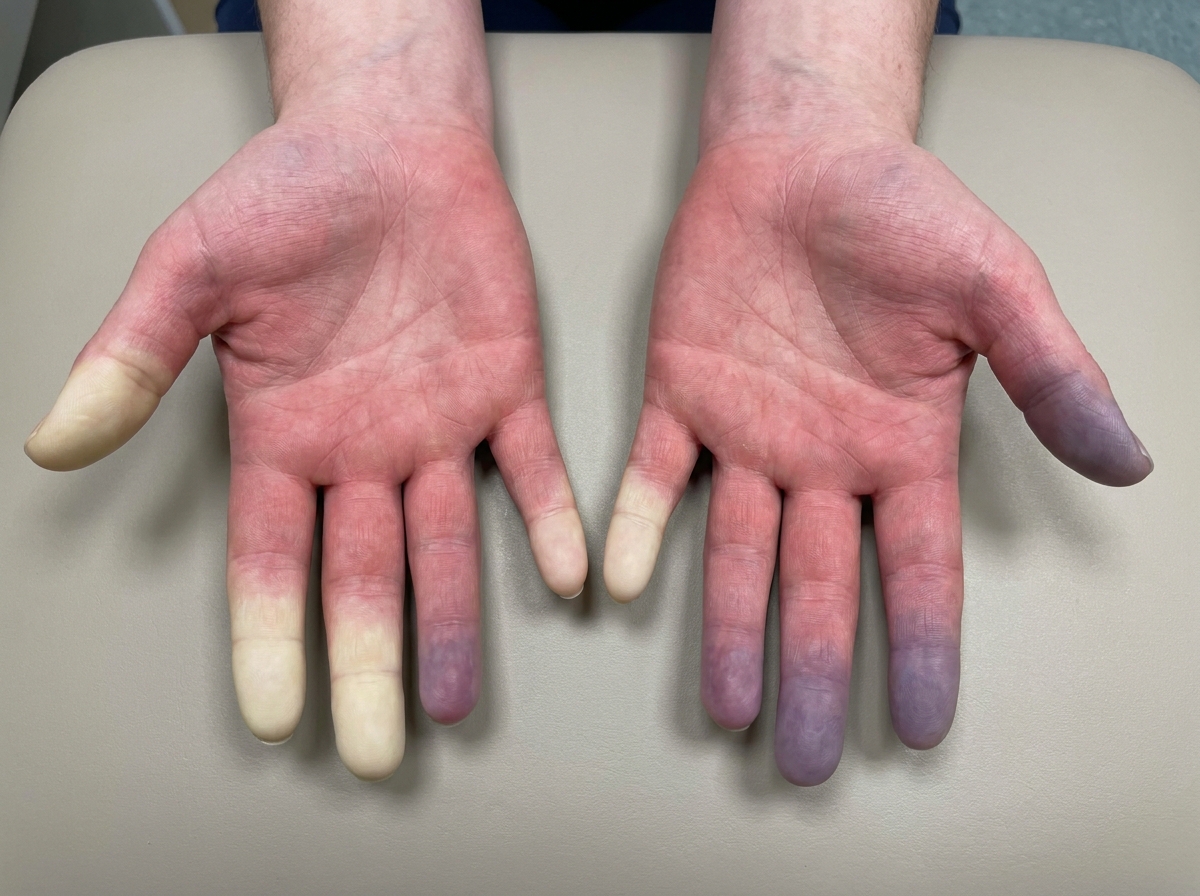
Explanation: Explanation: CREST syndrome is a limited form of Systemic Sclerosis (Scleroderma). It is characterized by a specific constellation of clinical features represented by its acronym. 1. Why "Endocrine disorders" is the correct answer: Endocrine dysfunction is not a component of the CREST acronym or the underlying pathophysiology of systemic sclerosis. While patients with autoimmune diseases can occasionally have co-existing conditions (like Hashimoto’s thyroiditis), endocrine failure is not a diagnostic or characteristic feature of this syndrome. 2. Analysis of Incorrect Options (Components of CREST): * C – Calcinosis cutis: Calcium deposits in the skin and soft tissues, often seen on fingertips or over joints. * R – Raynaud's phenomenon: Episodic vasospasm of digits in response to cold or stress; often the earliest manifestation. * E – Esophageal dysmotility: Resulting from neuromuscular dysfunction and fibrosis, leading to dysphagia and GERD. * S – Sclerodactyly: Thickening and tightening of the skin of the fingers and toes, giving them a "tapered" appearance [1]. * T – Telangiectasis: Dilated small blood vessels, typically on the face, mucous membranes, and palms. NEET-PG High-Yield Pearls: * Antibody Marker: The most specific marker for CREST syndrome is Anti-centromere antibody (present in ~90% of cases). * Prognosis: Limited Scleroderma (CREST) generally has a better prognosis than Diffuse Cutaneous Systemic Sclerosis (dcSSc), which is associated with Anti-Scl-70 (Anti-topoisomerase I) antibodies. * Major Complication: The most feared late complication of CREST syndrome is Pulmonary Arterial Hypertension (PAH), whereas diffuse disease is more associated with Interstitial Lung Disease (ILD).
Explanation: **Explanation:** **Palpable purpura** is the clinical hallmark of **leukocytoclastic vasculitis**. Unlike non-inflammatory purpura (caused by trauma or thrombocytopenia), these lesions are raised because the underlying inflammation leads to vessel wall damage, edema, and the extravasation of red blood cells into the dermis [1]. * **Henoch-Schönlein Purpura (HSP):** This is a small-vessel vasculitis characterized by IgA immune complex deposition [2]. It typically presents with the classic tetrad of palpable purpura (usually on the lower extremities), arthralgia, abdominal pain, and renal involvement. * **Microscopic Polyangiitis (MPA):** This is a pauci-immune small-vessel vasculitis. Because it affects capillaries and post-capillary venules in the skin, palpable purpura is a common cutaneous manifestation [1]. * **Polyarteritis Nodosa (PAN):** While PAN is primarily a medium-vessel vasculitis, it frequently involves the small vessels of the skin. Cutaneous manifestations include livedo reticularis, skin ulcers, and palpable purpura. **Why "All of the above" is correct:** Palpable purpura occurs whenever there is inflammation of the small cutaneous blood vessels. Since all three conditions listed involve small-vessel inflammation (either as the primary pathology or as part of a systemic process), they can all present with this clinical finding. **High-Yield Clinical Pearls for NEET-PG:** 1. **Non-palpable purpura** is usually due to **thrombocytopenia** or vascular fragility (e.g., Senile purpura, Scurvy). 2. **HSP** is the most common vasculitis in children; always look for **IgA deposits** on skin biopsy [2]. 3. **PAN** is strongly associated with **Hepatitis B** infection and characteristically **spares the lungs**. 4. **Microscopic Polyangiitis** is most commonly associated with **p-ANCA** (MPO-antibodies).
Explanation: ### Explanation **1. Why Option D is Correct:** The patient presents with classic features of **Giant Cell Arteritis (GCA)**, also known as Temporal Arteritis: headache, scalp tenderness, jaw claudication (highly specific), and elevated ESR. In cases of GCA **without visual loss**, the standard of care is immediate initiation of **high-dose oral corticosteroids** (typically Prednisone 40–60 mg/day). Treatment should never be delayed while awaiting biopsy results, as the risk of irreversible blindness (due to anterior ischemic optic neuropathy) is high [1]. **2. Why Other Options are Incorrect:** * **Option A (IV high-dose steroids):** Intravenous "pulse" methylprednisolone is reserved for patients presenting with **acute visual loss** or neurological deficits to prevent further deterioration. This patient has no visual symptoms. * **Option B (Acetylsalicylic acid):** While low-dose aspirin may reduce the risk of stroke in GCA, it is an **adjunctive** therapy and not the primary treatment for the underlying vasculitis. * **Option C (Indomethacin):** This is the treatment of choice for *Hemicrania continua* or *Paroxysmal hemicrania*. It has no role in treating the systemic inflammation of GCA and will not prevent blindness. **3. High-Yield Clinical Pearls for NEET-PG:** * **Association:** ~50% of GCA patients have **Polymyalgia Rheumatica (PMR)** (proximal muscle pain/stiffness). * **Diagnosis:** Temporal artery biopsy is the gold standard [1]. Due to "skip lesions," a long segment (2–3 cm) must be biopsied. * **Histopathology:** Granulomatous inflammation of the media with fragmented internal elastic lamina and multinucleated giant cells [1]. * **Lab Findings:** Characteristically high ESR (>50 mm/h) and Normocytic Normochromic Anemia (Anemia of Chronic Disease). * **Steroid Sparing Agent:** **Tocilizumab** (IL-6 inhibitor) is now FDA-approved for GCA to help taper steroids.
Explanation: The hallmark of **Seronegative Spondyloarthropathies (SpA)**—which include Ankylosing Spondylitis, Reactive Arthritis, Psoriatic Arthritis, and Enteropathic Arthritis—is an **asymmetric oligoarthritis** (affecting <5 joints) that typically involves the lower extremities first [1]. A classic clinical feature of these conditions is **ascending joint involvement**, where the disease starts in the small joints of the feet or the sacroiliac joints and progresses upward to the knees, hips, and eventually the spine [1]. **Analysis of Options:** * **Seronegative Arthritis (Correct):** These disorders are characterized by the absence of Rheumatoid Factor (RF). They typically present with an asymmetric pattern, enthesitis (inflammation at tendon insertion sites), and a predilection for the axial skeleton and large joints of the lower limbs in an ascending fashion [1]. * **Juvenile Osteoarthritis (Incorrect):** Osteoarthritis is a degenerative "wear and tear" disease. While it can be polyarticular, it does not follow a specific "ascending" inflammatory pattern and is rare in the juvenile population unless secondary to trauma or dysplasia. * **SLE (Incorrect):** Systemic Lupus Erythematosus typically presents with a **symmetric, migratory, non-erosive polyarthritis** involving small joints (similar to RA but without joint destruction). * **Septic Arthritis (Incorrect):** This is usually **monoarticular** (involving a single joint, most commonly the knee) and presents acutely with severe pain, swelling, and fever. It does not follow an ascending pattern. **NEET-PG High-Yield Pearls:** * **HLA-B27 Association:** Strongly linked with Seronegative SpA, especially Ankylosing Spondylitis (>90%) [1]. * **Dactylitis:** "Sausage digits" are a pathognomonic feature of Psoriatic and Reactive arthritis. * **Extra-articular features:** Look for uveitis, aortitis, and Achilles tendonitis (enthesitis) in clinical vignettes [1]. * **Symmetry:** RA is symmetric; Seronegative SpA is asymmetric [1].
Explanation: **Explanation:** The management of an **acute gouty attack** focuses on rapid anti-inflammatory relief. The first-line agents are typically NSAIDs (e.g., Indomethacin, Naproxen), Colchicine, or Corticosteroids. **Why Steroids are correct:** When a patient is intolerant to NSAIDs (due to reasons like peptic ulcer disease, chronic kidney disease, or hypersensitivity) or if NSAIDs are contraindicated, **Corticosteroids** (oral, intravenous, or intra-articular) are the preferred alternative. They effectively suppress the inflammatory response triggered by monosodium urate crystals. **Why the other options are incorrect:** * **A & D (Allopurinol and Febuxostat):** These are **Xanthine Oxidase Inhibitors (XOIs)** used for *chronic* management to lower serum uric acid levels [1]. They should **never** be initiated during an acute attack, as a rapid drop in urate levels can mobilize crystals from tissues, potentially worsening or prolonging the acute inflammation [1]. * **C (Probenecid):** This is a **uricosuric agent** that increases uric acid excretion in the urine. Like XOIs, it is used for chronic prophylaxis and has no role in treating acute inflammation [1]. **Clinical Pearls for NEET-PG:** * **Drug of Choice (DOC):** NSAIDs are generally the first-line treatment for acute gout. * **Colchicine:** Most effective if started within 12–24 hours of symptom onset. Watch for diarrhea as a common side effect. * **The "Golden Rule":** Do not start or stop urate-lowering therapy (Allopurinol) during an acute attack [1]. If the patient is already on it, continue the same dose; if they are not on it, wait 2 weeks after the attack resolves before starting. * **Target Urate Level:** Aim for <6 mg/dL in chronic management.
Explanation: **Explanation:** **Libman-Sacks Endocarditis (LSE)** is a form of **non-bacterial verrucous endocarditis** classically associated with **Systemic Lupus Erythematosus (SLE)**. It is characterized by small, sterile, fibro-fibrinous vegetations that can occur on any part of the heart valve surface (undersurface, chordae tendineae, or endocardial surfaces), though they most commonly affect the mitral and aortic valves. **Why Option B is Correct:** In SLE, immune complex deposition and subsequent complement activation lead to chronic inflammation of the endocardium [1]. Unlike infective endocarditis, these vegetations are **sterile** (non-infectious) and consist of fibrin, inflammatory cells, and hematoxylin bodies (the only pathognomonic finding). **Analysis of Incorrect Options:** * **A. Rheumatic Fever:** Characterized by small, friable vegetations (verrucae) along the **lines of closure** of the valves, leading to commissural fusion and fish-mouth stenosis [2]. * **C. Infective Endocarditis:** Involves **large, friable, destructive vegetations** containing bacteria/fungi, usually associated with fever and systemic emboli [2]. * **D. Hypercoagulable States:** Associated with **Non-Bacterial Thrombotic Endocarditis (NBTE)** or Marantic endocarditis, typically seen in advanced malignancies (e.g., mucinous adenocarcinoma). **High-Yield Clinical Pearls for NEET-PG:** * **Location:** LSE vegetations are unique because they can occur on **both sides** of the valve leaflets (pathognomonic feature). * **Association:** Strongly linked with **Antiphospholipid Antibody Syndrome (APS)** in SLE patients [1]. * **Complication:** While often asymptomatic, it can lead to valve regurgitation or act as a source for systemic embolization (embolic stroke). * **Treatment:** Focuses on managing the underlying SLE and anticoagulation if embolic events occur.
Rheumatoid Arthritis
Practice Questions
Spondyloarthropathies
Practice Questions
Systemic Lupus Erythematosus
Practice Questions
Vasculitis Syndromes
Practice Questions
Scleroderma and Related Disorders
Practice Questions
Inflammatory Myopathies
Practice Questions
Crystal Arthropathies
Practice Questions
Osteoarthritis
Practice Questions
Primary Immunodeficiency Disorders
Practice Questions
Autoinflammatory Syndromes
Practice Questions
Sjögren's Syndrome
Practice Questions
Antiphospholipid Syndrome
Practice Questions
Get full access to all questions, explanations, and performance tracking.
Start For Free