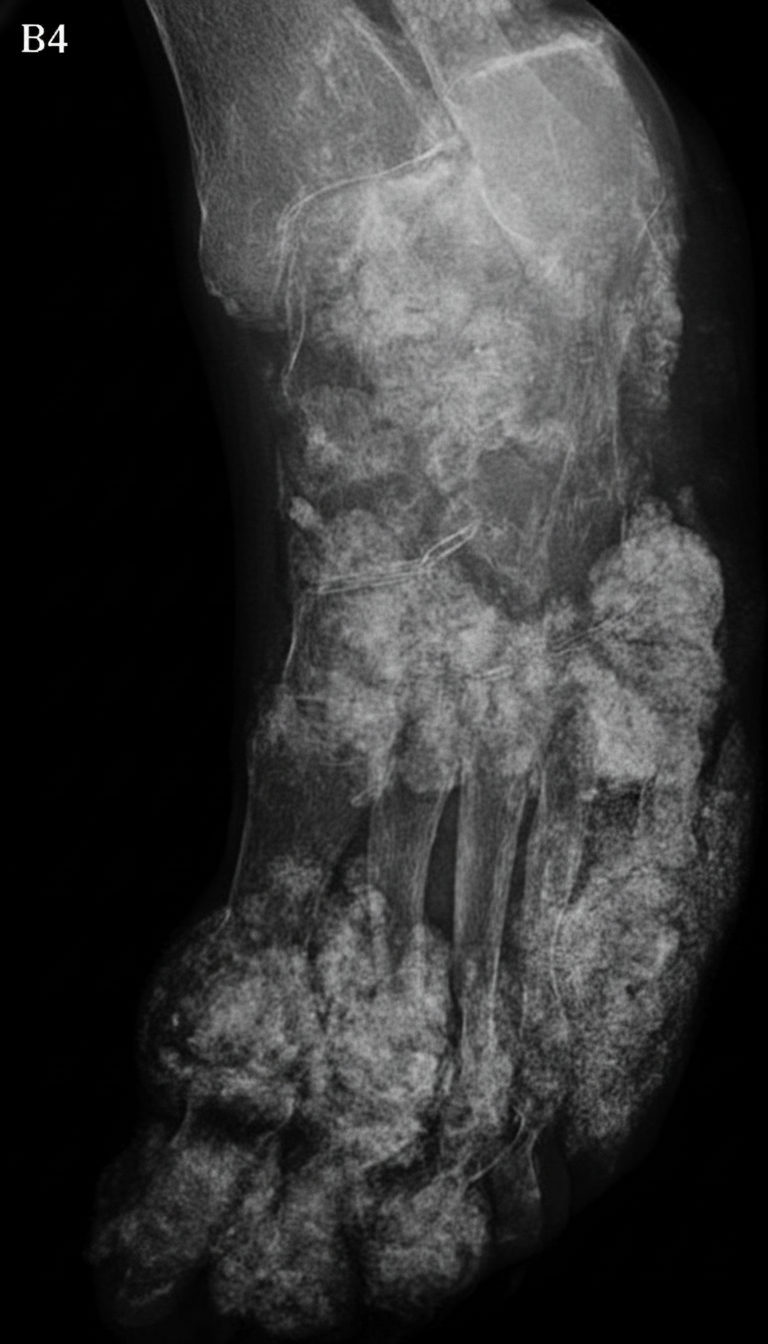
A 58-year-old man with a 10-year history of gout presents with nodular masses in the periarticular tissue of the proximal and distal interphalangeal joints of his right hand. Which of the following choices best describes the characteristics of these masses?
All of the following are seen in inflammatory polyarthritis, except?
A 21-year-old woman presents with a 3-month history of malaise, joint pain, weight loss, and sporadic fever. The patient appears agitated. Her temperature is 38degC (101degF). Other physical findings include malar rash, erythematous pink plaques with telangiectatic vessels, oral ulcers, and non-blanching purpuric papules on her legs. Laboratory studies show elevated levels of blood urea nitrogen and creatinine. Antibodies directed to which of the following antigens would be expected in the serum of this patient?
Which of the following is associated with double-stranded DNA antibodies?
Which of the following inflammatory conditions is associated with HLA-B27 in 90% of cases?
A 23-year-old woman is diagnosed with SLE. Which of the following organ system complications is she most likely to have over the course of her lifetime?
HLA B27 is commonly associated with which of the following?
A 40-year-old woman presents with complaints of burning and tingling sensations in the left hand for several months. She relates that she has been frequently awakened at night by aching pain in the same hand. Pain is elicited by extreme dorsiflexion of the wrist. What is the most likely diagnosis?
A 27-year-old male presents with low backache that occurs early in the morning, associated with stiffness that persists for more than 30 minutes. On examination, his chest expansion is also restricted. What is the most probable diagnosis?
Which of the following is NOT true regarding joint involvement in hemochromatosis?
Explanation: ### Explanation The clinical presentation of nodular masses in the periarticular tissues of a patient with long-standing gout is diagnostic of **Tophaceous Gout**. [1] **1. Why Option A is Correct:** The masses described are **tophi**, which are the hallmark of chronic polyarticular gout. [1] A tophus is a large deposit of monosodium urate (MSU) crystals surrounded by an intense inflammatory granulomatous reaction (macrophages, lymphocytes, and giant cells). The presence of a tophus is considered a **pathognomonic lesion** of chronic gouty arthritis, typically appearing about 10 years or more after the initial acute attack in untreated patients. [1] **2. Why the Other Options are Incorrect:** * **Option B:** Histologically, a tophus is a **foreign-body granuloma** centered around urate crystals. In contrast, a rheumatoid nodule consists of a central area of fibrinoid necrosis surrounded by palisading macrophages. Tophi have a white color, differentiating them from rheumatoid nodules. [1] * **Option C:** MSU crystals in gout are **needle-shaped** and show **strong negative birefringence** under polarized light. [1] Weakly positive birefringence is characteristic of Calcium Pyrophosphate Deposition Disease (CPPD/Pseudogout). [2] * **Option D:** Fibrinoid necrosis is a feature of Rheumatoid nodules and certain vasculitides, not gouty tophi. **Clinical Pearls for NEET-PG:** * **Common Sites for Tophi:** Olecranon bursa, Achilles tendon, and the **helix of the ear** (classic board-style location). [1] * **Radiology:** Look for "punched-out" erosions with overhanging edges (**Martel’s sign** or G-sign). * **Polarized Microscopy:** MSU crystals appear **yellow** when parallel to the slow vibration axis (Negative birefringence). [1] * **Treatment Goal:** In tophaceous gout, the target serum uric acid level is lower than usual (**<5 mg/dL**) to facilitate the dissolution of crystals.
Explanation: **Explanation:** In rheumatology, the fundamental distinction lies between **inflammatory** (e.g., Rheumatoid Arthritis) and **non-inflammatory/degenerative** (e.g., Osteoarthritis) joint diseases. **1. Why "New bone formation" is the correct answer:** Inflammatory polyarthritis is characterized by synovial inflammation (synovitis) which leads to the release of pro-inflammatory cytokines (like TNF-α and IL-1) [1]. these cytokines stimulate **osteoclast** activity, leading to **bone erosions** and periarticular osteopenia rather than bone formation [1]. In contrast, **new bone formation** (osteophytes, subchondral sclerosis) is the hallmark of **degenerative/non-inflammatory** arthritis (Osteoarthritis). **2. Analysis of incorrect options:** * **Erythema:** This is one of the cardinal signs of inflammation (*rubor*). While less common in chronic RA, it is frequently seen in acute inflammatory states like gouty polyarthritis or septic arthritis. * **Increased ESR:** Inflammatory joint diseases are systemic [1]. Elevated acute-phase reactants (ESR and CRP) are standard laboratory markers reflecting the underlying systemic inflammatory process. * **Morning stiffness > 1 hour:** This is a classic diagnostic criterion for inflammatory arthritis [2]. In non-inflammatory conditions (OA), stiffness is typically brief (less than 30 minutes) and worsens with activity ("wear and tear"). **Clinical Pearls for NEET-PG:** * **Inflammatory Arthritis:** Better with activity, worse with rest, prolonged morning stiffness, systemic symptoms (fever, weight loss) [2]. * **Non-inflammatory Arthritis:** Worse with activity, better with rest, minimal morning stiffness, no systemic symptoms. * **Radiology Tip:** Look for "Joint space narrowing + Erosions" in RA, and "Joint space narrowing + Osteophytes" in OA.
Explanation: **Explanation:** The clinical presentation is classic for **Systemic Lupus Erythematosus (SLE)**. The patient meets multiple ACR/EULAR criteria: constitutional symptoms (fever, weight loss), malar rash, oral ulcers, arthritis (joint pain), and neuropsychiatric involvement (agitation/psychosis) [1]. The elevated BUN and creatinine suggest **Lupus Nephritis**, and the purpuric papules indicate cutaneous vasculitis [1]. **1. Why Double-stranded DNA (dsDNA) is correct:** Anti-dsDNA antibodies are highly specific for SLE. In this patient, they are particularly relevant because their titers correlate with **disease activity** and the presence of **Lupus Nephritis** [2]. While Anti-Smith (Sm) is the most specific, Anti-dsDNA is the hallmark for monitoring renal involvement and flares [2]. **2. Why other options are incorrect:** * **A & C (C-ANCA & P-ANCA):** These are markers for Small Vessel Vasculitides. C-ANCA (PR3) is associated with Granulomatosis with Polyangiitis (GPA), while P-ANCA (MPO) is seen in Microscopic Polyangiitis and Eosinophilic Granulomatosis with Polyangiitis (EGPA). While SLE can cause vasculitis, it is not an ANCA-associated disease. * **D (Rheumatoid Factor):** Though RF can be positive in 20-30% of SLE cases, it is non-specific and primarily used for Rheumatoid Arthritis [1]. It does not explain the multisystem (renal/CNS) involvement as accurately as dsDNA. **Clinical Pearls for NEET-PG:** * **Most Sensitive Screen:** ANA (Anti-nuclear antibody) [2]. * **Most Specific Marker:** Anti-Smith (Sm) antibody [1]. * **Drug-Induced Lupus:** Anti-Histone antibodies (Hydralazine, Procainamide, Isoniazid). * **Neonatal Lupus/Sjogren’s:** Anti-Ro (SSA) and Anti-La (SSB) [1]. * **Complement levels (C3, C4):** These decrease during active SLE flares, especially in renal disease [2].
Explanation: ### Explanation **Systemic Lupus Erythematosus (SLE)** is the correct answer because anti-double-stranded DNA (anti-dsDNA) antibodies are highly specific for this condition [1]. While the Antinuclear Antibody (ANA) test is the best initial screening tool for SLE due to its high sensitivity, **anti-dsDNA** and **anti-Smith (anti-Sm)** antibodies are the "confirmatory" markers due to their high specificity (nearly 100%) [1]. Furthermore, anti-dsDNA levels correlate with disease activity, particularly the development of **lupus nephritis** [1]. **Analysis of Incorrect Options:** * **Juvenile Idiopathic Arthritis (JIA):** While ANA can be positive in JIA (especially in the oligoarticular subtype, where it predicts a higher risk of uveitis), anti-dsDNA is typically absent. * **Systemic Sclerosis (Scleroderma):** This condition is associated with **anti-Scl-70** (anti-topoisomerase I) in diffuse disease and **anti-centromere** antibodies in limited disease (CREST syndrome) [1]. * **Dermatomyositis:** This inflammatory myopathy is characterized by **anti-Jo-1** (associated with interstitial lung disease) and **anti-Mi-2** antibodies [1]. **High-Yield Clinical Pearls for NEET-PG:** 1. **Most Sensitive Test for SLE:** ANA (best for screening) [1]. 2. **Most Specific Tests for SLE:** Anti-dsDNA and Anti-Smith [1]. 3. **Prognostic Value:** Anti-dsDNA titers fluctuate with disease activity and are linked to renal involvement; Anti-Smith titers do not correlate with activity [1]. 4. **Drug-Induced Lupus:** Associated with **anti-histone antibodies**; anti-dsDNA is usually negative here. 5. **Neonatal Lupus/Sjögren’s:** Associated with **anti-Ro (SS-A)** and **anti-La (SS-B)** antibodies [1].
Explanation: Explanation: The correct answer is **Ankylosing Spondylitis (AS)**. This condition belongs to the group of **Seronegative Spondyloarthritides**, which are characterized by the absence of Rheumatoid Factor (RF) and a strong genetic association with the **HLA-B27** allele [1]. 1. **Ankylosing Spondylitis (AS):** This has the strongest association with HLA-B27 among all diseases. Approximately **90-95%** of patients with AS are HLA-B27 positive [1]. The presence of this allele is a major diagnostic clue [2], especially in young males presenting with chronic low back pain and "bamboo spine" on imaging [2]. 2. **Reiter’s Arthritis (Reactive Arthritis):** While also a seronegative spondyloarthropathy, the association with HLA-B27 is lower, seen in approximately **60-80%** of cases (though some sources cite up to 90% in specific contexts) [1]. 3. **Psoriasis (Psoriatic Arthritis):** HLA-B27 is found in about **40-50%** of patients, specifically those who present with axial (spinal) involvement. 4. **Rheumatoid Arthritis:** This is an autoimmune condition associated with **HLA-DR4**, not HLA-B27. It is characterized by symmetric small joint involvement and the presence of RF or anti-CCP antibodies. **High-Yield Clinical Pearls for NEET-PG:** * **Mnemonic for HLA-B27 (PAIR):** **P**soriatic arthritis, **A**nkylosing spondylitis, **I**nflammatory bowel disease-associated arthritis, and **R**eactive arthritis. * **AS Hallmark:** Sacroiliitis is the earliest radiographic sign [3]. * **Extra-articular manifestation:** Acute anterior uveitis is the most common extra-articular feature of AS (seen in ~25-30% of cases) [1]. * **Schober’s Test:** Used clinically to assess the restriction of lumbar spine flexion in AS.
Explanation: In Systemic Lupus Erythematosus (SLE), the **musculoskeletal system** is the most frequently involved organ system, affecting approximately **90% to 95%** of patients during their lifetime [1]. The most common manifestations include migratory, symmetrical, non-erosive inflammatory polyarthritis and arthralgia, typically involving the small joints of the hands and wrists. A characteristic finding is **Jaccoud’s arthropathy**, which presents as reducible deformities due to ligamentous laxity rather than bone destruction. **Analysis of Options:** * **B. Cutaneous:** While very common (affecting ~80% of patients), skin manifestations like the malar rash or photosensitivity are slightly less frequent than joint involvement [1]. * **C. Renal:** Lupus nephritis is a major cause of morbidity and mortality, occurring in about 50% of patients [1]. While clinically significant, it is not the most common manifestation. * **A. Cardiopulmonary:** Pleuritis and pericarditis are common, but they occur in roughly 50% of cases, making this system less frequently involved than the musculoskeletal system. **NEET-PG High-Yield Pearls:** * **Most common initial symptom:** Fatigue or Arthralgia. * **Most common organ system involved:** Musculoskeletal (>90%) [1]. * **Most common cause of death (Early):** Active disease or Infections. * **Most common cause of death (Late):** Cardiovascular disease (Accelerated Atherosclerosis). * **Most specific antibody:** Anti-dsDNA and Anti-Smith (Anti-Sm) [2]. * **Best screening test:** ANA (High sensitivity, low specificity) [2].
Explanation: **Explanation:** **Ankylosing Spondylitis (AS)** is the correct answer because it is the prototypical **Seronegative Spondyloarthropathy (SpA)**. There is a profound genetic association between **HLA-B27** (a Class I MHC molecule) and AS; approximately **90-95%** of patients with AS are HLA-B27 positive [1]. While the exact pathogenesis is debated (theories include the "misfolded protein response" or "arthritogenic peptide hypothesis"), the presence of this allele significantly increases the risk of developing sacroiliitis and enthesitis [1]. **Analysis of Incorrect Options:** * **Rheumatic Fever:** This is an immunologically mediated post-streptococcal (Group A Streptococcus) sequela. It is associated with **HLA-DR4** and **DR7**, not HLA-B27. * **Rheumatoid Arthritis (RA):** RA is strongly associated with **HLA-DR4** (specifically the "shared epitope" on the DRB1 allele). It is characterized by symmetric small joint involvement and positive Rheumatoid Factor/anti-CCP. * **Osteoarthritis:** This is primarily a degenerative joint disease related to aging, mechanical stress, and metabolic factors, with no specific HLA-B27 association. **High-Yield Clinical Pearls for NEET-PG:** 1. **Mnemonic for HLA-B27 (PAIR):** **P**soriatic arthritis, **A**nkylosing spondylitis, **I**nflammatory bowel disease-associated arthritis, and **R**eactive arthritis [1]. 2. **Strongest Association:** Among all SpAs, the association is strongest with **Ankylosing Spondylitis**. 3. **Clinical Presentation:** Look for a young male with chronic low back pain, **morning stiffness** that improves with exercise, and "Bamboo spine" on X-ray [1]. 4. **Extra-articular manifestation:** The most common extra-articular feature of AS is **Acute Anterior Uveitis** [1].
Explanation: ### Explanation **Correct Answer: B. Carpal tunnel syndrome** **1. Why Carpal Tunnel Syndrome (CTS) is correct:** The clinical presentation is classic for **Carpal Tunnel Syndrome**, which results from the compression of the **median nerve** as it passes through the carpal tunnel at the wrist [1]. * **Sensory Symptoms:** Burning, tingling (paresthesia), and numbness in the median nerve distribution (thumb, index, middle, and radial half of the ring finger) [1], [2]. * **Nocturnal Pain:** A hallmark of CTS is pain that awakens the patient at night, often relieved by "shaking" the hand (flick sign) [2]. * **Provocative Maneuvers:** Pain elicited by extreme dorsiflexion (Phalen’s maneuver or reverse Phalen’s) increases pressure within the carpal tunnel, reproducing symptoms. **2. Why the other options are incorrect:** * **A. Angina pectoris:** While cardiac pain can radiate to the left arm/hand, it is typically exertional, dull/crushing in nature, and associated with chest pressure rather than localized wrist-provoked tingling. * **C. Dupuytren contracture:** This involves fibroproliferative thickening of the palmar fascia, leading to fixed flexion contractures of the fingers (usually the 4th and 5th). It does not cause nocturnal paresthesia. * **D. Fibrositis (Fibromyalgia):** This presents with chronic widespread musculoskeletal pain and specific "tender points" rather than focal nerve entrapment symptoms in a single hand. **3. NEET-PG High-Yield Pearls:** * **Most common nerve entrapment syndrome:** Carpal Tunnel Syndrome [1]. * **Clinical Tests:** **Phalen’s test** (forced flexion) and **Tinel’s sign** (percussion over the flexor retinaculum). * **Associated Conditions:** Hypothyroidism, Diabetes Mellitus, Pregnancy, Rheumatoid Arthritis, and Acromegaly [1]. * **Muscle Involvement:** Severe cases lead to atrophy of the **Thenar eminence** (LOAF muscles: Lumbricals 1&2, Opponens pollicis, Abductor pollicis brevis, Flexor pollicis brevis) [2]. * **Diagnosis:** Confirmed by **Nerve Conduction Studies (NCS)** showing slowed conduction velocity across the wrist.
Explanation: The clinical presentation of a young male with chronic inflammatory back pain (morning stiffness >30 minutes that improves with activity) and restricted chest expansion is classic for **Ankylosing Spondylitis (AS)**. **1. Why Ankylosing Spondylitis is correct:** AS is a chronic inflammatory disease primarily affecting the sacroiliac joints and the axial skeleton [1]. It typically affects young males (late teens to 20s). The hallmark is **enthesitis** (inflammation at the site where tendons/ligaments insert into bone) [1]. Restricted chest expansion occurs due to involvement of the costovertebral and costosternal joints, leading to ankylosis (fusion). According to the Modified New York Criteria, chest expansion <2.5 cm is a significant clinical marker. **2. Why the other options are incorrect:** * **Rheumatoid Arthritis:** Primarily affects small joints of the hands and feet symmetrically. While it can involve the cervical spine, it characteristically **spares** the thoracolumbar spine and sacroiliac joints. * **Osteoarthritis:** This is a degenerative "wear and tear" disease. Pain typically worsens with activity and improves with rest [1]. Morning stiffness is brief (usually <15–30 minutes). * **Gouty Arthritis:** Presents as acute, episodic, exquisitely painful monoarthritis (most commonly the 1st metatarsophalangeal joint), not chronic axial stiffness. **3. High-Yield Clinical Pearls for NEET-PG:** * **Genetic Association:** Strongly linked with **HLA-B27** (>90% of cases) [1]. * **Radiology:** Look for "Bamboo Spine" (syndesmophytes) and "Dagger Sign" on X-ray [1]. * **Schober’s Test:** Used to assess restricted lumbar flexion. * **Extra-articular manifestation:** **Acute Anterior Uveitis** is the most common [1]. * **Treatment:** NSAIDs are the first-line therapy; TNF-alpha inhibitors (e.g., Etanercept, Infliximab) are used for refractory cases [1].
Explanation: The arthropathy of hereditary hemochromatosis is a classic "high-yield" topic in NEET-PG, often presenting as a mimic of osteoarthritis but with a specific distribution [3]. **Explanation of the Correct Answer:** The question asks for the statement that is **NOT** true. However, there is a technical nuance in the options provided. **Chondrocalcinosis is indeed a feature** of hemochromatosis (occurring in up to 50% of patients due to calcium pyrophosphate deposition) [1]. If Option C is marked as the "correct" (false) answer in your source, it is likely due to a phrasing error in the question or a specific focus on the primary nature of the arthropathy. In standard medical literature, **Option A, B, and C are all true statements.** If we must identify a "false" statement among these, **Option D** is the most debatable because while the arthropathy is primarily degenerative (non-inflammatory), acute inflammatory episodes (pseudogout) frequently occur [2]. **Analysis of Options:** * **Option A (True):** Unlike the skin pigmentation or hepatomegaly, the **arthropathy is notorious for being progressive** even after therapeutic phlebotomy and normalization of iron stores. * **Option B (True):** The "Iron Fist" sign—involvement of the **2nd and 3rd metacarpophalangeal (MCP) joints**—is a hallmark [4]. Finding OA-like changes in these joints is highly suggestive of hemochromatosis [3]. * **Option C (True):** Chondrocalcinosis (CPPD) is a characteristic radiographic finding, often seen in the knees, wrists, and symphysis pubis [2]. * **Option D (True/Partial):** The baseline disease is a **non-inflammatory, degenerative joint disease**, though it can be punctuated by acute inflammatory attacks. **Clinical Pearls for NEET-PG:** 1. **Hook-like Osteophytes:** Radiographs often show characteristic "hook-like" or "beak-like" osteophytes on the radial side of the metacarpal heads. 2. **The "Bronze Diabetes" Triad:** Cirrhosis, Diabetes Mellitus, and Skin Pigmentation. 3. **Screening:** Transferrin saturation >45% is the most sensitive initial test; HFE gene analysis (C282Y mutation) is confirmatory. 4. **Treatment:** Phlebotomy improves survival and liver function but **does not reverse** established arthropathy or hypogonadism.
Rheumatoid Arthritis
Practice Questions
Spondyloarthropathies
Practice Questions
Systemic Lupus Erythematosus
Practice Questions
Vasculitis Syndromes
Practice Questions
Scleroderma and Related Disorders
Practice Questions
Inflammatory Myopathies
Practice Questions
Crystal Arthropathies
Practice Questions
Osteoarthritis
Practice Questions
Primary Immunodeficiency Disorders
Practice Questions
Autoinflammatory Syndromes
Practice Questions
Sjögren's Syndrome
Practice Questions
Antiphospholipid Syndrome
Practice Questions
Get full access to all questions, explanations, and performance tracking.
Start For Free