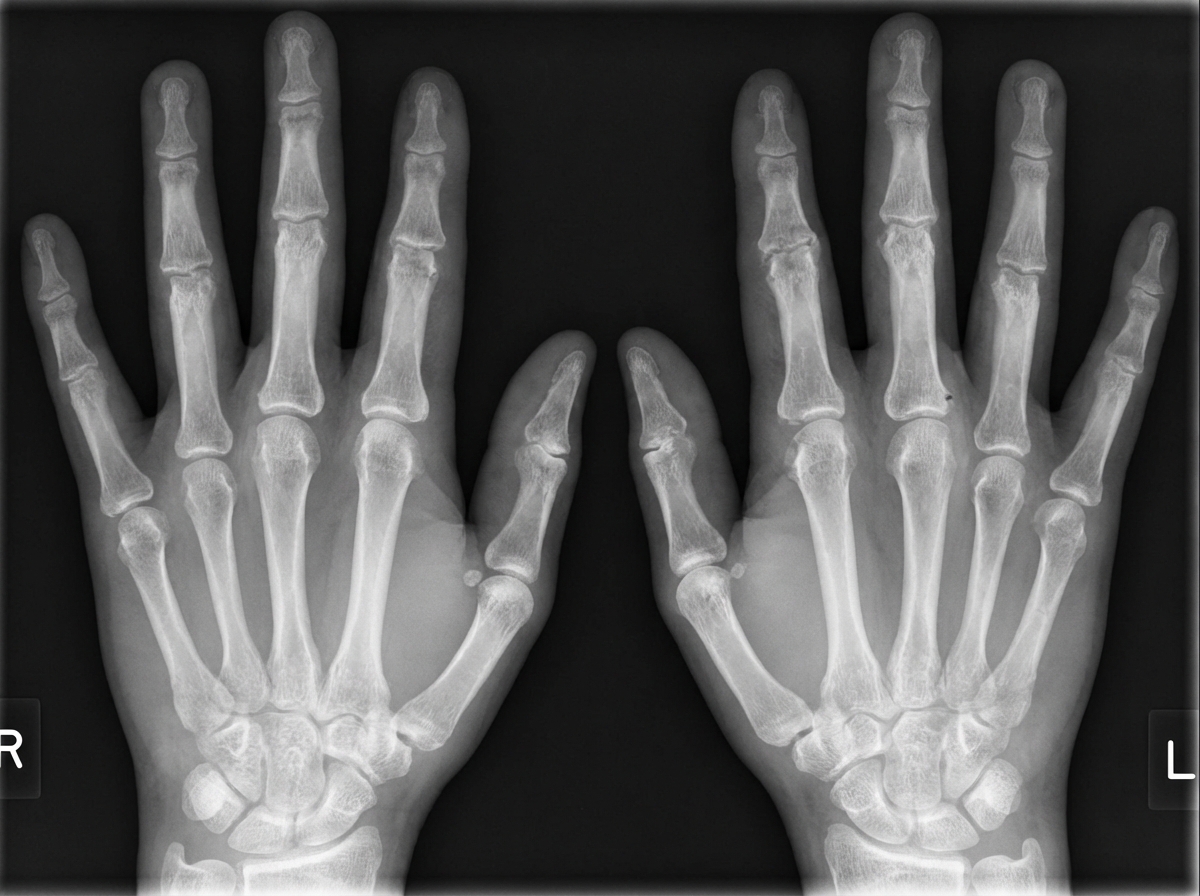
A female presents with symmetrical small joint polyarthritis for 2 weeks. Labs show rheumatoid factor levels at 1:320 (positive is 1:40) and anti-CCP at 58 units (40 to 59 units are considered strongly positive). An antinuclear antibody test is negative. Labs also reveal positive cytomegalovirus and parvovirus IgG, and negative parvovirus IgM. The ESR is 62 mm/hour. What is the appropriate next step in the management of this patient?
Which of the following is NOT a major manifestation of rheumatic fever?
Which of the following is true about anti-cardiolipin antibody syndrome?
Which organ's primary involvement is not yet reported to be affected by sarcoidosis?
Pseudogout more commonly involves which joint?
HLA B5I is associated with which disease?
Which of the following is NOT seen in dermatomyositis?
Which of the following is true about Felty's syndrome?
Which antinuclear antibody is specific for Systemic Lupus Erythematosus (SLE)?
Hypermobility of the temporomandibular joint (TMJ) is seen in all of the following except?
Explanation: The patient presents with a classic clinical picture of **Rheumatoid Arthritis (RA)**: symmetrical small joint polyarthritis, elevated ESR, and high titers of both Rheumatoid Factor (RF) and anti-CCP antibodies [3]. ### Why Option B is Correct According to the **ACR/EULAR 2010 Classification Criteria**, a diagnosis of RA is made with a score of ≥6. This patient scores highly due to: * **Joint involvement:** Symmetrical small joint involvement. * **Serology:** High-titer RF (>3x upper limit) and strongly positive anti-CCP. * **Acute phase reactants:** Elevated ESR. The current standard of care is **"Treat to Target,"** which mandates the initiation of a **Disease-Modifying Antirheumatic Drug (DMARD)** as soon as the diagnosis is established to prevent irreversible joint erosions [1]. **Methotrexate** is the first-line "anchor" DMARD [2]. Baseline and periodic Liver Function Tests (LFTs) are mandatory due to its potential hepatotoxicity [1]. ### Why Other Options are Incorrect * **Option A:** NSAIDs like Naproxen provide symptomatic relief but do not modify the disease course or prevent joint destruction. Delaying DMARDs by a month is inappropriate given the high-titer serology. * **Option C:** ANA is negative, and the clinical picture (symmetrical polyarthritis with high anti-CCP) is highly specific for RA, making SLE or drug-induced lupus unlikely. * **Option D:** High-dose Prednisone (60 mg) is generally reserved for vasculitis or severe systemic involvement. While low-dose steroids are used as "bridge therapy," they are not a substitute for DMARDs. ### NEET-PG High-Yield Pearls * **Anti-CCP (Anti-cyclic citrullinated peptide):** Most specific marker for RA (>95%) and a predictor of aggressive, erosive disease. * **Viral Mimicry:** While Parvovirus B19 can cause acute polyarthritis, the **negative IgM** and strongly positive anti-CCP/RF in this case point toward RA rather than a viral-induced transient arthritis [3]. * **Methotrexate Side Effects:** Hepatotoxicity, stomatitis, and bone marrow suppression. Always co-prescribe **Folic acid** to reduce toxicity [2].
Explanation: ### Explanation Acute Rheumatic Fever (ARF) is diagnosed using the **Revised Jones Criteria**. This criteria categorizes clinical and laboratory findings into **Major** and **Minor** manifestations [1]. **Why Arthralgia is the correct answer:** Arthralgia (joint pain without objective findings of inflammation) is classified as a **Minor manifestation**. In the diagnosis of ARF, a patient must meet either two major criteria OR one major and two minor criteria (plus evidence of a preceding Group A Streptococcal infection) [1]. Since the question asks for the option that is NOT a major manifestation, arthralgia is the correct choice. **Analysis of Incorrect Options (Major Criteria):** The mnemonic **J♥NES** is commonly used to remember the five Major manifestations: * **J (Joints):** **Polyarthritis** (Option B) is a major criterion. It is typically migratory, affecting large joints (knees, ankles, elbows, wrists). * **♥ (Carditis):** **Carditis** (Option A) is the most serious major criterion, often presenting as valvulitis (mitral regurgitation is most common) [1]. * **N (Nodules):** **Subcutaneous nodules** (Option C) are firm, painless, small bumps usually found over bony prominences or tendons. * **E (Erythema Marginatum):** A pink, non-pruritic, evanescent rash with serpiginous borders. * **S (Sydenham Chorea):** Involuntary, purposeless movements; often a late manifestation [1]. **NEET-PG High-Yield Pearls:** * **Most common manifestation:** Migratory Polyarthritis. * **Most serious manifestation:** Carditis (can lead to chronic Rheumatic Heart Disease) [1]. * **Minor Criteria:** Arthralgia, Fever, Elevated ESR/CRP, and Prolonged PR interval on ECG. * **Important Note:** If polyarthritis is counted as a major criterion, arthralgia cannot be counted as an additional minor criterion in the same patient.
Explanation: Explanation: Anti-cardiolipin antibody syndrome, a subset of **Antiphospholipid Syndrome (APS)**, is an autoimmune hypercoagulable state characterized by the presence of antiphospholipid antibodies (aPL). 1. **Recurrent Fetal Loss (Option A):** APS is a leading cause of treatable recurrent pregnancy loss. The antibodies cause placental infarction, spiral artery thrombosis, and inflammation, leading to complications such as early miscarriages (usually >10 weeks), premature births, or pre-eclampsia. 2. **Arterial Thrombosis (Option B):** Unlike many other hypercoagulable states that primarily cause venous clots, APS is unique because it causes **both venous and arterial thrombosis**. Common arterial sites include the cerebral arteries (leading to Stroke or TIA) and coronary arteries. 3. **Raised PTT (Option C):** This is a classic "medical paradox" high-yield for exams. Although APS causes *clotting* in the body (in vivo), the antibodies interfere with the phospholipids used in the laboratory **Activated Partial Thromboplastin Time (aPTT)** test, causing a **prolonged (raised) PTT** (in vitro). Crucially, this prolonged PTT does not correct with a 1:1 mixing study. **Clinical Pearls for NEET-PG:** * **The Triad:** Thrombosis (Venous/Arterial), Pregnancy morbidity, and presence of aPL (Anti-cardiolipin, Anti-β2 glycoprotein I, or Lupus Anticoagulant). * **Livedo Reticularis:** The most common cutaneous manifestation [1]. * **Libman-Sacks Endocarditis:** Non-bacterial verrucous vegetations on heart valves associated with APS/SLE. * **False Positive VDRL:** Anti-cardiolipin antibodies can cross-react with the cardiolipin used in syphilis screening, leading to a false positive VDRL/RPR.
Explanation: Explanation: Sarcoidosis is a multisystem, chronic inflammatory disease characterized by the formation of **non-caseating granulomas**. While it can affect almost any organ in the body, its distribution is not uniform. **Why Adrenals are the correct answer:** The **adrenal gland** is famously "spared" in sarcoidosis. While granulomatous diseases like Tuberculosis and Histoplasmosis are leading causes of primary adrenal insufficiency (Addison’s disease), sarcoidosis involvement of the adrenal cortex is extremely rare or not reported as a primary clinical manifestation. If adrenal insufficiency occurs in a sarcoid patient, it is usually **secondary** due to sarcoid involvement of the hypothalamus or pituitary gland, rather than direct destruction of the adrenal glands themselves. **Why other options are incorrect:** * **Heart:** Cardiac sarcoidosis occurs in about 5-10% of patients, leading to restrictive cardiomyopathy, arrhythmias, and heart block [1]. It is a significant cause of mortality. * **Kidney:** Renal involvement includes hypercalciuria and hypercalcemia (due to 1-alpha-hydroxylase activity in macrophages), which can lead to nephrocalcinosis and interstitial nephritis [1]. * **Brain:** Neurosarcoidosis affects approximately 5-10% of patients, most commonly presenting as cranial nerve palsies (especially Facial Nerve/CN VII) [1]. **High-Yield Clinical Pearls for NEET-PG:** * **Most common organ involved:** Lungs (>90%). * **Most common cranial nerve involved:** Facial nerve (CN VII) [1]. * **Lofgren’s Syndrome:** Triad of Erythema nodosum, bilateral hilar adenopathy, and polyarthritis (good prognosis) [1]. * **Heerfordt’s Syndrome (Uveoparotid fever):** Parotid enlargement, Uveitis, and Facial palsy. * **Biochemical marker:** Elevated Serum ACE levels (reflects total body granuloma burden).
Explanation: **Explanation:** **Pseudogout**, clinically known as **Calcium Pyrophosphate Deposition (CPPD)** disease, is a crystal-induced arthropathy caused by the deposition of calcium pyrophosphate dihydrate crystals in the articular cartilage (chondrocalcinosis) and synovial fluid [1]. 1. **Why the Knee is Correct:** The **knee** is the most frequently affected joint in pseudogout, involved in over 50% of acute attacks [1]. Unlike gout, which favors small distal joints, CPPD has a predilection for large joints. The fibrocartilage and hyaline cartilage of the knee are primary sites for crystal nucleation [3]. 2. **Why Other Options are Incorrect:** * **MTP joint of great toe:** This is the classic site for **Gout** (Podagra), caused by monosodium urate crystals [2]. While pseudogout can occur here, it is much less common. * **Shoulder and Hip:** While CPPD can affect these joints (especially in the elderly or in "Crowned Dens Syndrome" of the cervical spine), they are involved significantly less often than the knee and wrist. **High-Yield Clinical Pearls for NEET-PG:** * **Synovial Fluid Analysis:** The gold standard for diagnosis is identifying **rhomboid-shaped**, **weakly positively birefringent** crystals under polarized light microscopy. * **Radiology:** Look for **chondrocalcinosis** (linear calcification of articular cartilage or menisci) [1]. * **Associated Metabolic Conditions:** Always screen for "The 4 Hs": **H**yperparathyroidism, **H**emochromatosis, **H**ypomagnesemia, and **H**ypophosphatasia [1]. * **Treatment:** Acute management involves NSAIDs, colchicine, or intra-articular glucocorticoids.
Explanation: **Explanation:** **Behcet’s Disease (Option A)** is a multi-systemic, chronic inflammatory perivasculitis characterized by the classic triad of recurrent oral ulcers, genital ulcers, and uveitis. The strongest genetic risk factor identified for Behcet’s disease is the presence of the **HLA-B51** allele (a subtype of HLA-B5). This association is particularly strong in populations along the "Silk Road" (Middle East and East Asia). Patients with HLA-B51 are not only at a higher risk of developing the disease but often exhibit a more severe clinical phenotype, including increased risk of ocular involvement. **Why the other options are incorrect:** * **Churg-Strauss Syndrome (EGPA) (Option B):** This is a small-vessel vasculitis characterized by asthma, eosinophilia, and necrotizing granulomas [1]. It is more closely associated with **ANCA** (specifically p-ANCA/MPO-ANCA in ~40% of cases) rather than a specific HLA-B allele [1]. * **Microscopic Polyangiitis (MPA) (Option C):** This is a pauci-immune necrotizing vasculitis strongly associated with **p-ANCA (MPO-ANCA)**. * **Polyarteritis Nodosa (PAN) (Option D):** This is a medium-vessel vasculitis. Its most significant association is with **Hepatitis B virus (HBV)** infection, not HLA-B51. **High-Yield Clinical Pearls for NEET-PG:** * **Pathergy Test:** A highly specific (though less sensitive) diagnostic test for Behcet’s where a sterile needle prick causes a papule or pustule within 24–48 hours. * **HLA-B27:** Associated with Seronegative Spondyloarthropathies (Ankylosing Spondylitis, Reiter’s Syndrome). * **HLA-DR4:** Associated with Rheumatoid Arthritis. * **Vessel Involvement:** Behcet’s is unique because it can involve vessels of **all sizes** (small, medium, and large) and affects both **arteries and veins** (high risk of venous thrombosis).
Explanation: The question asks for the feature **NOT** typically seen in dermatomyositis. However, there is a clinical nuance here: while **Calcinosis cutis** (Option A) can occur in dermatomyositis, it is primarily a feature of **juvenile dermatomyositis** and is relatively uncommon in the adult form [1]. In the context of standard NEET-PG patterns, if this is marked as the "correct" answer (the feature not seen), it implies it is the least characteristic or least common finding compared to the classic pathognomonic skin signs listed in the other options. 1. **Why Calcinosis cutis is the answer:** Calcinosis cutis (calcium deposits in skin/fascia) occurs in up to 30-70% of children with dermatomyositis but is rare in adults [1]. If a question asks to differentiate classic diagnostic signs, calcinosis is often the "odd one out" as it is a late complication rather than a primary diagnostic rash. 2. **Why other options are incorrect:** * **Heliotropic rash:** A pathognomonic violaceous eruption on the upper eyelids, often with periorbital edema [1]. * **Gottron’s rash/papules:** Pathognomonic erythematous, scaly papules found over the dorsal aspect of MCP and IP joints [1], [2]. * **Shawl sign:** An erythematous rash in a shawl distribution over the back, shoulders, and posterior neck. (V-sign is the equivalent on the anterior chest) [1]. **High-Yield Clinical Pearls for NEET-PG:** * **Anti-Jo-1:** Most common myositis-specific antibody; associated with **Antisynthetase Syndrome** (interstitial lung disease, Raynaud’s, mechanic’s hands) [2]. * **Anti-Mi-2:** Highly specific for dermatomyositis; carries a good prognosis. * **Malignancy:** Adult-onset dermatomyositis is strongly associated with underlying visceral malignancies (paraneoplastic syndrome) [1]. * **Mechanic’s Hands:** Hyperkeratotic, fissured skin on the lateral aspects of the fingers.
Explanation: Felty’s syndrome (FS) is a rare but severe extra-articular manifestation of long-standing Rheumatoid Arthritis (RA). It is classically defined by the clinical triad of **Rheumatoid Arthritis, Splenomegaly, and Neutropenia.** [1] **Why Option D is correct:** Patients with Felty’s syndrome almost universally exhibit **high titers of Rheumatoid Factor (RF)** and Anti-cyclic citrullinated peptide (anti-CCP) antibodies. [1] The condition is strongly associated with the **HLA-DR4** serotype. These high titers reflect the intense underlying systemic inflammation and the presence of immune complexes that contribute to the pathogenesis of the syndrome. **Analysis of Incorrect Options:** * **Option A:** Felty’s syndrome is more common in **females** (matching the general gender distribution of RA), typically occurring in the 5th to 7th decades of life. [1] * **Option B:** It occurs in the **late/chronic phase** of RA, usually after 10–15 years of aggressive, erosive joint disease. [1] * **Option C:** While it includes RA and splenomegaly, the hematological hallmark is **neutropenia** (Absolute Neutrophil Count <2000/mm³), not lymphopenia. [1] **Clinical Pearls for NEET-PG:** * **Infections:** The primary clinical concern is recurrent bacterial infections (skin and respiratory) due to severe neutropenia. * **Large Granular Lymphocyte (LGL) Leukemia:** There is a significant phenotypic overlap between FS and T-cell LGL leukemia; both may present with the same triad. * **Extra-articular features:** Patients often present with systemic features like vasculitis, leg ulcers, and lymphadenopathy. [1] * **Treatment:** Management focuses on controlling the underlying RA, typically using Methotrexate. Granulocyte colony-stimulating factor (G-CSF) may be used for refractory neutropenia.
Explanation: ### Explanation **Correct Answer: A. Anti-dsDNA** **1. Why Anti-dsDNA is the Correct Answer:** In Systemic Lupus Erythematosus (SLE), **Anti-dsDNA** and **Anti-Smith (Anti-Sm)** antibodies [1] are considered highly specific (nearly 100%). While Anti-dsDNA is specific for the diagnosis, it is also clinically significant because its titers fluctuate with disease activity [2], particularly in **Lupus Nephritis**. **2. Analysis of Incorrect Options:** * **B. Anti-nuclear antibodies (ANA):** This is the **best screening test** for SLE due to its high sensitivity (>95%) [1]. However, it lacks specificity as it can be positive in other autoimmune diseases (Scleroderma, Sjögren’s), chronic infections, or even in healthy individuals [1]. * **C. Anti-centromere antibody:** This is highly specific for **Limited Cutaneous Systemic Sclerosis** (formerly CREST syndrome), not SLE. * **D. Anti-histone antibody:** This is the hallmark of **Drug-Induced Lupus (DILE)**. While it can be present in idiopathic SLE, its presence in the absence of other SLE-specific markers strongly suggests a drug-induced etiology (e.g., Hydralazine, Procainamide, Isoniazid). **3. NEET-PG High-Yield Pearls:** * **Most Sensitive Test for SLE:** ANA (Indirect Immunofluorescence is the gold standard). * **Most Specific Test for SLE:** Anti-Smith (Anti-Sm) followed by Anti-dsDNA [1]. * **Antibody correlating with Disease Activity/Renal involvement:** Anti-dsDNA [2]. * **Antibody associated with Neonatal Lupus/Congenital Heart Block:** Anti-Ro (SS-A) [1]. * **Antibody associated with Psychosis/CNS Lupus:** Anti-ribosomal P protein. * **Drug-Induced Lupus:** Characterized by Anti-histone antibodies; usually spares the kidney and CNS.
Explanation: ### Explanation **Concept:** Hypermobility of the Temporomandibular Joint (TMJ) refers to an excessive range of motion where the condyle moves beyond the articular eminence. This can be caused by systemic connective tissue laxity or neuromuscular triggers that cause repetitive, forceful opening of the jaw. **Why "Anterior dislocation of the disk" is the correct answer:** In **Anterior Dislocation of the Disk** (Internal Derangement), the articular disk is displaced forward, acting as a mechanical obstruction. This typically leads to **hypomobility** (limited mouth opening or "lockjaw") and painful clicking, rather than hypermobility. The displaced disk prevents the condyle from gliding forward smoothly. **Analysis of Incorrect Options:** * **Marfan’s Syndrome:** This is a systemic connective tissue disorder caused by a mutation in the *FBN1* gene (fibrillin-1). It leads to generalized ligamentous laxity, which directly results in TMJ hypermobility and frequent subluxations. * **Phenothiazine Therapy & Tardive Dyskinesia:** Phenothiazines (antipsychotics) can cause extrapyramidal side effects. Acute dystonic reactions or chronic **Tardive Dyskinesia** involve involuntary, repetitive movements of the jaw (orofacial dyskinesia). These forceful, uncontrolled muscle contractions stretch the TMJ ligaments over time, leading to secondary hypermobility and dislocation. **High-Yield Clinical Pearls for NEET-PG:** * **Ehlers-Danlos Syndrome:** Another common systemic cause of TMJ hypermobility due to defective collagen synthesis. * **Management of Acute TMJ Dislocation:** Manual reduction using the **Nelaton maneuver** (downward and backward pressure on the molars). * **Drug-induced Dystonia:** Often treated with intravenous anticholinergics like **Benztropine** or **Promethazine.** * **Internal Derangement:** The most common cause of TMJ pain; characterized by "clicking" (reduction) or "locking" (without reduction).
Rheumatoid Arthritis
Practice Questions
Spondyloarthropathies
Practice Questions
Systemic Lupus Erythematosus
Practice Questions
Vasculitis Syndromes
Practice Questions
Scleroderma and Related Disorders
Practice Questions
Inflammatory Myopathies
Practice Questions
Crystal Arthropathies
Practice Questions
Osteoarthritis
Practice Questions
Primary Immunodeficiency Disorders
Practice Questions
Autoinflammatory Syndromes
Practice Questions
Sjögren's Syndrome
Practice Questions
Antiphospholipid Syndrome
Practice Questions
Get full access to all questions, explanations, and performance tracking.
Start For Free