Which of the following is the most characteristic laboratory finding in sarcoidosis?
Samters triad is seen in patients with ?
A male patient presents to the emergency department. The arterial blood gas report is as follows: pH, 7.2; pCO2, 81 mmHg; and HCO3, 40 meq/L. Which of the following is the most likely diagnosis?
A patient with a history of carcinoma of the bladder presents with dyspnoea, clinical signs of deep vein thrombosis (DVT), and tachycardia. Based on the Wells score for pulmonary embolism, what is the risk classification for this patient?
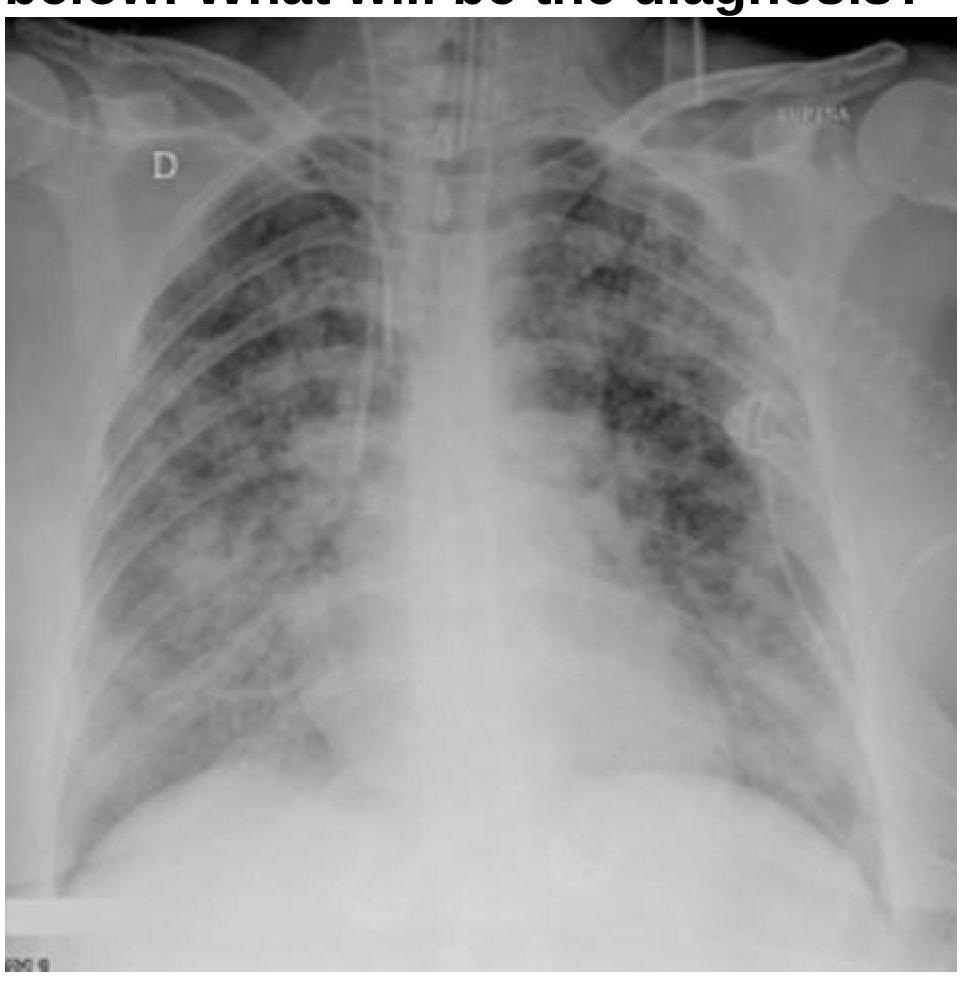
A patient with a known case of acute pancreatitis develops breathlessness and bilateral basal crepitations on day 4. What is the most likely diagnosis based on the chest radiography image?
Which of the following is least likely to be associated with allergic bronchopulmonary aspergillosis (ABPA)?
What does a decreased FEV1/FVC ratio typically indicate in pulmonary function tests?
Oxygen therapy may not be useful in
All of the following may lead to pneumatocele formation except which of the following?
Which of the following is least likely to be associated with emphysema?
Explanation: ***Elevated level of angiotensin converting enzyme (ACE)*** - **Elevated ACE levels** are a classic laboratory finding in active sarcoidosis, reflecting the increased activity of **macrophages** and **epithelioid cells** within the granulomas. - While not diagnostic on its own, it is a highly **characteristic marker** that correlates with disease activity in many patients. *Pleural effusion is common in sarcoidosis* - **Pleural effusions** are **uncommon** in sarcoidosis, occurring in less than 5% of cases. - When present, they are often small and lymphocytic but not a typical or common feature. *Facial nerve palsy is the most common neurological manifestation* - While **facial nerve palsy** can occur in sarcoidosis (neurosarcoidosis), it is **not the most common neurological manifestation**. - **Cranial neuropathies** (especially facial nerve palsy) are notable features, but other neurological presentations like **meningitis**, **seizures**, or **peripheral neuropathy** are also seen. *Bilateral parotid enlargement is the most common presentation* - **Parotid gland enlargement** can occur in sarcoidosis, particularly as part of **Heerfordt's syndrome** (uveoparotid fever), but it is **not the most common presentation** of the disease. - The most common initial presentation of sarcoidosis is usually **pulmonary involvement**, often detected incidentally on chest X-ray or presenting with respiratory symptoms.
Explanation: ***Asthma*** - **Samter's triad** (also known as aspirin-exacerbated respiratory disease or AERD) is characterized by the presence of **asthma**, **aspirin sensitivity**, and **nasal polyps**. [1] - This condition is a distinct phenotype of asthma, where exposure to aspirin or other NSAIDs can trigger severe bronchospasm and other respiratory symptoms. [1] *Chronic pancreatitis* - Chronic pancreatitis is recurrent **inflammation of the pancreas** leading to progressive destruction of pancreatic tissue. [2] - It is not associated with Samter's triad; its symptoms often include **abdominal pain**, malabsorption, and diabetes. [2] *Crohn's disease* - Crohn's disease is a type of **inflammatory bowel disease** (IBD) that can affect any part of the gastrointestinal tract. [3] - Its symptoms typically involve **abdominal pain**, diarrhea, and weight loss, and it has no direct link to Samter's triad. *Liver cell carcinoma* - **Liver cell carcinoma** (hepatocellular carcinoma) is a primary cancer of the liver. - It is associated with risk factors such as **chronic hepatitis B or C infection** and cirrhosis, not Samter's triad.
Explanation: ***Respiratory acidosis*** - The **pH of 7.2** indicates **acidemia**, while the **elevated pCO2 (81 mmHg)** points to a primary respiratory problem [2]. - The elevated **HCO3 (40 meq/L)** suggests **renal compensation** attempting to buffer the increased carbonic acid [1]. *Respiratory alkalosis* - This condition presents with an **elevated pH (alkalemia)** and a **decreased pCO2**, which is opposite to the given ABG values [2]. - While there might be metabolic compensation with a decreased HCO3, the primary disturbance is an increase in respiratory rate leading to excessive CO2 exhalation. *Metabolic acidosis* - Metabolic acidosis is characterized by a **low pH** and a **low HCO3**, with a compensatory decrease in pCO2 [1]. - The given ABG shows a high HCO3, which rules out primary metabolic acidosis. *Metabolic alkalosis* - This condition would typically show an **elevated pH** and an **elevated HCO3**, with a compensatory increase in pCO2. - While both HCO3 and pCO2 are high in the given ABG, the low pH points to a primary acidosis, not alkalosis.
Explanation: ***Moderate risk for pulmonary embolism*** - This patient accumulates several points on the Wells score: **malignancy** (1 point), **tachycardia** (HR > 100 bpm, 1.5 points), and **clinical signs of DVT** (3 points). [1] - A total score of 5.5 points falls into the **moderate risk category** (2 to 6 points) for pulmonary embolism. *Insufficient data to assess risk* - The provided clinical information, including a history of malignancy, dyspnoea, tachycardia, and signs of DVT, offers sufficient data for Wells score calculation. - The Wells score is designed to assess the pre-test probability of PE using readily available clinical parameters. [1] *Low risk for pulmonary embolism* - A low risk classification would require a Wells score of less than 2 points, which is not the case here given the patient's symptoms and history. - This patient's symptoms are highly suggestive of PE, making a low risk classification inappropriate. *High risk for pulmonary embolism* - A high risk classification typically corresponds to a Wells score greater than 6 points. - While concerning, a score of 5.5 points places the patient in the moderate rather than high-risk category.
Explanation: ***Acute Respiratory Distress Syndrome (ARDS)*** - The chest radiograph shows **bilateral patchy infiltrates** and **diffuse alveolar opacities** consistent with ARDS, especially in the context of **acute pancreatitis** as a known risk factor. - The development of **breathlessness** and **bilateral basal crepitations** (rales) on day 4 further supports ARDS due to fluid accumulation in the lungs. *Bilateral pneumonia* - While pneumonia can cause bilateral infiltrates, the **symmetrical and widespread distribution** seen on this radiograph, combined with the context of acute pancreatitis, makes ARDS a more likely diagnosis. - Pneumonia typically presents with fever, productive cough, and lung consolidation, which are not specifically highlighted as primary symptoms over the breathlessness. *Carcinogenic Pulmonary Embolism* - Pulmonary embolism typically manifests with **sudden onset dyspnea**, pleuritic chest pain, and sometimes hemoptysis, and chest X-rays are often normal or show subtle findings like a **Westermark sign** or Hampton's hump. - The widespread bilateral infiltrates seen in the image are **not characteristic of pulmonary embolism**. *Lung collapse (atelectasis)* - Atelectasis usually appears as a ** localised area of increased opacification**, often with volume loss (e.g., tracheal deviation, elevated hemidiaphragm), and is often unilateral or segmental. - The **diffuse, bilateral, and often fluffy infiltrates** seen in this image are not consistent with typical atelectasis.
Explanation: ***Pleural effusion*** - **Pleural effusions** are rare in ABPA because it is primarily an airway disease, affecting the bronchi and parenchyma, not typically the pleura. - While other conditions causing lung disease can lead to pleural effusions, ABPA itself does not commonly involve the development of **fluid in the pleural space**. *Occurrence in patients with old cavitary lesions* - ABPA can sometimes occur in patients with pre-existing lung conditions, including those with old cavitary lesions, especially if these lesions create an environment conducive to **fungal growth**. - However, **aspergilloma** (a fungal ball within a cavity) is more directly associated with cavitary lesions, distinct from the allergic reaction of ABPA [1]. *Elevated IgE levels* - **Elevated serum total IgE levels** (typically >1000 IU/mL) are a key diagnostic criterion for ABPA, indicating a significant allergic response. - Both **total IgE** and **Aspergillus-specific IgE** are characteristically high due to the hypersensitivity reaction. *Recurrent respiratory symptoms* - Patients with ABPA frequently experience **recurrent respiratory symptoms** such as **wheezing**, **cough**, and **dyspnea** due to inflammation and bronchospasm. - These recurrent symptoms contribute to progressive lung damage if the condition is not adequately managed.
Explanation: ***Obstructive lung disease*** - A decreased **FEV1/FVC ratio** indicates that the amount of air forcefully exhaled in one second (FEV1) is disproportionately low compared to the total forced vital capacity (FVC) [1]. This is a hallmark of **airflow limitation**, distinguishing obstructive lung diseases. - This pattern suggests a problem with **airway narrowing** or obstruction, making it difficult to exhale air quickly, which is characteristic of conditions like **COPD** (emphysema, chronic bronchitis) or **asthma** [1]. *Normal pulmonary function* - In normal pulmonary function, the **FEV1/FVC ratio** would be within the expected reference range, typically **above 70%** (or 0.7) for adults [1]. - A low ratio explicitly indicates a deviation from normal airflow dynamics, not a state of healthy lung function. *Restrictive lung disease* - **Restrictive lung diseases** are characterized by a **reduced total lung volume** (decreased FVC), but the FEV1/FVC ratio is typically **normal or even increased**. - This is because the airways are generally not obstructed; instead, the problem lies with the lungs' inability to expand fully, leading to a proportional reduction in FEV1 and FVC. *Both obstructive and restrictive lung disease* - While it is possible to have both conditions, a **decreased FEV1/FVC ratio** primarily points to an **obstructive pattern**. - A definitive diagnosis of both would require further interpretation of other PFT parameters such as **total lung capacity (TLC)**, which would be normal or increased in obstruction and reduced in restriction.
Explanation: **Pulmonary fibrosis** - Oxygen therapy is beneficial in **pulmonary fibrosis**, especially with exercise or at night, as it can significantly improve **oxygen saturation** and relieve **dyspnea**. - While not a cure, it improves quality of life by combating the effects of **scarring** in the lungs. *Asthma* - Oxygen therapy is a critical component in the management of **acute severe asthma** to correct **hypoxemia**. - It is often administered along with **bronchodilators** and **corticosteroids** to stabilize the patient's respiratory status. *Pneumonia* - Oxygen therapy is commonly used in pneumonia patients who develop **hypoxemia** due to impaired gas exchange in affected lung areas. - Supplemental oxygen helps maintain adequate **tissue oxygenation** and can prevent complications from severe respiratory distress. *Subglottic stenosis* - While supplemental oxygen can be administered, the primary intervention for **subglottic stenosis** often involves addressing the **airway obstruction** directly. - The benefit of oxygen therapy alone is limited due to the mechanical restriction of airflow, which may require surgical or interventional procedures.
Explanation: ***ARDS*** - **Acute Respiratory Distress Syndrome (ARDS)** is primarily characterized by **inflammatory lung injury**, leading to **alveolar edema**, but does not typically cause pneumatocele formation [1]. - Pneumatoceles are more likely associated with infections or mechanical ventilation, not with ARDS itself. *Staphylococcal pneumonia* - **Staphylococcal pneumonia** can lead to pneumatocele formation due to **necrotizing pneumonia**, where the formation of air-filled cysts occurs from lung tissue damage. - This type of pneumonia is associated with **Staphylococcus aureus** and can cause cavitary lesions. *Positive pressure ventilation* - **Positive pressure ventilation** can increase the risk of barotrauma, leading to the formation of pneumatocele through excess air entering lung tissue. - It is often used in cases of respiratory distress but can inadvertently contribute to pneumatocele development. *Hydrocarbon inhalation* - **Hydrocarbon inhalation** is linked to pneumonitis and can cause lung injury, leading to the formation of **pneumatoceles** as a result of **lung inflammation**. - Such inhalation can create **alveolar damage**, allowing for air-filled spaces to develop.
Explanation: **Type I respiratory failure** - **Emphysema** primarily causes **Type II respiratory failure** (hypercapnic) due to impaired gas exchange and CO2 retention resulting from alveolar destruction and air trapping [2][4]. - While hypoxemia can occur in severe emphysema, it is the more prominent **hypercapnia** that defines its typical respiratory failure pattern, making pure Type I less likely [3][4]. *Associated with smoking* - **Cigarette smoking** is the leading cause of emphysema, directly linked to the destruction of alveolar walls and loss of elastic recoil [1]. - The inhaled toxins trigger an inflammatory response in the lungs, leading to the release of proteases that break down lung tissue [1][2]. *Barrel shaped chest* - This is a classic sign of advanced emphysema, caused by **chronic air trapping** and subsequent hyperinflation of the lungs [2]. - The diaphragm flattens, and the ribs become more horizontal, increasing the anterior-posterior diameter of the chest. *Cyanosis* - Often seen in patients with severe emphysema (especially in a subgroup referred to as "blue bloaters" for chronic bronchitis overlap) due to **significant hypoxemia** [3]. - Impaired gas exchange leads to insufficient oxygenation of hemoglobin, causing a bluish discoloration of the skin and mucous membranes [3].
Obstructive Airway Diseases (Asthma, COPD)
Practice Questions
Interstitial Lung Diseases
Practice Questions
Pulmonary Infections
Practice Questions
Pulmonary Vascular Diseases
Practice Questions
Pleural Diseases
Practice Questions
Sleep-Disordered Breathing
Practice Questions
Respiratory Failure
Practice Questions
Mediastinal Disorders
Practice Questions
Occupational Lung Diseases
Practice Questions
Pulmonary Function Testing
Practice Questions
Bronchiectasis and Cystic Fibrosis
Practice Questions
Lung Cancer Approach
Practice Questions
Get full access to all questions, explanations, and performance tracking.
Start For Free