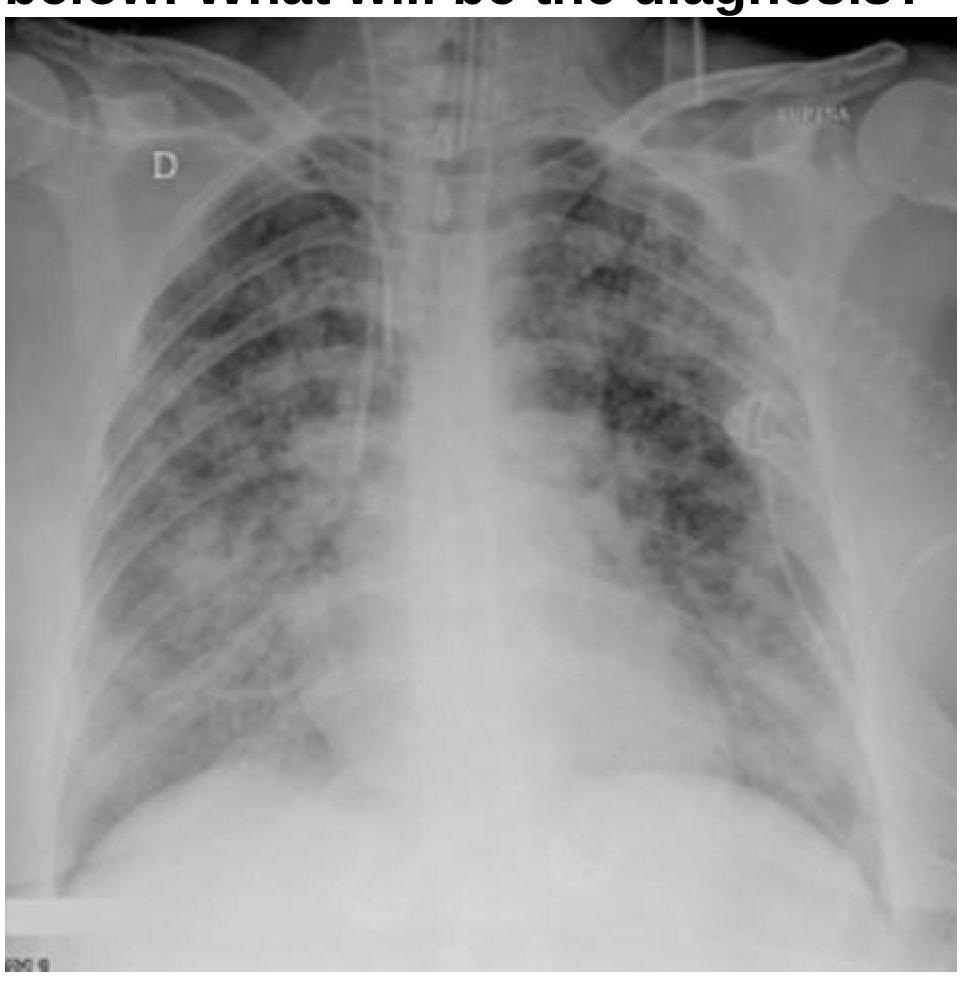
Pleural effusion with very low glucose is typically associated with which of the following conditions?
A 64-year-old man presents with fever, chills, and increasing shortness of breath. The patient appears in acute respiratory distress and complains of pleuritic chest pain. Physical examination shows crackles and decreased breath sounds over both lung fields. The patient exhibits tachypnea with flaring of the nares. The sputum is rusty-yellow and displays numerous neutrophils and erythrocytes. The patient is appropriately treated with antibiotics. Which of the following is the most likely outcome?
A 33-year-old farmer presents with recurrent wheezing and coughing after working in a barn where hay is stored. He has no prior history of asthma and is not taking any medications. Physical examination reveals bibasilar crackles on auscultation, normal heart sounds, JVP of 2 cm above the sternal angle, and no peripheral edema. Laboratory investigations are normal with no increase in eosinophils on the CBC. Chest x-ray reveals patchy lower lobe infiltrates and a normal cardiac silhouette. What is the most likely diagnosis?
A 70-year-old man presents with a 6-hour history of breathing difficulty and cough. On examination, his pulse rate is 120/min, BP is 80/40 mm Hg, and there is swelling in the left lower limb. Urgent venous Doppler of the left lower limb revealed left CFV thrombosis, and D-dimer assay was positive. CT pulmonary angiogram was performed. What is the most likely diagnosis?
Which of the following is NOT recommended for the treatment of a primary lung abscess?
All the following diseases are associated with peripheral blood eosinophilia except?
Chronic cor pulmonale is seen in all except?
A 57-year-old male suffering from acute pancreatitis develops sudden onset breathlessness with a CVP < 18 mmHg. The chest X-ray shows bilateral infiltrates. What is the possible diagnosis?
A man presented with bilateral crepitations in the base of the lungs and signs of pneumonitis with a history of exposure to pigeon feces. Which of the following is true about this condition?
A 65-year-old coal miner, who smokes one pack of cigarettes a day for 40 years, presents with chronic lung disease. Physical examination reveals a barrel chest, use of accessory muscles for inspiration, a puffy and red face, and 2+ pitting edema of the lower extremities. A chest X-ray shows diffuse fibrosis with some nodularity in central areas. What is the most likely diagnosis?
Explanation: In the context of pleural effusion, a **"very low glucose"** level is typically defined as **<30 mg/dL**. **1. Why Rheumatoid Arthritis (RA) is correct:** Rheumatoid pleural effusion is characterized by the most profound reduction in glucose levels among all pleural exudates. The underlying mechanism involves a **selective defect in the transport of glucose** across the inflamed pleural membrane, combined with high metabolic activity (glycolysis) by pleural macrophages and neutrophils. In RA, glucose levels are frequently <30 mg/dL and can even be 0 mg/dL [1]. **2. Analysis of Incorrect Options:** * **Malignancy:** While malignant effusions often have low glucose due to high metabolic consumption by tumor cells, the levels usually range between **30–60 mg/dL**. It rarely drops below 30 mg/dL [1]. * **Tuberculosis (TB):** Similar to malignancy, TB effusions are exudative and typically show glucose levels in the **40–60 mg/dL** range. * **Systemic Lupus Erythematosus (SLE):** Pleural glucose in SLE is usually **normal (>60 mg/dL)**. This is a key biochemical marker used to differentiate SLE pleuritis from Rheumatoid pleuritis [1]. **3. NEET-PG High-Yield Pearls:** * **Differential for Low Pleural Glucose (<60 mg/dL):** Rheumatoid Arthritis, Empyema, Malignancy, Tuberculosis, Lupus Pleuritis, and Esophageal Rupture [1]. * **The "Very Low" Rule:** If glucose is **<30 mg/dL**, think **Rheumatoid Arthritis** or **Empyema** first. * **RA Triad in Pleural Fluid:** Very low glucose, low pH (<7.20), and high LDH (>1000 U/L) [1]. * **Complement Levels:** Both RA and SLE effusions will show **low complement (CH50)** levels, but glucose helps distinguish them.
Explanation: The clinical presentation of fever, pleuritic chest pain, rusty sputum [1], and bilateral crackles in an elderly patient is classic for **Community-Acquired Pneumonia (CAP)**, most commonly caused by *Streptococcus pneumoniae*. **1. Why Resolution is the Correct Answer:** In the majority of cases of lobar pneumonia, especially when treated promptly with appropriate antibiotics, the inflammatory exudate within the alveoli undergoes enzymatic digestion by neutrophils. This debris is then either resorbed by macrophages or coughed up. Crucially, the **alveolar basement membrane remains intact**, allowing for the complete restoration of normal lung architecture. This process is known as **Resolution**. **2. Analysis of Incorrect Options:** * **A. Abscess formation:** This occurs when there is localized tissue necrosis and suppuration (common with *Staph. aureus* or *Klebsiella*). While a complication, it is not the *most likely* outcome in a patient receiving appropriate treatment. * **B. Bronchopleural fistula:** This is a rare, severe complication involving a communication between the bronchial tree and the pleural space, usually following a ruptured abscess or necrotizing pneumonia [2]. * **C. Bullous emphysema:** This is a chronic obstructive pulmonary disease (COPD) pathology characterized by permanent enlargement of airspaces and wall destruction, not an acute sequela of pneumonia. **Clinical Pearls for NEET-PG:** * **Stages of Lobar Pneumonia:** Congestion → Red Hepatization → Gray Hepatization → Resolution. * **Rusty Sputum:** Pathognomonic for *Streptococcus pneumoniae* (due to altered hemoglobin from lysed RBCs) [1]. * **Organization:** If the exudate is not resolved, it may be replaced by fibroblasts, leading to permanent scarring (Organizing Pneumonia). * **Radiology:** Radiological resolution usually lags behind clinical improvement by 4–6 weeks.
Explanation: ### Explanation **Correct Answer: C. Hypersensitivity pneumonitis (HP)** **Why it is correct:** The clinical presentation is classic for **Acute/Subacute Hypersensitivity Pneumonitis**, specifically "Farmer’s Lung." This is an immune-mediated (Type III and IV hypersensitivity) inflammatory disease of the distal airways and alveoli caused by inhaling organic dusts—in this case, **thermophilic actinomycetes** found in moldy hay. * **Key features:** Recurrent respiratory symptoms (cough, wheeze, dyspnea) following occupational exposure [1], **bibasilar crackles** (suggesting interstitial involvement) [1], and **patchy infiltrates** on CXR [1]. * **Distinguishing factor:** The absence of peripheral eosinophilia is a crucial clue that differentiates HP from eosinophilic lung diseases or allergic asthma. **Why incorrect options are wrong:** * **A. Asthma:** While asthma causes wheezing, it typically presents with a normal CXR (or hyperinflation) and would not explain bibasilar crackles or patchy infiltrates. * **B. Chronic Obstructive Lung Disease (COPD):** This is unlikely in a 33-year-old non-smoker. COPD presents with chronic productive cough and obstructive patterns, not acute patchy infiltrates. * **D. Bronchiectasis:** This involves permanent dilation of bronchi, usually presenting with chronic, copious purulent sputum and "tram-track" opacities or ring shadows on imaging, rather than acute episodes related to hay exposure. **NEET-PG High-Yield Pearls:** * **Farmer’s Lung:** Caused by *Saccharopolyspora rectivirgula* (formerly *Micropolyspora faeni*). * **Bird Fancier’s Lung:** Caused by avian proteins (droppings/feathers) [1]. * **Diagnosis:** High-resolution CT (HRCT) shows **ground-glass opacities** and centrilobular nodules [1]. Bronchoalveolar lavage (BAL) typically shows **marked lymphocytosis** (often >50%). * **Management:** The most important step is **avoidance of the allergen**. Systemic steroids are used for severe acute symptoms.
Explanation: **Explanation:** The clinical presentation is a classic triad for **Massive Pulmonary Embolism (PE)**. The patient exhibits sudden onset dyspnea, hemodynamic instability (BP 80/40 mm Hg), and signs of Deep Vein Thrombosis (DVT) in the left lower limb. 1. **Why Pulmonary Embolism is correct:** The presence of left Common Femoral Vein (CFV) thrombosis on Doppler and a positive D-dimer strongly suggest a thromboembolic event [3, 4]. In a patient with hypotension (obstructive shock), the diagnosis is **Massive PE** [1]. CT Pulmonary Angiogram (CTPA) is the gold standard investigation to confirm the presence of thrombi in the pulmonary arteries [3]. 2. **Why other options are incorrect:** * **Carcinoma Lung:** While it can cause cough and dyspnea, it does not typically present with acute hemodynamic collapse and acute DVT [2]. * **Tuberculosis:** Usually presents with a chronic history of fever, weight loss, and night sweats, rather than sudden onset shock and limb swelling [2]. * **Aortic Dissection:** Presents with "tearing" chest pain radiating to the back. While it causes hypotension, it would not explain the CFV thrombosis or the positive D-dimer in the context of limb swelling [1]. **High-Yield Clinical Pearls for NEET-PG:** * **Virchow’s Triad:** Stasis, endothelial injury, and hypercoagulability are the precursors to DVT/PE. * **Gold Standard Investigation:** CT Pulmonary Angiogram (CTPA) [3]. * **ECG Findings:** Most common finding is **Sinus Tachycardia** [1]. The classic **S1Q3T3 pattern** (Deep S in Lead I, Q wave and inverted T in Lead III) is specific but not sensitive [1]. * **Management:** For Massive PE (hemodynamically unstable), the treatment of choice is **Thrombolysis** (e.g., Alteplase). For non-massive PE, anticoagulation (Heparin/LMWH) is preferred. * **Wells’ Score:** Used clinically to predict the probability of PE.
Explanation: The treatment of a primary lung abscess requires coverage against a polymicrobial flora, typically consisting of **anaerobes** (found in the oropharynx) and **aerobic streptococci**. While Metronidazole is a potent anaerobicidal agent, it is **not recommended as monotherapy** for lung abscesses [1]. This is because primary lung abscesses are rarely caused by pure anaerobes; they almost always involve microaerophilic or aerobic streptococci, against which Metronidazole has **poor activity** [1, 2]. Clinical trials have shown high failure rates when Metronidazole is used alone compared to other regimens. It should only be used in combination with Penicillin or a Macrolide. **Clindamycin (Option B):** Historically the "gold standard" for lung abscesses. It provides excellent coverage against both anaerobes and Gram-positive cocci (Streptococci) [2]. **Amoxicillin-clavulanate (Option C):** Currently considered a first-line agent. The beta-lactamase inhibitor provides the necessary anaerobic coverage, while the amoxicillin covers the aerobic components. **Duration of treatment:** Unlike standard pneumonia, lung abscesses require prolonged antibiotic therapy (usually **3–6 weeks**) until the cavity disappears or only a small stable scar remains on imaging [3]. **Surgical drainage:** Rarely required (<10% of cases); medical management is successful in the vast majority but surgery should be contemplated if no improvement occurs despite medical therapy [3].
Explanation: **Explanation:** The correct answer is **Pulmonary eosinophilic granuloma** (also known as Pulmonary Langerhans Cell Histiocytosis - PLCH). **1. Why Pulmonary Eosinophilic Granuloma is the correct answer:** Despite its name, Pulmonary Eosinophilic Granuloma is **not** characterized by peripheral blood eosinophilia. It is a smoking-related interstitial lung disease caused by the monoclonal proliferation of **Langerhans cells** (dendritic cells). While eosinophils may be found within the lung tissue lesions (granulomas), the systemic white blood cell count typically remains normal. **2. Analysis of Incorrect Options:** * **Allergic Bronchopulmonary Aspergillosis (ABPA):** This is a hypersensitivity reaction to *Aspergillus fumigatus*. It is classically defined by the "Rosenberg-Patterson criteria," which include peripheral blood eosinophilia (>1000/µL) and elevated serum IgE. * **Loffler’s Syndrome:** This is a form of simple pulmonary eosinophilia often caused by migrating helminth larvae (e.g., *Ascaris*). It is characterized by transient, migratory pulmonary opacities and marked peripheral eosinophilia. * **Churg-Strauss Syndrome (EGPA):** Now called Eosinophilic Granulomatosis with Polyangiitis, this is a systemic vasculitis [1]. Peripheral eosinophilia (>1500/µL or >10% of total WBC count) is a hallmark and a primary diagnostic criterion [1]. **3. NEET-PG High-Yield Pearls:** * **PLCH (Eosinophilic Granuloma):** Strongly associated with **smoking** (90-100% of cases). High-yield CT finding: **Bizarre-shaped cysts** and nodules, primarily in the upper and middle lobes. * **Langerhans Cells:** On electron microscopy, they show pathognomonic **Birbeck granules** (tennis-racket shaped). They are positive for **CD1a and S100** markers. * **Rule of Thumb:** If a pulmonary disease has "Eosinophilic" in the name but is related to smoking or Langerhans cells, do not expect peripheral eosinophilia.
Explanation: **Explanation:** The core concept tested here is the distinction between **Acute** and **Chronic Cor Pulmonale**. Cor pulmonale is defined as right ventricular (RV) hypertrophy or dilatation resulting from diseases affecting the structure or function of the lungs or its vasculature. **1. Why Pulmonary Embolization is the correct answer:** Pulmonary embolization (PE) typically presents as an **acute** event. A massive PE causes a sudden, sharp rise in pulmonary vascular resistance. Because the right ventricle is a thin-walled chamber, it cannot adapt quickly to high pressures, leading to acute RV dilatation and failure (**Acute Cor Pulmonale**). Chronic cor pulmonale requires a slow, progressive increase in pulmonary pressure over time to allow for RV hypertrophy. **2. Analysis of Incorrect Options (Causes of Chronic Cor Pulmonale):** * **COPD (Option B):** The most common cause of chronic cor pulmonale worldwide. Chronic hypoxia leads to pulmonary vasoconstriction and remodeling. * **Cystic Fibrosis (Option C):** Leads to chronic obstructive and restrictive lung disease, causing progressive pulmonary hypertension and subsequent RV hypertrophy. * **Primary Pulmonary Hypertension (Option D):** Now termed Idiopathic Pulmonary Arterial Hypertension (IPAH), this is a classic cause of chronic cor pulmonale due to the gradual obliteration of the pulmonary capillary bed. **Clinical Pearls for NEET-PG:** * **Definition:** Cor pulmonale must exclude right heart failure caused by left-sided heart disease or congenital heart disease. * **ECG Findings:** Look for "P-pulmonale" (tall peaked P waves in lead II), right axis deviation, and RV hypertrophy patterns. * **Gold Standard Diagnosis:** Right heart catheterization (to measure pulmonary artery pressures). * **Most common cause of Right Heart Failure:** Left-sided heart failure (Note: This is *not* cor pulmonale).
Explanation: ### Explanation The clinical presentation of sudden onset breathlessness, bilateral infiltrates on chest X-ray, and a low Central Venous Pressure (CVP) in the setting of acute pancreatitis is classic for **Acute Respiratory Distress Syndrome (ARDS)**. **1. Why ARDS is the Correct Answer:** ARDS is a clinical syndrome characterized by non-cardiogenic pulmonary edema due to increased alveolar-capillary permeability. * **Trigger:** Acute pancreatitis is a well-known systemic inflammatory trigger for ARDS. * **Imaging:** Bilateral pulmonary infiltrates are a hallmark finding. * **Hemodynamics:** A **CVP < 18 mmHg** (or a Pulmonary Capillary Wedge Pressure ≤ 18 mmHg) is crucial because it helps rule out a cardiogenic cause. It indicates that the pulmonary edema is due to "leaky capillaries" rather than fluid overload or heart failure. **2. Why Other Options are Incorrect:** * **Congestive Left Heart Failure (CHF):** While CHF presents with breathlessness and bilateral infiltrates, the CVP (and PCWP) would typically be **elevated (> 18 mmHg)** due to high hydrostatic pressure in the pulmonary vasculature. * **Myocardial Infarction (MI):** Though MI can lead to cardiogenic shock and pulmonary edema, the low CVP makes this unlikely as the primary cause of the infiltrates in this scenario. * **Pulmonary Embolism (PE):** While PE causes sudden breathlessness, the chest X-ray is often normal or shows focal signs (e.g., Westermark sign). It does not typically present with diffuse bilateral infiltrates. **3. NEET-PG High-Yield Pearls:** * **Berlin Criteria for ARDS:** 1) Acute onset (within 1 week); 2) Bilateral opacities on CXR/CT not explained by effusions or collapse; 3) Respiratory failure not fully explained by heart failure (PCWP ≤ 18); 4) Reduced PaO2/FiO2 ratio (< 300 mmHg). * **Management:** The mainstay is **Low Tidal Volume Ventilation (6 mL/kg)** to prevent volutrauma and maintaining high PEEP. * **Common Causes:** Sepsis (most common), pneumonia, gastric aspiration, and acute pancreatitis.
Explanation: The clinical presentation describes **Hypersensitivity Pneumonitis (HP)**, specifically "Bird Fancier’s Lung," caused by the inhalation of organic antigens from pigeon droppings or feathers. [1] ### **Why Option A is Correct** In Hypersensitivity Pneumonitis, the **clinical history** is the most critical diagnostic tool. A definitive diagnosis is often reached by identifying a temporal relationship between exposure to a specific antigen (pigeons, hay, humidifiers) and the onset of respiratory symptoms (dyspnea, cough, crepitations). [1] If the history is classic and symptoms resolve upon removal of the trigger, extensive invasive testing is often unnecessary. ### **Why Other Options are Incorrect** * **Option B:** While **High-Resolution CT (HRCT)** is the imaging modality of choice (showing ground-glass opacities or centrilobular nodules), it is not the "investigation of choice" for diagnosis compared to a thorough history. [1] Diagnosis is a constellation of history, physical exam, and imaging. * **Option C:** Chest X-rays are often **normal** in the acute phase or show non-specific reticulonodular patterns. [1] They lack the sensitivity and specificity required to be "characteristic." * **Option D:** HP is primarily a **Type III (immune complex)** and **Type IV (delayed-type/cell-mediated)** hypersensitivity reaction, not Type I (IgE-mediated). ### **NEET-PG High-Yield Pearls** * **Common Triggers:** Farmer’s Lung (Actinomycetes in moldy hay), Bagassosis (moldy sugar cane), Humidifier Lung (thermophilic bacteria). * **Histopathology:** Characterized by the "Triad" of interstitial pneumonitis, non-caseating granulomas (loose), and bronchiolitis. [1] * **PFT Pattern:** Typically shows a **Restrictive** lung defect with decreased DLCO. * **Management:** The primary treatment is **strict avoidance of the offending antigen**. Corticosteroids are used for severe acute or chronic progressive cases.
Explanation: The correct answer is **Anthracosis** (specifically Coal Workers' Pneumoconiosis or CWP). **Why Anthracosis is correct:** The patient’s occupational history as a **coal miner** is the primary diagnostic clue [1]. Anthracosis refers to the accumulation of carbon pigment in the lungs. In symptomatic miners, this progresses to Coal Workers' Pneumoconiosis. The chest X-ray findings of **diffuse fibrosis with central nodularity** (coal macules and nodules) are classic for simple and complicated CWP [1]. The clinical presentation of a "barrel chest" and accessory muscle use indicates underlying obstructive pathology (often exacerbated by his 40-pack-year smoking history [2]), while the **puffy, red face and lower extremity edema** suggest **Cor Pulmonale** (right-sided heart failure) resulting from chronic pulmonary hypertension due to long-standing lung disease. **Why other options are incorrect:** * **Asbestosis:** Typically presents with pleural plaques and interstitial fibrosis predominantly in the **lower lobes** [3], rather than central nodularity. It is associated with construction, shipbuilding, or insulation work [3]. * **Diffuse Alveolar Damage (DAD):** This is the histological hallmark of **ARDS**. It presents acutely with severe hypoxia and "white-out" on X-ray, not as a chronic occupational disease. * **Sarcoidosis:** While it features nodules and fibrosis, it characteristically presents with **bilateral hilar lymphadenopathy** and non-caseating granulomas, usually in a younger demographic. **NEET-PG High-Yield Pearls:** * **Caplan Syndrome:** The association of Coal Workers' Pneumoconiosis with Rheumatoid Arthritis (characterized by large necrobiotic nodules). * **Silicosis vs. CWP:** Silicosis typically shows "eggshell calcification" of hilar nodes and increases the risk of Tuberculosis; CWP does not significantly increase TB risk. * **Centrilobular Emphysema:** Common in smokers (like this patient) and often co-exists with CWP, contributing to the "barrel chest" appearance [2].
Obstructive Airway Diseases (Asthma, COPD)
Practice Questions
Interstitial Lung Diseases
Practice Questions
Pulmonary Infections
Practice Questions
Pulmonary Vascular Diseases
Practice Questions
Pleural Diseases
Practice Questions
Sleep-Disordered Breathing
Practice Questions
Respiratory Failure
Practice Questions
Mediastinal Disorders
Practice Questions
Occupational Lung Diseases
Practice Questions
Pulmonary Function Testing
Practice Questions
Bronchiectasis and Cystic Fibrosis
Practice Questions
Lung Cancer Approach
Practice Questions
Get full access to all questions, explanations, and performance tracking.
Start For Free