Hamman's sign is a clinical finding associated with which of the following conditions?
All of the following are characterized by upper lobe fibrosis except?
Which of the following is NOT a characteristic feature of chronic bronchitis?
In pulmonary embolism, what is the primary risk associated with fibrinolytic therapy?
A 36-year-old male presents with a 2-day history of continuous chest pain that does not change with activity. Vital signs reveal normal blood pressure, mild tachycardia and tachypnea, and an oxygen saturation of 90% on room air. The cardiopulmonary examination is normal. An ECG shows a rate of 106 beats/min, left axis deviation, left ventricular hypertrophy, PR depression, and T wave inversions in V2 to V5. Troponin and CPK-MB are minimally elevated. What is the most likely diagnosis?
What is the typical sequence of symptoms in pulmonary embolism?
An elderly male, a chronic smoker with 40 pack-years, complains of recurrent difficulty in breathing. A chest X-ray showed abnormalities. Which of the following positions is most comfortable for a patient experiencing difficulty in breathing?
Which of the following conditions may lead to exudative pleural effusions?
A patient presents with left hemiplegia and a history of right deep vein thrombosis. What is the most likely cause of hemoptysis in this patient?
All are true about hepatopulmonary syndrome except?
Explanation: **Explanation:** **Hamman’s sign** (also known as Hamman’s crunch) is a pathognomonic clinical finding for **pneumomediastinum (mediastinal emphysema)**. It is characterized by a series of precordial crunches, clicks, or popping sounds heard synchronous with the heartbeat, rather than the respiratory cycle. 1. **Mechanism:** When air is trapped in the mediastinum, the beating of the heart and the movement of the great vessels compress the air pockets against the parietal pleura and pericardium, creating a distinct "crunching" sound. It is best heard in the left lateral decubitus position. **Analysis of Options:** * **A. Mediastinal emphysema (Correct):** As explained, the presence of air in the mediastinal space is the direct cause of this auscultatory finding. * **B. Surgical emphysema:** This refers to air in the subcutaneous tissues (crepitus). While it often coexists with pneumomediastinum, the specific "crunch" synchronous with the heart is unique to the mediastinal location. * **C. Panacinar emphysema:** This is a pathological subtype of COPD (often associated with Alpha-1 antitrypsin deficiency) involving alveolar destruction, not free air in the mediastinum. * **D. Interstitial lung disease:** This presents with "Velcro" crackles (crepitations) which are synchronous with inspiration, not the heartbeat. **High-Yield Clinical Pearls for NEET-PG:** * **Hamman’s Syndrome:** Spontaneous pneumomediastinum (often triggered by Valsalva maneuvers like coughing, vomiting, or childbirth). * **Differential Diagnosis:** Must be distinguished from a pericardial friction rub. Hamman's sign is more irregular and positional. * **Macklin Effect:** The pathophysiological process where alveolar rupture leads to air dissecting along bronchovascular sheaths toward the mediastinum. * **Associated finding:** Look for "continuous diaphragm sign" on a chest X-ray in these patients.
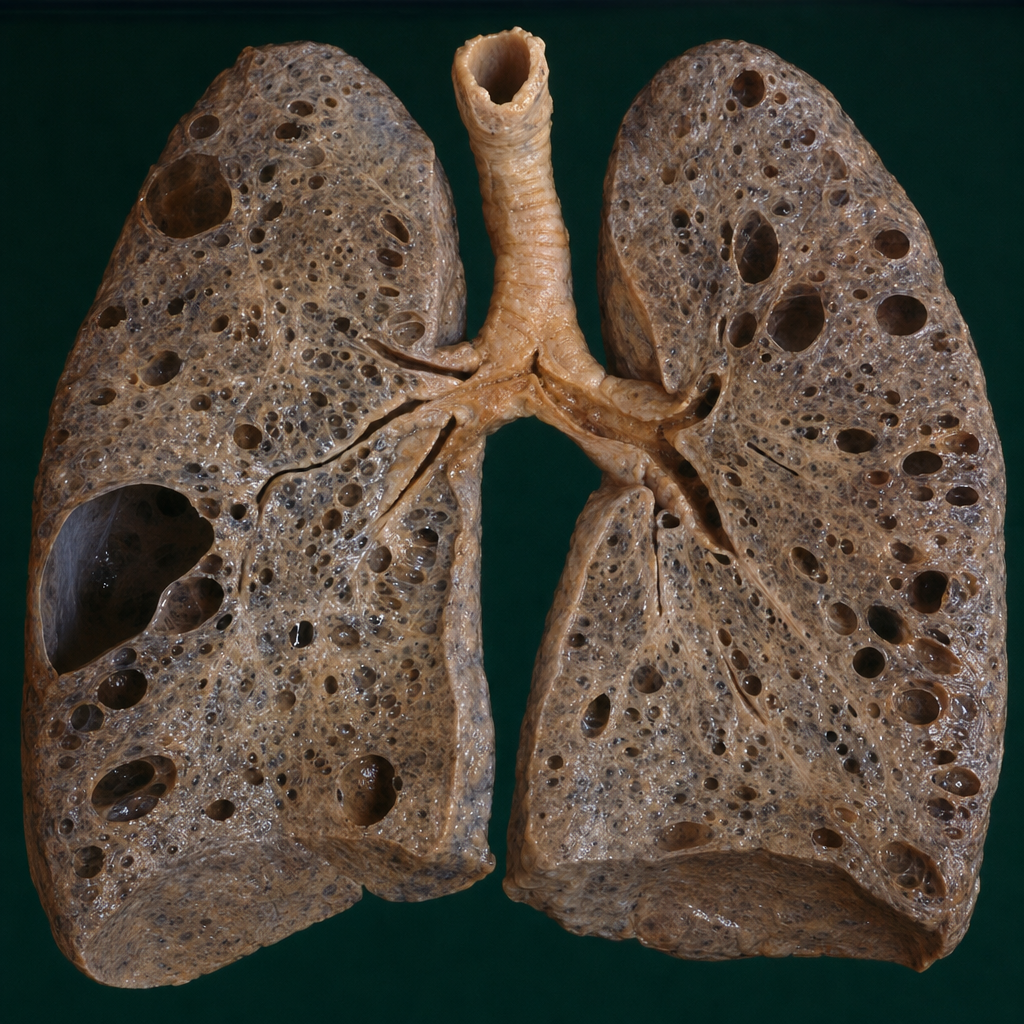
Explanation: **Explanation:** The distribution of pulmonary fibrosis (upper vs. lower lobe) is a high-yield topic in NEET-PG. Most interstitial lung diseases (ILDs) and drug-induced toxicities typically affect the **lower lobes** due to higher blood flow and gravity-dependent deposition. **1. Why Busulfan is the correct answer:** Busulfan is an alkylating agent used in chemotherapy (e.g., for CML). It is a classic cause of **drug-induced pulmonary fibrosis**, which characteristically involves the **lower lobes**. Other drugs following this pattern include Bleomycin, Amiodarone, and Methotrexate. **2. Analysis of Incorrect Options (Upper Lobe Involvement):** * **Silicosis:** A pneumoconiosis caused by silica dust inhalation. It typically presents with nodular opacities and progressive massive fibrosis (PMF) in the **upper lobes** [1]. * **Cystic Fibrosis:** Characterized by thick secretions and recurrent infections (like *Pseudomonas*). It predominantly affects the **upper lobes** with bronchiectasis and secondary fibrosis. * **Histoplasmosis:** Fungal infections (and others like Tuberculosis) have a predilection for the **upper lobes** due to higher oxygen tension, leading to apical scarring and cavitation [2]. **3. High-Yield Clinical Pearls for NEET-PG:** To remember the causes of **Upper Lobe Fibrosis**, use the mnemonic **"SCART"**: * **S:** Silicosis, Sarcoidosis * **C:** Coal Worker's Pneumoconiosis, Cystic Fibrosis [1] * **A:** Ankylosing Spondylitis, Allergic Bronchopulmonary Aspergillosis (ABPA) [2] * **R:** Radiation (if the field is upper lobe) * **T:** Tuberculosis [2] **Lower Lobe Fibrosis** is typically seen in **BAD** conditions: **B**ras (Busulfan/Bleomycin), **A**miodarone/Asbestosis, and **D**rugs/Dermatomyositis/IPF.
Explanation: **Explanation:** Chronic bronchitis is clinically defined as a **productive cough for at least 3 months in each of 2 consecutive years**, provided other causes of productive cough have been excluded. **Why Hemoptysis is the Correct Answer:** While chronic bronchitis involves inflammation of the airways, **hemoptysis is NOT a characteristic or defining feature**. If a patient with suspected COPD/chronic bronchitis presents with hemoptysis [2], clinicians must urgently investigate for alternative or comorbid pathologies, most notably **Bronchogenic Carcinoma** or **Bronchiectasis** [4][5]. In the context of this question, it is the "odd one out" compared to the typical clinical signs of the disease. **Analysis of Other Options:** * **Cough lasting for more than 2 months:** While the formal definition is 3 months, a prolonged productive cough is the hallmark of the disease [1]. In MCQ formats, "more than 2 months" aligns with the chronic nature of the pathology. * **Hoover Sign:** This refers to the paradoxical inward movement of the lower costal margins during inspiration. It is a characteristic physical finding in severe COPD (both chronic bronchitis and emphysema) due to hyperinflation and a flattened diaphragm. * **Bronchorrhea:** This refers to the excessive production of watery sputum ( >100 mL/day). Chronic bronchitis is characterized by goblet cell hyperplasia and mucus gland hypertrophy, leading to significant sputum production [3]. **Clinical Pearls for NEET-PG:** * **Reid Index:** The gold standard pathological finding in chronic bronchitis. It is the ratio of the thickness of the mucous gland layer to the thickness of the wall between the epithelium and the cartilage (Normal <0.4; Chronic Bronchitis >0.5). * **"Blue Bloaters":** The classic clinical phenotype of chronic bronchitis (hypoxemic, hypercapnic, and edematous), as opposed to "Pink Puffers" (emphysema). * **Early Change:** The earliest physiological change in smokers leading to chronic bronchitis is **small airway obstruction** (flow limitation in airways <2mm).
Explanation: The primary risk associated with fibrinolytic therapy (e.g., Alteplase, Streptokinase) in pulmonary embolism (PE) is **haemorrhage** [1]. Fibrinolytics work by converting plasminogen to plasmin, which enzymatically degrades fibrin clots [2]. However, this process is systemic and non-specific; it dissolves not only the pathological embolus but also protective physiological hemostatic plugs. The most feared complication is **intracranial haemorrhage (ICH)**, occurring in approximately 1-2% of patients, while major bleeding occurs in up to 10% [1]. **Analysis of Options:** * **Option A (Correct):** Haemorrhage is the most significant adverse effect and the primary reason why thrombolysis is reserved only for high-risk (massive) PE [1]. * **Option B (Incorrect):** While thrombolysis improves hemodynamics in massive PE [1], "improved prognosis" is a therapeutic goal/benefit, not a "risk." * **Option C (Incorrect):** Resolution of the emboli is the intended mechanism of action and clinical objective, not a risk. * **Option D (Incorrect):** Thrombolysis does not reduce the risk of recurrence; long-term anticoagulation is required for that purpose [1]. **High-Yield Clinical Pearls for NEET-PG:** 1. **Indication:** Thrombolysis is indicated for **Massive PE** (defined by hemodynamic instability/systolic BP <90 mmHg) [1]. It is generally *not* recommended for low-risk or submassive PE unless there is clinical deterioration. 2. **Absolute Contraindications:** Prior ICH, known structural cerebrovascular lesion, ischemic stroke within 3 months, active internal bleeding, or suspected aortic dissection. 3. **Window:** Benefit is greatest when started within 48 hours of symptom onset but can be effective up to 14 days [1].
Explanation: **Explanation:** The clinical presentation and ECG findings point toward **Acute Pericarditis**. **1. Why Pericarditis is correct:** The patient presents with continuous chest pain and classic ECG markers. **PR segment depression** is considered a highly specific (though not always sensitive) sign of acute pericarditis, representing atrial injury [1]. While the T-wave inversions in V2-V5 and minimal biomarker elevation (Troponin/CPK-MB) might suggest ischemia, they are also common in **myopericarditis** (pericarditis with myocardial involvement) [1]. The absence of dynamic changes with activity and the presence of PR depression are the key discriminators here. **2. Why the other options are incorrect:** * **Pulmonary Embolism (PE):** While PE causes tachycardia, tachypnea, and hypoxia (90% SpO2), the ECG typically shows sinus tachycardia or the S1Q3T3 pattern. PR depression is not a feature of PE. * **Costochondritis:** This causes localized chest wall tenderness (musculoskeletal). It would not cause hypoxia, tachycardia, or ECG/biomarker abnormalities. * **Unstable Angina:** This typically presents with exertional chest pain or pain at rest with ST-segment depressions or T-wave inversions [2]. However, it does not cause PR depression or hypoxia, and by definition, biomarkers remain normal in unstable angina (elevated troponins indicate NSTEMI) [2]. **NEET-PG High-Yield Pearls:** * **ECG Stages of Pericarditis:** Stage 1 (Diffuse ST elevation & PR depression) → Stage 2 (Normalization) → Stage 3 (T-wave inversion) → Stage 4 (Normalization) [1]. * **SpO2 in Pericarditis:** While hypoxia is unusual for simple pericarditis, it can occur if there is significant pleuritic pain leading to splinting/hypoventilation or associated pulmonary pathology. * **Gold Standard:** PR depression in limb leads (especially II, aVF, V5-V6) and PR elevation in aVR are diagnostic hallmarks [1].
Explanation: **Explanation:** Pulmonary Embolism (PE) typically presents with a classic triad of symptoms that follow a specific physiological sequence based on the progression of the embolic event [1]. **1. Why Option C is Correct:** The sequence **Dyspnea → Chest Pain → Hemoptysis** reflects the clinical progression of PE: * **Dyspnea:** This is usually the first and most common symptom. It occurs suddenly due to a reflex increase in ventilation and an increase in alveolar dead space (V/Q mismatch) [1]. * **Chest Pain:** As the embolus lodges, it causes pleural irritation or localized ischemia. This is typically pleuritic in nature [1]. * **Hemoptysis:** This is a later sign, occurring when the obstruction leads to pulmonary infarction or hemorrhage into the alveolar spaces [1]. **2. Why Other Options are Incorrect:** * **Options A & B:** While a low-grade fever can occur in PE due to inflammation/infarction, it is rarely the presenting or primary symptom. Fever is more characteristic of infectious processes like pneumonia. * **Option D:** Purulent sputum is a hallmark of bacterial pneumonia or bronchiectasis, not PE. PE is associated with a dry cough or hemoptysis, but never purulent expectoration. **3. High-Yield Clinical Pearls for NEET-PG:** * **Most Common Symptom:** Tachypnea (Sign) and Dyspnea (Symptom). * **ECG Findings:** Most common is **Sinus Tachycardia** [2]. The classic **S1Q3T3** pattern is specific but seen in only <20% of cases [2]. * **Gold Standard Investigation:** CT Pulmonary Angiography (CTPA). * **Chest X-ray:** Usually normal, but look for **Westermark sign** (focal oligemia) or **Hampton’s Hump** (wedge-shaped opacity) [2]. * **Wells Score:** Used for clinical probability assessment before ordering a D-dimer or CTPA.
Explanation: **Explanation:** The correct answer is **D. All positions are the same in respect to comfort.** While clinical intuition often suggests that patients with respiratory distress prefer sitting up (orthopnea), the question asks for the most comfortable position in a general sense for a patient with chronic respiratory issues. In medical examinations, unless a specific condition like Congestive Heart Failure (CHF) or severe COPD is specified as having a positional preference, the physiological demand for oxygen remains constant regardless of posture. **Why the other options are incorrect:** * **Standing (A):** While standing can increase lung volumes slightly, it also increases the metabolic demand and work of postural muscles, which can exacerbate fatigue in a chronic smoker with potential underlying lung disease. * **Sitting (B):** This is the preferred position for patients with **Orthopnea** (common in Left Heart Failure) as it decreases venous return and lowers the diaphragm [1]. However, it is not a universal rule for all "difficulty in breathing" scenarios unless specified. * **Lying down (C):** This is generally the *least* comfortable position for patients with respiratory distress because the abdominal viscera push against the diaphragm, reducing functional residual capacity (FRC) and increasing the work of breathing [1]. **High-Yield Clinical Pearls for NEET-PG:** 1. **Orthopnea:** Difficulty breathing while lying flat; highly suggestive of **Congestive Heart Failure** or bilateral diaphragmatic palsy [1]. 2. **Platypnea:** Difficulty breathing while upright, relieved by lying flat. Seen in **Hepatopulmonary Syndrome** and atrial septal defects (Right-to-Left shunts). 3. **Trepopnea:** Dyspnea felt only when lying on one side. Seen in unilateral lung disease (patient prefers lying with the "good lung" down to improve V/Q matching) or dilated cardiomyopathy. 4. **Tripod Position:** Patients with severe COPD often lean forward with hands on knees to optimize the use of accessory muscles.
Explanation: Explanation: Pleural effusions are classified into **transudates** and **exudates** based on Light's Criteria, which reflect the underlying pathophysiology of fluid accumulation [1]. **Correct Answer: D. Bronchogenic Carcinoma** Exudative effusions occur due to inflammation, increased capillary permeability, or lymphatic obstruction. In **Bronchogenic Carcinoma**, the malignancy causes direct pleural involvement, inflammatory cytokine release, and obstruction of lymphatic drainage [1]. This leads to the leakage of proteins and cells into the pleural space. Malignancy is one of the most common causes of exudative effusion, often presenting with hemorrhagic fluid and low glucose levels [1]. **Incorrect Options:** * **A, B, and C (Cirrhosis, Nephrotic Syndrome, CHF):** These are classic causes of **transudative effusions**. * **CHF** increases pulmonary capillary hydrostatic pressure. * **Cirrhosis and Nephrotic Syndrome** lead to hypoalbuminemia, which decreases plasma oncotic pressure. In these conditions, the pleural membranes are intact, but systemic factors alter the pressure gradients, forcing protein-poor fluid into the pleural space. **High-Yield Clinical Pearls for NEET-PG:** * **Light’s Criteria:** An effusion is an **exudate** if it meets at least one: 1. Pleural fluid protein/Serum protein ratio > 0.5 2. Pleural fluid LDH/Serum LDH ratio > 0.6 3. Pleural fluid LDH > 2/3rd the upper limit of normal serum LDH. * **Most common cause of transudate:** Congestive Heart Failure. * **Most common cause of exudate:** Parapneumonic effusion, followed by Malignancy [1]. * **Meigs Syndrome:** A rare triad of benign ovarian tumor (fibroma), ascites, and pleural effusion (usually transudative).
Explanation: ### Explanation **Correct Option: A. Pulmonary thromboembolism (PTE)** The clinical scenario describes a patient with a history of **Deep Vein Thrombosis (DVT)** who now presents with **left hemiplegia**. This suggests a **Paradoxical Embolism**. A thrombus from the venous system (DVT) bypassed the pulmonary circulation via a Right-to-Left shunt (most commonly a **Patent Foramen Ovale**) to enter the systemic circulation, causing an embolic stroke (hemiplegia). In this context, **hemoptysis** occurs due to **Pulmonary Infarction** [1]. When a thromboembolus occludes a peripheral pulmonary artery, the resulting ischemia leads to alveolar hemorrhage and necrosis of the lung parenchyma, manifesting as hemoptysis [1]. This is a classic component of the triad: pleuritic chest pain, dyspnea, and hemoptysis. **Analysis of Incorrect Options:** * **B. Disseminated Intravascular Coagulation (DIC):** While DIC causes bleeding, it is usually a systemic consumptive coagulopathy associated with sepsis or trauma, not focal neurological deficits and DVT. * **C. Fat Embolism:** Typically follows long-bone fractures. While it causes the "triad" of dyspnea, petechiae, and confusion, it does not typically present with focal hemiplegia or a direct link to a pre-existing DVT. * **D. Superior Vena Cava (SVC) Syndrome:** This is a result of venous obstruction (usually by a tumor), leading to facial swelling and venous distension, not acute embolic events or hemoptysis. **High-Yield Clinical Pearls for NEET-PG:** * **Paradoxical Embolism:** Always suspect this in a patient with simultaneous DVT/PE and a systemic arterial event (Stroke/MI) [2]. * **Hampton’s Hump:** A wedge-shaped opacity on CXR indicative of pulmonary infarction. * **Westermark Sign:** Focal oligemia distal to the embolus on CXR. * **Gold Standard Investigation:** CT Pulmonary Angiography (CTPA). * **ECG Finding:** S1Q3T3 pattern (specific but not sensitive for right heart strain).
Explanation: Hepatopulmonary Syndrome (HPS) is a triad of **liver disease**, **increased alveolar-arterial oxygen gradient** (hypoxemia), and **intrapulmonary vascular dilatations (IPVDs)** [1]. **Why Option D is the Correct Answer (The False Statement):** A preoperative PaO₂ of **<50 mmHg** (not <30 mmHg) is considered a significant predictor of increased mortality following Orthotopic Liver Transplantation (OLT). Furthermore, a PaO₂ <30 mmHg is extremely rare in HPS and usually indicates a terminal state or alternative pathology. The diagnosis of HPS is based on an A-a gradient ≥15 mmHg (or >20 mmHg in patients >64 years) while breathing room air. **Analysis of Other Options:** * **Option A:** The prevalence of HPS in patients awaiting liver transplantation is reported to be between **8% and 29%**, making this a true statement. * **Option B:** HPS is characterized by **functional shunting** due to massive precapillary and capillary dilatations [1]. This leads to a "diffusion-perfusion mismatch" where oxygen cannot reach the center of the dilated vessel to saturate the hemoglobin. * **Option C:** Currently, **Orthotopic Liver Transplantation** is the only definitive treatment that leads to the resolution of HPS in the majority of patients [1]. Medical therapies (like somatostatin or garlic) have not shown consistent benefits. **High-Yield Clinical Pearls for NEET-PG:** 1. **Platypnea:** Shortness of breath that worsens when sitting or standing. 2. **Orthodeoxia:** A decrease in arterial oxygen saturation (>5% or >4 mmHg) when moving from a supine to an upright position [1]. 3. **Gold Standard Investigation:** Contrast-enhanced echocardiography (Bubble study) using agitated saline. Appearance of microbubbles in the left atrium after **3–6 cardiac cycles** indicates IPVDs. 4. **MAA Lung Scan:** Used to quantify the shunt fraction; a brain uptake of >6% is abnormal.
Obstructive Airway Diseases (Asthma, COPD)
Practice Questions
Interstitial Lung Diseases
Practice Questions
Pulmonary Infections
Practice Questions
Pulmonary Vascular Diseases
Practice Questions
Pleural Diseases
Practice Questions
Sleep-Disordered Breathing
Practice Questions
Respiratory Failure
Practice Questions
Mediastinal Disorders
Practice Questions
Occupational Lung Diseases
Practice Questions
Pulmonary Function Testing
Practice Questions
Bronchiectasis and Cystic Fibrosis
Practice Questions
Lung Cancer Approach
Practice Questions
Get full access to all questions, explanations, and performance tracking.
Start For Free