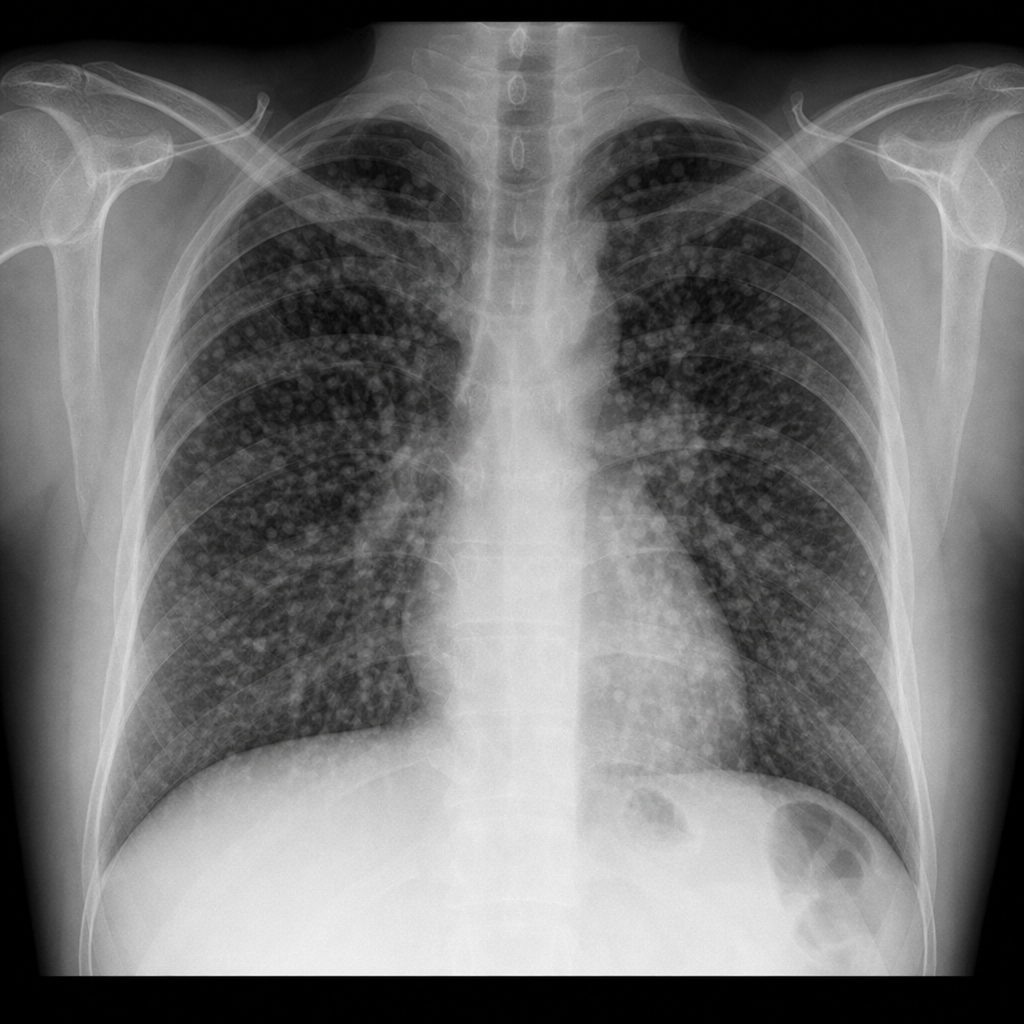
Smoking is generally not associated as a risk factor with which of the following conditions?
What is true about chronic obstructive pulmonary disease (COPD)?
What is the most definitive method for diagnosing pulmonary embolism?
A 60-year-old female presented to the casualty with a fracture of the neck of the femur. She subsequently developed chest pain and breathlessness. What is the most likely diagnosis?
Which of the following findings is NOT typically associated with bronchial breathing?
In bronchiectasis, which of the following findings is NOT typically seen?
All of the following are true about intrinsic asthma, except?
What is a criterion for the diagnosis of acute respiratory distress syndrome?
A patient with previously diagnosed lung cancer develops a large pleural effusion. The effusion is tapped and demonstrates an unusual milky white fluid that upon standing, separates into a thin white layer over a thicker clear layer. The lipid content of the fluid is high. This is most likely an example of which of the following?
What is the treatment of choice in a patient with massive pulmonary embolism presenting with shock?
Explanation: The correct answer is **D. Bronchiolitis obliterans organizing pneumonia (BOOP)**, now more commonly referred to as **Cryptogenic Organizing Pneumonia (COP)**. **1. Why BOOP/COP is the correct answer:** Unlike most chronic inflammatory lung diseases, BOOP/COP has **no established association with smoking**. In fact, several epidemiological studies suggest that BOOP is more frequently seen in **non-smokers** or former smokers. It is characterized by the presence of "Masson bodies" (plugs of loose connective tissue) in the distal airways and alveoli, usually following an unresolved pneumonia or as an idiopathic condition. **2. Analysis of Incorrect Options:** * **Small cell carcinoma (A):** This is the malignancy most strongly associated with smoking (along with Squamous Cell Carcinoma). Over 95% of patients with small cell carcinoma are smokers [1]. * **Respiratory bronchiolitis (B):** This is a histopathologic lesion found almost exclusively in **active smokers**. It is characterized by pigmented macrophages (smoker's macrophages) within the bronchioles. When it causes clinical symptoms, it is termed Respiratory Bronchiolitis-Associated Interstitial Lung Disease (RB-ILD). * **Emphysema (C):** Smoking is the primary etiology of centriacinar emphysema. It causes an imbalance between proteases (elastase) and anti-proteases, leading to the destruction of alveolar walls. **3. NEET-PG High-Yield Pearls:** * **Smoking-Related Interstitial Lung Diseases (ILDs):** These include RB-ILD, Desquamative Interstitial Pneumonia (DIP), and Langerhans Cell Histiocytosis (LCH). * **Non-Smoking Related Lung Diseases:** BOOP/COP and Sarcoidosis are classic examples where smoking is either not a risk factor or may even appear "protective" (in the case of Sarcoidosis/Hypersensitivity Pneumonitis). * **BOOP Histology:** Look for the "Butterfly pattern" or "Reverse Halo Sign" (Atoll sign) on HRCT.
Explanation: Chronic Obstructive Pulmonary Disease (COPD) is characterized by persistent airflow limitation that is usually progressive [1, 5]. The diagnosis and staging are based on spirometry and lung volume measurements. 1. **FEV1/FVC < 0.7 (Option B):** This is the **hallmark of diagnosis**. According to GOLD guidelines, a post-bronchodilator FEV1/FVC ratio of less than 0.70 confirms the presence of persistent airflow limitation (obstructive pattern) [3]. 2. **FEV1 < 30% of predicted (Option A):** While FEV1 varies by severity, an FEV1 < 30% represents **GOLD Grade 4 (Very Severe)** COPD. Since the question asks what is "true" about COPD, this clinical finding is a recognized stage of the disease [1]. 3. **Increased Total Lung Capacity (Option C):** In COPD (especially emphysema), there is a loss of elastic recoil and significant air trapping [1]. This leads to **hyperinflation**, which manifests as an increase in Total Lung Capacity (TLC), Functional Residual Capacity (FRC), and Residual Volume (RV). **Why "All of the above" is correct:** All three statements describe valid physiological or diagnostic criteria associated with COPD. Option B defines the disease, Option A represents its most severe stage, and Option C describes the characteristic hyperinflation seen on lung volume studies. **High-Yield Clinical Pearls for NEET-PG:** * **Gold Standard Diagnosis:** Spirometry (Post-bronchodilator FEV1/FVC < 0.7) [3]. * **Most Common Cause:** Smoking (Alpha-1 antitrypsin deficiency in young, non-smokers) [1]. * **Pink Puffers vs. Blue Bloaters:** Emphysema (Type A) presents with hyperinflation and dyspnea; Chronic Bronchitis (Type B) presents with cough, sputum, and cyanosis [2]. * **X-ray findings:** Flattened diaphragm, increased retrosternal airspace, and tubular heart.
Explanation: ### Explanation **Correct Answer: A. Pulmonary Arteriography** Pulmonary arteriography remains the **"Gold Standard"** and the most definitive method for diagnosing pulmonary embolism (PE). The diagnosis is confirmed by the direct visualization of an intraluminal filling defect or the abrupt "cutoff" of a pulmonary artery branch. While highly accurate, it is an invasive procedure involving catheterization of the right heart and carries a small risk of complications, which is why it has been largely replaced in clinical practice by CT Pulmonary Angiography (CTPA) [1]. However, for examination purposes, it remains the definitive reference standard. **Why other options are incorrect:** * **B. Radioisotope perfusion pulmonary scintigraphy (V/Q Scan):** This is a screening tool, not the definitive one. It is useful in patients with renal failure or contrast allergy but often yields "indeterminate" results, requiring further testing [1]. * **C. EKG:** EKG findings in PE (like the classic S1Q3T3 pattern or sinus tachycardia) are common but highly **non-specific** [1]. An EKG is primarily used to rule out other conditions like myocardial infarction. * **D. Venography:** While once the gold standard for diagnosing Deep Vein Thrombosis (DVT), it does not directly diagnose an embolism in the pulmonary vasculature [1]. **High-Yield Clinical Pearls for NEET-PG:** * **Investigation of Choice (IOC):** CT Pulmonary Angiography (CTPA) is the most commonly used first-line investigation in clinical practice [1]. * **Most Common EKG Finding:** Sinus Tachycardia [1]. * **Most Specific EKG Finding:** S1Q3T3 pattern (indicates acute right heart strain) [1]. * **Initial Screening Test:** D-Dimer (high negative predictive value; used to rule out PE in low-probability patients). * **Chest X-ray:** Usually normal, but may show **Westermark sign** (focal oligemia) [1] or **Hampton’s Hump** (wedge-shaped opacity).
Explanation: ### Explanation **Correct Answer: B. Pulmonary embolism** **Clinical Reasoning:** The patient presents with a classic clinical scenario for **Pulmonary Embolism (PE)**. The key diagnostic clue is the **fracture of the neck of the femur**. According to **Virchow’s Triad** (Stasis, Hypercoagulability, and Endothelial injury), orthopedic trauma and subsequent immobilization are major risk factors for Deep Vein Thrombosis (DVT). A thrombus from the lower limb veins can dislodge and travel to the pulmonary vasculature, causing sudden-onset chest pain and breathlessness [1]. **Analysis of Incorrect Options:** * **A. Myocardial Infarction (MI):** While MI presents with chest pain and dyspnea, the surgical/trauma context (femur fracture) strongly points toward a thromboembolic event [1]. In a post-traumatic setting, PE is a more common cause of acute respiratory distress. * **C. Angina:** Angina typically presents as exertional chest pain relieved by rest or nitrates. It does not explain the acute, severe breathlessness following a major orthopedic injury. **NEET-PG High-Yield Pearls:** 1. **Risk Factors:** Orthopedic surgeries (hip/knee replacement) and pelvic/femur fractures carry the highest risk for PE. 2. **Gold Standard Investigation:** CT Pulmonary Angiography (CTPA) [2]. 3. **ECG Findings:** Most common finding is **Sinus Tachycardia** [1]. The classic **S1Q3T3 pattern** (Deep S in Lead I, Q wave and inverted T in Lead III) is specific but seen in only 20% of cases [1]. 4. **Fat Embolism:** If the question mentioned a "lucid interval" of 24–72 hours followed by a triad of dyspnea, neurological symptoms, and **petechial rashes**, the diagnosis would shift to Fat Embolism Syndrome. 5. **Wells’ Score:** Used clinically to pre-test the probability of PE [2].
Explanation: **Explanation:** The presence of **bronchial breathing** indicates that sound from the large airways is being conducted directly to the chest wall through a solid or dense medium, bypassing the normal air-filled alveoli which usually filter out high-frequency sounds. **Why Chronic Bronchitis is the correct answer:** In **Chronic Bronchitis**, the primary pathology involves inflammation of the airways and mucus hypersecretion, but the underlying lung parenchyma remains air-filled. Since there is no solid medium (consolidation) to conduct sound from the large bronchi to the periphery, the breath sounds remain **vesicular**, often accompanied by added sounds like wheezes or rhonchi. Therefore, bronchial breathing is not a feature of this condition. **Analysis of Incorrect Options:** * **Lobar Pneumonia & Consolidation:** These are the classic causes of bronchial breathing. When alveoli fill with fluid, exudate, or cells (consolidation), the lung becomes "solidified." This solid medium conducts the turbulent sounds of the trachea and bronchi to the surface without attenuation. * **Bronchopneumonia:** While it presents as patchy areas of consolidation rather than a full lobe, if these patches are large enough or confluent near the chest wall, they will produce bronchial breath sounds. **NEET-PG High-Yield Pearls:** * **Character of Bronchial Breathing:** It is high-pitched, harsh, and has a distinct pause between inspiration and expiration. Expiration is typically longer and louder than inspiration. * **Prerequisite:** For bronchial breathing to be heard, the **bronchus leading to the consolidated area must be patent**. If the bronchus is obstructed (e.g., by a tumor or mucus plug), breath sounds will be absent or diminished [1]. * **Associated Signs:** Always look for **increased Vocal Fremitus (VF)** and **Vocal Resonance (VR)** (e.g., aegophony) in areas of bronchial breathing; these are hallmarks of consolidation. Advanced disease such as scarring can also cause overlying bronchial breathing [1].
Explanation: Bronchiectasis is a chronic condition characterized by the permanent, abnormal dilation of the bronchi due to a cycle of inflammation and infection. **Why Pleural Effusion is the correct answer:** While bronchiectasis involves significant airway pathology, **pleural effusion is not a typical or diagnostic feature** of the disease. If a pleural effusion is present in a patient with bronchiectasis, it usually indicates a secondary complication, such as an acute superimposed pneumonia (parapneumonic effusion) or an alternative diagnosis like malignancy or tuberculosis. **Analysis of Incorrect Options:** * **Normal Chest X-ray:** In early or mild cases of bronchiectasis, a standard chest X-ray can be completely normal [1]. High-Resolution CT (HRCT) is the gold standard for diagnosis because it is much more sensitive than radiography. * **Cystic cavities and Tramline appearance:** These are classic radiologic hallmarks [1]. **Tramline shadows** represent thickened, non-tapering bronchial walls seen in parallel. **Cystic shadows** (sometimes with air-fluid levels) represent severely dilated bronchi. * **Clubbing:** Digital clubbing is a well-recognized clinical sign of chronic suppurative lung diseases, including bronchiectasis, cystic fibrosis, and lung abscess. **High-Yield Clinical Pearls for NEET-PG:** * **Gold Standard Diagnosis:** HRCT scan of the chest. * **Key HRCT Sign:** **Signet ring sign** (the internal diameter of the bronchus is larger than its accompanying pulmonary artery). * **Most Common Cause (Global):** Post-infectious (e.g., following Tuberculosis, Measles, or Pertussis). * **Most Common Cause (Developed Countries/Genetic):** Cystic Fibrosis. * **Kartagener Syndrome Triad:** Bronchiectasis, Sinusitis, and Situs Inversus (due to ciliary dyskinesia) [2].
Explanation: Asthma is broadly classified into two phenotypes: **Extrinsic (Atopic/Allergic)** and **Intrinsic (Non-atopic/Idiosyncratic)** [1]. **Why Option D is the correct answer:** In **Intrinsic (Idiosyncratic) asthma**, the serum **IgE levels are typically normal**, and skin prick tests for common allergens are negative [1]. This condition is not mediated by a Type I hypersensitivity reaction. In contrast, Extrinsic asthma is characterized by elevated IgE levels and a clear allergic trigger [1]. Therefore, the statement that IgE is increased in idiosyncratic asthma is false. **Analysis of other options:** * **Option A:** There is a documented **increasing incidence** of all types of asthma globally, including intrinsic asthma, likely due to environmental factors and improved diagnostics. * **Option B:** **Allergic asthma** is the most common form and typically has an **early onset** in childhood or young adulthood, often associated with other atopic conditions like eczema or allergic rhinitis [1]. * **Option C:** **Intrinsic asthma** (Idiosyncratic) usually presents later in life (**adult-onset**) [1] and is often more severe and persistent than the extrinsic variety [2]. **Clinical Pearls for NEET-PG:** * **Samter’s Triad:** A classic presentation of intrinsic asthma involving **Asthma, Aspirin sensitivity, and Nasal polyps** [2]. * **Sputum Findings:** Both types show eosinophilia in sputum, but peripheral blood eosinophilia is more characteristic of extrinsic asthma. * **Curschmann Spirals & Charcot-Leyden Crystals:** High-yield microscopic findings in the sputum of asthmatic patients. * **Treatment:** Intrinsic asthma often responds less predictably to inhaled corticosteroids compared to extrinsic asthma.
Explanation: ### Explanation The diagnosis of **Acute Respiratory Distress Syndrome (ARDS)** is based on the **Berlin Criteria (2012)** [1]. ARDS is characterized by non-cardiogenic pulmonary edema leading to severe hypoxemia [1]. **Why Option C is Correct:** The hallmark of ARDS is impaired gas exchange, measured by the **PaO2/FiO2 (P/F) ratio** while the patient is on a minimum PEEP of 5 cm H2O. According to the Berlin definition, ARDS is categorized by severity: * **Mild:** P/F ratio 201–300 mm Hg * **Moderate:** P/F ratio 101–200 mm Hg * **Severe:** P/F ratio ≤ 100 mm Hg Since **PaO2/FiO2 < 200 mm Hg** falls within the moderate-to-severe range, it is a valid diagnostic criterion [1]. **Analysis of Incorrect Options:** * **Option A:** A P/F ratio > 400 mm Hg is considered normal. ARDS requires a ratio of ≤ 300 mm Hg. * **Option B:** ARDS is defined by an **acute onset**, occurring within **one week** of a known clinical insult or new/worsening respiratory symptoms [1]. * **Option D:** A PCWP > 18 mm Hg suggests cardiogenic pulmonary edema (heart failure). To diagnose ARDS, respiratory failure must **not** be fully explained by cardiac failure or fluid overload [1]. **High-Yield Clinical Pearls for NEET-PG:** * **Radiology:** Chest X-ray shows **bilateral opacities** not fully explained by effusions, collapse, or nodules [1]. * **Pathology:** The characteristic histological finding is **Diffuse Alveolar Damage (DAD)** with hyaline membrane formation. * **Management:** The mainstay is **Low Tidal Volume Ventilation (6 mL/kg)** to prevent volutrauma and maintaining a plateau pressure < 30 cm H2O.
Explanation: **Explanation:** The clinical presentation describes a **Chylous effusion** (Chylothorax), which occurs due to the leakage of lymph (chyle) from the thoracic duct into the pleural space. **1. Why Chylous Effusion is Correct:** The hallmark of a chylothorax is its **milky white appearance**, which results from a high concentration of triglycerides (chylomicrons) [1]. A key diagnostic feature mentioned is that upon standing, the fluid separates into layers (creamy top layer). In the context of lung cancer, this usually occurs due to malignant obstruction or direct invasion of the **thoracic duct**. * **Diagnostic Gold Standard:** Pleural fluid triglyceride levels **>110 mg/dL** or the presence of chylomicrons on electrophoresis. **2. Why Other Options are Incorrect:** * **Exudate:** While a chylous effusion is technically a type of exudate (based on protein/LDH), "Exudate" is a broad category [1]. The question asks for the specific type of fluid characterized by the milky appearance and high lipid content. * **Fibrinous Pleuritis:** This refers to an inflammatory process where fibrin is deposited on the pleural surfaces (common in pneumonia or uremia). It typically presents with a "pleural friction rub" rather than a large, milky effusion. * **Fibrous Pleuritis:** This is a chronic stage of pleural inflammation leading to thickening and scarring (fibrothorax), which would restrict lung expansion rather than produce a free-flowing milky fluid. **3. NEET-PG High-Yield Pearls:** * **Most common cause of Chylothorax:** Malignancy (specifically **Lymphoma**). * **Traumatic cause:** Iatrogenic injury during thoracic surgery. * **Pseudochylothorax:** A "milky" effusion seen in chronic conditions (TB/RA) due to high **cholesterol**, not triglycerides. Unlike chylothorax, it lacks chylomicrons and usually has thickened pleura. * **Thoracic Duct Anatomy:** It enters the thorax through the aortic hiatus (T12) and crosses from the right to the left side at the level of **T4-T5**.
Explanation: **Explanation:** The management of Pulmonary Embolism (PE) is dictated by hemodynamic stability. This patient has a **Massive PE**, defined by the presence of sustained hypotension (systolic BP <90 mmHg) or obstructive shock. **1. Why Thrombolytic Therapy is Correct:** In massive PE, the primary pathology is acute right ventricular (RV) failure due to a sudden increase in pulmonary vascular resistance. **Thrombolytic therapy** (e.g., Alteplase/rtPA) is the treatment of choice because it rapidly dissolves the obstructing clot, reduces pulmonary artery pressure, and improves RV function [2]. This is a life-saving intervention aimed at restoring systemic circulation. **2. Why the Other Options are Incorrect:** * **Low Molecular Weight Heparin (LMWH):** While anticoagulation is the mainstay for *stable* (non-massive) PE, it only prevents further clot formation; it does not dissolve existing large thrombi rapidly enough to reverse shock [2]. * **Aggressive Fluid Resuscitation:** In massive PE, the RV is already dilated and failing. Excessive fluids can worsen RV wall stress, shift the interventricular septum to the left, and further decrease cardiac output. Fluids should be used sparingly (e.g., <500ml). * **Diuretic Therapy:** This would further decrease preload in a patient already in shock, potentially leading to cardiovascular collapse. **Clinical Pearls for NEET-PG:** * **Gold Standard Diagnosis:** CT Pulmonary Angiography (CTPA) [1]. * **ECG Finding:** Most common is Sinus Tachycardia; most specific is **S1Q3T3** (sign of acute RV strain). * **Absolute Contraindications to Thrombolysis:** Prior intracranial hemorrhage, active internal bleeding, or recent ischemic stroke (within 3 months). * **Alternative:** If thrombolysis is contraindicated or fails, the next step is **Surgical Embolectomy** or catheter-directed treatment [2].
Obstructive Airway Diseases (Asthma, COPD)
Practice Questions
Interstitial Lung Diseases
Practice Questions
Pulmonary Infections
Practice Questions
Pulmonary Vascular Diseases
Practice Questions
Pleural Diseases
Practice Questions
Sleep-Disordered Breathing
Practice Questions
Respiratory Failure
Practice Questions
Mediastinal Disorders
Practice Questions
Occupational Lung Diseases
Practice Questions
Pulmonary Function Testing
Practice Questions
Bronchiectasis and Cystic Fibrosis
Practice Questions
Lung Cancer Approach
Practice Questions
Get full access to all questions, explanations, and performance tracking.
Start For Free