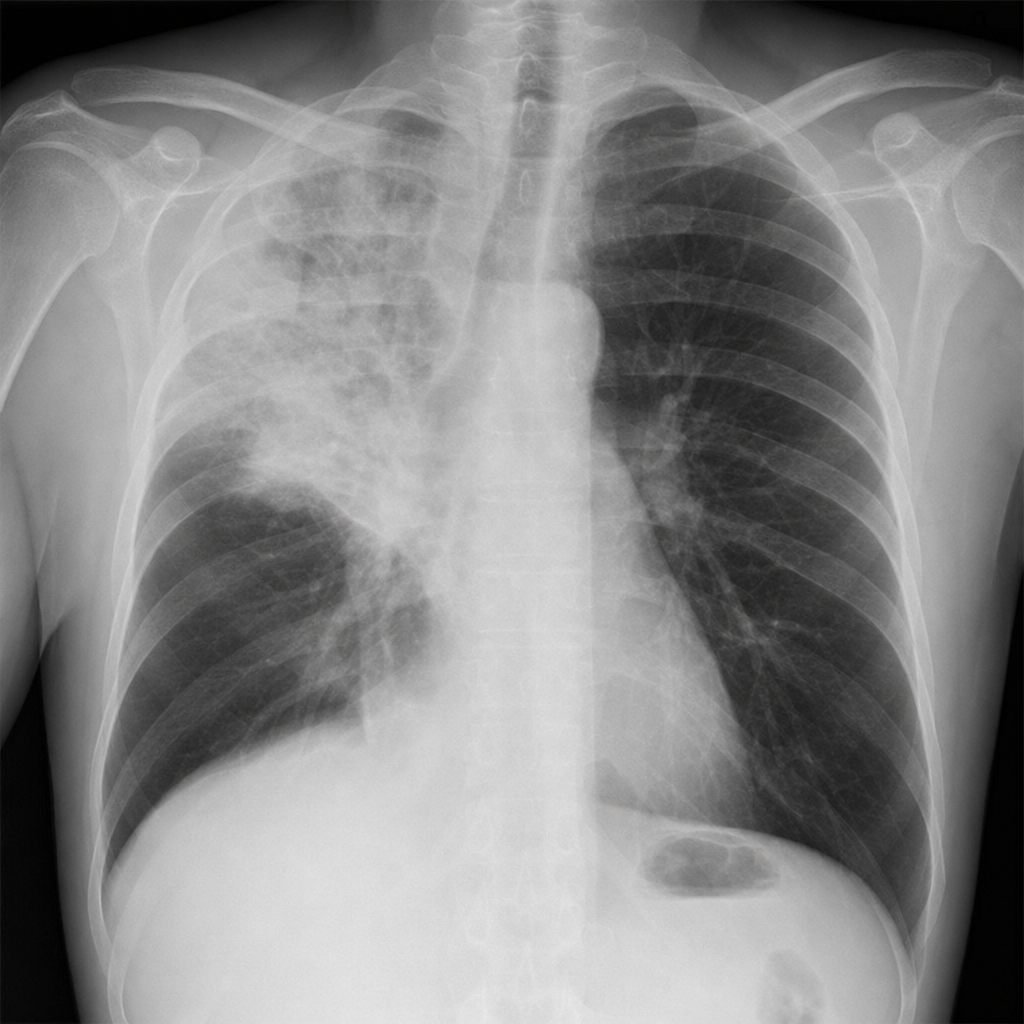
Spontaneous pneumothorax is commonly seen in which group?
All are seen in Pancoast syndrome except?
Pulmonary edema will be caused by all except:
What is the most common symptom of Pulmonary embolism?
What is the earliest evidence of clubbing?
A 36-year-old woman with a history of obstructive sleep apnea is admitted with acute shortness of breath, cough with greenish sputum, and fever. On physical examination, she is febrile and has decreased breath sounds generally and diffuse bilateral rhonchi. ABGs: pH 7.32; PCO2 47 mm Hg; PO2 65 mm Hg with O2 saturation 87%. The patient improves initially but has a respiratory arrest as she is being moved to the ICU, requiring emergency endotracheal intubation. While a CXR is ordered, it is noted that she has absent breath sounds on the left side. What is the most likely diagnosis based on the clinical presentation and the finding of absent breath sounds on the left side prior to CXR results?
A 45-year-old male presents with 2 days of haemoptysis, coughing up 1-3 tablespoons of blood daily. He also reports mild chest pain, low-grade fevers, and weight loss. For the past year, he has experienced severe upper respiratory symptoms, including frequent epistaxis and purulent discharge, treated with multiple antibiotic courses. His medications include daily aspirin and lovastatin. On examination, vital signs are normal. The upper airway shows a saddle nose deformity, and lung auscultation is clear. A CT scan of the chest reveals multiple cavitating nodules, and urinalysis shows RBCs. Which of the following tests offers the highest diagnostic yield to make the appropriate diagnosis?
Which is a biomarker for ventilator-associated pneumonia?
A 65-year-old man presents with intermittent hemoptysis for the past 1 week. He denies chest pain, fever, cough, or chronic sputum production. He has a 35-pack-year smoking history. Physical examination reveals normal vital signs, a JVP of 2 cm, normal heart sounds, and clear lungs on auscultation. There are no palpable lymph nodes. Sputum cytology is positive for malignant cells, but chest X-ray and CT chest are normal. What is the next best step in management?
Miliary mottling in a chest x-ray is seen in all of the following conditions except:
Explanation: **Explanation:** **Primary Spontaneous Pneumothorax (PSP)** occurs without a preceding traumatic event or underlying clinical lung disease [1]. The correct answer is **Smokers** because cigarette smoking is the most significant risk factor for the development of PSP [1]. 1. **Why Smokers?** Smoking increases the risk of pneumothorax by approximately **20-fold in men** and **9-fold in women** in a dose-dependent manner. Smoking leads to the inflammation of small airways and the formation of subpleural blebs or bullae (usually at the lung apices) [1]. The rupture of these blebs allows air to enter the pleural space, causing lung collapse [1]. 2. **Why the other options are incorrect:** * **Young females:** PSP is significantly more common in **males** (M:F ratio approx. 3:1 to 6:1). * **Elderly individuals:** While Secondary Spontaneous Pneumothorax (SSP) occurs in older patients with COPD, PSP characteristically affects young adults (20s–30s). * **Short-statured men:** The classic phenotype for PSP is actually **tall, thin (ectomorphic) young men** [1]. The increased vertical height of the lung leads to higher negative intrapleural pressure at the apex, predisposing them to bleb formation. **High-Yield Clinical Pearls for NEET-PG:** * **Most common cause of PSP:** Rupture of subpleural apical blebs [1]. * **Most common cause of SSP:** COPD/Emphysema. * **Diagnosis:** Erect Inspiratory Chest X-ray (shows a visceral pleural line with absence of distal lung markings) [1]. * **Management:** Small (<2cm) asymptomatic PSP can be managed with observation/oxygen; large or symptomatic cases require needle aspiration or intercostal chest tube drainage (ICD) [1]. * **Recurrence:** Smoking cessation is the most effective way to reduce the risk of recurrence [1].
Explanation: **Explanation:** **Pancoast syndrome** (Superior Sulcus Tumor) refers to a malignancy (usually squamous cell or adenocarcinoma) located at the apical pleuropulmonary groove. The syndrome is defined by a constellation of symptoms resulting from the local invasion of adjacent structures at the thoracic inlet. **Why Myasthenia Gravis is the Correct Answer:** Myasthenia gravis is a paraneoplastic manifestation typically associated with **Thymoma**, not Pancoast tumors. While Pancoast tumors can cause muscle weakness in the hand due to nerve root involvement [4], they do not cause the neuromuscular junction dysfunction seen in Myasthenia. **Analysis of Incorrect Options:** * **Brachial Plexus Involvement:** This is a hallmark of the syndrome. The tumor typically invades the lower roots of the brachial plexus (**C8, T1, and T2**) [4], leading to pain in the shoulder and radiating down the ulnar distribution of the arm, along with wasting of the small muscles of the hand [4]. * **Dyspnoea:** While not the presenting symptom (due to the peripheral location of the tumor), dyspnoea can occur if the tumor involves the phrenic nerve (causing diaphragmatic palsy) [2] or as the underlying lung cancer progresses [3]. * **Clubbing:** Digital clubbing and Hypertrophic Osteoarthropathy (HOA) are well-recognized paraneoplastic features of non-small cell lung cancer, including Pancoast tumors [1]. **NEET-PG High-Yield Pearls:** 1. **Horner’s Syndrome:** Often co-exists with Pancoast syndrome due to involvement of the **paravertebral sympathetic chain** and stellate ganglion (Ptosis, Miosis, Anhidrosis). 2. **Most Common Histology:** Adenocarcinoma (previously Squamous cell carcinoma). 3. **Rib Destruction:** The tumor frequently causes destruction of the first and second ribs. 4. **Initial Investigation:** Chest X-ray (shows apical cap/mass); **Best Investigation:** MRI (to assess brachial plexus and vertebral invasion).
Explanation: Explanation: Pulmonary edema is the accumulation of fluid in the alveolar spaces and interstitium, typically categorized into Cardiogenic (increased hydrostatic pressure) and Non-cardiogenic (increased capillary permeability). Why COPD is the correct answer: COPD (Chronic Obstructive Pulmonary Disease) is characterized by airflow obstruction and destruction of lung parenchyma (emphysema). While it can lead to Cor Pulmonale (right-sided heart failure), this results in systemic venous congestion (peripheral edema, JVP elevation, hepatomegaly) rather than pulmonary edema. In fact, the pulmonary vascular bed in COPD is often "pruned" or destroyed, and the pathology is primarily obstructive, not exudative or congestive in the alveoli. Analysis of Incorrect Options: * Mitral Stenosis: A classic cause of Cardiogenic Pulmonary Edema. Narrowing of the mitral valve increases left atrial pressure, which is transmitted backwards into the pulmonary veins and capillaries, forcing fluid into the alveoli. * Pneumonia: A cause of Non-cardiogenic Pulmonary Edema. The inflammatory response to infection increases capillary permeability (exudate), leading to localized or diffuse alveolar filling. * Pulmonary Embolism: While primarily a vascular obstruction, massive PE can cause pulmonary edema through several mechanisms, including surfactant dysfunction, inflammatory mediator release, and "overperfusion" of the non-obstructed lung segments. NEET-PG High-Yield Pearls: * Starling’s Law: Governs fluid movement; edema occurs when hydrostatic pressure exceeds oncotic pressure or capillary permeability increases. * Kerley B Lines: Horizontal lines at the lung bases on CXR, pathognomonic for interstitial pulmonary edema. * PCWP (Pulmonary Capillary Wedge Pressure): In cardiogenic edema, PCWP is >18 mmHg; in non-cardiogenic edema (like ARDS), PCWP is typically <18 mmHg.
Explanation: The diagnosis of Pulmonary Embolism (PE) relies heavily on clinical suspicion as its presentation is often non-specific. **1. Why Dyspnea is the correct answer:** According to the **PIOPED study**, **Dyspnea (shortness of breath)** is the most common symptom of pulmonary embolism, occurring in approximately 73–82% of patients [1]. It is typically sudden in onset. The underlying pathophysiology involves a ventilation-perfusion (V/Q) mismatch and increased physiological dead space, leading to acute respiratory distress. **2. Analysis of Incorrect Options:** * **A. Chest pain:** While very common (occurring in about 66% of cases), it is the second most frequent symptom [1]. It is usually pleuritic in nature due to pleural inflammation if the embolus causes pulmonary infarction. * **C. Palpitations:** These occur due to sinus tachycardia (the most common ECG finding), but they are a secondary clinical sign rather than the primary presenting symptom [1]. * **D. Calf pain:** This suggests Deep Vein Thrombosis (DVT), which is the most common *source* of PE, but it is not a symptom of the pulmonary embolic event itself. **3. High-Yield Clinical Pearls for NEET-PG:** * **Most common Symptom:** Dyspnea. * **Most common Sign:** Tachypnea (Respiratory rate >20/min). * **Most common ECG finding:** Sinus Tachycardia (The classic **S1Q3T3** pattern is specific but seen in <20% of cases) [1]. * **Gold Standard Investigation:** Pulmonary Angiography (rarely used now). * **Investigation of Choice (IOC):** CT Pulmonary Angiography (CTPA). * **Classic Triad (Virchow’s):** Stasis, Hypercoagulability, and Endothelial injury. * **Chest X-ray:** Usually normal, but may show **Hampton’s Hump** (wedge-shaped opacity) or **Westermark sign** (focal oligemia) [1].
Explanation: **Explanation:** The earliest clinical sign of finger clubbing (hypertrophic osteoarthropathy) is the **softening of the nail bed** [1]. This occurs due to the proliferation of soft tissue and increased vascularity at the base of the nail. Clinically, this is demonstrated by the **"Fluctuation Test,"** where palpating the nail bed gives a spongy, floating sensation because the nail plate is no longer firmly attached to the underlying bone [1]. **Analysis of Options:** * **Softening of the nail bed (Correct):** This is the initial pathological change. It precedes any visible structural alterations in the nail's curvature or diameter [1]. * **Shininess of the nail (Incorrect):** While the skin at the base of the nail may become smooth and shiny, this is a secondary change that occurs after the initial softening and loss of the Lovibond angle. * **Increased anteroposterior (AP) diameter (Incorrect):** This is a later feature of clubbing [2]. As the condition progresses, the AP diameter increases, eventually leading to the characteristic "drumstick" appearance. * **Increased transverse diameter (Incorrect):** Similar to the AP diameter, changes in the transverse curvature occur in more advanced stages of clubbing. **High-Yield Clinical Pearls for NEET-PG:** 1. **Lovibond Angle:** The angle between the nail plate and the proximal nail fold. In clubbing, this angle is lost (becomes >180°). 2. **Schamroth’s Sign:** Loss of the diamond-shaped window when the dorsal surfaces of terminal phalanges of corresponding fingers are opposed. 3. **Common Causes:** Lung cancer (especially non-small cell), Bronchiectasis, Lung abscess, Cyanotic congenital heart disease, and Inflammatory Bowel Disease (IBD) [2]. 4. **Note:** Clubbing is **NOT** typically seen in uncomplicated COPD or Asthma; its presence in these patients should prompt a search for underlying malignancy or bronchiectasis.
Explanation: The correct diagnosis is **Atelectasis**, specifically **mucus plugging** leading to obstructive collapse of the left lung. 1. **Why it is correct:** The patient presents with an acute exacerbation of a respiratory infection (greenish sputum, fever, rhonchi) on a background of obstructive sleep apnea (OSA). In patients with thick secretions and respiratory distress, a common complication during or immediately after emergency intubation is the displacement of a large mucus plug into a mainstem bronchus [3]. This causes rapid absorption of air distal to the obstruction, leading to **whole-lung atelectasis**. The sudden absence of breath sounds on one side following a respiratory arrest/intubation in this clinical context is classic for a mucus plug or a right mainstem bronchus intubation (though the latter is a procedural complication, atelectasis from plugging is the pathological process described) [2]. 2. **Why incorrect options are wrong:** * **Left pneumothorax:** While it causes absent breath sounds, it usually presents with hyper-resonance on percussion and sudden pleuritic chest pain. In a post-intubation setting, it is often due to barotrauma, but the presence of greenish sputum and fever strongly points toward an obstructive infectious etiology. * **Pneumomediastinum/Esophageal rupture:** This typically presents with "Hamman’s crunch" (systolic clicking) and severe retrosternal pain, not isolated absent breath sounds on one side. * **Left pleural effusion:** This is a chronic or subacute process [1]. It would not cause a sudden, acute disappearance of breath sounds during a respiratory arrest/transfer. **NEET-PG High-Yield Pearls:** * **Mucus Plugging:** A common cause of sudden lobar or whole-lung collapse in ICU patients with pneumonia or COPD. * **Post-Intubation Rule Out:** Always check for **Right Mainstem Intubation** first if breath sounds are absent on the left after tube placement. * **Management:** Therapeutic bronchoscopy or aggressive chest physiotherapy is often required to clear the plug.
Explanation: The clinical presentation of **saddle nose deformity**, chronic sinusitis (epistaxis/purulent discharge), **cavitating lung nodules**, and hematuria (suggesting glomerulonephritis) is classic for **Granulomatosis with Polyangiitis (GPA)**, formerly known as Wegener’s Granulomatosis [1]. GPA is a small-vessel vasculitis characterized by a triad of upper respiratory tract, lower respiratory tract, and renal involvement. **Why Surgical Lung Biopsy is correct:** While c-ANCA (PR3-ANCA) is a highly specific marker, a tissue diagnosis is often required for confirmation. Among the biopsy sites, **surgical lung biopsy (VATS or open)** provides the **highest diagnostic yield (up to 90%)**. It provides sufficient tissue to demonstrate the characteristic triad: **vasculitis, granulomatous inflammation, and geographic necrosis** [1]. **Analysis of Incorrect Options:** * **Deep skin biopsy:** While easy to perform if lesions are present, it typically shows non-specific leukoclastic vasculitis and lacks the diagnostic granulomas found in the lungs. * **Percutaneous kidney biopsy:** This is often performed to confirm renal involvement; however, it typically shows **pauci-immune necrotizing crescentic glomerulonephritis**. Crucially, granulomas are rarely seen in renal biopsies, making it less specific for GPA than a lung biopsy. * **Pulmonary angiogram:** This is the gold standard for diagnosing Polyarteritis Nodosa (showing microaneurysms) or pulmonary embolism, but it has no role in diagnosing the granulomatous inflammation of GPA [1]. **NEET-PG High-Yield Pearls:** * **Classic Triad:** Upper Respiratory (Sinusitis/Saddle nose) + Lower Respiratory (Cavitary nodules) + Renal (RPGN) [1]. * **Marker:** c-ANCA (anti-proteinase 3) is positive in >90% of active systemic cases. * **Treatment:** Induction with Corticosteroids + Cyclophosphamide (or Rituximab). * **Limited GPA:** Refers to cases without renal involvement.
Explanation: ### Explanation **Correct Option: A. Procalcitonin** Procalcitonin (PCT) is a precursor of calcitonin, normally produced by the C-cells of the thyroid. In healthy individuals, serum levels are negligible. However, in response to **bacterial endotoxins** and inflammatory cytokines (like IL-6 and TNF-α), PCT is rapidly synthesized by extrathyroidal tissues (liver, lungs, kidney). [1] * **Why it is used in VAP:** PCT is highly specific for bacterial infections compared to viral or non-infectious inflammation [1]. In Ventilator-Associated Pneumonia (VAP), PCT levels help clinicians differentiate bacterial colonization from active infection, guide the initiation of antibiotics, and, most importantly, determine the **duration of antibiotic therapy** (de-escalation). **Incorrect Options:** * **B. C-reactive protein (CRP):** While CRP is an acute-phase reactant that rises in VAP, it lacks specificity [1]. It increases in any inflammatory state (trauma, surgery, burns), making it less reliable than PCT for diagnosing bacterial pneumonia in ICU patients. * **C. ESR:** Erythrocyte Sedimentation Rate is a non-specific marker of chronic inflammation. It rises slowly and stays elevated for weeks, making it useless for the acute diagnosis or monitoring of VAP. * **D. CA19-9:** This is a tumor marker primarily used for pancreatic and hepatobiliary malignancies; it has no role in the diagnosis of pneumonia. **High-Yield Clinical Pearls for NEET-PG:** * **Cut-off:** A PCT level **<0.25 ng/mL** strongly suggests that bacterial infection is unlikely, whereas **>0.5 ng/mL** suggests VAP. * **sTREM-1:** Soluble Triggering Receptor Expressed on Myeloid cells-1 is another emerging biomarker found in Bronchoalveolar Lavage (BAL) fluid for VAP diagnosis. * **Gold Standard:** The definitive diagnosis of VAP still relies on clinical criteria (CPIS score) and quantitative cultures of lower respiratory tract secretions (BAL or protected brush specimen). [2] Ventilator-associated pneumonia (VAP) is specifically defined as pneumonia occurring at least 2 days after admission in patients who are mechanically ventilated [2].
Explanation: **Explanation:** This patient presents with **occult lung cancer**—a scenario where sputum cytology confirms malignancy, but imaging (CXR and CT) fails to localize the lesion. Given his significant smoking history and age, the primary suspicion is a central airway lesion (likely Squamous Cell Carcinoma) that is too small or flat to be detected by conventional imaging [2]. **1. Why Bronchoscopy is the Correct Choice:** When cytology is positive but imaging is negative, the next step is to visualize the tracheobronchial tree directly. **Fiberoptic Bronchoscopy (FOB)** allows for the identification of endobronchial lesions, mucosal irregularities, or "carcinoma in situ" [2]. Techniques like **brushings and biopsies** are essential to obtain a histological diagnosis and localize the tumor for future treatment (e.g., surgical resection or photodynamic therapy). **2. Why Other Options are Incorrect:** * **Option A (Annual CXR):** This is inappropriate. A positive cytology indicates an active malignancy; waiting a year allows the cancer to progress from a potentially curable stage to an advanced one. * **Option B (Unilateral Pneumonectomy):** Surgery cannot be performed without localizing the tumor. Performing a "blind" pneumonectomy is contraindicated and carries high morbidity. * **Option C (Blind Percutaneous Needle Biopsies):** Transthoracic needle aspiration (TTNA) is image-guided and used for peripheral nodules [1]. "Blind" biopsies are never indicated in modern pulmonology and would likely miss a central endobronchial lesion [3]. **Clinical Pearls for NEET-PG:** * **Occult Carcinoma:** Defined as Tx N0 M0. * **Squamous Cell Carcinoma:** Most common lung cancer to present with positive sputum cytology and a central location. * **Advanced Imaging:** If standard bronchoscopy is negative, **Fluorescence Bronchoscopy** (using autofluorescence) is the gold standard for detecting subtle areas of carcinoma in situ.
Explanation: The term **"Miliary mottling"** refers to a radiographic pattern characterized by fine, discrete, 1–3 mm nodules distributed uniformly throughout both lung fields, resembling millet seeds. [1] **Why Asbestosis is the correct answer:** Asbestosis is a form of pneumoconiosis that primarily causes **interstitial fibrosis**, which manifests on a chest X-ray as **reticular (net-like) opacities**, "shaggy heart" borders, and pleural plaques. [3] It typically involves the **lower lobes** and does not present with a miliary (nodular) pattern. Therefore, it is the "except" in this list. **Analysis of other options:** * **Tuberculosis (Miliary TB):** The classic cause of miliary mottling, resulting from hematogenous spread of *Mycobacterium tuberculosis*. * **Sarcoidosis:** Stage II sarcoidosis often presents with a micronodular pattern that can mimic miliary TB, though it is usually associated with bilateral hilar lymphadenopathy. [2] * **Silicosis:** Chronic inhalation of silica dust leads to the formation of silicotic nodules. In its acute or accelerated forms, it can present with diffuse miliary-sized nodules (often with a predilection for upper lobes). [1] **NEET-PG High-Yield Pearls:** 1. **Mnemonic for Miliary Mottling:** "S-T-E-P-S" (Silicosis, Tuberculosis, Endogenous/Exogenous lipoid pneumonia, Pneumoconiosis/Psittacosis, Sarcoidosis/Staphylococcal pneumonia). 2. **Asbestosis vs. Silicosis:** Asbestosis affects the **lower lobes** (like most interstitial lung diseases), whereas Silicosis and Coal Worker's Pneumoconiosis typically affect the **upper lobes**. [1] 3. **Eggshell Calcification:** Highly characteristic of Silicosis (hilar lymph nodes). 4. **Pleural Plaques:** The most common radiographic sign of asbestos exposure.
Obstructive Airway Diseases (Asthma, COPD)
Practice Questions
Interstitial Lung Diseases
Practice Questions
Pulmonary Infections
Practice Questions
Pulmonary Vascular Diseases
Practice Questions
Pleural Diseases
Practice Questions
Sleep-Disordered Breathing
Practice Questions
Respiratory Failure
Practice Questions
Mediastinal Disorders
Practice Questions
Occupational Lung Diseases
Practice Questions
Pulmonary Function Testing
Practice Questions
Bronchiectasis and Cystic Fibrosis
Practice Questions
Lung Cancer Approach
Practice Questions
Get full access to all questions, explanations, and performance tracking.
Start For Free