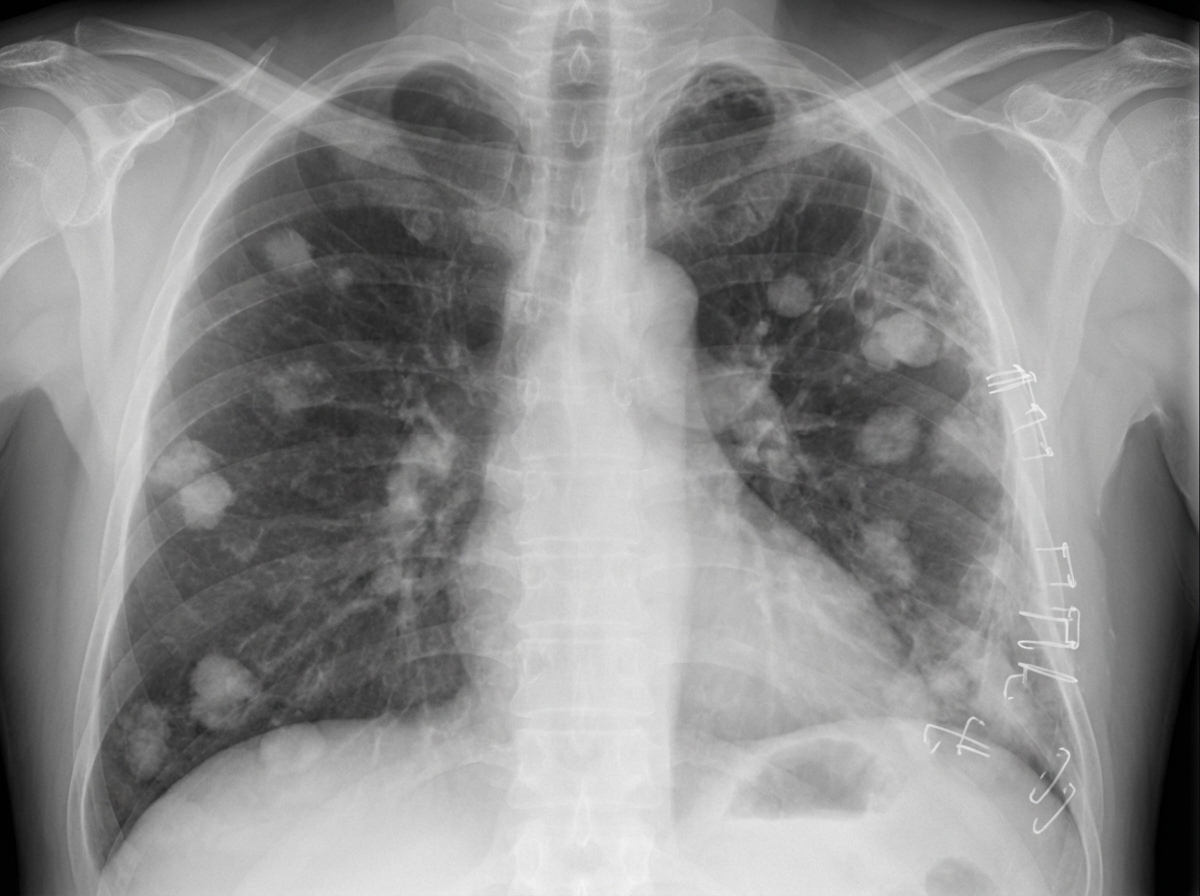
Proximal bronchiectasis and segmental collapse in a patient with chronic persistent asthma should raise suspicion for which of the following conditions?
Which of the following is the investigation of choice for interstitial lung disease?
All are seen in asthma except?
Which of the following is NOT associated with interstitial pulmonary fibrosis?
All are features of allergic bronchopulmonary aspergillosis except?
In a patient with pulmonary embolism, right ventricle hypokinesia, and decreased output, which drug therapy is most helpful?
Lung abscess is common following which type of pneumonia?
Which of the following is NOT a cavitating lesion in the lung?
A 23-year-old man is experiencing a flare of his asthma. He is using his salbutamol inhaler more frequently than usual and despite increasing his inhaled steroids, he is still short of breath. Previously, his asthma was considered mild with no severe exacerbations requiring oral steroids or hospitalization. With his flare, he has recurrent episodes of bronchial obstruction, fever, malaise, and expectoration of brownish mucous plugs. On examination, there is bilateral wheezing. The heart, abdomen, neurologic, and skin exams are normal. CXR reveals upper lobe pulmonary infiltrates; the eosinophil count is 3000/mL, and serum precipitating antibodies to Aspergillus are positive. Which of the following is the most likely diagnosis?
All of the following are components of Light's criteria for pleural effusion except?
Explanation: The clinical presentation of **Allergic Bronchopulmonary Aspergillosis (ABPA)** is a classic high-yield topic for NEET-PG. ABPA is a hypersensitivity reaction to *Aspergillus fumigatus* colonization in the airways, typically occurring in patients with pre-existing **asthma** [1] or cystic fibrosis. **Why Option D is Correct:** The hallmark of ABPA is the formation of **mucus plugs** containing fungal hyphae. These plugs lead to two characteristic findings mentioned in the question: 1. **Segmental/Lobar Collapse:** Caused by the physical obstruction of airways by thick, "tenacious" mucus [1]. 2. **Proximal (Central) Bronchiectasis:** Repeated inflammation and plugging cause permanent dilation of the large, central bronchi (unlike most other causes of bronchiectasis which are peripheral). **Why Other Options are Incorrect:** * **A & B (Atypical Mycobacteria/Mycoplasma):** These typically present with constitutional symptoms (fever, weight loss) and patchy infiltrates or interstitial patterns. They do not specifically target asthmatics to cause proximal bronchiectasis. * **C (Lymphangitis Carcinomatosis):** This represents the spread of a tumor through the pulmonary lymphatics. It presents with progressive dyspnea and a reticulonodular pattern on X-ray, not localized segmental collapse or bronchiectasis. **High-Yield Clinical Pearls for ABPA:** * **Diagnostic Criteria (Rosenberg-Patterson):** Look for asthma [2], peripheral **eosinophilia**, elevated **total IgE** (>1000 IU/mL), and positive skin test for *Aspergillus* [2]. * **Radiology:** "Finger-in-glove" appearance (mucus-filled bronchi) and "Tram-line" shadows. * **Treatment:** The mainstay is **Oral Corticosteroids** (to reduce inflammation) and **Itraconazole** (to reduce fungal burden).
Explanation: **Explanation:** **High-Resolution Computed Tomography (HRCT)** is the investigation of choice (gold standard imaging) for Interstitial Lung Disease (ILD) [1]. Unlike a standard CT, HRCT uses thin slices (1–2 mm) and high-spatial-frequency reconstruction algorithms, allowing for the visualization of the secondary pulmonary lobule—the fundamental anatomic unit of the lung. It is highly sensitive for detecting early parenchymal changes, such as ground-glass opacities, honeycombing, and reticular patterns, which are essential for diagnosing specific ILD subtypes like Idiopathic Pulmonary Fibrosis (IPF) [1]. **Why other options are incorrect:** * **Bronchoscopy:** While Bronchoalveolar Lavage (BAL) or transbronchial biopsy can help rule out infections or sarcoidosis, they lack the sensitivity and specificity of HRCT for primary diagnosis. * **MRI:** MRI has limited utility in the lungs due to low proton density and artifacts caused by respiratory motion and air-tissue interfaces. * **Spirometry:** This is used to assess the *functional* severity (showing a restrictive pattern with decreased TLC and FVC) [1]. While it monitors progression, it cannot provide a definitive structural diagnosis. **High-Yield Clinical Pearls for NEET-PG:** * **Classic HRCT Pattern:** "Honeycombing" and subpleural basal predominance are hallmarks of **UIP (Usual Interstitial Pneumonia)** [1]. * **Ground-glass opacities:** Suggest active inflammation and potential reversibility (common in NSIP). * **PFT in ILD:** Characterized by a **Restrictive pattern** (Reduced FVC, Reduced TLC, but a Normal or Increased FEV1/FVC ratio) and **Decreased DLCO** [1]. * **Chest X-ray:** Often shows a "reticulonodular pattern" but may be normal in up to 10% of early ILD cases [1].
Explanation: **Explanation:** **Why Clubbing is the correct answer:** Digital clubbing is **not** a feature of uncomplicated bronchial asthma. Clubbing typically signifies chronic intracellular hypoxia or suppurative lung diseases. Since asthma is an episodic, reversible inflammatory airway disease rather than a chronic destructive or cyanotic condition, clubbing does not occur. If clubbing is present in a patient with asthma-like symptoms, clinicians must investigate for alternative diagnoses such as **Bronchiectasis, Cystic Fibrosis, Lung Abscess, or Bronchogenic Carcinoma.** [1] **Analysis of incorrect options:** * **Wheezing:** This is a hallmark of asthma. It is a high-pitched whistling sound produced by turbulent airflow through narrowed, edematous, and mucus-filled intrathoracic airways. [1] * **Dyspnea:** Shortness of breath is a primary symptom of asthma, resulting from increased work of breathing due to airway resistance and hyperinflation. [1] * **Cyanosis:** While not present in mild cases, cyanosis is a sign of **Life-Threatening Asthma** (Status Asthmaticus). It indicates severe V/Q mismatch leading to significant hypoxemia ($SaO_2 < 90\%$). **High-Yield Clinical Pearls for NEET-PG:** * **Differential Diagnosis of Clubbing in Pulmonology:** Remember the mnemonic **"ABCDEF"**: **A**bscess, **B**ronchiectasis, **C**ystic Fibrosis, **D**on't forget Empyema, **E**mpyema, **F**ibrosis (IPF). * **COPD vs. Asthma:** Like asthma, uncomplicated COPD (Emphysema/Bronchitis) also does **not** typically cause clubbing. Its presence in COPD suggests underlying malignancy or bronchiectasis. [1] * **Silent Chest:** The disappearance of wheezing in a severe asthma attack is an ominous sign indicating imminent respiratory failure.
Explanation: **Explanation:** The correct answer is **C. Carcinoid lung**. **Why Carcinoid lung is the correct answer:** Carcinoid tumors are well-differentiated **neuroendocrine tumors** arising from the bronchial epithelium (Kulchitsky cells). They typically present as endobronchial masses causing localized airway obstruction, hemoptysis, or recurrent pneumonia. Unlike the other options, carcinoid tumors are neoplastic processes and do not involve the diffuse alveolar wall thickening or fibroblast proliferation characteristic of **Interstitial Lung Disease (ILD)**. **Analysis of Incorrect Options:** * **Sarcoidosis:** A multisystem granulomatous disease. While it primarily involves hilar lymphadenopathy, Stage III and IV sarcoidosis lead to progressive parenchymal destruction and **upper lobe predominant** pulmonary fibrosis [1]. * **Asbestosis:** A classic form of pneumoconiosis caused by inhaling asbestos fibers. It results in diffuse interstitial fibrosis, typically starting in the **lower lobes**, and is often associated with pleural plaques [1]. * **Radiation exposure:** Radiation-induced lung injury occurs in two phases: acute radiation pneumonitis followed by **chronic radiation fibrosis**, usually localized to the radiation field. **High-Yield Clinical Pearls for NEET-PG:** * **Radiological Pattern:** Most ILDs (Asbestosis, IPF) affect the **lower lobes**, but remember the mnemonic **"SET"** for **Upper Lobe Fibrosis**: **S**arcoidosis, **E**xtrinsic allergic alveolitis (chronic), and **T**uberculosis/Ankylosing spondylitis [1]. * **Carcinoid Syndrome:** Though rare in bronchial carcinoids (due to lack of first-pass metabolism bypass), it presents with flushing, diarrhea, and wheezing. * **Diagnosis:** High-Resolution CT (HRCT) is the gold standard for diagnosing interstitial fibrosis, often showing "honeycombing" and reticular opacities [1].
Explanation: Explanation: Allergic Bronchopulmonary Aspergillosis (ABPA) is a complex hypersensitivity reaction to Aspergillus fumigatus that occurs primarily in patients with asthma or cystic fibrosis. 1. Why IgA is the correct answer (The "Except"): The immunological hallmark of ABPA involves Type I (IgE-mediated) [1] and Type III (Immune complex-mediated) hypersensitivity reactions. While IgG and IgE play central roles in the pathogenesis and diagnosis, IgA is not a diagnostic or characteristic feature of the disease. Elevated serum IgA is not part of the Rosenberg-Patterson criteria used to diagnose ABPA. 2. Analysis of other options: * IgE: Elevated total serum IgE (typically >1000 IU/mL) is a cardinal diagnostic requirement [1]. It reflects the intense Th2-mediated allergic response. * Eosinophil > 10⁹/liter: Peripheral blood eosinophilia is a classic feature of ABPA. A count >1000 cells/µL (10⁹/L) supports the diagnosis, reflecting the systemic eosinophilic inflammation. * Demonstration of hyphae in sputum: The presence of Aspergillus hyphae in sputum or "brownish plugs" is a common clinical finding. While not specific (as it can occur in simple colonization), it is a recognized feature of the disease. Clinical Pearls for NEET-PG: * Diagnostic Gold Standard: Central bronchiectasis (CB) on HRCT with normal tapering of distal airways. * "Finger-in-glove" appearance: Radiographic sign caused by mucoid impaction in dilated bronchi. * Treatment: Oral corticosteroids (to suppress inflammation) and Itraconazole (to reduce fungal burden). * High-Yield Criteria: Look for "High-attenuation mucus" (HAM) on CT, which is highly specific for ABPA.
Explanation: The clinical presentation described—Pulmonary Embolism (PE) associated with **right ventricular (RV) hypokinesia** and **decreased output** (hypotension/shock)—defines **Massive (High-risk) Pulmonary Embolism** [2]. **1. Why Thrombolytic therapy is correct:** In massive PE, the primary goal is to rapidly dissolve the obstructing clot to decrease pulmonary artery pressure and relieve RV strain. Thrombolytics (e.g., Alteplase, Streptokinase) are the treatment of choice because they actively lyse the thrombus, unlike anticoagulants which only prevent further clot formation [2]. Restoring RV function and systemic hemodynamics is critical to preventing imminent cardiovascular collapse. **2. Why the other options are incorrect:** * **Low Molecular Weight Heparin (LMWH) & Unfractionated Heparin (UFH):** These are the mainstays for *Stable (Low-risk)* or *Sub-massive (Intermediate-risk)* PE. While they prevent clot propagation, they do not dissolve the existing life-threatening obstruction quickly enough in a hemodynamically unstable patient. * **Warfarin:** This is an oral anticoagulant used for long-term maintenance therapy [2]. It has a slow onset of action (requiring 5–7 days to reach therapeutic levels) and has no role in the acute management of massive PE. **Clinical Pearls for NEET-PG:** * **Hemodynamic Stability** is the key deciding factor: If BP <90 mmHg (systolic) or there is a drop of >40 mmHg for >15 mins, it is Massive PE $\rightarrow$ **Thrombolytics** [2]. * **Gold Standard Diagnosis:** CT Pulmonary Angiography (CTPA) [1]. * **ECG Finding:** Most common is Sinus Tachycardia; most specific is **S1Q3T3** (sign of acute RV strain) [3]. * **Absolute Contraindications to Thrombolysis:** Recent intracranial hemorrhage, active internal bleeding, or recent ischemic stroke (within 3 months). In such cases, **Surgical Embolectomy** is the next step [2].
Explanation: **Explanation:** The correct answer is **Klebsiella pneumoniae**. **Why Klebsiella is correct:** *Klebsiella pneumoniae* is a Gram-negative encapsulated bacillus known for causing severe, necrotizing pneumonia. It produces significant tissue destruction and alveolar wall necrosis, leading to the formation of multiple small cavities that coalesce into a **lung abscess**. A classic clinical hallmark is the production of **"Currant-jelly sputum"** (a mixture of blood and mucus). It is particularly common in patients with underlying debilitation, such as chronic alcoholics, diabetics, and those with COPD [1]. **Analysis of Incorrect Options:** * **Streptococcal (Option A):** *Streptococcus pneumoniae* is the most common cause of community-acquired pneumonia (CAP) [1]. It typically causes lobar consolidation but is **non-necrotizing**, meaning it rarely leads to cavitation or abscess formation [2]. * **Staphylococcal (Option B):** While *Staphylococcus aureus* can cause necrotizing pneumonia and abscesses (especially post-influenza) [1], it is more frequently associated with **pneumatoceles** (thin-walled air cysts), particularly in children. In the context of standard NEET-PG questions, Klebsiella remains the classic association for abscesses in the elderly/alcoholic demographic. * **Viral (Option C):** Viral pneumonias (e.g., Influenza, RSV) typically cause interstitial inflammation rather than parenchymal necrosis. While they may predispose a patient to secondary bacterial infections, they do not directly cause lung abscesses. **High-Yield Clinical Pearls for NEET-PG:** * **Most common cause of lung abscess overall:** Aspiration of anaerobic bacteria (e.g., *Peptostreptococcus*, *Bacteroides*). * **Most common site for aspiration lung abscess:** Posterior segment of the right upper lobe or superior segment of the right lower lobe (due to the vertical nature of the right main bronchus). * **Radiological sign of Klebsiella:** **Bulging Fissure Sign**, caused by heavy inflammatory exudate displacing the interlobar fissure.
Explanation: **Explanation:** The correct answer is **Hamartoma**. In pulmonary imaging, a cavity is defined as a gas-filled space within a pulmonary consolidation, mass, or nodule. [1] **1. Why Hamartoma is the correct answer:** A pulmonary hamartoma is the most common **benign** lung tumor. It typically presents as a well-defined, solid peripheral nodule. [1] Its hallmark radiological feature is **"popcorn calcification"** (seen in about 10-30% of cases) and the presence of fat densities on CT scan. It is a solid lesion and does **not** undergo central necrosis or cavitation. **2. Analysis of incorrect options:** * **Caplan’s Syndrome:** This is the combination of Rheumatoid Arthritis and Coal Worker’s Pneumoconiosis. It presents with multiple necrobiotic nodules (0.5–5 cm) in the periphery of the lung which **frequently cavitate**. [2] * **Wegener’s Granulomatosis (GPA):** This small-vessel vasculitis commonly presents with multiple bilateral pulmonary nodules. Approximately **50% of these nodules cavitate**, often with thick, irregular walls. * **Squamous Cell Carcinoma (SCC):** Among bronchogenic carcinomas, SCC is the **most common to cavitate** (occurring in ~10-15% of cases) due to rapid growth leading to central ischemic necrosis. [3] **High-Yield Clinical Pearls for NEET-PG:** * **Mnemonic for Cavitating Lung Lesions (CAVITY):** **C**ancer (Squamous cell), **A**utoimmune (Wegener’s, RA/Caplan’s), **V**ascular (Septic emboli), **I**nfection (TB, Abscess, Fungal/Aspergilloma), **T**rauma, **Y**outh (CPAM/Sequestration). [3] * **Thin-walled cavities** are often seen in Coccidioidomycosis or PJP (pneumatoceles). * **Thick-walled, irregular cavities** are highly suggestive of malignancy (SCC).
Explanation: ### **Explanation** The clinical presentation is classic for **Allergic Bronchopulmonary Aspergillosis (ABPA)**, a hypersensitivity reaction to *Aspergillus fumigatus* colonization in the airways, typically seen in patients with asthma or cystic fibrosis [1]. **Why Option B is Correct:** The diagnosis of ABPA is established by a combination of clinical and laboratory findings present in this patient: 1. **Clinical:** Refractory asthma symptoms and expectoration of **brownish mucous plugs** (containing fungal hyphae). 2. **Radiology:** **Upper lobe pulmonary infiltrates** (often transient or "fleeting"). 3. **Laboratory:** Significant peripheral **eosinophilia** (>1000/mL) and positive **serum precipitating antibodies** (IgG) against *Aspergillus* [1]. *Note: Central bronchiectasis is a hallmark radiological sign often seen on HRCT in these patients.* **Why Other Options are Incorrect:** * **A. Ascaris infestation:** While it causes eosinophilia and lung symptoms (Löffler’s), it does not typically present with brownish plugs or specific *Aspergillus* antibodies. * **C. Churg-Strauss (EGPA):** This is a systemic vasculitis. While it involves asthma and eosinophilia, the absence of skin lesions (purpura), neuropathy (mononeuritis multiplex), or cardiac involvement makes it less likely. It is usually associated with p-ANCA. * **D. Loeffler's Syndrome:** This refers to simple pulmonary eosinophilia (often due to parasites). It presents with migratory infiltrates and is usually self-limiting and milder than the destructive airway process seen in ABPA. ### **High-Yield Pearls for NEET-PG** * **Diagnostic Criteria (Rosenberg-Patterson):** Asthma, immediate skin reactivity to *Aspergillus* antigen, elevated total IgE (>1000 IU/mL), and central bronchiectasis. * **Radiological Signs:** "Finger-in-glove" appearance (mucoid impaction) and "Tram-line" shadows. * **Treatment of Choice:** Oral **Corticosteroids** (to reduce inflammation) + **Itraconazole** (to reduce fungal burden). * **Key differentiator:** ABPA is a Type I (IgE) and Type III (IgG) hypersensitivity reaction, unlike invasive aspergillosis which occurs in immunocompromised hosts [1].
Explanation: Light’s criteria are the gold standard for differentiating between **transudative** and **exudative** pleural effusions [1]. An effusion is classified as an **exudate** if it meets at least one of the three criteria. **1. Why Option D is the correct answer (The Exception):** Effusion glucose (sugar) levels are **not** part of Light’s criteria. While a low pleural fluid glucose (<60 mg/dL or a ratio <0.5 compared to serum) is clinically significant and seen in conditions like rheumatoid arthritis, empyema, malignancy, and tuberculosis [1], it is used for narrowing the differential diagnosis of an exudate, not for the initial classification itself. **2. Why the other options are incorrect (The actual criteria):** Options A, B, and C represent the three formal components of Light’s criteria. If any of these are present, the fluid is an exudate: * **Option A:** Pleural fluid protein / Serum protein ratio **> 0.5**. * **Option B:** Pleural fluid LDH / Serum LDH ratio **> 0.6**. * **Option C:** Pleural fluid LDH **> 2/3rd the upper limit of normal (ULN)** for serum LDH. **Clinical Pearls for NEET-PG:** * **Sensitivity:** Light’s criteria are highly sensitive (98%) for identifying exudates but can sometimes misidentify transudates (especially in patients on diuretics for CHF) as exudates. * **The "Serum-Effusion Albumin Gradient":** If a patient with CHF meets Light’s criteria for an exudate (false positive), calculate the albumin gradient (Serum albumin minus Pleural fluid albumin). If the gradient is **> 1.2 g/dL**, the effusion is likely transudative. * **High-Yield Tip:** Remember that LDH is a marker of inflammation/cell turnover; hence, its elevation is characteristic of exudative processes.
Obstructive Airway Diseases (Asthma, COPD)
Practice Questions
Interstitial Lung Diseases
Practice Questions
Pulmonary Infections
Practice Questions
Pulmonary Vascular Diseases
Practice Questions
Pleural Diseases
Practice Questions
Sleep-Disordered Breathing
Practice Questions
Respiratory Failure
Practice Questions
Mediastinal Disorders
Practice Questions
Occupational Lung Diseases
Practice Questions
Pulmonary Function Testing
Practice Questions
Bronchiectasis and Cystic Fibrosis
Practice Questions
Lung Cancer Approach
Practice Questions
Get full access to all questions, explanations, and performance tracking.
Start For Free