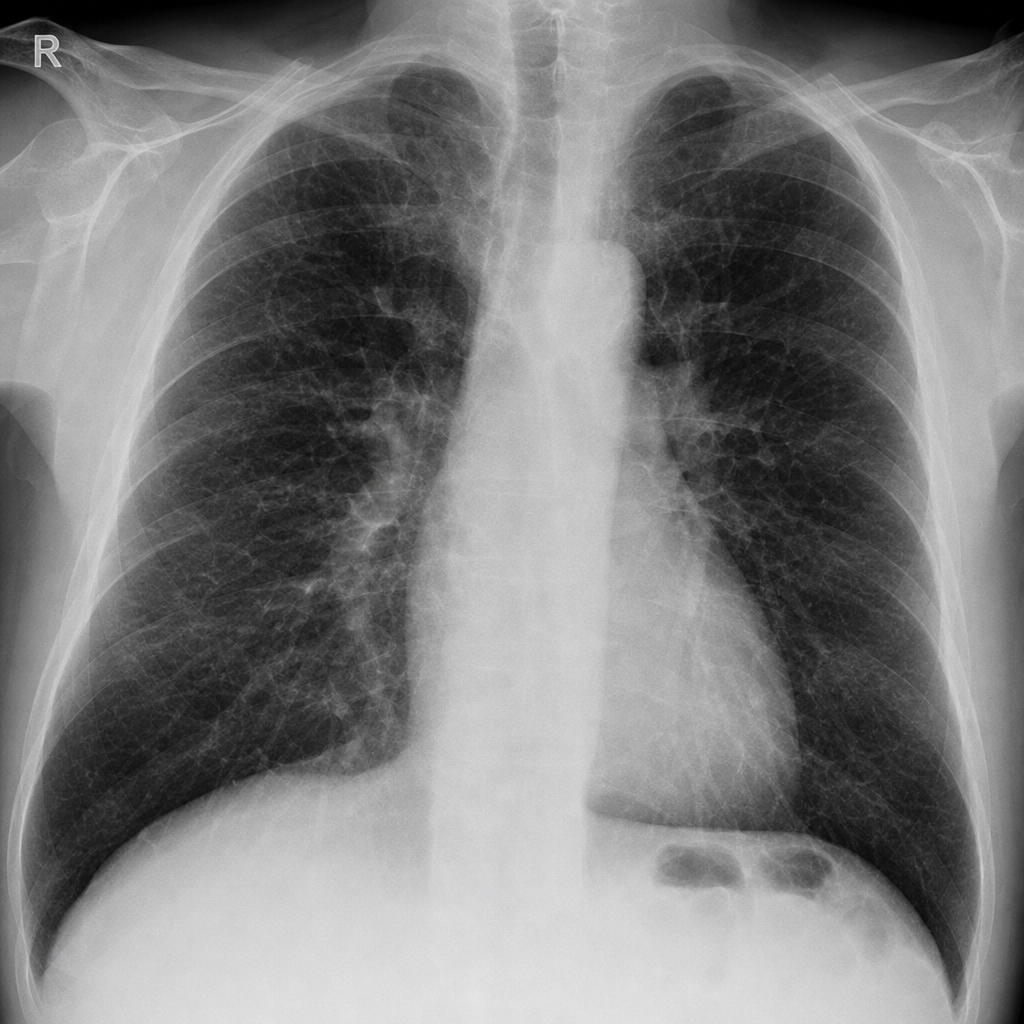
All of the following statements are TRUE about Pulmonary Embolism (PE) EXCEPT?
Pleural effusion without evident lung infiltration is most often due to which of the following conditions?
Which of the following is NOT seen in precapillary pulmonary hypertension?
Which of the following is NOT a cause of community-acquired pneumonia?
A female patient presents with bilateral hilar lymphadenopathy and joint pain. Her angiotensin-converting enzyme (ACE) levels are elevated. What is the most likely diagnosis?
Which of the following conditions commonly presents with pulmonary crackles?
Which of the following statements about hemoptysis is false?
Kagener syndrome includes all of the following except?
A patient presents with massive thromboembolism and hypotension (88/50 mmHg) despite receiving a 1 L fluid bolus. Echocardiogram shows right ventricular hypokinesis. What is the next best step in management?
Which needle is used for pleural biopsy?
Explanation: ### Explanation **Correct Answer: D. Syncope is the presenting complaint in up to 5 percent of cases.** **Why Option D is the correct (False) statement:** In Pulmonary Embolism (PE), syncope is a significant clinical sign often indicating a massive or sub-massive embolism with hemodynamic instability [1]. While it was traditionally thought to be rare, current literature (including the **PESIT study**) and standard textbooks like **Harrison’s Principles of Internal Medicine** indicate that syncope is the presenting complaint in approximately **10% to 17%** of patients, not 5%. Therefore, the statement "up to 5 percent" underestimates its clinical prevalence. **Analysis of Other Options:** * **Option A:** This is **True**. The risk of embolization from a proximal DVT (popliteal, femoral, or iliac veins) is highest within the first 7 days of the thrombus formation before it becomes more adherent to the vessel wall. * **Option B:** This is **True**. Over 80–90% of patients with PE have at least one identifiable risk factor (Virchow’s Triad: stasis, endothelial injury, hypercoagulability), such as recent surgery, malignancy, or immobilization. * **Option C:** This is **True**. In the context of the **Wells’ Criteria** and clinical assessment for PE, tachypnea is strictly defined as a respiratory rate **>16 breaths per minute** (though some sources use >20, 16 is the standard threshold in many validated scoring systems). **High-Yield Clinical Pearls for NEET-PG:** * **Most common symptom:** Dyspnea (at rest or with exertion). * **Most common sign:** Tachypnea. * **Gold Standard Investigation:** CT Pulmonary Angiography (CTPA) [2]. * **ECG Findings:** Most common is **Sinus Tachycardia** [3]; most specific is **S1Q3T3** (indicates right heart strain) [3]. * **Chest X-ray:** Usually normal, but may show **Hampton’s Hump** (wedge-shaped opacity) or **Westermark Sign** (focal oligemia) [3].
Explanation: ### Explanation **Correct Answer: D. Tuberculosis** **Medical Concept:** In the context of a pleural effusion occurring without visible lung parenchymal infiltration (a "clear" lung field on X-ray), **Tuberculous Pleurisy** is the most common cause, especially in endemic regions like India. This typically occurs as a primary manifestation of TB due to the rupture of a subpleural caseous focus into the pleural space [1]. This triggers a **delayed-type hypersensitivity reaction** rather than a widespread pulmonary infection, which explains why the underlying lung often appears normal on imaging. **Analysis of Incorrect Options:** * **A. Viral Pleurisy:** While it can cause pleuritic chest pain and small effusions, it is rarely the "most common" cause of a significant isolated effusion compared to TB in the NEET-PG context. * **B. Lymphoma:** This can cause isolated effusions (often chylous or due to lymphatic obstruction), but it is statistically less common than TB or metastatic carcinoma. * **C. Carcinoma:** While malignancy is a leading cause of exudative effusion, it is frequently associated with a visible primary lung mass, hilar lymphadenopathy, or multiple nodules [1]. TB remains the classic answer for "isolated" effusion in young to middle-aged patients. **High-Yield Clinical Pearls for NEET-PG:** * **Biochemical Profile:** TB effusion is typically an **exudate** with high protein (>3g/dL) and **lymphocytic predominance** [1]. * **ADA Levels:** Adenosine Deaminase (ADA) > 40 U/L is highly suggestive of TB. * **Gold Standard Diagnosis:** Pleural biopsy (showing granulomas) has a higher yield than pleural fluid culture or cytology, as the fluid is often paucibacillary [1]. * **Light’s Criteria:** Always remember these to differentiate exudate from transudate (Fluid/Serum Protein >0.5, Fluid/Serum LDH >0.6) [1].
Explanation: To understand this question, one must distinguish between **Pre-capillary** and **Post-capillary** Pulmonary Hypertension (PH). ### **Why Option D is the Correct Answer** **Pulmonary Capillary Wedge Pressure (PCWP)** is a surrogate marker for left atrial pressure. * In **Pre-capillary PH** (WHO Groups 1, 3, 4, and 5), the pathology lies *before* the pulmonary capillaries or within the pulmonary arteries themselves. Therefore, the left-sided heart pressures remain normal (**PCWP ≤ 15 mmHg**). * In **Post-capillary PH** (WHO Group 2, e.g., Mitral Stenosis or Left Ventricular Failure), the pressure backs up from the left heart into the lungs, leading to an **increased PCWP (> 15 mmHg)**. ### **Analysis of Incorrect Options** * **A. Increased pressure in pulmonary circulation:** By definition, all forms of PH require a Mean Pulmonary Artery Pressure (mPAP) > 20 mmHg. * **B. Increased capillary pressure:** While PCWP is normal, the actual pressure within the arterial side of the capillary bed can be elevated due to high upstream pulmonary arterial resistance. * **C. Right ventricular hypertrophy (RVH):** Chronic high resistance in the pulmonary arteries (pre-capillary) forces the right ventricle to work harder, leading to compensatory RVH and eventually Cor Pulmonale. ### **NEET-PG High-Yield Pearls** 1. **Hemodynamic Definition:** Pre-capillary PH is defined as **mPAP > 20 mmHg** AND **PCWP ≤ 15 mmHg** AND **PVR ≥ 2 Wood Units**. 2. **WHO Group 1 (PAH):** Prototype of pre-capillary PH (e.g., Idiopathic, Scleroderma, BMPR2 mutation). 3. **Gold Standard Investigation:** Right Heart Catheterization (RHC) is required to differentiate pre-capillary from post-capillary PH. 4. **Drug of Choice:** For Vasoreactive PAH, Calcium Channel Blockers; for non-reactive, Phosphodiesterase-5 inhibitors (Sildenafil) or Endothelin receptor antagonists (Bosentan).
Explanation: The distinction between Community-Acquired Pneumonia (CAP) and other pulmonary infections is based on the typical causative pathogens and the clinical setting. CAP is defined as an acute infection of the pulmonary parenchyma in a patient who has acquired the infection in the community (outside of healthcare facilities) [1]. **Why Blastomyces is the correct answer:** *Blastomyces dermatitidis* is a dimorphic fungus that causes **Blastomycosis**, a systemic granulomatous infection. While it is acquired from the environment (soil/decaying wood), it is clinically classified as a **chronic or endemic fungal pneumonia**, rather than "Community-Acquired Pneumonia." CAP typically refers to acute bacterial or viral infections. Blastomycosis often presents with subacute symptoms, skin lesions, and bone involvement, distinguishing it from the acute presentation of CAP. **Analysis of incorrect options:** * **A. Streptococcus pneumoniae:** The most common cause of CAP worldwide ("Typical" pneumonia) [1]. It classically presents with rust-colored sputum and lobar consolidation [2]. * **B. Mycoplasma pneumoniae:** The most common cause of "Atypical" CAP, especially in young adults [1]. It is associated with extrapulmonary features like bullous myringitis and cold agglutinin hemolytic anemia. * **C. Moraxella catarrhalis:** A common bacterial cause of CAP, particularly in patients with underlying chronic obstructive pulmonary disease (COPD) or the elderly [1]. **High-Yield Clinical Pearls for NEET-PG:** * **Most common cause of CAP:** *Streptococcus pneumoniae* [1]. * **CAP in Alcoholics:** *Klebsiella pneumoniae* (Currant jelly sputum) [2]. * **CAP post-Influenza:** *Staphylococcus aureus* (often necrotizing) [1]. * **CURB-65 Score:** Used to decide the site of care (Outpatient vs. Inpatient) for CAP patients [2]. * **Blastomyces Histology:** Characterized by **Broad-Based Budding** yeast.
Explanation: ### Explanation **Correct Answer: C. Sarcoidosis** **Why it is correct:** The clinical triad of **bilateral hilar lymphadenopathy (BHL)**, **joint pain** (often part of Löfgren syndrome), and **elevated serum ACE levels** is classic for Sarcoidosis [1]. Sarcoidosis is a multisystem, idiopathic disease characterized by non-caseating granulomas. The ACE levels are elevated because the epithelioid cells within these granulomas produce the enzyme. While ACE levels lack high specificity, they are a strong diagnostic marker when combined with the characteristic radiological finding of symmetrical BHL. **Why the other options are incorrect:** * **Silicosis:** While it can cause hilar lymphadenopathy, it typically presents with "eggshell calcification" of the nodes and a history of occupational exposure (e.g., mining, sandblasting) [2]. It does not typically elevate ACE levels. * **Hodgkin & Non-Hodgkin Lymphoma:** Lymphoma often presents with **asymmetrical** or unilateral mediastinal lymphadenopathy rather than the symmetrical BHL seen in Sarcoidosis. Patients usually present with "B symptoms" (fever, night sweats, weight loss) and normal ACE levels. **High-Yield Clinical Pearls for NEET-PG:** * **Löfgren Syndrome:** A specific acute presentation of Sarcoidosis consisting of the triad: Erythema nodosum, Bilateral hilar lymphadenopathy, and Polyarthritis/Arthralgia [1]. It carries a favorable prognosis. * **Heerfordt Syndrome (Uveoparotid fever):** Parotid enlargement, Facial nerve palsy, and Anterior uveitis. * **Biopsy Gold Standard:** Transbronchial lung biopsy showing **non-caseating granulomas**. * **Other Lab Findings:** Hypercalcemia and hypercalciuria (due to 1-alpha-hydroxylase activity in macrophages converting Vitamin D to its active form). * **Kveim-Siltzbach Test:** Historically used but now largely replaced by modern imaging and biopsy.
Explanation: **Explanation:** **Pulmonary fibrosis** is the correct answer because it is a classic cause of **fine, end-expiratory "Velcro" crackles**. These crackles are generated by the sudden opening of small airways and alveoli that have been compressed by the surrounding stiff, fibrotic interstitial tissue [1]. Unlike crackles in pneumonia or heart failure, those in fibrosis are typically "dry" and consistent across breaths. **Analysis of Incorrect Options:** * **Pneumothorax (A):** Characterized by a sudden onset of pleuritic chest pain and dyspnea. Physical findings include **absent or diminished breath sounds** and hyper-resonance on percussion due to air in the pleural space. * **Pleural Effusion (C):** Presents with **stony dullness** on percussion and **absent breath sounds** over the fluid collection. Crackles are not a feature of effusion itself, though they may be heard just above the fluid level due to compressive atelectasis. * **Lung Cancer (D):** Secondary lung cancer (metastasis) typically presents with symptoms like cough, hemoptysis, or weight loss. While it can cause localized wheeze (if obstructing a bronchus) or diminished sounds (if causing collapse), crackles are not a primary or common diagnostic sign. **NEET-PG High-Yield Pearls:** * **Velcro Crackles:** Pathognomonic for Interstitial Lung Disease (ILD)/Idiopathic Pulmonary Fibrosis (IPF) [1]. * **Early vs. Late Crackles:** Early inspiratory crackles are common in obstructive diseases (COPD), while **late inspiratory crackles** are characteristic of restrictive diseases (Fibrosis, Pulmonary Edema). * **Clubbing + Crackles:** When seen together, think of IPF, Bronchiectasis, or Cystic Fibrosis [1]. * **Auscultation Tip:** Crackles in IPF are usually heard best at the **lung bases** posteriorly.
Explanation: ### Explanation **1. Why Option C is the correct (False) statement:** The initial investigation for any patient presenting with hemoptysis is a **Chest X-ray (CXR)**, not a CT scan. While MDCT (Multidetector CT) is highly sensitive for identifying the site and cause of bleeding, the CXR is the rapid, cost-effective first-line tool used to screen for obvious pathologies like pneumonia, masses, or cavitation [1]. In cases of massive hemoptysis, the immediate priority is stabilization (Airway, Breathing, Circulation) before moving to advanced imaging [3]. **2. Analysis of other options:** * **Option A (True):** Massive hemoptysis is defined by volume, typically **>200 to 600 mL within 24 hours**. The clinical significance lies in the risk of asphyxiation rather than exsanguination, as the anatomical dead space of the major airways is only about 150 mL. * **Option B (True):** In approximately **90% of cases**, the source of bleeding is the **bronchial arteries** (high-pressure systemic circulation). Only 5-10% originates from the pulmonary arterial system (low-pressure system). * **Option D (True):** In an unstable patient with massive hemoptysis, **Rigid Bronchoscopy** is the procedure of choice. It allows for better airway control, superior suctioning of large clots, and the ability to perform therapeutic interventions (e.g., balloon tamponade). **Clinical Pearls for NEET-PG:** * **Most common cause of hemoptysis (Worldwide):** Tuberculosis [1]. * **Most common cause (Developed countries):** Bronchitis or Bronchogenic carcinoma [1]. * **Management Priority:** Always place the patient in the **lateral decubitus position with the bleeding lung down** to prevent aspiration into the healthy lung. * **Gold Standard for identifying the bleeding vessel:** Bronchial Artery Angiography (often followed by embolization) [2].
Explanation: ### Explanation **Kartagener Syndrome** is a subset of **Primary Ciliary Dyskinesia (PCD)**, an autosomal recessive genetic disorder characterized by a defect in the structure or function of the cilia (most commonly a deficiency in the **outer dynein arms**). [2] #### Why Dysphagia is the Correct Answer: **Dysphagia** (difficulty swallowing) is not a component of Kartagener syndrome. Dysphagia is typically associated with esophageal motility disorders, neurological conditions, or structural obstructions, none of which are primary features of ciliary dysfunction. #### Analysis of Other Options (The Classic Triad): Kartagener syndrome is defined by a classic clinical triad: 1. **Bronchiectasis (Option B):** Impaired ciliary clearance leads to chronic mucus stasis and recurrent endobronchial infections, eventually causing permanent dilation of the bronchi. [1], [2] 2. **Sinusitis (Option C):** Defective cilia in the paranasal sinuses prevent the drainage of mucus, leading to chronic rhinosinusitis and nasal polyposis. [2] 3. **Dextrocardia/Situs Inversus (Option D):** During embryogenesis, normal ciliary beating is required for the left-right asymmetry of internal organs. In PCD, the lack of coordinated ciliary movement leads to a 50% chance of **Situs Inversus Totalis** (where the heart is on the right side—dextrocardia—and abdominal viscera are transposed). --- ### High-Yield Clinical Pearls for NEET-PG: * **Genetics:** Autosomal Recessive; most common defect is in the **DNAH5** and **DNAI1** genes. * **Infertility:** A key association. Males are infertile due to **immotile spermatozoa** (flagella share the same structural microtubule defect as cilia). Females may have reduced fertility due to impaired ciliary action in the fallopian tubes. * **Screening Test:** Low levels of **Nasal Nitric Oxide (nNO)** is a highly sensitive screening tool. * **Gold Standard Diagnosis:** Electron microscopy showing structural microtubule defects (e.g., absence of dynein arms). * **Radiology:** Chest X-ray will show dextrocardia and "tram-track" appearances or "ring shadows" indicative of bronchiectasis. [1]
Explanation: ### Explanation **1. Why Option A is Correct:** The patient is presenting with **Massive Pulmonary Embolism (PE)**, defined by the presence of sustained hypotension (systolic BP < 90 mmHg) or obstructive shock. The echocardiographic finding of RV hypokinesis further confirms hemodynamic instability. In massive PE, the primary goal is rapid restoration of pulmonary perfusion to relieve RV strain [2]. **Systemic Thrombolysis** (e.g., 100 mg of IV rtPA) is the treatment of choice, as it is indicated in any patient presenting with acute massive PE accompanied by cardiogenic shock [2]. Simultaneously, vasopressors like **Dopamine** or Norepinephrine are indicated to maintain systemic blood pressure and coronary perfusion to the failing right ventricle. **2. Why Other Options are Incorrect:** * **Option B:** While initial fluid resuscitation (up to 500-1000 mL) is appropriate, aggressive fluid loading (>1 L) in massive PE can be harmful. Excessive fluids cause RV overdistension, shifting the interventricular septum to the left, which further reduces left ventricular filling and cardiac output. * **Option C:** IVC filters are indicated only when there is a strict contraindication to anticoagulation or recurrent PE despite adequate anticoagulation. They do not treat the acute hemodynamic collapse. * **Option D:** Surgical embolectomy is a second-line intervention reserved for patients where thrombolysis is contraindicated or has failed [2]. **3. NEET-PG Clinical Pearls:** * **Definition of Massive PE:** Hypotension (SBP <90 mmHg) or a drop in SBP by ≥40 mmHg for >15 mins. * **Submassive PE:** Hemodynamically stable but shows evidence of RV dysfunction (Echo/CT) or elevated cardiac biomarkers (Troponin/BNP) [2]. * **Gold Standard Diagnosis:** CT Pulmonary Angiography (CTPA) [1]. However, in unstable patients, a bedside Echo showing RV strain is sufficient to initiate thrombolysis. * **McConnell’s Sign:** A specific Echo finding in PE—akinesia of the RV free wall with sparing of the apex.
Explanation: **Explanation:** The correct answer is **Abram’s needle**. Pleural biopsy is a bedside procedure performed to obtain a tissue sample of the parietal pleura, most commonly indicated for diagnosing exudative pleural effusions such as tuberculous pleurisy or malignancy [1]. **Why Abram’s Needle is Correct:** The **Abram’s needle** is the gold standard for "blind" or closed-needle pleural biopsy. It features a unique three-part design: an outer trocar, an inner cutting cannula, and a stylet. The key mechanism is a **notched side-opening** that allows the parietal pleura to be hooked and "punched out" as the inner cannula is rotated or withdrawn. This design minimizes the risk of air entry (pneumothorax) while ensuring a tissue sample is captured. **Analysis of Incorrect Options:** * **Vin Silverman’s Needle:** Historically used for liver and kidney biopsies; it uses a split-fork mechanism to capture tissue but is not designed for the pleural space. * **Abraham’s Needle:** This is a common distractor in exams. It is a misspelling of "Abram’s." * **Osgood’s Needle:** This is used for **bone marrow aspiration**, not for pleural procedures. **Clinical Pearls for NEET-PG:** * **Cope’s Needle:** Another needle used for pleural biopsy, though Abram’s is generally preferred for its higher diagnostic yield. * **Site of Biopsy:** Always performed at the **superior border of the rib** to avoid injury to the intercostal neurovascular bundle (which runs along the inferior border) [3]. * **Diagnostic Yield:** Closed pleural biopsy has a high sensitivity for **Tuberculosis (approx. 70-80%)** but is less sensitive for malignancy compared to thoracoscopy-guided biopsy [1]. * **Complication:** The most common complication is pneumothorax [2].
Obstructive Airway Diseases (Asthma, COPD)
Practice Questions
Interstitial Lung Diseases
Practice Questions
Pulmonary Infections
Practice Questions
Pulmonary Vascular Diseases
Practice Questions
Pleural Diseases
Practice Questions
Sleep-Disordered Breathing
Practice Questions
Respiratory Failure
Practice Questions
Mediastinal Disorders
Practice Questions
Occupational Lung Diseases
Practice Questions
Pulmonary Function Testing
Practice Questions
Bronchiectasis and Cystic Fibrosis
Practice Questions
Lung Cancer Approach
Practice Questions
Get full access to all questions, explanations, and performance tracking.
Start For Free