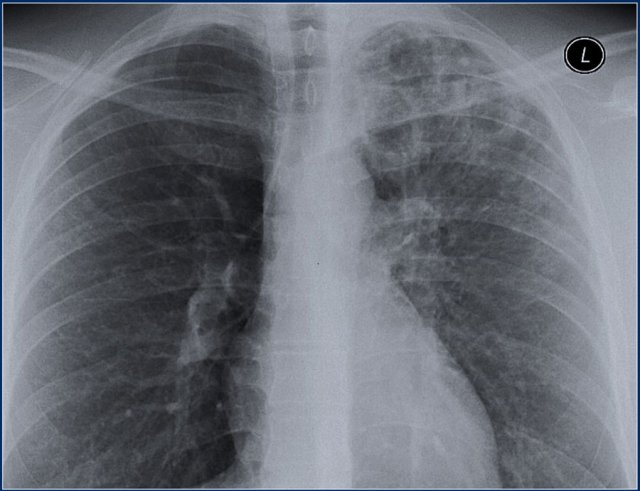
A 64-year-old man with a history of COPD presents with increased shortness of breath, cough, and sputum production, but no fever or chills. On examination, he is in mild respiratory distress with a respiratory rate of 26/min, pulse of 120 beats/min, blood pressure of 145/84 mm Hg, and oxygen saturation of 90%. He has bilateral expiratory wheezes. His ECG reveals multifocal atrial tachycardia (MAT), characterized by discrete P waves with at least three different morphologies. What is the most appropriate treatment for this patient's arrhythmia?
In acute exacerbations of COPD, noninvasive positive pressure ventilation (NIPPV) is initiated when
What is the diagnosis in a patient who has situs inversus and sinusitis?
Which of the following is not a restrictive pulmonary disease?
A 15-year-old boy is subjected to recurrent attacks of asthma. A careful clinical history reveals that the asthma attacks occur most frequently after aspirin administration. Which of the following is the pathogenetic mechanism in this form of asthma?
Pulmonary function abnormalities in interstitial lung diseases include all of the following, EXCEPT:
A patient diagnosed with bronchial asthma is maintained on oral prednisolone 20 mg daily and inhaled salbutamol as required. The patient develops a chest infection. Which of the following measures would you like to take?
A patient presents with a cavitatory lesion in the right upper lobe of the lung. What is the best investigation?
Blood gas analysis in type I respiratory failure typically shows which of the following?
Which of the following conditions can lead to end-stage lung disease?
Explanation: ### Explanation **Multifocal Atrial Tachycardia (MAT)** is a supraventricular arrhythmia characterized by a heart rate >100 bpm and at least three distinct P-wave morphologies on ECG. It is most commonly associated with **acute exacerbations of COPD**, hypoxia, and hypercapnia. #### 1. Why Verapamil is Correct The primary management of MAT involves treating the underlying cause (e.g., oxygenation, bronchodilators for COPD). However, if the arrhythmia persists or causes hemodynamic instability/symptoms, **Non-dihydropyridine Calcium Channel Blockers (CCBs)** like **Verapamil** are the first-line pharmacological agents [1]. Verapamil works by slowing conduction through the AV node and suppressing ectopic atrial foci, effectively reducing the ventricular rate without affecting pulmonary airway resistance. #### 2. Why Other Options are Incorrect * **Beta-blockers (Option D):** While effective for many tachyarrhythmias, they are **contraindicated** in this patient due to his active COPD exacerbation and wheezing. Non-selective and even cardioselective beta-blockers can trigger life-threatening bronchospasm [1]. * **Digoxin (Option A):** Digoxin is generally ineffective in MAT because the arrhythmia is driven by triggered activity/automaticity in the atria rather than a re-entrant circuit. Furthermore, patients with COPD and hypoxia are at an increased risk of digoxin toxicity. * **Diltiazem (Option C):** While Diltiazem is also a non-dihydropyridine CCB and can be used, **Verapamil** is traditionally the more frequently cited "classic" answer in medical boards for rate control in MAT when beta-blockers are contraindicated. #### 3. High-Yield Pearls for NEET-PG * **ECG Hallmark:** Irregularly irregular rhythm + $\geq$ 3 different P-wave morphologies + varying P-R intervals. * **Wandering Atrial Pacemaker (WAP):** Same ECG findings as MAT but with a heart rate **<100 bpm**. * **The "No-Go" Rule:** Never use Beta-blockers for MAT in a patient with bronchospastic lung disease [1]. * **Theophylline:** Historically, theophylline toxicity was a common cause of MAT; always check levels if a patient is on this drug.
Explanation: **Explanation:** The primary goal of Noninvasive Positive Pressure Ventilation (NIPPV) in acute exacerbations of COPD (AECOPD) is to reduce the work of breathing and improve gas exchange, specifically by addressing **respiratory acidosis** and **hypercapnia** [1]. **1. Why Option A is Correct:** According to GOLD guidelines, NIPPV is indicated in AECOPD when there is evidence of acute respiratory failure characterized by: * **Respiratory acidosis:** Arterial pH ≤ 7.35 [1]. * **Hypercapnia:** PaCO2 > 45 mmHg [1]. * **Clinical distress:** Severe dyspnea with use of accessory muscles or paradoxical abdominal breathing. PaCO2 > 45 mmHg signifies alveolar hypoventilation, which NIPPV corrects by providing pressure support to increase tidal volume and clear CO2. **2. Why the Other Options are Incorrect:** * **Option B (PaO2 < 80 mmHg):** Mild hypoxemia alone is not an indication for NIPPV; it is initially managed with controlled oxygen therapy (Venturi mask) [2]. NIPPV is considered if PaO2 remains < 50–60 mmHg despite oxygen. * **Option C (FEV1 < 30%):** While this indicates "Very Severe" COPD (GOLD Stage 4), it is a measure of chronic baseline function, not a trigger for acute NIPPV initiation. * **Option D (FEV1/FVC < 0.7):** This is the diagnostic criterion for the presence of airflow obstruction (COPD) and does not reflect the severity of an acute exacerbation. **Clinical Pearls for NEET-PG:** * **First-line therapy:** NIPPV is the preferred "standard of care" for AECOPD with respiratory acidosis, reducing the need for endotracheal intubation and decreasing mortality. * **Contraindications:** Impaired consciousness (GCS < 10), hemodynamic instability, facial trauma, or excessive secretions. * **Success Marker:** An improvement in pH and PaCO2 within the first 1–2 hours of NIPPV is the best predictor of success.
Explanation: ### Explanation **Correct Answer: A. Kartagener's syndrome** **Mechanism:** Kartagener’s syndrome is a subset of **Primary Ciliary Dyskinesia (PCD)**, an autosomal recessive disorder characterized by structural defects in the cilia (most commonly a deficiency of **outer/inner dynein arms**). This leads to impaired mucociliary clearance [1]. The classic clinical triad includes: 1. **Situs Inversus:** Due to the failure of ciliary movement during embryonic development, which is necessary for normal organ rotation. 2. **Chronic Sinusitis:** Due to impaired clearance of mucus from the paranasal sinuses [1]. 3. **Bronchiectasis:** Resulting from recurrent lower respiratory tract infections [1],[3]. **Why other options are incorrect:** * **B. Goodpasture’s syndrome:** An autoimmune condition involving anti-GBM antibodies. It presents with the duo of **pulmonary hemorrhage (hemoptysis)** and **glomerulonephritis**, not situs inversus or sinusitis. * **C. Cystic Fibrosis:** While it causes chronic sinusitis and bronchiectasis, it is caused by a **CFTR gene mutation** affecting chloride transport [2]. It is **not** associated with situs inversus. * **D. William Campbell syndrome:** A rare congenital disorder characterized by the **deficiency of bronchial cartilage** in the 3rd to 6th generation bronchi, leading to bronchiectasis. It does not involve situs inversus. **NEET-PG High-Yield Pearls:** * **Diagnosis:** Screening is done via **nasal nitric oxide** levels (low in PCD). Definitive diagnosis is via **high-speed video microscopy** or electron microscopy showing dynein arm defects. * **Infertility:** Males are infertile due to **immotile spermatozoa** (flagella share the same microtubule structure as cilia). Females may have reduced fertility due to impaired ciliary action in the fallopian tubes. * **Dextrocardia:** If the question mentions "heart on the right side" plus respiratory symptoms, always think Kartagener’s.
Explanation: **Explanation** Pulmonary function tests categorize lung diseases into **Obstructive** (difficulty exhaling air) and **Restrictive** (difficulty fully expanding lungs). **Why Bronchiolitis is the Correct Answer:** Bronchiolitis is an **Obstructive** lung disease [2]. It involves inflammation and narrowing of the small airways (bronchioles), which increases airway resistance. Like asthma and COPD, it is characterized by a decreased FEV1/FVC ratio (<0.7) [2]. In some forms, like *bronchiolitis obliterans*, it causes severe, irreversible airflow limitation. **Analysis of Incorrect Options (Restrictive Diseases):** * **Sarcoidosis:** This is an **Intrinsic Restrictive** disease [3]. The formation of non-caseating granulomas in the lung parenchyma leads to interstitial fibrosis, reducing lung compliance and total lung capacity (TLC) [1]. * **Kyphoscoliosis:** This is an **Extrinsic (Chest Wall) Restrictive** disease [3]. The mechanical deformity of the thoracic cage prevents the lungs from expanding fully, despite the lung parenchyma being initially normal. * **Amyotrophic Lateral Sclerosis (ALS):** This is a **Neuromuscular Restrictive** disease. Weakness of the diaphragm and intercostal muscles results in an inability to generate enough force to expand the chest wall, leading to reduced lung volumes [3]. **NEET-PG High-Yield Pearls:** 1. **FEV1/FVC Ratio:** Decreased in Obstructive; Normal or Increased in Restrictive [2]. 2. **TLC (Total Lung Capacity):** The hallmark of Restrictive disease is a **decrease in TLC** [1]. 3. **Bronchiolitis Obliterans:** Also known as "Popcorn Lung," it is a classic complication of post-lung transplant rejection and certain toxic inhalations. 4. **DLCO:** Usually decreased in intrinsic restrictive diseases (like Sarcoidosis) but normal in extrinsic/neuromuscular restrictive diseases (like Kyphoscoliosis or ALS).
Explanation: ### Explanation **Correct Option: C. Inhibition of cyclooxygenase pathway** The clinical scenario describes **Aspirin-Exacerbated Respiratory Disease (AERD)**, historically known as Samter’s Triad (asthma, nasal polyps, and aspirin sensitivity). The underlying mechanism is not an allergy, but a **metabolic shunting**. Aspirin and other NSAIDs inhibit the **Cyclooxygenase (COX-1)** enzyme. This inhibition blocks the production of prostaglandins (like PGE2), which normally inhibit 5-lipoxygenase. When the COX pathway is blocked, arachidonic acid metabolism is shunted toward the **Lipoxygenase (LOX) pathway**. This results in the overproduction of **cysteinyl leukotrienes** (LTC4, LTD4, and LTE4), which are potent bronchoconstrictors and mediators of airway inflammation. **Why other options are incorrect:** * **A. Direct release of bronchoconstrictor mediators:** While mediators are released, it is secondary to the biochemical shunting of the arachidonic acid pathway, not a direct primary release by the drug itself. * **B. Enhanced sensitivity to vagal stimulation:** This describes the mechanism of airway hyperresponsiveness in general asthma or triggers like cold air, but it is not the specific mechanism for aspirin-induced attacks. * **D. Type I hypersensitivity reaction:** AERD is a **pseudo-allergy**. It is not IgE-mediated. Therefore, skin prick tests for aspirin are negative, and there is no prior sensitization required. **NEET-PG High-Yield Pearls:** * **Samter’s Triad:** Asthma + Recurrent Nasal Polyps + Aspirin/NSAID sensitivity. * **Treatment of Choice:** Leukotriene Receptor Antagonists (e.g., **Montelukast**, Zafirlukast) are particularly effective in these patients. * **Safe Alternative:** Acetaminophen (Paracetamol) is generally safe at low doses as it is a weak COX-1 inhibitor. * **Key Enzyme:** The shunting occurs due to the inhibition of **COX-1**, leading to an increase in **Leukotrienes**.
Explanation: Interstitial Lung Diseases (ILD) are the classic prototype of **Restrictive Lung Disease**. The fundamental pathology involves inflammation and fibrosis of the alveolar walls, leading to "stiff" lungs with decreased compliance [1]. **1. Why "Reduced FEV1/FVC ratio" is the correct answer:** In restrictive diseases, both the Forced Expiratory Volume in 1 second (FEV1) and the Forced Vital Capacity (FVC) decrease proportionately because the lungs are small and stiff [1]. Consequently, the **FEV1/FVC ratio remains normal or is often increased** (due to increased radial traction on the airways keeping them open). A *reduced* FEV1/FVC ratio (<0.7) is the hallmark of **Obstructive Lung Diseases** (like Asthma or COPD), not ILD [2]. **2. Analysis of incorrect options:** * **Reduced Vital Capacity (A) & Total Lung Capacity (D):** These are the defining features of restriction. Fibrosis prevents the lungs from expanding fully, leading to a reduction in all lung volumes and capacities (TLC, FRC, RV, and VC) [1]. * **Reduced Diffusion Capacity (C):** DLCO (Diffusing Capacity of the Lungs for Carbon Monoxide) is characteristically reduced in ILD [1]. This occurs because the thickened, fibrotic alveolar-capillary membrane increases the distance for gas exchange and reduces the available surface area. **Clinical Pearls for NEET-PG:** * **Gold Standard for Diagnosis:** High-Resolution CT (HRCT) of the chest [1]. * **Earliest Sign of ILD:** Reduced DLCO (often precedes changes in lung volumes). * **PFT Pattern:** "Witch’s Hat" appearance on the Flow-Volume loop (tall, narrow loop with preserved peak flow but low volumes). * **Physical Exam:** Look for "Velcro" inspiratory crackles and digital clubbing [1].
Explanation: ### Explanation **1. Why Option C is Correct:** The patient is on long-term systemic corticosteroids (20 mg prednisolone), which leads to **Suppression of the Hypothalamic-Pituitary-Adrenal (HPA) axis**. During physiological stress, such as a chest infection, the body normally increases cortisol production to maintain homeostasis. Since this patient’s adrenal glands cannot mount an adequate response, they are at high risk of **Acute Adrenal Crisis** if the steroid dose is reduced or stopped. Furthermore, a chest infection can trigger an acute asthma exacerbation, necessitating a stable or even higher dose of steroids to control airway inflammation [1]. **2. Why Other Options are Incorrect:** * **Options A & B:** Stopping or reducing the dose during an infection is dangerous. It precipitates adrenal insufficiency and worsens the underlying asthma, which is likely to flare up due to the infection. Short courses of oral corticosteroids are often required to regain control during exacerbations [1]. * **Option D:** Inhaled corticosteroids (Budesonide) have high local potency but negligible systemic absorption [2]. They cannot replace the systemic requirement of a patient with a suppressed HPA axis during acute stress. **3. NEET-PG High-Yield Pearls:** * **Steroid Cover:** Patients on >5 mg prednisolone (or equivalent) for >3 weeks should be considered HPA-axis suppressed. Tapering is not necessary unless given for more than 3 weeks [1]. * **Stress Dosing:** In "minor" stress (like a mild infection), the dose should be doubled or maintained. In "major" stress (like major surgery or sepsis), IV hydrocortisone (100 mg 8-hourly) is the gold standard. * **Rule of Thumb:** Never taper steroids during an acute illness; always manage the underlying infection while maintaining or increasing the steroid cover.
Explanation: **Explanation:** The primary goal in evaluating a cavitatory lung lesion is to establish a definitive diagnosis, as the differential includes **Malignancy** (especially Squamous Cell Carcinoma), **Infections** (Tuberculosis, Fungal balls/Aspergilloma [1], Lung abscess), and **Autoimmune conditions** (GPA). **Why Option A is correct:** Bronchoscopy with Bronchoalveolar Lavage (BAL) and brushing is the investigation of choice because it provides **tissue and microbiological samples** [3]. It allows for direct visualization of the airways, cytological examination (to rule out malignancy), and cultures (for TB or fungi). In a cavitatory lesion, the yield of BAL for acid-fast bacilli (AFB) and malignant cells is significantly high, making it both a diagnostic and therapeutic guiding tool. **Why other options are incorrect:** * **B. CT Scan:** While CT is the best imaging modality to characterize the morphology of the cavity (wall thickness, inner lining) [2], it is a **radiological** investigation and cannot provide a pathological or microbiological diagnosis. * **C. X-ray:** This is usually the initial screening tool that detects the cavity, but it lacks the specificity to differentiate between an abscess, TB, or cancer [1]. * **D. FNAC:** Transthoracic FNAC is generally reserved for peripheral nodules. For upper lobe cavitatory lesions, the risk of **pneumothorax** is higher, and bronchoscopy is preferred for central or accessible lesions. **NEET-PG High-Yield Pearls:** * **Most common cause of a thin-walled cavity:** Coccidioidomycosis or a resolving lung abscess. * **Most common cause of a thick-walled cavity:** Squamous cell carcinoma (Mnemonic: **S**quamous = **S**hell/Thick wall). * **Air-crescent sign:** Classically seen in Invasive Aspergillosis (recovery phase) or an Aspergilloma (Monod sign). * **Upper lobe cavity differentials:** TB (most common in India), Klebsiella pneumonia, and Squamous cell carcinoma.
Explanation: **Explanation:** Respiratory failure is clinically defined as the inability of the respiratory system to maintain adequate gas exchange. It is categorized into two primary types based on Arterial Blood Gas (ABG) patterns: **1. Why Option B is Correct:** Type I Respiratory Failure (Hypoxemic) is characterized by **Hypoxemia (pO2 < 60 mmHg)** with a **Normal or Low pCO2**. This occurs due to conditions affecting the lung parenchyma (e.g., pneumonia, pulmonary edema, ARDS) that impair oxygenation but allow for CO2 clearance. Because CO2 is 20 times more diffusible than Oxygen, and hypoxemia often triggers compensatory hyperventilation, the pCO2 remains normal or even drops. **2. Analysis of Incorrect Options:** * **Option A (Increased pCO2 and decreased pO2):** This describes **Type II Respiratory Failure (Hypercapnic)**. It is caused by "pump failure" (e.g., COPD, neuromuscular disorders, or CNS depression) where alveolar ventilation is inadequate to clear CO2. * **Option C (Decreased pCO2 and decreased pO2):** While this can occur in early Type I failure due to hyperventilation, "Normal pCO2" is the classic hallmark used to differentiate Type I from Type II in standard examinations. **Clinical Pearls for NEET-PG:** * **Type I (Hypoxemic):** V/Q mismatch is the most common cause. The A-a gradient is typically **increased**. * **Type II (Hypercapnic):** Defined as **pCO2 > 45-50 mmHg**. The A-a gradient is **normal** if the cause is purely extrapulmonary (e.g., opioid overdose). * **Mnemonic:** Type **One** = **One** abnormality (Low O2). Type **Two** = **Two** abnormalities (Low O2 + High CO2).
Explanation: Explanation: The correct answer is **D. All of the above.** **Medical Concept:** End-stage lung disease (ESLD) is the final common pathway for various chronic, progressive pulmonary conditions. It is characterized by irreversible structural damage, extensive fibrosis (honeycombing), and severe impairment of gas exchange, often requiring long-term oxygen therapy or lung transplantation [1]. * **Interstitial Lung Disease (ILD):** This is a broad category of disorders (including Idiopathic Pulmonary Fibrosis) characterized by inflammation and scarring of the alveolar walls. Persistent injury leads to progressive fibrosis, loss of lung compliance, and eventually ESLD [1]. * **Sarcoidosis:** While many cases resolve spontaneously, approximately 10–20% of patients develop chronic progressive disease. Stage IV sarcoidosis is defined by permanent "pulmonary fibrosis" with architectural distortion, leading to respiratory failure and cor pulmonale [2]. * **Langerhans Cell Histiocytosis (LCH):** This smoking-related cystic lung disease involves the formation of nodules and thin-walled cysts. Over time, these cysts can coalesce, leading to diffuse scarring and end-stage cystic lung destruction [2]. **Why other options are "wrong":** In this "All of the above" format, options A, B, and C are individual contributors to the same pathological outcome. Selecting only one would be incomplete, as all three are well-recognized precursors to terminal respiratory failure. **High-Yield Clinical Pearls for NEET-PG:** * **Radiological Hallmark:** The presence of **"Honeycombing"** on HRCT is the definitive sign of end-stage pulmonary fibrosis [1]. * **Common Complication:** Pulmonary Hypertension and **Cor Pulmonale** are the most frequent cardiovascular complications of ESLD. * **Definitive Treatment:** For patients with ESLD refractory to medical therapy, **Lung Transplantation** is the only definitive intervention. * **Sarcoidosis Staging:** Remember that **Stage IV** is the only stage representing irreversible fibrosis (End-stage) [2].
Obstructive Airway Diseases (Asthma, COPD)
Practice Questions
Interstitial Lung Diseases
Practice Questions
Pulmonary Infections
Practice Questions
Pulmonary Vascular Diseases
Practice Questions
Pleural Diseases
Practice Questions
Sleep-Disordered Breathing
Practice Questions
Respiratory Failure
Practice Questions
Mediastinal Disorders
Practice Questions
Occupational Lung Diseases
Practice Questions
Pulmonary Function Testing
Practice Questions
Bronchiectasis and Cystic Fibrosis
Practice Questions
Lung Cancer Approach
Practice Questions
Get full access to all questions, explanations, and performance tracking.
Start For Free