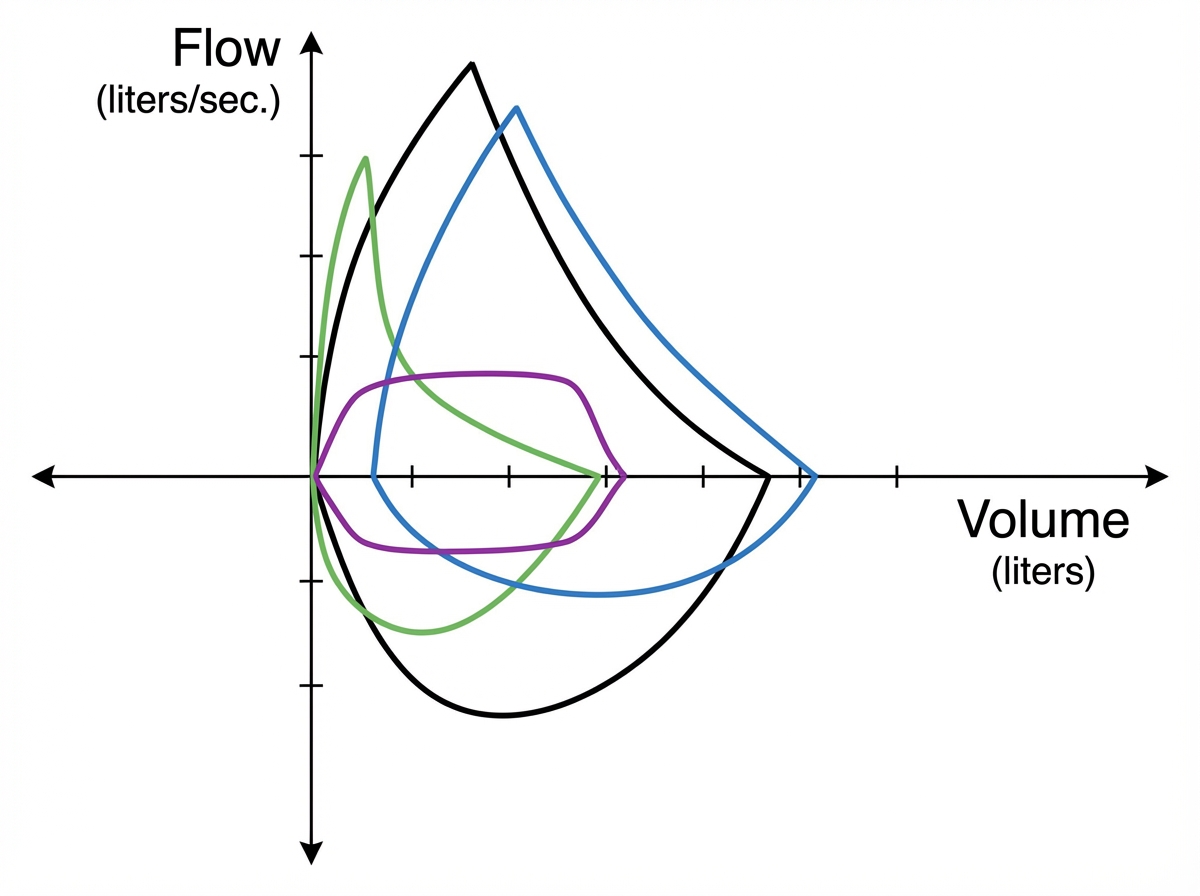
Sudden onset of cough followed by increasing dyspnea is characteristic of which condition?
Increased amylase levels in pleural fluid are seen in which of the following conditions?
A patient presented with bilateral hilar lymphadenopathy and a negative Mantoux test. What is the most likely diagnosis?
Which of the following statements about ABPA is FALSE?
All of the following test results can exclude pulmonary embolism, EXCEPT:
A 64-year-old woman is found to have a left-sided pleural effusion on chest x-ray. Analysis of the pleural fluid reveals a ratio of concentration of total protein in pleural fluid to serum of 0.38, a lactate dehydrogenase (LDH) level of 125 IU, and a ratio of LDH concentration in pleural fluid to serum of 0.46. Which of the following disorders is most likely in this patient?
Which of the following conditions commonly progresses to cor pulmonale?
A 50-year-old woman presents with a 4-week history of fever, shortness of breath, and dry cough. She reports that her chest feels 'tight.' The patient is a pigeon fancier. Blood tests show leukocytosis and neutrophilia, an elevated erythrocyte sedimentation rate, and increased levels of immunoglobulins and C-reactive protein. A lung biopsy reveals poorly formed granulomas composed of epithelioid macrophages and multinucleated giant cells. Which of the following is the most likely diagnosis?
An adolescent girl presents with symmetrical, red, tender swellings in her shins and arthralgia. X-ray reveals hilar and paratracheal lymphadenopathy. She is clinically suspected to have sarcoidosis. What is the next step in the diagnosis?
The Bode index is used in which type of transplantation?
Explanation: Lobar pneumonia typically presents with an acute onset of symptoms [1]. The "sudden onset of cough" is triggered by the rapid inflammatory exudation into the alveoli, which irritates the cough receptors. As the consolidation spreads to involve an entire lobe, the ventilation-perfusion (V/Q) mismatch worsens, leading to "increasing dyspnea." The classic progression involves a productive cough (often with rusty sputum) and pleuritic chest pain due to pleural involvement [2]. **Analysis of Incorrect Options:** * **A. Pleural Effusion:** This usually presents with a dull, aching chest pain and progressive dyspnea. Cough is typically dry and less prominent than in pneumonia. * **C. Myocardial Infarct:** While dyspnea is common (due to acute left heart failure), the primary presenting symptom is typically retrosternal chest pain. * **D. Pneumothorax:** This presents with **sudden** onset of dyspnea and **pleuritic chest pain**. **NEET-PG High-Yield Pearls:** * **Lobar Pneumonia Stages:** Congestion → Red Hepatization → Gray Hepatization → Resolution. * **Physical Signs:** Increased tactile vocal fremitus (TVF), dullness on percussion, and bronchial breath sounds with crackles [2]. * **Most Common Cause:** *Streptococcus pneumoniae* (Pneumococcus) [3]. * **Differentiating Feature:** Pneumonia has **increased** TVF/Vocal Resonance, whereas Pleural Effusion and Pneumothorax have decreased TVF/Vocal Resonance.
Explanation: **Explanation:** Pleural fluid amylase is considered elevated when the level exceeds the upper limit of normal for serum amylase or when the pleural fluid-to-serum amylase ratio is greater than 1.0. 1. **Pancreatitis (Option B):** This is the most common cause [1]. In acute pancreatitis, pancreatic enzymes leak into the retroperitoneum and reach the pleural space (usually on the left side) via transdiaphragmatic lymphatics or small diaphragmatic defects. 2. **Oesophageal Rupture (Option C):** This is a critical diagnosis. The amylase found here is of **salivary origin** (not pancreatic). Saliva, which is rich in amylase, leaks through the rupture into the mediastinum and subsequently into the pleural space. 3. **Malignancy (Option A):** Approximately 10% of malignant pleural effusions (most commonly Adenocarcinoma of the lung or ovary) show elevated amylase levels. Similar to esophageal rupture, this is usually the **salivary isoenzyme**. **Why "All of the above" is correct:** Since all three conditions can pathologically increase amylase levels in the pleural space through different mechanisms (pancreatic leakage, salivary leakage, or ectopic production by tumor cells), Option D is the correct choice. **High-Yield Clinical Pearls for NEET-PG:** * **Isoenzyme Differentiation:** If the diagnosis is unclear, checking isoenzymes helps. Elevated **pancreatic isoenzyme** points to pancreatitis; elevated **salivary isoenzyme** points to malignancy or esophageal rupture. * **Esophageal Rupture:** Often associated with a very low pleural fluid pH (<6.0). * **Other causes:** Ruptured ectopic pregnancy (rare) can also cause elevated pleural amylase. * **Lateralization:** Pancreatitis-associated effusion is typically **left-sided**, while esophageal rupture (Boerhaave syndrome) is also frequently left-sided.
Explanation: ### Explanation **Correct Answer: B. Sarcoidosis** **Reasoning:** The combination of **bilateral hilar lymphadenopathy (BHL)** and a **negative Mantoux test** is a classic presentation of Sarcoidosis. 1. **Bilateral Hilar Lymphadenopathy:** This is the hallmark radiological finding in Stage I and II Sarcoidosis [1]. 2. **Negative Mantoux (Anergy):** Sarcoidosis is characterized by a paradox: there is systemic T-cell energy (suppression of delayed-type hypersensitivity) despite intense local inflammation in the lungs. Approximately 30–70% of sarcoidosis patients will have a negative tuberculin skin test, even if previously exposed to TB. **Analysis of Incorrect Options:** * **D. Tuberculosis:** While TB is a common cause of lymphadenopathy in India, it typically presents with **unilateral** hilar lymphadenopathy and a **positive** Mantoux test [2]. * **A. Erythema Nodosum:** This is a clinical *sign* (painful shins) often associated with Sarcoidosis (as part of Löfgren syndrome), but it is not a diagnosis for the systemic findings described [1]. * **C. Hepatitis:** This is an inflammatory condition of the liver and does not typically present with hilar lymphadenopathy or specific Mantoux findings. **High-Yield Clinical Pearls for NEET-PG:** * **Löfgren Syndrome:** A triad of BHL, Erythema Nodosum, and Migratory Polyarthritis [1]. It has a highly favorable prognosis. * **Heerfordt Syndrome (Uveoparotid Fever):** Parotid enlargement, Uveitis, and Facial nerve palsy. * **Biopsy Finding:** Non-caseating granulomas (unlike the caseating granulomas of TB) [2]. * **Biomarkers:** Elevated Serum ACE levels and hypercalciuria/hypercalcemia (due to 1-alpha hydroxylase activity in macrophages) [1]. * **Kveim-Siltzbach Test:** Historically used for diagnosis but now largely replaced by biopsy and imaging.
Explanation: Allergic Bronchopulmonary Aspergillosis (ABPA) is a complex hypersensitivity reaction to Aspergillus fumigatus that occurs almost exclusively in patients with Asthma or Cystic Fibrosis. **Why Option D is the Correct Answer (False Statement):** ABPA typically involves the **upper and middle lobes** rather than the lower lobes [1]. The characteristic pathology involves mucoid impaction and bronchiectasis in the segmental and subsegmental bronchi, which predominantly affects the upper zones of the lungs [1]. **Analysis of Incorrect Options (True Statements about ABPA):** * **Option A (Serum IgE > 1000 ng/ml):** A total serum IgE level > 1000 IU/mL (approx. 2400 ng/ml) is a major diagnostic criterion [2]. If the IgE is < 1000, ABPA is unlikely unless the patient is on systemic steroids. * **Option B (Eosinophils > 1000/mm³):** Peripheral blood eosinophilia is a hallmark of the disease, typically exceeding 500–1000 cells/mm³. * **Option C (Elevated IgG antibodies):** The presence of serum precipitating antibodies (IgG) against *Aspergillus fumigatus* is a key immunological marker used for diagnosis. **High-Yield Clinical Pearls for NEET-PG:** * **Radiology:** Look for the **"Finger-in-glove" appearance** (mucoid impaction) and **Central Bronchiectasis** (pathognomonic) [1]. * **High-Attenuation Mucus (HAM):** On CT, mucus plugs that are denser than skeletal muscle are highly suggestive of ABPA. * **Diagnosis:** Requires a positive skin prick test for *Aspergillus* or elevated specific IgE/IgG [2]. * **Treatment:** The mainstay is **Oral Corticosteroids** to reduce inflammation, often combined with **Itraconazole** to reduce the fungal burden.
Explanation: ### Explanation The diagnosis of Pulmonary Embolism (PE) relies on a combination of clinical probability and objective testing. To "exclude" a diagnosis means the test result must have a high **Negative Predictive Value (NPV)**. **Why "D-Dimer Test: Positive" is the correct answer:** The D-dimer test is highly sensitive but lacks specificity. A **negative** D-dimer (in a patient with low-to-moderate clinical probability) is excellent for ruling out PE. However, a **positive** D-dimer does not confirm PE, nor does it exclude it; it simply necessitates further imaging. Many conditions (pregnancy, malignancy, inflammation, or recent surgery) can cause a false positive D-dimer. Therefore, a positive result is non-diagnostic. **Analysis of other options:** * **CT Pulmonary Angiogram (CTPA): Normal:** CTPA is the current "Gold Standard" for diagnosing PE [1]. A normal CTPA effectively excludes PE in most clinical scenarios due to its high sensitivity and specificity for clots in the pulmonary arteries. * **Perfusion Scan: Normal:** A normal perfusion scan (part of the V/Q scan) has a nearly 100% NPV. If blood flow to all segments of the lung is uniform and normal, PE is effectively ruled out. **Clinical Pearls for NEET-PG:** * **Wells’ Score:** Always the first step to determine clinical probability. * **Rule-out Criteria:** In a low-probability patient, a **negative D-dimer (<500 ng/mL)** is sufficient to stop the workup. * **Gold Standard:** CTPA is the investigation of choice [1]. However, **Pulmonary Angiography** remains the definitive "invasive" gold standard (though rarely used now). * **V/Q Scan:** Preferred in patients with renal failure (high creatinine) or severe contrast allergy [1]. * **ECG Finding:** Most common finding is **Sinus Tachycardia**; most specific (but rare) is **S1Q3T3** [1].
Explanation: ### Explanation The core of this question lies in distinguishing between **transudative** and **exudative** pleural effusions using **Light’s Criteria**. According to Light’s Criteria, an effusion is **exudative** if it meets at least one of the following: 1. Pleural fluid protein / Serum protein ratio **> 0.5** 2. Pleural fluid LDH / Serum LDH ratio **> 0.6** 3. Pleural fluid LDH **> 2/3rd** the upper limit of normal serum LDH (usually >200 IU) **Analysis of the Patient’s Data:** * Protein ratio: **0.38** (Normal is < 0.5) * LDH ratio: **0.46** (Normal is < 0.6) * LDH level: **125 IU** (Normal is < 200 IU) Since the fluid meets **none** of the criteria, it is a **transudative effusion**. Biochemical analysis allows classification into transudate and exudates based on such criteria [1]. Transudates occur due to imbalances in hydrostatic and oncotic pressures without pleural inflammation. **Congestive Heart Failure (CHF)** is the most common cause of transudative effusion [1], [2]. --- ### Why the Other Options are Incorrect: * **Uremia (A):** Typically causes a **fibrinous pleuritis**, which results in an **exudative** effusion. * **Pulmonary Embolism (C):** While it can occasionally be transudative, it is **exudative in about 75% of cases** due to ischemia and increased permeability [1]. * **Sarcoidosis (D):** This is a granulomatous disease that causes pleural inflammation, leading to an **exudative** effusion (often lymphocyte-predominant). --- ### NEET-PG High-Yield Pearls: * **Most common cause of transudate:** Congestive Heart Failure (followed by Cirrhosis/Nephrotic syndrome) [1], [2]. * **Most common cause of exudate:** Parapneumonic effusion (followed by Malignancy). * **The "Pseudo-exudate" Rule:** In CHF patients on diuretics, protein levels may rise, falsely suggesting an exudate. In such cases, calculate the **Serum-Effusion Albumin Gradient (SEAG)**. If SEAG is **> 1.2 g/dL**, the fluid is likely transudative. * **pH Fact:** A pleural fluid pH **< 7.2** indicates a complicated parapneumonic effusion or empyema, requiring chest tube drainage [1].
Explanation: **Explanation:** **Cor pulmonale** is defined as hypertrophy and/or dilation of the right ventricle resulting from pulmonary hypertension caused by diseases of the lung parenchyma or pulmonary vasculature (excluding left-sided heart disease). **Why COPD is the correct answer:** COPD is the **most common cause** of chronic cor pulmonale worldwide [1]. The pathogenesis involves chronic alveolar hypoxia, which triggers **hypoxic pulmonary vasoconstriction**. Over time, this leads to vascular remodeling, increased pulmonary vascular resistance, and permanent pulmonary hypertension. The right ventricle must pump against this high pressure, eventually leading to right-sided heart failure. **Analysis of Incorrect Options:** * **A. Pulmonary thromboembolism:** While a massive PE can cause *acute* cor pulmonale (sudden RV strain), it is not the most common cause of the chronic progression typically implied in such questions. Chronic Thromboembolic Pulmonary Hypertension (CTEPH) is a specific subset but is less common than COPD. * **B. Bronchial Asthma:** Unlike COPD, asthma is characterized by reversible airway obstruction. Chronic remodeling can occur, but it rarely leads to the sustained, severe pulmonary hypertension required to cause cor pulmonale. * **C. Airway foreign body:** This causes acute upper airway obstruction or localized collapse/infection, not the generalized chronic parenchymal or vascular disease necessary for cor pulmonale. **High-Yield Clinical Pearls for NEET-PG:** * **Gold Standard Diagnosis:** Right heart catheterization (showing mean Pulmonary Artery Pressure >20 mmHg). * **ECG Findings:** Right axis deviation, "P-pulmonale" (tall, peaked P waves in lead II), and R/S ratio >1 in V1. * **Management Tip:** Long-term oxygen therapy (LTOT) is the only intervention proven to improve survival in COPD patients with cor pulmonale by reducing hypoxic vasoconstriction.
Explanation: ### Explanation **Correct Answer: C. Hypersensitivity Pneumonitis (HP)** **Why it is correct:** Hypersensitivity Pneumonitis (also known as Extrinsic Allergic Alveolitis) is an immunologically mediated inflammatory disease of the lung parenchyma and small airways. It occurs in response to the inhalation of organic antigens or low-molecular-weight chemicals. * **Clinical Clue:** The patient is a **pigeon fancier**, suggesting exposure to avian proteins (Bird Fancier’s Lung). Indoor pet bird exposure often presents in an indolent fashion with progressive breathlessness [1]. * **Presentation:** Subacute HP typically presents with fever, cough, and dyspnea occurring weeks after exposure. * **Histopathology:** The classic triad includes **poorly formed non-caseating granulomas**, patchy mononuclear cell infiltration (lymphocytic alveolitis), and peribronchiolar fibrosis [1]. The presence of epithelioid macrophages and giant cells is a hallmark of the granulomatous response. * **Laboratory:** Elevated ESR, CRP, and immunoglobulins (IgG) are common markers of systemic inflammation. **Why the other options are incorrect:** * **A. Actinomycosis:** Caused by *Actinomyces israelii*, it typically presents with chronic abscesses, sinus tracts, and "sulfur granules." It is not associated with bird exposure or diffuse granulomatous lung disease. * **B. Goodpasture Syndrome:** An autoimmune condition involving anti-GBM antibodies. It presents with the association of pulmonary hemorrhage and glomerulonephritis, in which IgG antibodies bind to basement membranes, not granulomas [2]. * **D. Wegener Granulomatosis (GPA):** While it involves granulomas, they are typically **well-formed** and associated with **necrotising vasculitis** and C-ANCA positivity [2]. It usually involves the upper respiratory tract and kidneys. **NEET-PG High-Yield Pearls:** * **Type of Hypersensitivity:** HP involves both **Type III** (immune complex) and **Type IV** (delayed-type) hypersensitivity reactions. * **Radiology:** Acute/Subacute HP often shows "ground-glass opacities" or centrilobular nodules on HRCT [1]. * **Farmer’s Lung:** Caused by *Saccharopolyspora rectivirgula* (thermophilic actinomycetes) in moldy hay. * **Management:** The most crucial step is the **removal of the offending antigen**; corticosteroids are used for severe symptoms.
Explanation: The patient presents with the classic triad of **Löfgren syndrome**: Erythema nodosum (tender shin swellings), arthralgia, and bilateral hilar lymphadenopathy (BHL) [1]. While this clinical presentation is highly suggestive of Sarcoidosis, the gold standard for diagnosis requires **histopathological confirmation** of non-caseating granulomas and the exclusion of other diseases (like tuberculosis or lymphoma). **1. Why Option A is correct:** Sarcoidosis is a diagnosis of exclusion. According to international guidelines (ATS/ERS/WASOG), a tissue biopsy is mandatory in most cases to confirm the presence of **non-caseating granulomas**. In this patient, the most accessible and high-yield sites for biopsy are the enlarged mediastinal or hilar lymph nodes, typically via **Endobronchial Ultrasound-guided Transbronchial Needle Aspiration (EBUS-TBNA)** or mediastinoscopy. **2. Why other options are incorrect:** * **Option B:** 24-hour urine calcium may show hypercalciuria (due to 1-alpha-hydroxylase activity in macrophages), but it is a supportive finding, not a diagnostic one [1]. * **Option C:** CT Thorax provides better anatomical detail of the lymphadenopathy and interstitial lung disease, but it cannot provide the histopathological proof required for a definitive diagnosis. * **Option D:** Follow-up is inappropriate when a diagnosis has not yet been established, especially when invasive confirmation is feasible. **NEET-PG High-Yield Pearls:** * **Löfgren Syndrome:** A subset of acute sarcoidosis with an excellent prognosis (spontaneous remission in >80%) [1]. * **Biopsy Site:** Always choose the most superficial/accessible lesion (e.g., skin plaques, palpable lymph nodes). If none are present, EBUS-TBNA of mediastinal nodes is the preferred next step. * **Note:** While some experts argue that classic Löfgren syndrome can be diagnosed clinically, for exam purposes, **tissue diagnosis** remains the definitive "next step" to rule out mimics like TB.
Explanation: The **BODE Index** is a multidimensional scoring system used primarily to predict the prognosis and mortality risk in patients with **Chronic Obstructive Pulmonary Disease (COPD)** [1]. In the context of transplantation, it is a critical tool used to determine the timing and eligibility for **Lung Transplantation** [2]. The acronym **BODE** stands for: * **B: Body Mass Index (BMI)** – Points are given for BMI < 21 kg/m² [1]. * **O: Obstruction** – Measured by FEV1 (% of predicted). * **D: Dyspnea** – Measured by the mMRC (Modified Medical Research Council) scale. * **E: Exercise Capacity** – Measured by the 6-minute walk distance (6MWD). A higher BODE score (0–10) correlates with a higher risk of death. According to international guidelines, a **BODE score of 7–10** is one of the primary indications for referring a COPD patient for lung transplant evaluation [2]. **Why other options are incorrect:** * **Liver Transplantation:** Uses the **MELD** (Model for End-Stage Liver Disease) or **Child-Pugh** score for prioritization. * **Renal Transplantation:** Uses glomerular filtration rate (GFR) and time on dialysis; the **KDPI** (Kidney Donor Profile Index) is used for organ allocation. * **Heart Transplantation:** Uses the **NYHA** classification and hemodynamic parameters (e.g., VO2 max) for assessment. **High-Yield Clinical Pearls for NEET-PG:** * The BODE index is a better predictor of mortality in COPD than FEV1 alone. * **mMRC Scale:** Grade 4 dyspnea (breathless while dressing/undressing) is a key component. * **6-Minute Walk Test:** A distance of <150 meters is a strong predictor of poor outcomes.
Obstructive Airway Diseases (Asthma, COPD)
Practice Questions
Interstitial Lung Diseases
Practice Questions
Pulmonary Infections
Practice Questions
Pulmonary Vascular Diseases
Practice Questions
Pleural Diseases
Practice Questions
Sleep-Disordered Breathing
Practice Questions
Respiratory Failure
Practice Questions
Mediastinal Disorders
Practice Questions
Occupational Lung Diseases
Practice Questions
Pulmonary Function Testing
Practice Questions
Bronchiectasis and Cystic Fibrosis
Practice Questions
Lung Cancer Approach
Practice Questions
Get full access to all questions, explanations, and performance tracking.
Start For Free