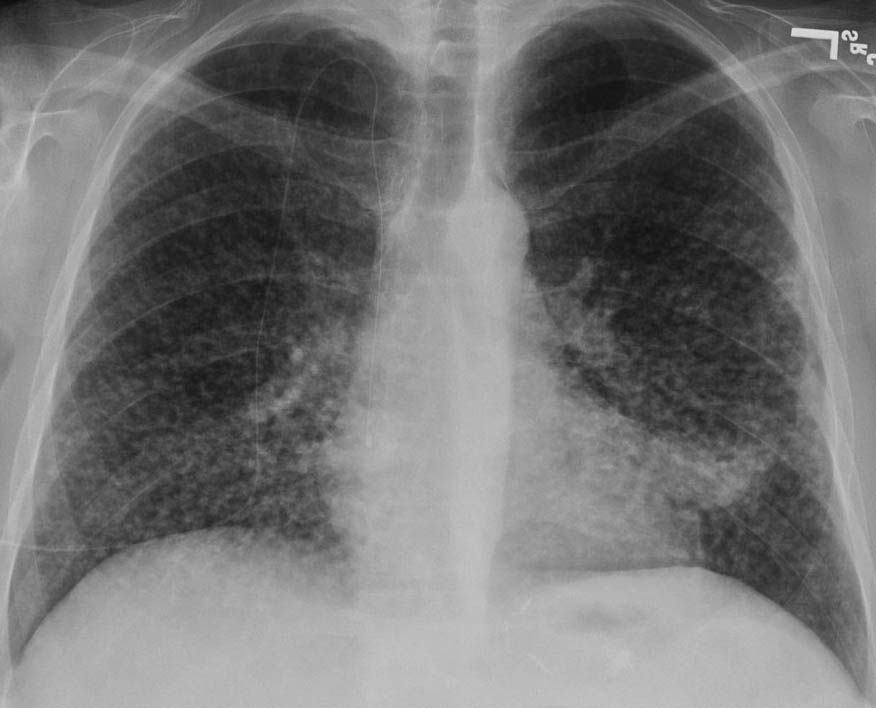
Which of the following statements is NOT true regarding Macleod's Syndrome?
A 54-year-old female patient undergoes a routine insurance physical examination. Chest x-ray revealed bilateral hilar masses. Biopsy of the masses shows granulomata, but acid-fast and fungal stains are negative for organisms. Which of the following diseases should be suspected?
Pneumonia results from the proliferation of microbial pathogens at the level of:
What is the definition of bronchial asthma?
Type 1 respiratory failure is characterized by which of the following?
Which of the following statements is true regarding an acute attack of asthma?
A 30-year-old paraplegic male with a history of recurrent UTIs secondary to an indwelling Foley catheter presents with fever and hypotension requiring hospitalization, fluid therapy, and intravenous antibiotics. He improves initially, but over one week, he develops increasing shortness of breath and tachypnea. He has frothy sputum and diffuse alveolar infiltrates. There is no fever, jugular venous distension, S3 gallop, or peripheral or sacral edema. What is the best prognostic indicator?
Which interstitial lung disease is characterized by granulomas on lung biopsy?
Which of the following conditions is associated with hypersensitive pneumonitis?
Which of the following is NOT true about Kartagener's syndrome?
Explanation: **Explanation:** **Macleod’s Syndrome** (also known as **Swyer-James Syndrome**) is a rare sequela of childhood post-infectious bronchiolitis obliterans. It is characterized by the inflammation and fibrosis of small airways, leading to air trapping and distal lung destruction. **Why Option C is the correct answer (The "NOT true" statement):** While Macleod’s syndrome is often colloquially called "unilateral emphysema," it is **not a true emphysema**. In true emphysema, there is permanent destruction of alveolar walls [2]. In Macleod’s syndrome, the primary pathology is bronchiolitis obliterans; the hyperlucency seen on imaging is due to **air trapping** and **reduced vascular perfusion** (hypoplasia), not the destruction of alveolar septa. Therefore, calling it "unilateral emphysema" is pathologically inaccurate. **Analysis of other options:** * **Option A:** Correct statement. As explained above, it is a form of obstructive lung disease/bronchiolitis, not true acinar destruction. * **Option B:** Correct statement. The initial insult (usually viral pneumonia like Adenovirus or Measles) typically occurs in early childhood (**before age 8**) [1], while the lungs are still developing. * **Option D:** Incorrect statement (making it a "true" fact about the disease). The pulmonary artery on the affected side is **hypoplastic** (small), not hyperplastic. This occurs due to reflex vasoconstriction in response to chronic hypoxia in the under-ventilated lung. **NEET-PG High-Yield Pearls:** * **Radiology:** Characterized by a **unilateral hyperlucent lung** with a small or normal-sized hilum. * **CT Scan:** Shows "mosaic attenuation" and air trapping on expiration. * **Etiology:** Most commonly follows **Adenovirus type 7** or Mycoplasma infection. * **Key Differential:** Congenital lobar emphysema (usually presents in neonates) and Pulmonary Artery Agenesis.
Explanation: The clinical presentation of an asymptomatic patient with incidental **bilateral hilar lymphadenopathy** [1] on chest X-ray and biopsy showing **non-caseating granulomas** (negative for acid-fast bacilli and fungi) is the classic "textbook" description of **Sarcoidosis**. **Why Sarcoidosis is correct:** Sarcoidosis is a multisystem inflammatory disease of unknown etiology characterized by the formation of non-caseating granulomas. Stage I sarcoidosis often presents as asymptomatic bilateral hilar lymphadenopathy (BHL) [1]. The diagnosis is one of exclusion; therefore, negative stains for tuberculosis (AFB) and fungal infections are crucial to confirm the diagnosis. **Why the other options are incorrect:** * **Caroli’s Disease:** A rare congenital disorder characterized by cystic dilatation of the intrahepatic bile ducts. It presents with jaundice or cholangitis, not pulmonary findings. * **Raynaud’s Disease:** A vascular disorder characterized by episodic vasospasm of the digits in response to cold or stress. It does not cause hilar masses or granulomas. * **Scleroderma (Systemic Sclerosis):** While it can cause Interstitial Lung Disease (ILD) and pulmonary hypertension, it does not typically present with isolated bilateral hilar granulomata. **High-Yield Clinical Pearls for NEET-PG:** * **Löfgren Syndrome:** A specific acute presentation of sarcoidosis consisting of the triad: Erythema nodosum, Bilateral hilar lymphadenopathy, and Polyarthritis/Arthralgia [1]. * **Heerfordt Syndrome (Uveoparotid Fever):** Parotid enlargement, Facial nerve palsy, and Anterior uveitis. * **Biochemical Marker:** Elevated **Serum ACE (Angiotensin-Converting Enzyme)** levels are seen in 60-80% of active cases. * **Pathology:** Look for **Asteroid bodies** or **Schaumann bodies** within the giant cells of the granuloma. * **Kveim-Siltzbach Test:** An older, specific skin test for sarcoidosis (rarely used now).
Explanation: **Explanation:** **1. Why Alveoli is Correct:** Pneumonia is clinically defined as an infection of the **lung parenchyma**. The primary site of microbial proliferation and the subsequent inflammatory response occurs within the **alveoli** (the terminal gas-exchange units). When pathogens reach the alveoli, the body responds by filling these air sacs with inflammatory exudate (pus, white blood cells, and fibrin). This process is known as **consolidation**, which is the hallmark of bacterial pneumonia. **2. Why Other Options are Incorrect:** * **Bronchi and Bronchioles (Options A & B):** Infections primarily involving these structures are termed **bronchitis** or **bronchiolitis**. While "bronchopneumonia" involves the bronchioles, the definitive site where the infection transitions into pneumonia is the alveolar space. * **Interstitium (Option C):** The interstitium refers to the tissue surrounding the alveoli. While "interstitial pneumonia" (often viral or atypical) involves this area, the classic definition of pneumonia—and the most common presentation—focuses on the alveolar spaces. **3. High-Yield Clinical Pearls for NEET-PG:** * **Pathophysiology:** The transition from congestion to **red hepatization**, **gray hepatization**, and finally resolution describes the stages of lobar pneumonia. * **Radiology:** The presence of an **air bronchogram** (visible air-filled bronchi against opaque, fluid-filled alveoli) is a classic sign of alveolar consolidation. * **Microbiology:** *Streptococcus pneumoniae* remains the most common cause of community-acquired pneumonia (CAP) worldwide. * **Physical Exam:** Look for signs of consolidation such as **increased vocal fremitus**, **dullness to percussion**, and **bronchial breath sounds**.
Explanation: **Explanation:** **Bronchial Asthma** is defined as a chronic inflammatory disorder of the airways characterized by two key components: **chronic airway inflammation** and **bronchial hyperresponsiveness (BHR)** [1]. This inflammation leads to recurrent episodes of wheezing, breathlessness, chest tightness, and coughing, particularly at night or in the early morning [2]. These episodes are typically associated with widespread but **variable airflow obstruction** that is often reversible either spontaneously or with treatment [1]. **Analysis of Options:** * **Option A:** Describes **Allergic Rhinitis**. While frequently associated with asthma (the "one airway, one disease" concept), it is limited to the upper respiratory tract. * **Option B:** This is the clinical definition of **Chronic Bronchitis** (part of COPD), defined by a productive cough for at least 3 months in 2 successive years. * **Option D:** Describes **Pneumonia** or **Alveolitis**. Asthma is primarily a disease of the conducting airways (bronchi and bronchioles), not the gas-exchanging units (alveoli). **High-Yield Clinical Pearls for NEET-PG:** * **Gold Standard Diagnosis:** Spirometry showing reversibility (increase in FEV1 of **>12% and >200 ml** after inhalation of a short-acting beta-agonist). * **Pathology:** Characterized by **Curschmann spirals** (mucus plugs), **Charcot-Leyden crystals** (eosinophil breakdown products), and **Creola bodies** (sloughed epithelial cells). * **Airway Remodeling:** Chronic untreated inflammation leads to subepithelial fibrosis and smooth muscle hypertrophy, making the obstruction irreversible over time. * **Phenotypes:** The most common is **Atopic (Type 1 Hypersensitivity)**, mediated by IgE and Th2 cytokines (IL-4, IL-5, IL-13) [1].
Explanation: Respiratory failure is clinically defined as the inability of the respiratory system to maintain adequate gas exchange [1]. It is categorized into two primary types based on arterial blood gas (ABG) patterns: **1. Why Option A is Correct:** **Type 1 Respiratory Failure (Hypoxemic)** is characterized by **Hypoxemia (PaO2 < 60 mmHg)** with a **normal or low PaCO2 (normocapnia or hypocapnia)** [1]. The primary pathophysiology involves a failure of oxygenation, usually due to **V/Q mismatch** (the most common cause) or **intrapulmonary shunting** [2]. Because CO2 is 20 times more diffusible than oxygen, the patient can initially compensate for hypoxia by increasing minute ventilation (hyperventilation), which keeps the PCO2 normal or even low [2]. Common causes include pneumonia, pulmonary edema, ARDS, and pulmonary embolism. **2. Why the Other Options are Incorrect:** * **Option B (Low PaO2 and high PCO2):** This describes **Type 2 Respiratory Failure (Hypercapnic/Ventilatory failure)**. This occurs when alveolar ventilation is inadequate to excrete the CO2 produced by the body [1]. Common causes include COPD, neuromuscular disorders (e.g., Guillain-Barré), and CNS depression. * **Option C & D:** These do not fit the clinical definition of respiratory failure. Respiratory failure, by definition, requires the presence of hypoxemia (PaO2 < 60 mmHg) while breathing room air [1]. **High-Yield Clinical Pearls for NEET-PG:** * **Type 3 Respiratory Failure:** Perioperative respiratory failure (due to atelectasis). * **Type 4 Respiratory Failure:** Associated with shock (hypoperfusion of respiratory muscles). * **The A-a Gradient:** In Type 1 failure due to intrinsic lung disease, the Alveolar-arterial (A-a) gradient is **increased**. In Type 2 failure due to extrapulmonary causes (like opioid overdose), the A-a gradient remains **normal**.
Explanation: ### Explanation In an acute asthma exacerbation, the severity of the attack is determined by clinical signs and arterial blood gas (ABG) parameters. **1. Why Option D is correct:** All three statements describe critical physiological changes during a worsening asthma attack: * **Statement A (Pulsus Paradoxus):** Pulsus paradoxus (a drop in systolic BP >10 mmHg during inspiration) is a sign of **severe** asthma. It typically manifests when the airway obstruction is profound, specifically when the **FEV1 falls below 25%** of the predicted value or the Peak Expiratory Flow (PEF) is <120 L/min. It occurs due to exaggerated intrathoracic pressure swings affecting cardiac filling. * **Statement B (Impending Failure):** In the early stages of an attack, patients hyperventilate, leading to low PaCO2 (hypocapnia). A **"normal" or rising PaCO2** (≥42 mmHg) is an ominous sign [1]. It indicates that the patient’s respiratory muscles are fatiguing and they can no longer maintain the work of breathing required to clear CO2, signaling **impending respiratory failure** [3]. * **Statement C (Acid-Base Balance):** Most acute asthma attacks present with **Respiratory Alkalosis** [4]. Due to hyperventilation, the patient "blows off" CO2 (↓PaCO2), which subsequently increases the arterial pH (↑pH). **Clinical Pearls for NEET-PG:** * **Silent Chest:** The most dangerous clinical sign in asthma; it indicates insufficient air movement to even produce a wheeze. * **ABG Progression:** Early (Respiratory Alkalosis) → Late/Severe (Normal PaCO2/Pseudonormalization) → Critical (Respiratory Acidosis) [3]. * **Indication for Intubation:** Altered sensorium, exhaustion, and refractory respiratory acidosis [2].
Explanation: ### Explanation **Diagnosis: Acute Respiratory Distress Syndrome (ARDS)** The patient presented with sepsis (UTI, hypotension) and subsequently developed acute respiratory distress with diffuse alveolar infiltrates and frothy sputum. [1] The absence of jugular venous distension, S3 gallop, and edema suggests a **non-cardiogenic** cause of pulmonary edema, which is the hallmark of ARDS. **Why Pulmonary Capillary Wedge Pressure (PCWP) is the Correct Answer:** In the context of ARDS, the **PCWP** is the most critical prognostic and diagnostic indicator to differentiate it from cardiogenic pulmonary edema. * **ARDS:** PCWP is typically **<18 mmHg**. [1] * **Cardiogenic Edema:** PCWP is typically **>18 mmHg**. A low or normal PCWP confirms that the alveolar flooding is due to increased capillary permeability (lung injury) rather than hydrostatic pressure (heart failure). Identifying this distinction is vital for determining the prognosis and guiding the restrictive fluid management strategy required in ARDS. **Analysis of Incorrect Options:** * **A. Blood cultures:** While useful for identifying the initial source of sepsis, they do not help in diagnosing or prognosticating the current respiratory failure. * **B. CT scan of the chest:** Though it shows "ground-glass" opacities, it is not superior to a chest X-ray for the initial management of ARDS and does not provide hemodynamic data. * **D. Ventilation-perfusion (V/Q) scan:** This is used to diagnose Pulmonary Embolism. While PE is a differential for sudden SOB, it does not explain diffuse alveolar infiltrates. [2] **Clinical Pearls for NEET-PG:** * **Berlin Criteria for ARDS:** 1) Acute onset (within 1 week); 2) Bilateral opacities on imaging; 3) Respiratory failure not fully explained by heart failure (PCWP <18); 4) PaO2/FiO2 ratio <300. [1] * **Management:** Low tidal volume ventilation (6 mL/kg) is the only intervention proven to reduce mortality. * **Common Triggers:** Sepsis (most common), pneumonia, aspiration, and acute pancreatitis.
Explanation: **Explanation:** **Sarcoidosis** is the correct answer because it is a multisystem inflammatory disease defined histologically by the presence of **non-caseating granulomas**. These granulomas are organized collections of epithelioid histiocytes, multinucleated giant cells (often containing **Schumann bodies** or **Asteroid bodies**), and a rim of lymphocytes. In the lungs, these typically follow a lymphangitic distribution along the pleura and bronchovascular bundles. **Analysis of Incorrect Options:** * **Usual Interstitial Pneumonitis (UIP):** This is the hallmark pattern of Idiopathic Pulmonary Fibrosis (IPF). It is characterized by **spatial and temporal heterogeneity**, fibroblastic foci, and "honeycombing," but lacks granulomas. * **Diffuse Alveolar Damage (DAD):** This is the histological correlate of **ARDS**. It is characterized by the formation of **hyaline membranes** lining the alveolar spaces, not granulomatous inflammation. * **Desquamative Interstitial Pneumonia (DIP):** This is a smoking-related ILD characterized by the diffuse accumulation of **intra-alveolar macrophages** (pigmented "smoker's macrophages") rather than organized granulomas. **High-Yield NEET-PG Pearls:** * **Differential for Lung Granulomas:** Always distinguish between **Non-caseating** (Sarcoidosis, Hypersensitivity Pneumonitis, Berylliosis) and **Caseating** (Tuberculosis, Fungal infections). * **Kveim-Siltzbach Test:** A historical skin test for Sarcoidosis (rarely used now). * **Radiology:** Look for bilateral hilar lymphadenopathy (Stage I) and the "Galaxy Sign" on HRCT. * **Lab Marker:** Elevated Serum **ACE (Angiotensin-Converting Enzyme)** levels and hypercalciuria/hypercalcemia due to 1-alpha hydroxylase activity in macrophages.
Explanation: ### Explanation **Correct Option: C. Byssinosis** Hypersensitivity Pneumonitis (HP), also known as extrinsic allergic alveolitis, is an immunologic lung disease caused by an exaggerated immune response (Type III and Type IV hypersensitivity) to inhaled organic antigens [1]. **Byssinosis** is caused by the inhalation of cotton, flax, or hemp dust. While it primarily presents as an airway disease (occupational asthma-like symptoms), it is classically categorized under the spectrum of organic dust-induced lung diseases that can trigger hypersensitivity reactions in the lung parenchyma. In the context of this question, it is the only option involving **organic dust**, which is the hallmark of Hypersensitivity Pneumonitis. **Why other options are incorrect:** * **A. Silicosis:** This is a **Pneumoconiosis** caused by the inhalation of inorganic crystalline silica [2]. It involves direct macrophage toxicity and fibrogenesis rather than an allergic immune response [3]. * **B. Asbestosis:** This is a **Pneumoconiosis** caused by inorganic asbestos fibers [1]. It is characterized by interstitial fibrosis and is associated with pleural plaques and mesothelioma [1]. * **C. Berylliosis:** While Berylliosis involves a cell-mediated immune response (Type IV), it is technically classified as a **Granulomatous Lung Disease** caused by an inorganic metal [2]. It mimics Sarcoidosis rather than classic HP [2]. **High-Yield Clinical Pearls for NEET-PG:** * **Byssinosis Key Sign:** "Monday Chest Tightness" (symptoms worsen on the first day of the work week and improve during the weekend). * **Farmer’s Lung:** The most common type of HP, caused by *Saccharopolyspora rectivirgula* (thermophilic actinomycetes) in moldy hay. * **Bird Fancier’s Lung:** Caused by avian proteins in droppings or feathers [1]. * **Radiology:** Acute HP shows "Ground Glass Opacities"; Chronic HP shows a "Mosaic pattern" on HRCT [1].
Explanation: Explanation: **Kartagener’s Syndrome** is a subset of **Primary Ciliary Dyskinesia (PCD)**, an autosomal recessive disorder characterized by the structural and functional impairment of cilia. The syndrome is classically defined by a clinical triad: **Situs Inversus (including Dextrocardia), Chronic Sinusitis, and Bronchiectasis.** [1] **Why Mental Retardation is the Correct Answer:** Mental retardation is **not** a feature of Kartagener’s syndrome. The pathology is strictly related to the dysfunction of dynein arms in cilia (most commonly a defect in the DNAH5 or DNAH11 genes). Since cognitive development does not rely on ciliary motility, intelligence and neurological functions remain normal. **Analysis of Incorrect Options:** * **A. Dextrocardia:** In PCD, the lack of ciliary motion during embryonic development leads to the random rotation of internal organs. In 50% of cases, this results in *Situs Inversus Totalis*, where the heart is on the right side (Dextrocardia). * **B. Infertility:** Ciliary action is essential for the motility of sperm tails (flagella) and the movement of ova through the fallopian tubes. Therefore, both males and females with this syndrome often face infertility. * **C. Bronchiectasis:** Impaired mucociliary clearance leads to recurrent pulmonary infections, chronic inflammation, and permanent dilation of the bronchi (bronchiectasis), typically involving the lower lobes. [1] **High-Yield Clinical Pearls for NEET-PG:** * **The Triad:** Bronchiectasis + Sinusitis + Situs Inversus. [1] * **Diagnosis:** The screening test of choice is **Nasal Nitric Oxide (nNO)** levels (which are low). The gold standard for diagnosis is **Electron Microscopy** (showing absent dynein arms) or genetic testing. * **Associated Condition:** Young’s Syndrome (Bronchiectasis + Obstructive Azoospermia) is a common differential but lacks the ciliary structural defects seen in Kartagener’s. [1]
Obstructive Airway Diseases (Asthma, COPD)
Practice Questions
Interstitial Lung Diseases
Practice Questions
Pulmonary Infections
Practice Questions
Pulmonary Vascular Diseases
Practice Questions
Pleural Diseases
Practice Questions
Sleep-Disordered Breathing
Practice Questions
Respiratory Failure
Practice Questions
Mediastinal Disorders
Practice Questions
Occupational Lung Diseases
Practice Questions
Pulmonary Function Testing
Practice Questions
Bronchiectasis and Cystic Fibrosis
Practice Questions
Lung Cancer Approach
Practice Questions
Get full access to all questions, explanations, and performance tracking.
Start For Free