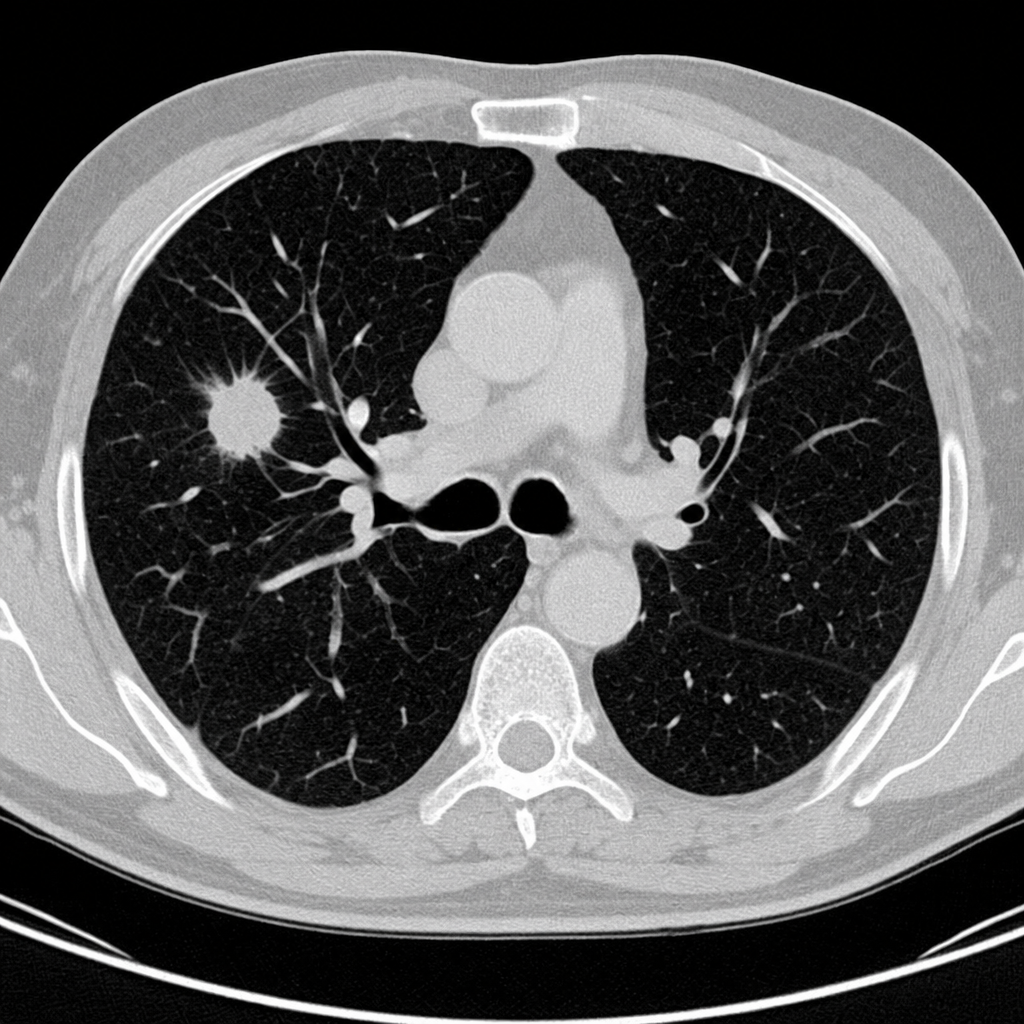
Which of the following is NOT a risk factor for pulmonary embolism?
What is the drug of choice in the management of sarcoidosis?
A patient with a known case of COPD presents with an acute exacerbation and is managed in the ICU. Which of the following statements is NOT true regarding its management?
A 53-year-old male smoker with progressive shortness of breath, who has received multiple courses of antibiotics for presumed bronchitis, presents with diffuse rhonchi and crackles on lung examination. Arterial blood gases show a PaO2 of 68 mm Hg with mild compensated respiratory alkalosis. Sputum for AFB is negative. Associated with this diagnosis is:
A 32-year-old nonsmoking female presents with a 5-week history of intermittent hemoptysis. She denies sputum production, fever, or recurrent infections. There is no history of TB contact. Physical examination reveals the patient is afebrile, with dullness on percussion and decreased breath sounds in the left lower lobe posteriorly. Cardiovascular examination is normal. PPD shows 4-mm induration. Bronchoscopy reveals a polypoid lesion partially obstructing the left lower lobe orifice, which bled easily during the procedure. Bronchial washings are negative for malignancy, and the biopsy is pending. What is the radiological diagnosis based on the described findings?
All of the following are decreased in infiltrative lung disease, except:
Extrinsic allergic alveolitis is caused by infection with which of the following agents?
Kartagener syndrome is characterized by which of the following?
The Kveim skin test is used for the diagnosis of which condition?
Eggshell calcification of hilar lymph nodes is associated with which condition?
Explanation: **Explanation:** The correct answer is **D. Progesterone therapy**. In the context of venous thromboembolism (VTE), it is **Estrogen**, not Progesterone, that significantly increases the risk of pulmonary embolism (PE). Estrogen increases the hepatic synthesis of clotting factors (II, VII, IX, X) and decreases anticoagulant proteins like Protein S and Antithrombin III. Pure progesterone-only pills or levonorgestrel-releasing IUDs are generally considered safe and are not established independent risk factors for VTE. **Analysis of Incorrect Options:** * **A. Protein S deficiency:** This is a hereditary thrombophilia. Protein S is a cofactor for Protein C; its deficiency leads to an inability to inactivate Factors Va and VIIIa, creating a hypercoagulable state. * **B. Malignancy:** Cancers (especially adenocarcinoma of the pancreas, lung, and GI tract) induce a prothrombotic state through the release of tissue factor, mucin, and inflammatory cytokines (Trousseau’s syndrome) [1]. * **C. Obesity:** A BMI >30 kg/m² is a well-recognized risk factor due to chronic inflammation, increased intra-abdominal pressure (venous stasis), and higher levels of plasminogen activator inhibitor-1 (PAI-1) [1]. **Clinical Pearls for NEET-PG:** * **Virchow’s Triad:** The pathophysiology of PE rests on three pillars: **Stasis** (immobilization), **Endothelial injury** (surgery/trauma), and **Hypercoagulability** (malignancy/OCPs) [1]. * **Most Common Risk Factor:** In hospitalized patients, the most common trigger is **recent surgery** (especially orthopedic). * **Genetic Risk:** **Factor V Leiden** is the most common inherited cause of hypercoagulability. * **ECG Finding:** While **Sinus Tachycardia** is the most common ECG finding, the **S1Q3T3 pattern** is the most specific but occurs in only <20% of cases.
Explanation: **Explanation:** **1. Why Prednisolone is the Correct Answer:** Sarcoidosis is a multisystem inflammatory disease characterized by non-caseating granulomas. **Corticosteroids (Prednisolone)** are the first-line treatment and the drug of choice because they effectively suppress the inflammatory response and inhibit granuloma formation. Treatment is indicated in symptomatic Stage II-IV pulmonary disease, or extrapulmonary involvement (cardiac, neurological, ocular, or hypercalcemia). The typical starting dose is 20–40 mg/day, tapered over 6–12 months. **2. Why the Other Options are Incorrect:** * **Methotrexate (Option B):** This is the **second-line agent** (steroid-sparing drug) of choice [1]. It is used when patients are refractory to steroids, experience intolerable side effects, or require high maintenance doses. * **Cyclophosphamide (Option A):** This is a potent immunosuppressant reserved for severe, refractory cases (e.g., neurosarcoidosis) that do not respond to steroids or methotrexate. It is not first-line due to its toxicity profile. * **Cyclosporine (Option D):** It has shown limited efficacy in pulmonary sarcoidosis and is rarely used in standard management protocols. **3. Clinical Pearls for NEET-PG:** * **Indications for Treatment:** Not all patients need treatment. Asymptomatic Stage I (bilateral hilar lymphadenopathy) usually requires only observation as it often resolves spontaneously [2]. * **Lofgren’s Syndrome:** A classic triad of Erythema nodosum, bilateral hilar lymphadenopathy, and arthralgia [2]. It has a highly favorable prognosis. * **Heerfordt’s Syndrome (Uveoparotid fever):** Characterized by parotid enlargement, facial nerve palsy, and anterior uveitis. * **Biomarker:** Elevated **Serum ACE (Angiotensin-Converting Enzyme)** levels are seen in 60-80% of active cases (useful for monitoring, not definitive for diagnosis).
Explanation: In the management of acute exacerbation of COPD (AECOPD), **Non-invasive Ventilation (NIV)** is considered the **gold standard** of care for patients with respiratory failure (specifically Type 2 respiratory failure with respiratory acidosis, pH <7.35). Therefore, the statement that NIV is "not indicated" is incorrect. NIV reduces the need for endotracheal intubation, decreases the length of hospital stay, and significantly reduces mortality. **Analysis of Options:** * **Option A (Correct Answer):** NIV is actually the first-line intervention in the ICU for AECOPD. It helps by providing positive end-expiratory pressure (PEEP) to counteract intrinsic PEEP, thereby reducing the work of breathing. * **Option B:** Oxygen inhalation is essential, but it must be titrated carefully (target SpO2: 88–92%) to avoid worsening hypercapnia due to the loss of hypoxic respiratory drive [3]. * **Option C:** Short-acting beta-agonists (SABA) like Salbutamol are the first-line bronchodilators used to relieve acute bronchospasm [2]. * **Option D:** Systemic corticosteroids (IV Dexamethasone or Methylprednisolone, or Oral Prednisolone) are standard care to reduce airway inflammation, improve lung function (FEV1), and shorten recovery time [1]. **Clinical Pearls for NEET-PG:** * **Indications for NIV in AECOPD:** Respiratory acidosis (pH ≤ 7.35 and/or PaCO2 > 45 mmHg) or severe dyspnea with clinical signs of muscle fatigue [4]. * **Antibiotics:** Indicated if there is increased sputum purulence, increased sputum volume, and increased dyspnea (Anthonisen Criteria). * **Most common trigger for AECOPD:** Viral or bacterial infections (e.g., *H. influenzae*, *S. pneumoniae*).
Explanation: **Diagnosis: Bronchioloalveolar Carcinoma (BAC) / Adenocarcinoma in situ** The clinical presentation of a chronic smoker with progressive dyspnea, "pseudo-pneumonia" (recurrent antibiotic use for presumed bronchitis), diffuse crackles, and hypoxemia strongly suggests **Bronchioloalveolar Carcinoma (BAC)**, now classified under the spectrum of Adenocarcinoma of the lung [1]. ### 1. Why Clubbing is the Correct Answer Digital clubbing is a classic paraneoplastic manifestation of primary lung malignancies, particularly **non-small cell lung cancer (NSCLC)** like adenocarcinoma [1]. In BAC, the tumor often spreads along the alveolar walls (lepidic growth) without invading the stroma, leading to significant V/Q mismatch and hypoxemia. Chronic hypoxemia and the release of growth factors (like PDGF and VEGF) from the tumor or impacted platelets in the distal vasculature lead to the soft tissue proliferation characteristic of **clubbing** [1]. ### 2. Why Other Options are Incorrect * **Increased IgE & Eosinophilia (Options B & D):** These are hallmarks of **Allergic Bronchopulmonary Aspergillosis (ABPA)** or asthma. While ABPA presents with cough and infiltrates, it typically occurs in long-standing asthmatics and wouldn't be the primary suspicion in an older smoker with this presentation. * **Hypocalcemia (Option C):** Lung malignancies, specifically Squamous Cell Carcinoma, are more commonly associated with **Hypercalcemia** due to the secretion of Parathyroid Hormone-related Protein (PTHrP) [1]. ### 3. Clinical Pearls for NEET-PG * **Bronchorrhea:** The production of large volumes of watery sputum (>100mL/day) is a pathognomonic feature of the mucinous subtype of BAC. * **Radiology:** BAC can mimic pneumonia on X-ray (consolidation) but fails to resolve with antibiotics—often called the **"non-resolving pneumonia"** sign [1]. * **Hypertrophic Osteoarthropathy (HOA):** The combination of clubbing and periostitis of long bones is highly associated with lung adenocarcinoma [1].
Explanation: ### Explanation The clinical presentation points toward an **endobronchial tumor** (likely a bronchial carcinoid, given the patient's age, non-smoking status, and the vascular, polypoid nature of the lesion). **1. Why Left Lower Lobe (LLL) Atelectasis is Correct:** The bronchoscopy reveals a **polypoid lesion partially obstructing** the LLL orifice. In clinical pulmonology, a persistent endobronchial obstruction leads to the resorption of air distal to the blockage, resulting in **resorption atelectasis** (collapse). [2] * **Physical Signs:** Dullness on percussion and decreased breath sounds are classic signs of both atelectasis and effusion. [2] However, the bronchoscopic finding of an obstructive mass makes atelectasis the most logical radiological consequence. **2. Why Incorrect Options are Wrong:** * **Pneumonia (A):** While pneumonia can cause dullness and decreased breath sounds, the patient is **afebrile** and has no sputum production or leukocytosis, making an acute infectious process unlikely. [1] * **Pneumothorax (C):** Pneumothorax presents with **hyper-resonance** on percussion (due to air in the pleural space), not dullness. * **Pleural Effusion (D):** While effusion causes dullness and decreased breath sounds, it would not explain the **endobronchial polypoid mass** seen on bronchoscopy. **3. NEET-PG Clinical Pearls:** * **Bronchial Carcinoid:** The most common primary lung tumor in young, non-smoking adults. They are highly vascular; hence, they present with **hemoptysis** and bleed easily during biopsy ("cherry-red adenoma"). [2] * **Atelectasis vs. Effusion:** On X-ray, both appear opaque. However, atelectasis causes a **mediastinal shift toward** the side of the lesion (volume loss), whereas a large effusion shifts the **mediastinum away** from the lesion (volume replacement). [2] * **PPD Interpretation:** A 4-mm induration is considered negative in a healthy individual, helping rule out TB in this scenario.
Explanation: **Explanation:** Infiltrative lung diseases, also known as **Interstitial Lung Diseases (ILD)**, are characterized by inflammation and fibrosis of the pulmonary interstitium [1]. This process leads to a **Restrictive Ventilatory Defect**. **1. Why the Alveolar-arterial (A-a) gradient is the correct answer:** The A-a gradient represents the difference between the oxygen concentration in the alveoli and the arterial blood. In ILD, the thickening of the alveolar-capillary membrane and ventilation-perfusion (V/Q) mismatch impair gas exchange. This causes the arterial oxygen (PaO2) to drop while alveolar oxygen remains relatively stable, resulting in an **increased A-a gradient**, not a decreased one. **2. Analysis of Incorrect Options:** * **Vital Capacity (VC) & Total Lung Capacity (TLC):** In restrictive diseases, the lung becomes "stiff" and cannot expand fully. This leads to a reduction in all lung volumes and capacities, including TLC, VC, and Functional Residual Capacity (FRC) [1]. * **Lung Compliance:** Compliance refers to the "distensibility" of the lung [2]. Fibrosis makes the lungs rigid and difficult to inflate, which directly results in **decreased lung compliance**. **Clinical Pearls for NEET-PG:** * **PFT Pattern in ILD:** Decreased TLC, Decreased VC, but a **Normal or Increased FEV1/FVC ratio** (because both FEV1 and FVC decrease proportionately) [1]. * **DLCO:** Diffusing capacity of the lung for carbon monoxide (DLCO) is typically **decreased** in ILD due to the thickened membrane [1]. * **Radiology:** Look for "ground-glass opacities" (early/active) or "honeycombing" (late/fibrotic) on HRCT [1]. * **Physical Exam:** Characterized by bilateral fine, late-inspiratory "Velcro" crackles and digital clubbing [1].
Explanation: **Explanation:** **Extrinsic Allergic Alveolitis (EAA)**, also known as **Hypersensitivity Pneumonitis (HP)**, is an immunologically mediated inflammatory disease of the lung parenchyma (alveoli and distal bronchioles) [1]. It is caused by repeated inhalation of organic dusts or certain chemicals in sensitized individuals. **Why Option B is Correct:** The most common cause of EAA is exposure to **Thermophilic Actinomycetes** (specifically *Saccharopolyspora rectivirgula*), which thrive in moldy hay, straw, or grain. This condition is classically known as **Farmer’s Lung**. The disease is a **Type III (immune complex)** and **Type IV (delayed-type)** hypersensitivity reaction, not a direct infection. **Why Other Options are Incorrect:** * **A & D (Histoplasma & Cryptococcus):** These are fungal pathogens that cause direct pulmonary **infections** (mycoses). EAA is an allergic/inflammatory response to inhaled antigens, not an invasive infection. * **C (Rhinosporidium seeberi):** This agent causes Rhinosporidiosis, a chronic granulomatous infection primarily affecting the mucous membranes of the nose and nasopharynx, presenting as friable polyps. **NEET-PG High-Yield Pearls:** * **Farmer’s Lung:** Caused by Thermophilic Actinomycetes (moldy hay). * **Bird Fancier’s Lung:** Caused by avian proteins in bird droppings/feathers [1]. * **Bagassosis:** Caused by moldy sugar cane residue (*Thermoactinomyces sacchari*). * **Histopathology:** Characterized by poorly formed, non-caseating granulomas and "triad" of interstitial pneumonitis, bronchiolitis, and granulomas [1]. * **Radiology:** Acute phase shows "ground-glass opacities"; chronic phase shows "honeycombing" (upper lobe predominance) [1].
Explanation: **Explanation:** **Kartagener Syndrome** is a specific subset of **Primary Ciliary Dyskinesia (PCD)**, an autosomal recessive disorder characterized by structural or functional defects in the cilia (most commonly a mutation in the **dynein arms**). The syndrome is classically defined by a **clinical triad**: 1. **Situs Inversus:** Due to the failure of ciliary movement during embryonic development, which is necessary for the normal left-right orientation of internal organs. 2. **Bronchiectasis:** Chronic impairment of the mucociliary escalator leads to recurrent lower respiratory tract infections, resulting in permanent dilation of the bronchi [1]. 3. **Sinusitis:** Impaired ciliary clearance in the paranasal sinuses leads to chronic inflammation and infection [1]. **Why "All of the above" is correct:** Since Kartagener Syndrome is defined by the presence of all three components—bronchiectasis, situs inversus, and sinusitis—options A, B, and C are all integral features of the condition. **Clinical Pearls for NEET-PG:** * **Infertility:** A high-yield association. Males are infertile due to **immotile spermatozoa** (tail of sperm is a modified cilium), while females may have reduced fertility due to impaired ciliary action in the **fallopian tubes**. * **Diagnosis:** The screening test of choice is **nasal Nitric Oxide (nNO)** levels (which are low). The definitive diagnosis is made via **electron microscopy** of ciliary biopsy (showing absent dynein arms) or genetic testing. * **Dextrocardia:** While situs inversus involves total organ reversal, dextrocardia (heart on the right side) is the most commonly recognized feature on a chest X-ray in these patients.
Explanation: **Explanation:** **Correct Answer: A. Sarcoidosis** The **Kveim-Siltzbach test** is a historical diagnostic tool for Sarcoidosis. It involves the intradermal injection of a heat-sterilized suspension derived from the spleen or lymph nodes of a patient with known sarcoidosis. If the patient has sarcoidosis, a papule develops at the injection site within 4–6 weeks. A biopsy of this papule reveals **non-caseating granulomas**, confirming a positive result. While highly specific, it is rarely used in modern clinical practice due to the risk of transmitting infections (like prions or hepatitis) and the availability of safer diagnostic methods like EBUS-guided biopsy. **Why other options are incorrect:** * **B. Wegener’s Granulomatosis (GPA):** This is a small-vessel vasculitis. The primary diagnostic markers are **c-ANCA (PR3-ANCA)** and biopsy showing necrotizing granulomatous inflammation. * **C. Graves Disease:** This is an autoimmune hyperthyroidism. Diagnosis is based on clinical features (exophthalmos, goiter), suppressed TSH, elevated T4/T3, and the presence of **TSH-receptor antibodies (TRAb)**. **High-Yield Clinical Pearls for NEET-PG:** * **Pathology of Sarcoidosis:** Characterized by non-caseating granulomas. Look for **Asteroid bodies** and **Schaumann bodies** on histology. * **Radiology:** Bilateral hilar lymphadenopathy (Stage I) is the classic finding [1]. * **Biochemical markers:** Elevated **Serum ACE levels** and **Hypercalciuria/Hypercalcemia** (due to 1-alpha-hydroxylase activity in macrophages) are common [1]. * **Lofgren’s Syndrome:** A specific acute presentation of sarcoidosis consisting of the triad: Erythema nodosum, Bilateral hilar lymphadenopathy, and Polyarthritis/Arthralgia [1].
Explanation: **Explanation:** **Silicosis (Correct Answer):** Eggshell calcification is a classic radiological hallmark of silicosis [1]. It occurs when inhaled crystalline silica particles are ingested by alveolar macrophages, leading to inflammation and fibrosis. These particles migrate to the hilar and mediastinal lymph nodes, causing peripheral calcification of the nodes while the center remains relatively clear, creating the "eggshell" appearance. This finding is seen in approximately 5% of silicosis patients. **Why other options are incorrect:** * **Asbestosis:** Characterized by pleural plaques (most common finding), subpleural linear densities, and "ferruginous bodies" (asbestos fibers coated with iron) [1]. It typically involves the lower lobes and does not cause eggshell calcification. * **Byssinosis:** Caused by cotton, flax, or hemp dust. It is a clinical diagnosis characterized by "Monday morning chest tightness." It does not produce distinct radiological calcifications. * **Anthracosis:** Associated with Coal Workers' Pneumoconiosis (CWP). While it causes "black lung" and progressive massive fibrosis, the lymph node calcification, if present, is usually solid or amorphous rather than the peripheral eggshell pattern [1]. **NEET-PG High-Yield Pearls:** * **Silicosis & TB:** Silicosis significantly increases the risk of Tuberculosis (Silicotuberculosis) because silica impairs macrophage function. * **Radiology:** Silicosis typically involves the **upper lobes** with nodular opacities [1]. * **Differential Diagnosis for Eggshell Calcification:** While Silicosis is the most common cause, it can also be seen in **Sarcoidosis** (rarely), treated Lymphoma, and Amyloidosis. * **Pathology:** Look for "Silicotic nodules" showing whorled collagen fibers under polarized light.
Obstructive Airway Diseases (Asthma, COPD)
Practice Questions
Interstitial Lung Diseases
Practice Questions
Pulmonary Infections
Practice Questions
Pulmonary Vascular Diseases
Practice Questions
Pleural Diseases
Practice Questions
Sleep-Disordered Breathing
Practice Questions
Respiratory Failure
Practice Questions
Mediastinal Disorders
Practice Questions
Occupational Lung Diseases
Practice Questions
Pulmonary Function Testing
Practice Questions
Bronchiectasis and Cystic Fibrosis
Practice Questions
Lung Cancer Approach
Practice Questions
Get full access to all questions, explanations, and performance tracking.
Start For Free