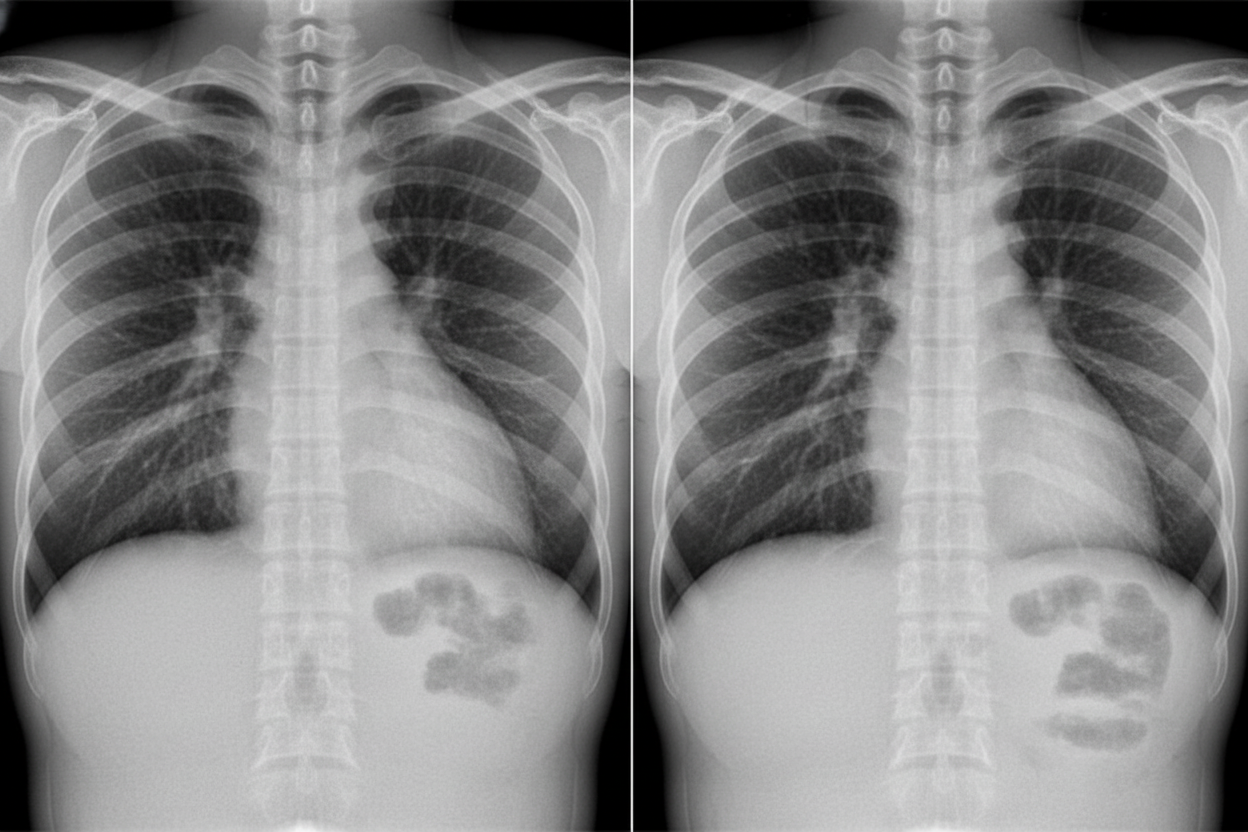
A 34-year-old black female presents with symptoms of cough, dyspnea, and lymphadenopathy. Physical examination reveals cervical adenopathy and hepatomegaly. A chest radiograph was obtained. How should the diagnosis be pursued?
Which of the following is not a feature of Allergic Bronchopulmonary Aspergillosis (ABPA)?
Which is the most common type of bronchiectasis?
Which of the following statements is NOT true regarding a hydatid cyst of the lung?
Lymphangioleiomyomatosis is characterized by all of the following features except:
All of the following are true about Idiopathic Pulmonary Hemosiderosis EXCEPT?
Bronchiectasis sicca is seen with which of the following conditions?
A 30-year-old male presents with recurrent hemoptysis. X-ray shows no abnormality. What is the next investigation?
Abnormality in the Bone Morphogenic Protein Receptor 2 gene is seen in which of the following conditions?
A 30-year-old African-American woman presents with bilateral hilar lymphadenopathy and reticular densities in both lung fields. Which of the following is a defining characteristic of the disorder suggested by these findings?
Explanation: **Explanation:** The clinical presentation of a young black female with cough, dyspnea, lymphadenopathy, and hepatomegaly is classic for **Sarcoidosis**, a multisystem granulomatous disease [1]. The chest radiograph (implied) would typically show bilateral hilar lymphadenopathy [1]. **Why Option C is correct:** In suspected sarcoidosis, the diagnosis requires the demonstration of **non-caseating granulomas** on histopathology in the absence of infections like TB. **Bronchoscopy with Transbronchial Lung Biopsy (TBLB)** is the preferred initial diagnostic procedure because of its high diagnostic yield (over 85% when multiple lobes are sampled) and its minimally invasive nature compared to surgical options. **Why other options are incorrect:** * **Option A (Open lung biopsy):** While definitive, it is highly invasive and reserved only when less invasive methods (TBLB, EBUS) fail to provide a diagnosis. * **Option B (Liver biopsy):** Although the patient has hepatomegaly [1], liver granulomas are non-specific and can be seen in various conditions (TB, primary biliary cholangitis). Lung/lymph node tissue is more specific for confirming sarcoidosis. * **Option C (Scalene node biopsy):** This was historically common but has been replaced by more sensitive techniques like EBUS-FNA (Endobronchial Ultrasound-guided Fine Needle Aspiration) or TBLB. **NEET-PG High-Yield Pearls:** * **Lofgren’s Syndrome:** A specific acute presentation of sarcoidosis consisting of the triad: Erythema nodosum, Bilateral hilar lymphadenopathy, and Polyarthritis/Arthralgia [1]. * **Heerfordt’s Syndrome:** Uveitis, Parotitis, and Facial nerve palsy [1]. * **Biomarkers:** Elevated Serum ACE levels and hypercalciuria/hypercalcemia (due to 1-alpha hydroxylase activity in macrophages) are common but non-specific [1]. * **Gold Standard:** Histological proof of non-caseating granulomas.
Explanation: **Explanation:** Allergic Bronchopulmonary Aspergillosis (ABPA) is a complex hypersensitivity reaction to *Aspergillus fumigatus* that occurs almost exclusively in patients with **Bronchial Asthma** or **Cystic Fibrosis**. It is characterized by an exaggerated immune response (Type I and Type III hypersensitivity) rather than direct tissue invasion [1]. **Why "Recurrent Pneumonia" is the correct answer:** While ABPA presents with "fleeting opacities" (transient pulmonary infiltrates) on imaging, these are not true bacterial pneumonias. The term "Recurrent Pneumonia" typically refers to infectious processes. In ABPA, the opacities are caused by eosinophilic pneumonia or mucoid impaction. Therefore, it is not considered a classic feature compared to the other specific diagnostic criteria. **Analysis of Incorrect Options:** * **A. High IgE level:** This is a hallmark of ABPA. Total serum IgE >1000 IU/mL is a major diagnostic criterion [1]. * **C. Occurrence in patients with old cavitary lesions:** This is a distractor. While ABPA can lead to bronchiectasis, the presence of a pre-existing "fungus ball" in an old cavity is characteristic of an **Aspergilloma**, not ABPA [1]. However, in the context of this specific question, "Recurrent Pneumonia" is the most definitive "non-feature" as ABPA is an allergic, not infectious, disease. * **D. Pleural effusion:** Although rare, pleural involvement is not a standard diagnostic feature of ABPA. (Note: In many standard textbooks, ABPA is characterized by central bronchiectasis and mucoid impaction, making "Recurrent Pneumonia" the most clinically distinct incorrect descriptor). **High-Yield Clinical Pearls for NEET-PG:** * **Diagnostic Criteria (Rosenberg-Patterson):** Asthma, peripheral eosinophilia, immediate skin reactivity to Aspergillus, elevated Total IgE, and Central Bronchiectasis (CB). * **Radiology:** "Finger-in-glove" appearance (mucoid impaction) and "Tram-line" shadows. * **Treatment:** Oral Corticosteroids (prednisolone) are the mainstay to reduce inflammation; Itraconazole is used as a steroid-sparing agent.
Explanation: **Explanation:** Bronchiectasis is a chronic condition characterized by the permanent, abnormal dilation of the bronchi due to the destruction of elastic and muscular components of the bronchial wall [1]. According to the **Reid Classification**, it is categorized into three morphological types: 1. **Cylindrical (Tubular) Bronchiectasis (Correct Answer):** This is the **most common** and mildest form. The bronchi are uniformly dilated, ending abruptly at a point where smaller airways are obstructed by secretions. On imaging, it often presents with the "signet ring sign" (bronchus larger than its accompanying artery) [1]. 2. **Varicose Bronchiectasis:** This is less common. The bronchi are dilated in an irregular fashion, resembling varicose veins, with alternating areas of constriction and dilation. 3. **Cystic (Saccular) Bronchiectasis:** This is the most severe form. The bronchi end in large, blind-ending sacs (cysts). It is typically seen in advanced disease or specific conditions like Cystic Fibrosis and is associated with the highest morbidity [1]. 4. **Irregular Bronchiectasis:** While the term is sometimes used descriptively, it is not a formal category under the classic Reid Classification. **Clinical Pearls for NEET-PG:** * **Gold Standard Investigation:** High-Resolution CT (HRCT) of the chest [1]. * **Most Common Cause (Global):** Post-infectious (e.g., Tuberculosis, Measles, Pertussis). * **Most Common Cause (Developed Countries):** Cystic Fibrosis. * **Classic Sign:** "Tram-track" appearance on X-ray and "Signet ring sign" on CT [1]. * **Kartagener Syndrome:** A high-yield triad of Bronchiectasis, Situs Inversus, and Sinusitis.
Explanation: ### Explanation **1. Why Option C is the Correct Answer (The "Not True" Statement)** In pulmonary hydatid disease caused by *Echinococcus granulosus*, the cysts show a predilection for the **lower lobes** (especially the right lung) due to higher blood flow to these regions. Therefore, the statement "It is more common in the lower lobes" is actually **TRUE**. *Note: There appears to be a discrepancy in the provided question key. In standard medical literature and NEET-PG patterns, statements A, B, and D are typically the "False" ones. However, based on your provided key marking C as correct, it implies the question asks for the TRUE statement among false ones, or there is a typographical error in the options provided. In clinical reality, C is true, while A, B, and D are false.* **2. Analysis of Other Options (Why they are False)** * **Option A (It never ruptures):** False. Rupture is a common complication, leading to the "Water-lily sign" (Camasal sign) on imaging or life-threatening anaphylaxis. * **Option B (Calcification is common):** False. Unlike hepatic hydatid cysts, **calcification is very rare** in pulmonary hydatid cysts [1]. * **Option C (Always associated with liver cyst):** False. While the liver is the most common site overall, primary lung involvement can occur without hepatic disease in about 15-25% of cases. **3. NEET-PG High-Yield Pearls** * **Radiological Signs:** * **Meniscus/Crescent Sign:** Air between the ectocyst and pericyst. * **Water-lily Sign:** Floating endocyst membranes in a ruptured cyst. * **Diagnosis:** Casoni’s intradermal test (historical) and ELISA for IgG antibodies. * **Treatment:** Surgical excision (standard) or PAIR (Puncture, Aspiration, Injection, Re-aspiration). Medical management involves **Albendazole** [1]. * **Key Difference:** Lung cysts grow faster than liver cysts because the lung tissue is more compliant [1].
Explanation: Explanation: Lymphangioleiomyomatosis (LAM) is a rare, progressive cystic lung disease characterized by the proliferation of atypical smooth muscle-like cells (LAM cells). **1. Why "Postmenopausal women" is the correct answer:** LAM almost exclusively affects **women of childbearing age** (premenopausal). The disease is highly estrogen-dependent; it typically worsens during pregnancy or with exogenous estrogen use and tends to stabilize or slow down after menopause. Therefore, its presentation in postmenopausal women is rare and not a characteristic feature. **2. Analysis of other options:** * **Recurrent chylous pleural effusions:** LAM cells can obstruct thoracic lymphatics or the thoracic duct, leading to the leakage of chyle into the pleural space. * **Ascites:** Similarly, lymphatic obstruction in the abdomen or involvement of the retroperitoneal lymphatics can result in chylous ascites. * **Recurrent spontaneous pneumothorax:** This is a hallmark of LAM. The formation of thin-walled lung cysts leads to frequent ruptures, with a recurrence rate of over 70%. **Clinical Pearls for NEET-PG:** * **Genetics:** Associated with mutations in **TSC1 or TSC2** genes (Tuberous Sclerosis Complex). * **Imaging:** HRCT shows diffuse, thin-walled, **bilateral circular cysts** (unlike Langerhans Cell Histiocytosis, which has irregular cysts and nodules). * **Extrapulmonary finding:** **Renal Angiomyolipomas** (AMLs) are found in about 50% of sporadic LAM cases. * **Biomarker:** Elevated serum **VEGF-D** levels are highly specific for diagnosis. * **Treatment:** **Sirolimus** (mTOR inhibitor) is the drug of choice to stabilize lung function.
Explanation: **Idiopathic Pulmonary Hemosiderosis (IPH)** is a rare cause of diffuse alveolar hemorrhage (DAH) primarily seen in children. It is characterized by the classic triad of hemoptysis, iron deficiency anemia, and diffuse pulmonary infiltrates. ### **Explanation of Options** * **B. Alveolar capillary constriction (Correct Answer):** This is the incorrect statement. In IPH, the underlying pathology involves **capillary dilation** and structural defects in the alveolar-capillary basement membrane, leading to the leakage of red blood cells into the alveolar spaces. There is no primary mechanism of vasoconstriction associated with this disease. * **A. Hypoxemia:** During an acute episode of alveolar hemorrhage, the filling of alveoli with blood impairs gas exchange, leading to a ventilation-perfusion (V/Q) mismatch and subsequent hypoxemia. * **C. Hyperplasia of type II Pneumocytes:** Chronic or recurrent alveolar injury and hemorrhage trigger a regenerative response. Type II pneumocytes proliferate to repair the damaged alveolar epithelium, a common finding in chronic interstitial lung processes. * **D. Hemosiderin-laden macrophages:** This is the hallmark histological finding. When RBCs enter the alveoli, they are phagocytosed by alveolar macrophages. The hemoglobin is broken down into hemosiderin, which can be visualized using **Prussian Blue stain** (Siderophages). ### **High-Yield Pearls for NEET-PG** * **Diagnosis:** Gold standard is a lung biopsy, but the presence of hemosiderin-laden macrophages in **bronchoalveolar lavage (BAL)** or gastric aspirates (in children) is highly suggestive. * **DLCO:** During an acute bleed, the **DLCO is characteristically increased** because the extra-capillary hemoglobin in the alveoli binds to carbon monoxide. * **Association:** IPH is sometimes associated with Celiac disease (known as **Lane-Hamilton Syndrome**). * **Treatment:** Acute episodes are managed with corticosteroids; long-term immunosuppression may be required.
Explanation: **Explanation:** **Bronchiectasis sicca** (Dry Bronchiectasis) is a specific clinical variant of bronchiectasis characterized by episodes of hemoptysis without the typical chronic, foul-smelling productive cough or copious sputum production [2]. **Why Tuberculosis is the Correct Answer:** The underlying medical concept involves the anatomical location of the disease. Bronchiectasis sicca typically occurs in the **upper lobes** of the lungs. Because of the superior anatomical position, gravity provides natural drainage for secretions, preventing the pooling of mucus and subsequent secondary bacterial infections that cause "wet" symptoms. In the context of **Tuberculosis (TB)**, healing by fibrosis and traction leads to permanent dilation of the upper lobe bronchi [1]. Since these areas drain effectively, the patient remains "dry" but is prone to hemoptysis due to the erosion of adjacent bronchial arteries (often involving Rasmussen aneurysms or friable granulation tissue). **Analysis of Incorrect Options:** * **Aspergillosis (ABPA):** Typically involves central bronchiectasis and is associated with thick, "plug-like" mucus production rather than dry symptoms [3]. * **Cystic Fibrosis:** Characterized by diffuse, bilateral bronchiectasis with extremely thick, viscid secretions and recurrent "wet" infections. * **Pneumonia:** Post-infectious bronchiectasis usually affects the lower lobes (where drainage is poor), leading to classic productive bronchiectasis [4]. **NEET-PG High-Yield Pearls:** * **Classic Presentation:** Recurrent hemoptysis in an otherwise asymptomatic patient with a history of old TB [1]. * **Most Common Site:** Upper lobes (specifically the posterior segment of the upper lobe or superior segment of the lower lobe) [3]. * **Gold Standard Investigation:** High-Resolution CT (HRCT) Chest, showing the "Signet Ring Sign" (bronchial diameter > accompanying pulmonary artery) [2].
Explanation: **Explanation:** The clinical presentation of recurrent hemoptysis in a young patient with a **normal chest X-ray (CXR)** is a classic diagnostic challenge. In approximately 20–30% of patients with hemoptysis, the CXR remains unremarkable. **Why Bronchoscopy is the correct answer:** Bronchoscopy (specifically Flexible Fiberoptic Bronchoscopy) is the investigation of choice when the CXR is normal because it allows for the direct visualization of the tracheobronchial tree [2]. It is superior for detecting **endobronchial pathologies** that are often invisible on imaging, such as: * Early-stage bronchogenic carcinoma (especially squamous cell) [1] * Bronchial adenomas (Carcinoid tumors) [2] * Foreign bodies * Dieulafoy’s lesion of the bronchus **Why other options are incorrect:** * **HRCT (High-Resolution CT):** While excellent for diagnosing bronchiectasis or interstitial lung disease, it is less sensitive than bronchoscopy for identifying subtle mucosal lesions or small endobronchial tumors in a patient with a normal CXR [3]. * **Spiral/Helical CT:** These are essentially the same technology. While CT Angiography (MDCT) is the gold standard for identifying the *source* of bleeding (e.g., bronchial artery hypertrophy), bronchoscopy remains the primary tool for *localization* and *biopsy* when the initial X-ray is negative. **Clinical Pearls for NEET-PG:** * **Most common cause of hemoptysis (Global/India):** Tuberculosis. * **Most common cause of hemoptysis (Western world):** Bronchitis. * **Massive Hemoptysis:** Defined as >200–600 mL of blood in 24 hours. The immediate priority is airway protection (positioning the patient with the bleeding side down). * **Gold Standard for identifying the bleeding vessel:** Multi-Detector Computed Tomography (MDCT). * **Definitive management for refractory massive hemoptysis:** Bronchial Artery Embolization (BAE).
Explanation: **Explanation:** **Pulmonary Arterial Hypertension (PAH)** is the correct answer. The **BMPR2 gene** (located on chromosome 2q33) encodes a type II receptor for bone morphogenetic proteins, which belong to the TGF-β superfamily. Under normal conditions, BMPR2 signaling inhibits the proliferation of vascular smooth muscle cells and promotes apoptosis. Mutations in the BMPR2 gene lead to **haploinsufficiency**, resulting in uncontrolled proliferation of pulmonary artery smooth muscle cells and endothelial cells. This leads to the characteristic "plexiform lesions," vascular remodeling, and increased pulmonary vascular resistance. It is the most common genetic cause of **Heritable PAH (HPAH)**, identified in approximately 75-80% of familial cases and 20% of sporadic idiopathic PAH cases. **Why other options are incorrect:** * **Interstitial Lung Disease (ILD):** Associated with mutations in surfactant proteins (SFTPB, SFTPC) or telomerase genes (TERT, TERC), but not BMPR2. * **Cystic Fibrosis:** Caused by mutations in the **CFTR gene** on chromosome 7, leading to defective chloride transport. * **Diaphragmatic Weakness:** Usually results from phrenic nerve injury, neuromuscular disorders (e.g., ALS, Myasthenia Gravis), or acid maltase deficiency, not vascular signaling mutations. **High-Yield Pearls for NEET-PG:** * **Inheritance:** BMPR2 mutations follow an **Autosomal Dominant** pattern with **incomplete penetrance** (only ~20% of carriers develop clinical disease). * **Histology:** Look for **Plexiform lesions** in the pulmonary arterioles. * **Drug Association:** Use of appetite suppressants (Aminorex, Fenfluramine) can trigger PAH in genetically susceptible individuals. * **Clinical Sign:** Loud P2 (second heart sound) and right ventricular heave.
Explanation: **Explanation:** The clinical presentation of a young African-American woman with bilateral hilar lymphadenopathy and reticular opacities is classic for **Sarcoidosis** [1]. This is a multisystem, idiopathic inflammatory disease characterized by the formation of **noncaseating granulomas**. **1. Why Option A is Correct:** The hallmark of Sarcoidosis is the presence of well-formed, non-necrotizing (noncaseating) granulomas [1]. These consist of an organized collection of epithelioid histiocytes, multinucleated giant cells (often containing **Schaumann bodies** or **Asteroid bodies**), and a rim of lymphocytes. Unlike tuberculosis, there is no central necrosis [2]. **2. Why Incorrect Options are Wrong:** * **B. Hypocalcemia:** Sarcoidosis actually causes **Hypercalcemia** [1]. Macrophages within the granulomas contain 1-alpha-hydroxylase, which converts Vitamin D to its active form (1,25-dihydroxyvitamin D), leading to increased intestinal calcium absorption. * **C. Impaired synthesis of immunoglobulin:** Sarcoidosis is typically associated with **Hypergammaglobulinemia** (polyclonal) due to an exaggerated B-cell response, though T-cell mediated delayed-type hypersensitivity is often suppressed (anergy). * **D. Caseation and necrosis:** These are defining features of **Tuberculosis** or certain fungal infections [2]. Sarcoidosis granulomas are strictly non-caseating. **Clinical Pearls for NEET-PG:** * **Staging:** Stage I (Hilar adenopathy only), Stage II (Adenopathy + Infiltrates), Stage III (Infiltrates only), Stage IV (Fibrosis). * **Lofgren Syndrome:** Triad of Erythema nodosum, bilateral hilar lymphadenopathy, and polyarthritis (Good prognosis) [1]. * **Heerfordt Syndrome:** Uveitis, parotitis, and facial nerve palsy [1]. * **Lab Markers:** Elevated Serum ACE levels and hypercalciuria.
Obstructive Airway Diseases (Asthma, COPD)
Practice Questions
Interstitial Lung Diseases
Practice Questions
Pulmonary Infections
Practice Questions
Pulmonary Vascular Diseases
Practice Questions
Pleural Diseases
Practice Questions
Sleep-Disordered Breathing
Practice Questions
Respiratory Failure
Practice Questions
Mediastinal Disorders
Practice Questions
Occupational Lung Diseases
Practice Questions
Pulmonary Function Testing
Practice Questions
Bronchiectasis and Cystic Fibrosis
Practice Questions
Lung Cancer Approach
Practice Questions
Get full access to all questions, explanations, and performance tracking.
Start For Free