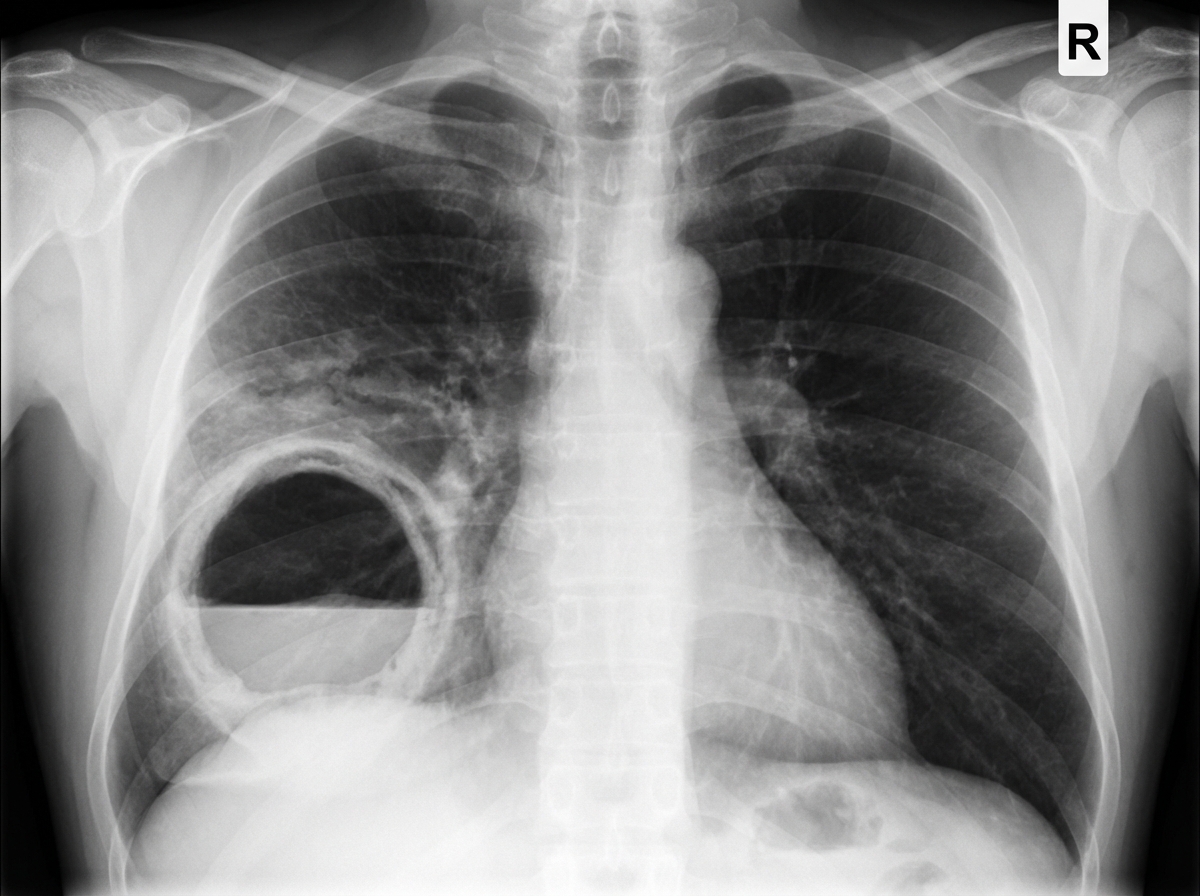
Atypical chest X-ray findings in tuberculosis are usually seen in which of the following populations?
Which investigation is known as the rule-out test in massive pulmonary embolism?
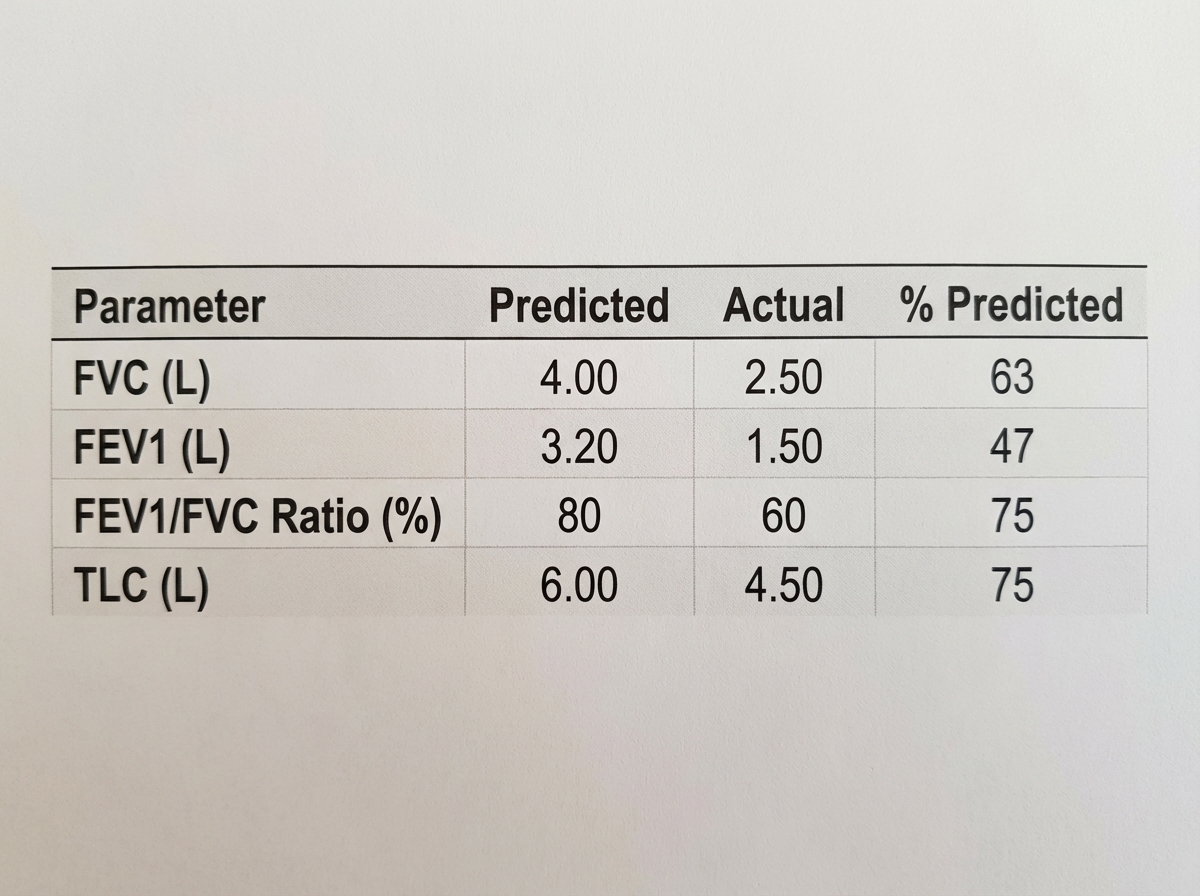
A 24-year-old African American woman presents with mild dyspnea on exertion, fever, and a rash on her legs. Her symptoms have come on gradually and she reports no pleuritic chest pain, hemoptysis, or sputum production. She has no significant past medical history, smokes 10 cigarettes/day, and is not taking any medications. Physical examination reveals generalized lymphadenopathy and tender erythematous nodules on her legs. CXR shows bilateral symmetric hilar adenopathy and reticulonodular changes in both lungs. She has a restrictive lung disease pattern on pulmonary function testing. Which of the following is the most likely diagnosis?
A 55-year-old man presents with a history of shortness of breath and dry cough for several years. He reports smoking 1.5 packs of cigarettes and consuming approximately four bottles of beer daily. He experiences significant dyspnea, limiting his ambulation to a few steps due to breathlessness. Physical examination reveals prolonged expiration with wheezing, a barrel chest, hyperresonance on percussion, and digital clubbing. The patient also exhibits facial plethora and pitting edema of the legs. Chest X-ray shows hyperinflation, flattened diaphragms, and an enlarged retrosternal air space. What is the most likely diagnosis?
While assessing the risk of fatality among adults using the Pneumonia Severity Index, which of the following factors is most important?
Curschmann spirals and flattening of the diaphragm are typically seen in which respiratory condition?
All of the following are used in pleurodesis except?
Caplan's syndrome, characterized by rheumatoid arthritis and pneumoconiosis, is typically associated with which of the following findings?
A nurse assessing a patient for tracheal displacement should know that the trachea will deviate toward which side in the following conditions?
Which of the following does not cause pulmonary hypertension?
Explanation: **Explanation:** The presentation of Pulmonary Tuberculosis (PTB) on a chest X-ray (CXR) is heavily dependent on the host's immune status. In immunocompetent adults, **Post-Primary (Reactivation) TB** typically presents with "typical" findings: upper lobe infiltrates and cavitary lesions. **1. Why HIV is the correct answer:** In patients with HIV, the radiological presentation depends on the degree of immunosuppression (CD4 count). [1] As the CD4 count declines, the body loses the ability to form granulomas and contain the infection. This leads to **"atypical" findings**, which resemble primary TB rather than reactivation TB. These include: * Lower or middle lobe opacities (instead of upper lobes). * Intrathoracic lymphadenopathy (hilar/mediastinal). * Miliary patterns. * **Absence of cavitation** (cavitation is an immune-mediated necrotic process; low immunity prevents its formation). [1] * Normal CXR (seen in up to 10-15% of symptomatic HIV patients). **2. Why other options are incorrect:** * **MDR-TB:** The drug resistance profile of the *M. tuberculosis* strain does not inherently change the radiological pattern; it affects treatment response. * **Adults with TB:** Most adults present with "typical" reactivation TB (upper lobe cavitary disease) unless they are severely immunocompromised. * **Culture-positive TB:** This simply confirms the diagnosis and does not dictate the radiological morphology. **High-Yield Clinical Pearls for NEET-PG:** * **CD4 >200/mm³:** CXR often shows typical post-primary patterns (cavitation). [1] * **CD4 <200/mm³:** CXR shows atypical patterns (adenopathy, no cavities, lower lobe involvement). [1] * **Most common CXR finding in Primary TB:** Hilar lymphadenopathy. * **Ghon’s Complex:** Calcified peripheral node + calcified hilar node (Ranke complex).
Explanation: **Explanation:** The correct answer is **D-dimer**. In the diagnostic workup of Pulmonary Embolism (PE), a D-dimer assay is characterized by its **high sensitivity** (approx. 95-97%) but low specificity. Because it is highly sensitive, a negative result (typically <500 ng/mL) effectively excludes the diagnosis of PE in patients with a low-to-moderate clinical probability (Wells' Score). Therefore, it is clinically utilized as a **"rule-out" test**. **Analysis of Options:** * **A. ECG:** While common findings include sinus tachycardia or the classic S1Q3T3 pattern, ECG is neither sensitive nor specific enough to rule out or rule in PE [1]. It is primarily used to exclude other differentials like Myocardial Infarction [1]. * **B. Echocardiogram:** This is the initial investigation of choice in **hemodynamically unstable (massive) PE** to look for right ventricular (RV) strain (e.g., McConnell’s sign) [1]. However, a normal echo does not definitively rule out a smaller PE. * **D. Arterial Blood Gas (ABG):** ABG typically shows hypoxemia, hypocapnia, and respiratory alkalosis [1]. However, a significant percentage of patients with PE can have a normal A-a gradient and normal PaO2, making it unreliable as a rule-out tool. **High-Yield Clinical Pearls for NEET-PG:** * **Gold Standard Investigation:** CT Pulmonary Angiography (CTPA) [1]. * **Most Common ECG Finding:** Sinus Tachycardia [1]. * **Most Specific ECG Finding:** S1Q3T3 pattern (indicates acute cor pulmonale) [1]. * **Definitive/Reference Standard:** Conventional Pulmonary Angiography (rarely used now). * **Age-Adjusted D-dimer:** For patients >50 years, use (Age × 10 µg/L) as the cutoff to improve specificity.
Explanation: ### Explanation **Correct Answer: D. Sarcoidosis** **1. Why Sarcoidosis is Correct:** This case presents the classic clinical triad of **Sarcoidosis**: bilateral hilar lymphadenopathy (BHL), erythema nodosum (the tender nodules on the legs), and systemic symptoms (fever, dyspnea) [1]. * **Demographics:** It is most common in young adults, particularly African American women. * **Clinical Features:** The "rash" described is **Erythema Nodosum**, a hallmark of acute sarcoidosis (often part of *Löfgren syndrome*) [1]. * **Imaging/PFTs:** CXR shows Stage II sarcoidosis (BHL + parenchymal infiltrates). The restrictive pattern on PFT (decreased TLC, decreased FVC) is characteristic of interstitial lung involvement. **2. Why Other Options are Incorrect:** * **A. Hodgkin’s Disease:** While it causes lymphadenopathy, it typically presents with asymmetric mediastinal nodes rather than symmetric hilar nodes. Erythema nodosum is not a classic feature. * **B. Tuberculosis:** TB can cause hilar adenopathy and fever, but it is usually asymmetric or unilateral. The presence of symmetric BHL and erythema nodosum in a stable patient strongly favors sarcoidosis over TB. * **C. Rheumatic Fever:** Presents with migratory polyarthritis, carditis, and *Erythema Marginatum* (not Nodosum). It does not cause BHL or restrictive lung disease. **3. NEET-PG High-Yield Pearls:** * **Löfgren Syndrome (Acute Sarcoid):** Triad of Erythema Nodosum + Bilateral Hilar Adenopathy + Polyarthritis/Arthralgia [1]. It has a highly favorable prognosis. * **Heerfordt Syndrome (Uveoparotid Fever):** Uveitis + Parotid swelling + Facial nerve palsy + Fever. * **Pathology:** Non-caseating granulomas (Schumann bodies and Asteroid bodies). * **Biomarkers:** Elevated Serum ACE levels and hypercalciuria/hypercalcemia (due to 1-alpha hydroxylase activity in macrophages). * **Diagnosis:** Transbronchial lung biopsy is the investigation of choice to confirm non-caseating granulomas.
Explanation: **Explanation:** The patient presents with classic features of **Emphysema**, a subtype of Chronic Obstructive Pulmonary Disease (COPD) characterized by the permanent enlargement of airspaces distal to the terminal bronchioles. **Why Emphysema is correct:** * **Clinical Presentation:** The "Pink Puffer" phenotype is suggested by severe dyspnea, a barrel chest (increased AP diameter), and prolonged expiration [1]. * **Radiological Findings:** Hyperinflation, flattened diaphragms, and an enlarged retrosternal airspace are hallmark signs of air trapping and loss of elastic recoil. * **Complications:** Facial plethora and pitting edema indicate **Cor Pulmonale** (right heart failure) and secondary polycythemia due to chronic hypoxemia [1]. * **Digital Clubbing:** While not a standard feature of uncomplicated COPD, its presence in a heavy smoker should raise suspicion for underlying bronchogenic carcinoma or significant bronchiectasis; [1] however, in the context of the provided options and classic hyperinflation, Emphysema remains the best fit. **Why other options are incorrect:** * **Asthma:** Typically presents with episodic, reversible wheezing and a history of atopy. It does not usually cause permanent barrel chest or chronic hyperinflation on X-ray in early stages [1]. * **Chronic Bronchitis:** Defined clinically by a productive cough for ≥3 months over 2 consecutive years ("Blue Bloaters"). This patient has a dry cough and predominant obstructive physical findings [1]. * **Usual Interstitial Pneumonia (UIP):** A restrictive lung disease characterized by "velcro" crackles and honeycombing on imaging, rather than hyperinflation and hyperresonance [2]. **NEET-PG High-Yield Pearls:** * **Centriacinar Emphysema:** Most common type; associated with smoking; affects upper lobes [3]. * **Panacinar Emphysema:** Associated with **Alpha-1 Antitrypsin deficiency**; affects lower lobes. * **Pathophysiology:** Imbalance between proteases (elastase) and antiproteases (A1AT). * **PFTs:** Characterized by decreased FEV1/FVC ratio (<0.70) and **increased Total Lung Capacity (TLC)** due to air trapping [3].
Explanation: ### Explanation The **Pneumonia Severity Index (PSI)**, also known as the **PORT Score**, is a clinical prediction rule used to calculate the probability of morbidity and mortality among patients with Community-Acquired Pneumonia (CAP). **Why Age is the Correct Answer:** The PSI is a weighted scoring system consisting of 20 variables. Among these, **Age** is the most significant driver of the total score. For men, the score starts with their age in years; for women, it is age minus 10. Because the score is cumulative, an elderly patient (e.g., 85 years old) automatically enters a higher risk category (Class IV) based on age alone, even before considering comorbidities or lab abnormalities. This reflects the clinical reality that advanced age is the strongest independent predictor of mortality in pneumonia [1]. **Analysis of Incorrect Options:** * **B. Presence of Congestive Heart Failure (CHF):** While a significant comorbidity, it adds only **+10 points** to the score. * **C. Hypothermia:** Defined as a temperature <35°C, it adds **+15 points**. * **D. Hyponatremia:** Sodium <130 mmol/L adds **+20 points**. In contrast, a 70-year-old male receives **70 points** for age alone, far outweighing the individual point values of the other clinical or laboratory parameters listed. **High-Yield Clinical Pearls for NEET-PG:** * **PSI vs. CURB-65:** PSI is more complex (20 variables) and better at identifying **low-risk patients** suitable for outpatient care. CURB-65 is simpler (5 variables) and better for identifying **high-risk patients** needing ICU admission [1]. * **PSI Risk Classes:** * **Class I-II:** Outpatient treatment. * **Class III:** Observation or brief hospitalization. * **Class IV-V:** Inpatient treatment (Class V often requires ICU). * **Other high-scoring variables:** Neoplastic disease (+30), Altered mental status (+20), and Tachypnea >30/min (+20).
Explanation: **Explanation:** The correct answer is **Asthma**. This question tests your ability to integrate pathological findings with radiological signs in obstructive airway diseases. 1. **Why Asthma is Correct:** * **Curschmann spirals** are a classic histopathological finding in bronchial asthma. They are microscopic mucus plugs consisting of twisted strips of desquamated epithelium found in the sputum. They represent the inspissated mucus that forms in the small airways during an attack. * **Flattening of the diaphragm** is a radiological sign of **hyperinflation**. During an acute asthma exacerbation, air trapping occurs due to bronchoconstriction and mucus plugging, leading to an increased functional residual capacity (FRC) and a flattened appearance of the diaphragm on a chest X-ray [1]. 2. **Analysis of Incorrect Options:** * **COPD:** While COPD (especially emphysema) frequently shows a flattened diaphragm due to chronic hyperinflation [1], **Curschmann spirals are not a characteristic feature**. * **Silicosis:** This is a restrictive lung disease characterized by "eggshell calcification" of hilar lymph nodes and nodular opacities in the upper lobes, not mucus spirals or hyperinflation. * **Pulmonary Embolism:** Typically presents with a normal X-ray or specific signs like Hampton’s hump or Westermark sign. It does not involve mucus plug formation. **High-Yield Clinical Pearls for NEET-PG:** * **Charcot-Leyden Crystals:** Often found alongside Curschmann spirals in asthma; these are needle-shaped crystals derived from eosinophil breakdown (Galectin-10). * **Creola Bodies:** Ciliated columnar epithelial cell clusters found in the sputum of asthmatics. * **Reversibility:** Asthma is defined by the reversibility of airway obstruction (>12% and >200ml improvement in FEV1 after bronchodilator inhalation) [2].
Explanation: **Explanation:** Pleurodesis is a medical procedure used to obliterate the pleural space to prevent the recurrent accumulation of air (pneumothorax) or fluid (malignant pleural effusion) [1], [2]. It involves the installation of a chemical irritant (sclerosant) into the pleural cavity to induce inflammation and subsequent fibrosis between the visceral and parietal pleura. **Why Clotrimazole is the correct answer:** Clotrimazole is an **antifungal medication** used to treat candidiasis and dermatophytosis. It has no sclerosing properties and does not induce the inflammatory response required for pleural symphysis. Therefore, it is not used in pleurodesis. **Analysis of other options:** * **C. parvum (*Corynebacterium parvum*):** This is a biological response modifier that was historically used as a sclerosant. It works by stimulating a local immune response and intense inflammation. * **Mustine HCl (Mechlorethamine):** An alkylating antineoplastic agent (Nitrogen Mustard). It was frequently used in the past for malignant effusions, acting both as a chemical irritant and a local cytotoxic agent. * **Tetracycline:** One of the most common traditional sclerosants. It induces pleurodesis by causing mesothelial cell injury and activating the coagulation cascade. (Note: Doxycycline is now more commonly used as Tetracycline is less available). **High-Yield Clinical Pearls for NEET-PG:** * **Gold Standard/Most Effective Sclerosant:** **Talc (Sterile, asbestos-free)** is the most effective agent with the lowest recurrence rates. * **Commonly used agents:** Talc, Doxycycline, Bleomycin, and Povidone-iodine. * **Contraindication:** Pleurodesis cannot be performed if the lung fails to expand (e.g., "trapped lung") [1]. * **Side Effects:** Pain and fever are the most common side effects. Talc can rarely cause ARDS if the particle size is too small.
Explanation: **Explanation:** **Caplan’s Syndrome** (also known as Rheumatoid Pneumoconiosis) is a clinical entity characterized by the coexistence of **Rheumatoid Arthritis (RA)** and **Pneumoconiosis** (most commonly Coal Worker’s Pneumoconiosis, but also silicosis or asbestosis). **1. Why Option A is Correct:** The hallmark of Caplan’s syndrome is the development of multiple, well-defined **pulmonary nodules** (0.5 to 5 cm in diameter) that typically appear rapidly in the periphery of the lungs [1]. These nodules occur on a background of **diffuse pulmonary fibrosis** caused by the underlying occupational dust exposure [1]. Pathologically, these nodules represent an exaggerated inflammatory response where the dust interacts with the rheumatoid process, leading to necrotic centers surrounded by palisading macrophages [4]. **2. Why Other Options are Incorrect:** * **Option B:** While Caplan nodules can occasionally cavitate, "bilateral symmetrical lung cavitations" is not the defining feature. This pattern is more suggestive of necrotizing infections or GPA (Wegener’s). * **Option C:** Air-space consolidation is typical of acute pneumonia or alveolar hemorrhage, not the chronic granulomatous/fibrotic process of Caplan’s. * **Option D:** Interstitial pneumonitis with hilar adenopathy is the classic presentation of **Sarcoidosis**, not Caplan’s syndrome [2]. **High-Yield Clinical Pearls for NEET-PG:** * **Radiology:** Nodules are often peripheral and may appear *before* the clinical onset of rheumatoid arthritis [3]. * **Differential:** Must be distinguished from Progressive Massive Fibrosis (PMF); Caplan nodules are usually more discrete and develop faster [1]. * **Association:** It is most frequently linked to **Coal Worker’s Pneumoconiosis (CWP)** [1]. * **Key Feature:** The nodules may undergo calcification or cavitation (though less common than the nodules themselves) [1].
Explanation: ### Explanation Tracheal deviation is a critical clinical sign in pulmonology, indicating a significant pressure imbalance or volume change within the pleural space. The direction of deviation depends on whether the pathology **pushes** the mediastinum away or **pulls** it toward the lesion. **1. Why Option D is Correct:** A **Hemothorax** involves the accumulation of a significant volume of blood within the pleural space. This acts as a "space-occupying lesion," increasing intrapleural pressure on the affected side. This positive pressure **pushes** the mediastinum and the trachea toward the **contralateral (opposite) side**. **2. Analysis of Incorrect Options:** * **Option A (Simple Pneumothorax):** In a small or simple pneumothorax, the trachea usually remains **midline** [1]. Deviation only occurs when the pneumothorax is large or progresses to a tension state. * **Option B (Affected side in Hemothorax):** As explained above, hemothorax causes a mass effect that pushes the trachea away, not toward the affected side. * **Option C (Tension Pneumothorax):** This is a medical emergency where air enters the pleural space but cannot escape [1]. The rapidly increasing pressure shifts the trachea to the **contralateral side**. Deviation to the affected side is incorrect. **3. NEET-PG High-Yield Pearls:** * **Pushes (Contralateral Deviation):** Tension pneumothorax, massive pleural effusion, hemothorax, and large intrathoracic tumors. * **Pulls (Ipsilateral Deviation):** Lung collapse (atelectasis), lung agenesis, and pleural fibrosis/fibrothorax. * **Clinical Tip:** Tracheal deviation is a **late sign** of tension pneumothorax. Clinical diagnosis should be based on respiratory distress, hypotension, and absent breath sounds; do not wait for tracheal shift or X-ray to intervene (needle decompression).
Explanation: **Explanation:** Pulmonary hypertension (PH) is defined as a mean pulmonary arterial pressure (mPAP) >20 mmHg. The pathophysiology involves vasoconstriction, remodeling of the pulmonary vessel wall, and thrombosis. **Why Hyperventilation is the correct answer:** Hyperventilation leads to a decrease in partial pressure of carbon dioxide ($PaCO_2$), causing respiratory alkalosis [1]. Alkalosis and high oxygen levels act as **pulmonary vasodilators**, which actually decrease pulmonary vascular resistance. In contrast, **hypoventilation** (leading to hypoxia and hypercapnia) is a potent trigger for hypoxic pulmonary vasoconstriction, a classic cause of Group 3 PH. **Analysis of Incorrect Options:** * **Sickle cell anemia:** Classified under Group 5 PH (multifactorial). It causes PH through chronic hemolysis, which depletes nitric oxide (a vasodilator), and chronic thromboembolism. * **Fenfluramine:** This appetite suppressant is a well-known cause of **Drug-induced PAH** (Group 1). It triggers pulmonary artery smooth muscle proliferation. * **Scleroderma (Systemic Sclerosis):** A major cause of Group 1 PAH. It involves progressive vasculopathy and fibrosis of the small pulmonary arterioles [2]. It is a high-yield association for NEET-PG. **High-Yield Clinical Pearls for NEET-PG:** * **WHO Classification:** Group 1 (PAH), Group 2 (Left heart disease - Most common), Group 3 (Lung disease/Hypoxia), Group 4 (CTEPH), Group 5 (Miscellaneous). * **Drug triggers:** Aminorex, Fenfluramine, and Methamphetamines are "definite" risk factors for PAH. * **Physical Sign:** A loud P2 (pulmonary component of the second heart sound) is the hallmark physical finding of pulmonary hypertension [2].
Obstructive Airway Diseases (Asthma, COPD)
Practice Questions
Interstitial Lung Diseases
Practice Questions
Pulmonary Infections
Practice Questions
Pulmonary Vascular Diseases
Practice Questions
Pleural Diseases
Practice Questions
Sleep-Disordered Breathing
Practice Questions
Respiratory Failure
Practice Questions
Mediastinal Disorders
Practice Questions
Occupational Lung Diseases
Practice Questions
Pulmonary Function Testing
Practice Questions
Bronchiectasis and Cystic Fibrosis
Practice Questions
Lung Cancer Approach
Practice Questions
Get full access to all questions, explanations, and performance tracking.
Start For Free