A patient presents with sudden respiratory distress. On examination, bilateral basal crepitations are noted, suggestive of pulmonary edema with normal alveolar-wedge pressure. What is the likely cause?
Which of the following classes of drugs is a precipitant of acute asthma?
According to the GOLD criteria, what FEV1 value defines very severe COPD?
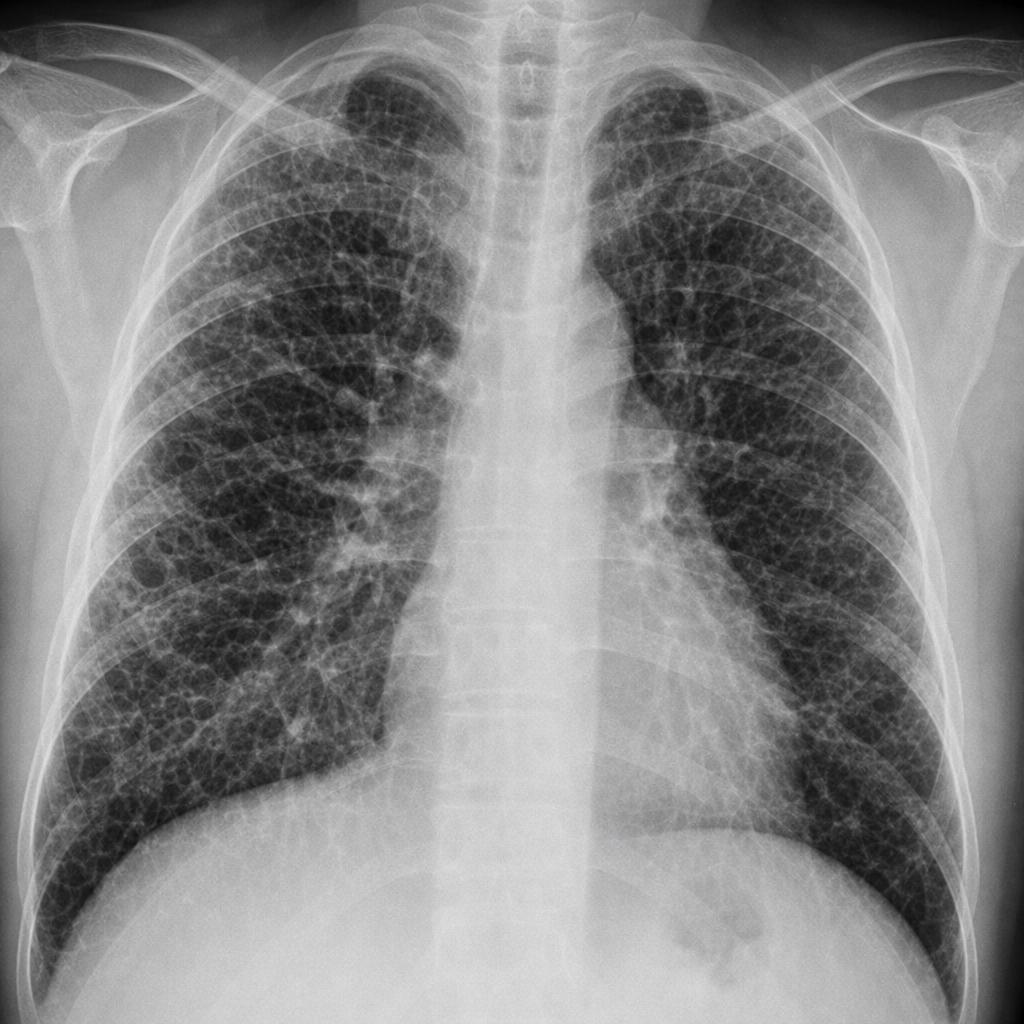
A 35-year-old man presents with shortness of breath and no history of lung or heart disease. He smokes half a pack a day and has for 10 years. Examination reveals a JVP of 2 cm, normal heart sounds, and clear lungs. Chest X-ray shows hyperinflation and increased lucency of the lung fields. A chest CT reveals bullae and emphysematous changes. Pulmonary function tests show an FEV1/FVC ratio of less than 70%. His family history is significant for other affected individuals. What is the most likely diagnosis?
What is a characteristic feature of an exudative pleural effusion?
Which of the following findings is true in Acute Respiratory Distress Syndrome (ARDS)?
Which of the following is the most common abnormality in ECG manifestation of pulmonary embolism?
All of the following are associated with pulmonary eosinophilic pneumonia, except?
A 48-year-old alcoholic man presents with a 6-day history of productive cough and fever. The temperature is 38.7°C (103°F), respirations are 32 per minute, and blood pressure is 126/86 mm Hg. The patient's cough worsens, and he begins expectorating large amounts of foul-smelling sputum. A chest X-ray shows a right upper and middle lobe infiltrate. A CBC demonstrates leukocytosis (WBC = 38,000/mL), with 80% slightly immature neutrophils and toxic granulation. Laboratory studies reveal elevated leukocyte alkaline phosphatase. Which of the following best describes this patient's hematologic condition?
A 31-year-old man with severe kyphoscoliosis due to cerebral palsy presents with worsening shortness of breath on exertion. He denies chest discomfort, fever, chills, cough, or sputum production. Examination reveals severe scoliosis to the left with decreased air entry on that side. His right lung is clear, JVP is at 3 cm, and heart sounds are normal. Which of the following is the most likely abnormality to be seen on the pulmonary function tests?
Explanation: ### Explanation The clinical presentation describes **Non-Cardiogenic Pulmonary Edema (NCPE)**. The hallmark of NCPE is the presence of pulmonary edema (bilateral crepitations) in the setting of a **normal pulmonary capillary wedge pressure (PCWP)**, indicating that the fluid accumulation is due to increased capillary permeability or altered pressure gradients rather than heart failure. **1. Why Narcotic Overdose is Correct:** Opioid/Narcotic overdose (e.g., Heroin, Morphine) is a classic cause of NCPE [1]. The exact mechanism is multifactorial but involves **increased capillary permeability** due to hypoxia, histamine release, and a sudden shift in hydrostatic pressure caused by a "negative pressure" effect when the patient attempts to breathe against a closed glottis (post-ictal or during profound CNS depression). Since the left ventricle is functioning normally, the wedge pressure remains within the normal range (typically <18 mmHg). **2. Why the Other Options are Incorrect:** * **Congestive Heart Failure (CHF), Myocardial Infarction (MI), and Cardiogenic Shock:** These are all causes of **Cardiogenic Pulmonary Edema** [2]. In these conditions, the primary pathology is left ventricular dysfunction, leading to a backup of blood into the pulmonary circulation [3]. This results in an **elevated pulmonary capillary wedge pressure (>18 mmHg)**. **3. High-Yield Clinical Pearls for NEET-PG:** * **PCWP Cut-off:** <18 mmHg suggests NCPE (e.g., ARDS, High Altitude, Narcotics); >18 mmHg suggests Cardiogenic causes. * **Other causes of NCPE:** ARDS (most common), High Altitude Pulmonary Edema (HAPE), Neurogenic pulmonary edema (post-seizure or head trauma), and Re-expansion pulmonary edema. * **Management of Narcotic Overdose:** The immediate priority is airway management and the administration of the antagonist **Naloxone**. * **Radiology:** NCPE often shows peripheral infiltrates and a normal-sized heart, whereas cardiogenic edema typically shows cardiomegaly, Kerley B lines, and perihilar "bat-wing" opacities [3].
Explanation: **Explanation:** **NSAIDs (Non-Steroidal Anti-inflammatory Drugs)** are well-known precipitants of acute asthma exacerbations [1], particularly in a subset of patients with **Aspirin-Exacerbated Respiratory Disease (AERD)**, also known as Samter’s Triad (Asthma, Nasal Polyposis, and Aspirin Sensitivity) [1]. **Pathophysiology:** The underlying mechanism involves the inhibition of the **Cyclooxygenase-1 (COX-1)** enzyme [3]. When COX-1 is blocked, the metabolism of arachidonic acid is shifted away from the prostaglandin pathway and shunted toward the **5-Lipoxygenase pathway**. This leads to an overproduction of **cysteinyl leukotrienes** (LTC4, LTD4, and LTE4), which are potent bronchoconstrictors that induce airway edema and mucus secretion, triggering an acute asthma attack [3]. **Analysis of Incorrect Options:** * **A. Beta-adrenergic receptor agonists:** These are the mainstay of treatment for acute asthma (e.g., Salbutamol) as they cause bronchodilation. However, **Beta-blockers** (especially non-selective ones like Propranolol) are known precipitants [1]. * **C. Calcium channel blockers:** These drugs generally have a neutral effect on the airways or may cause mild bronchodilation; they do not precipitate asthma. * **D. H1 blockers:** These are antihistamines used to treat allergic rhinitis and urticaria [2]. They do not cause bronchoconstriction and are often used as adjunctive therapy in allergic asthma [2]. **High-Yield Clinical Pearls for NEET-PG:** * **Samter’s Triad:** Asthma + Nasal polyps + Aspirin sensitivity [1]. * **Safe Alternative:** Acetaminophen (Paracetamol) is generally safe in aspirin-sensitive asthmatics at low doses (<1000mg). * **Other common precipitants:** Beta-blockers (even topical eye drops like Timolol), Sulfites (food preservatives), and Tartrazine (yellow food dye) [1]. * **Treatment of AERD:** Leukotriene receptor antagonists (e.g., Montelukast) are particularly effective in these patients.
Explanation: **Explanation:** The Global Initiative for Chronic Obstructive Lung Disease (GOLD) classification is used to grade the severity of airflow limitation in patients with COPD. This classification is based on the **post-bronchodilator FEV1** (Forced Expiratory Volume in 1 second) in patients with a confirmed FEV1/FVC ratio of < 0.70 [1]. **Correct Answer: D (FEV1 < 30% predicted)** According to GOLD criteria, **GOLD Grade 4 (Very Severe)** is defined as an FEV1 < 30% of the predicted value. This indicates a critical reduction in lung function, often associated with chronic respiratory failure or clinical signs of right heart failure. **Analysis of Incorrect Options:** * **Option A (FEV1 ≥ 80%):** This defines **GOLD 1 (Mild)** COPD. Patients are often asymptomatic or have a chronic cough. * **Option B (FEV1 50% – 79%):** This defines **GOLD 2 (Moderate)** COPD. This is the stage where patients typically first seek medical attention due to dyspnea on exertion. * **Option C (FEV1 30% – 49%):** This defines **GOLD 3 (Severe)** COPD. Patients experience significant limitation in exercise capacity and frequent exacerbations. **High-Yield Clinical Pearls for NEET-PG:** * **Diagnosis:** A post-bronchodilator **FEV1/FVC < 0.70** is the mandatory prerequisite for diagnosing COPD [1]. * **Assessment:** While GOLD 1-4 grades severity based on spirometry, the **ABCD (or ABE) assessment tool** is used to guide pharmacological therapy based on symptoms (mMRC/CAT scores) and exacerbation history. * **Prognosis:** The **BODE Index** (BMI, Obstruction, Dyspnea, Exercise capacity) is a better predictor of mortality than FEV1 alone [2]. * **Management:** Long-term oxygen therapy (LTOT) is indicated if PaO2 ≤ 55 mmHg or SaO2 ≤ 88% [3].
Explanation: **Explanation:** The clinical presentation describes a young patient (35 years old) with clinical and radiological evidence of **emphysema** (hyperinflation, bullae, and obstructive pattern on PFTs) despite a relatively light smoking history (5 pack-years) [2]. In a young patient presenting with COPD-like symptoms and a positive family history, **Alpha-1-Antitrypsin (A1AT) Deficiency** is the most likely diagnosis. **1. Why A1AT Deficiency is correct:** A1AT is a protease inhibitor produced in the liver that protects the lungs from **neutrophil elastase** [1]. A deficiency leads to unchecked alveolar wall destruction, resulting in **panacinar emphysema**, typically involving the **lower lobes**. While smoking accelerates the damage [2], the early onset and family history are classic hallmarks of this genetic condition. **2. Why other options are incorrect:** * **Beta-glycosidase deficiency (and Glucocerebroside deficiency):** These refer to the same condition, **Gaucher disease**, a lysosomal storage disorder characterized by hepatosplenomegaly, bone pain, and cytopenias, not primary emphysema. * **Glucose-6-phosphatase deficiency:** This is **Von Gierke disease (GSD Type I)**, which presents in infancy with severe hypoglycemia, lactic acidosis, and hepatomegaly. **Clinical Pearls for NEET-PG:** * **Inheritance:** Autosomal co-dominant (Chromosome 14). * **Genotype:** **PiZZ** is the most severe phenotype; **PiMM** is normal. * **Radiology:** Emphysema in A1AT deficiency characteristically affects the **basal (lower) lobes**, unlike smoking-induced emphysema which is typically apical. * **Extrapulmonary manifestation:** Liver cirrhosis and hepatocellular carcinoma (due to misfolded protein accumulation in hepatocytes). * **Diagnosis:** Low serum A1AT levels followed by phenotyping/genotyping. * **Physical Signs:** Patients may present with quiet breath sounds, though crackles might suggest infection or bronchiectasis [3].
Explanation: ### Explanation The differentiation between transudative and exudative pleural effusions is a high-yield topic for NEET-PG, primarily governed by **Light’s Criteria**. **Why Option A is Correct:** An exudative effusion occurs due to increased capillary permeability or impaired lymphatic drainage (e.g., pneumonia, malignancy, TB). [1] According to Light’s Criteria, an effusion is classified as an **exudate** if it meets at least one of the following: 1. **Pleural fluid protein : Serum protein ratio > 0.5** 2. Pleural fluid LDH : Serum LDH ratio > 0.6 3. Pleural fluid LDH > 2/3rd the upper limit of normal serum LDH. **Analysis of Incorrect Options:** * **Option B (> 0.8):** While a ratio of 0.8 is technically exudative, it is not the diagnostic threshold. The standard cutoff is 0.5. * **Option C (< 0.5):** This is characteristic of a **transudative effusion**, which occurs due to imbalances in hydrostatic or oncotic pressure (e.g., Congestive Heart Failure, Cirrhosis, Nephrotic Syndrome). * **Option D (> 1.0):** It is physiologically rare for pleural protein to exceed serum protein levels, and this is not a standard diagnostic criterion. **High-Yield Clinical Pearls for NEET-PG:** * **Most common cause of Transudate:** Congestive Heart Failure (bilateral). * **Most common cause of Exudate:** Parapneumonic effusion, followed by Malignancy. [1] * **Pseudo-exudate:** Patients on diuretics for CHF may show elevated protein levels. In such cases, calculate the **Serum-Effusion Albumin Gradient**. If the gradient is **> 1.2 g/dL**, the effusion is likely transudative despite Light’s Criteria. * **Low Glucose in Effusion (< 60 mg/dL):** Suggests Rheumatoid Arthritis (very low), Empyema, Tuberculosis, or Malignancy. [1]
Explanation: ### Explanation **Correct Option: B. Decreased lung compliance** **Mechanism:** Acute Respiratory Distress Syndrome (ARDS) is characterized by diffuse alveolar damage leading to increased permeability of the alveolar-capillary membrane. This results in the leakage of protein-rich fluid into the alveoli (non-cardiogenic pulmonary edema) and the inactivation of surfactant. The combination of fluid-filled alveoli and alveolar collapse (atelectasis) makes the lungs stiff [1]. In medical terms, this is a **decrease in static lung compliance**, requiring higher pressures to achieve the same tidal volume—often referred to as the **"Baby Lung"** concept [3]. **Analysis of Incorrect Options:** * **A. Type 2 respiratory failure:** ARDS typically presents with **Type 1 respiratory failure** (Hypoxemic) [2]. It is defined by severe hypoxemia ($PaO_2/FiO_2$ ratio $\leq 300$ mmHg) with a normal or low $PaCO_2$ due to compensatory tachypnea. Type 2 failure involves hypercapnia, which is not a primary feature of early ARDS. * **C. Increased diffusion capacity:** In ARDS, the diffusion capacity ($DLCO$) is **decreased**. The accumulation of edema fluid and the formation of hyaline membranes increase the thickness of the blood-gas barrier, severely impairing gas exchange. **High-Yield Clinical Pearls for NEET-PG:** * **Berlin Criteria:** Acute onset (within 1 week), bilateral opacities on imaging, and respiratory failure not fully explained by heart failure (PCWP $\leq 18$ mmHg) [1]. * **Pathological Hallmark:** Hyaline membranes in the alveolar walls. * **Management Strategy:** **Low Tidal Volume Ventilation** (6 mL/kg of predicted body weight) is the gold standard to prevent Ventilator-Induced Lung Injury (VILI). * **Prone Positioning:** Recommended for severe ARDS ($PaO_2/FiO_2 < 150$) to improve V/Q matching.
Explanation: The most common ECG abnormality in Pulmonary Embolism (PE) is **Sinus Tachycardia**. However, among the specific morphological changes, **T-wave inversion in the precordial leads (V1 to V4)** is the most frequent and specific finding. **1. Why T-wave inversion (V1-V4) is correct:** Acute PE causes a sudden increase in pulmonary artery pressure, leading to **Right Ventricular (RV) strain**. This pressure overload causes RV ischemia and repolarization abnormalities, manifesting as T-wave inversions in the right precordial leads (V1-V4) and sometimes lead III. This finding is more common and has higher diagnostic sensitivity than the classic S1Q3T3 pattern. **2. Why other options are incorrect:** * **Sinus bradycardia:** PE typically causes tachycardia due to sympathetic activation and hypoxia. Bradycardia is rare and usually signifies a pre-terminal event or severe vagal response. * **U wave:** This is associated with hypokalemia or certain drugs, not PE. * **S1Q3T3 pattern (McGinn-White Sign):** While highly "classic" and frequently tested, it is **not** the most common finding. It is seen in only about 10-20% of cases and indicates acute cor pulmonale. **Clinical Pearls for NEET-PG:** * **Most common ECG finding:** Sinus Tachycardia. * **Most common "abnormality" (if tachycardia is absent):** Non-specific ST-T wave changes. * **Most specific morphological pattern:** T-wave inversion in V1-V4 (Right ventricular strain pattern). * **Gold Standard Investigation:** CT Pulmonary Angiography (CTPA). * **Initial Investigation of choice:** Chest X-ray (usually normal, but helps rule out other causes).
Explanation: **Explanation:** The core concept tested here is the classification of **Pulmonary Eosinophilia (PE)**, a group of disorders characterized by pulmonary infiltrates on chest X-ray and an excess of eosinophils in the blood, lung tissue, or bronchoalveolar lavage (BAL) fluid. **Why Wegener’s Granulomatosis (Granulomatosis with Polyangiitis - GPA) is the correct answer:** GPA is a small-vessel vasculitis characterized by a triad of necrotizing granulomas of the respiratory tract, vasculitis, and glomerulonephritis. It is classically associated with **neutrophilic** inflammation and **c-ANCA (PR3-ANCA)** positivity [1]. Unlike other vasculitides, eosinophilia is **not** a feature of GPA. **Analysis of Incorrect Options:** * **ABPA (Allergic Bronchopulmonary Aspergillosis):** A hypersensitivity reaction to *Aspergillus fumigatus*. It is a classic cause of pulmonary eosinophilia, presenting with high IgE levels, peripheral eosinophilia, and central bronchiectasis. * **Loeffler’s Syndrome:** Also known as Simple Pulmonary Eosinophilia, it is often caused by trans-pulmonary migration of helminth larvae (e.g., *Ascaris*). It presents with transient, migratory "fleeting" opacities and peripheral eosinophilia. * **Churg-Strauss Syndrome (Eosinophilic Granulomatosis with Polyangiitis - EGPA):** This is the prototypical eosinophilic vasculitis [1]. It presents with asthma, prominent peripheral eosinophilia (>1500/µL), and **p-ANCA (MPO-ANCA)** positivity. **NEET-PG High-Yield Pearls:** 1. **Fleeting Infiltrates:** Think Loeffler’s Syndrome or ABPA. 2. **ANCA Association:** GPA = c-ANCA; EGPA = p-ANCA. 3. **Tropical Pulmonary Eosinophilia (TPE):** Caused by *Wuchereria bancrofti*; characterized by nocturnal cough and massive eosinophilia. 4. **Drug-Induced PE:** Common culprits include Nitrofurantoin, Sulfonamides, and NSAIDs.
Explanation: ### Explanation **1. Why the Correct Answer (D) is Right:** The patient presents with a classic **Leukemoid Reaction**, which is an exaggerated white blood cell response (typically >50,000/µL, though >30,000/µL is clinically significant) to severe infection, inflammation, or malignancy. * **Clinical Context:** The history of alcoholism and foul-smelling sputum suggests **aspiration pneumonia** (likely anaerobic). * **Hematologic Markers:** The presence of **toxic granulation** and **Döhle bodies** in neutrophils indicates a reactive process. * **Key Differentiator:** The **elevated Leukocyte Alkaline Phosphatase (LAP) score** is the "gold standard" for distinguishing a leukemoid reaction from Chronic Myelogenous Leukemia (CML). In reactive states, mature neutrophils are enzymatically active (High LAP), whereas in CML, they are functionally defective (Low LAP). **2. Why Incorrect Options are Wrong:** * **A. Acute Myelogenous Leukemia (AML):** AML presents with a "leukemic gap" (blasts and mature cells but few intermediate forms) and Auer rods [1]. The high LAP score and clear infectious trigger rule this out. * **B. Chronic Lymphocytic Leukemia (CLL):** CLL involves a proliferation of mature B-cells [2]. It is typically seen in older patients with significant lymphocytosis and "smudge cells" on peripheral smear, not neutrophilia with toxic granulation. * **C. Chronic Myelogenous Leukemia (CML):** While CML also presents with massive leukocytosis and a left shift, it is characterized by a **low LAP score**, splenomegaly, and the presence of the Philadelphia chromosome [t(9;22)]. **3. NEET-PG Clinical Pearls:** * **LAP Score:** High in Leukemoid Reaction, Polycythemia Vera, and pregnancy; Low in CML and Paroxysmal Nocturnal Hemoglobinuria (PNH). * **Left Shift:** Refers to an increase in immature precursors (bands, metamyelocytes) in the peripheral blood [3]. * **Aspiration Pneumonia:** Common in alcoholics (impaired gag reflex); usually involves the **Right Lower Lobe** (if upright) or **Right Upper Lobe/Superior segment of Lower Lobe** (if supine). Foul-smelling sputum is pathognomonic for anaerobes.
Explanation: The patient presents with severe **kyphoscoliosis**, a classic cause of **Extrapulmonary Restrictive Lung Disease**. In this condition, the structural deformity of the chest wall and spine physically limits the expansion of the lungs, leading to a reduction in all lung volumes [1]. **1. Why Decreased TLC is correct:** In restrictive lung diseases, the hallmark is a **reduction in Total Lung Capacity (TLC)**. Kyphoscoliosis increases the stiffness of the chest wall (decreased chest wall compliance), which prevents the lungs from inflating fully [1]. This results in a "small lung" physiology where TLC, Vital Capacity (VC), and Functional Residual Capacity (FRC) are all characteristically decreased [3]. **2. Why other options are incorrect:** * **A & B (Increased TLC/FRC):** These are features of **Obstructive Lung Diseases** (e.g., COPD, Emphysema, Asthma) due to air trapping and hyperinflation [2]. In kyphoscoliosis, the chest wall restriction makes it impossible to achieve high volumes. * **D (Increased Compliance):** Kyphoscoliosis causes **decreased** chest wall compliance. Increased compliance is seen in emphysema, where the loss of elastic recoil makes the lungs "floppy" and easy to distend. **Clinical Pearls for NEET-PG:** * **PFT Pattern in Kyphoscoliosis:** Decreased TLC, Decreased FRC, Decreased VC, but a **Normal or Increased FEV1/FVC ratio** (typical of restriction) [3]. * **Work of Breathing:** These patients have a high work of breathing and typically adopt a breathing pattern of **low tidal volume and high respiratory rate** (rapid shallow breathing) to minimize energy expenditure. * **Complications:** Long-standing severe kyphoscoliosis leads to chronic alveolar hypoventilation, pulmonary hypertension, and eventually **Cor Pulmonale** (Right heart failure).
Obstructive Airway Diseases (Asthma, COPD)
Practice Questions
Interstitial Lung Diseases
Practice Questions
Pulmonary Infections
Practice Questions
Pulmonary Vascular Diseases
Practice Questions
Pleural Diseases
Practice Questions
Sleep-Disordered Breathing
Practice Questions
Respiratory Failure
Practice Questions
Mediastinal Disorders
Practice Questions
Occupational Lung Diseases
Practice Questions
Pulmonary Function Testing
Practice Questions
Bronchiectasis and Cystic Fibrosis
Practice Questions
Lung Cancer Approach
Practice Questions
Get full access to all questions, explanations, and performance tracking.
Start For Free