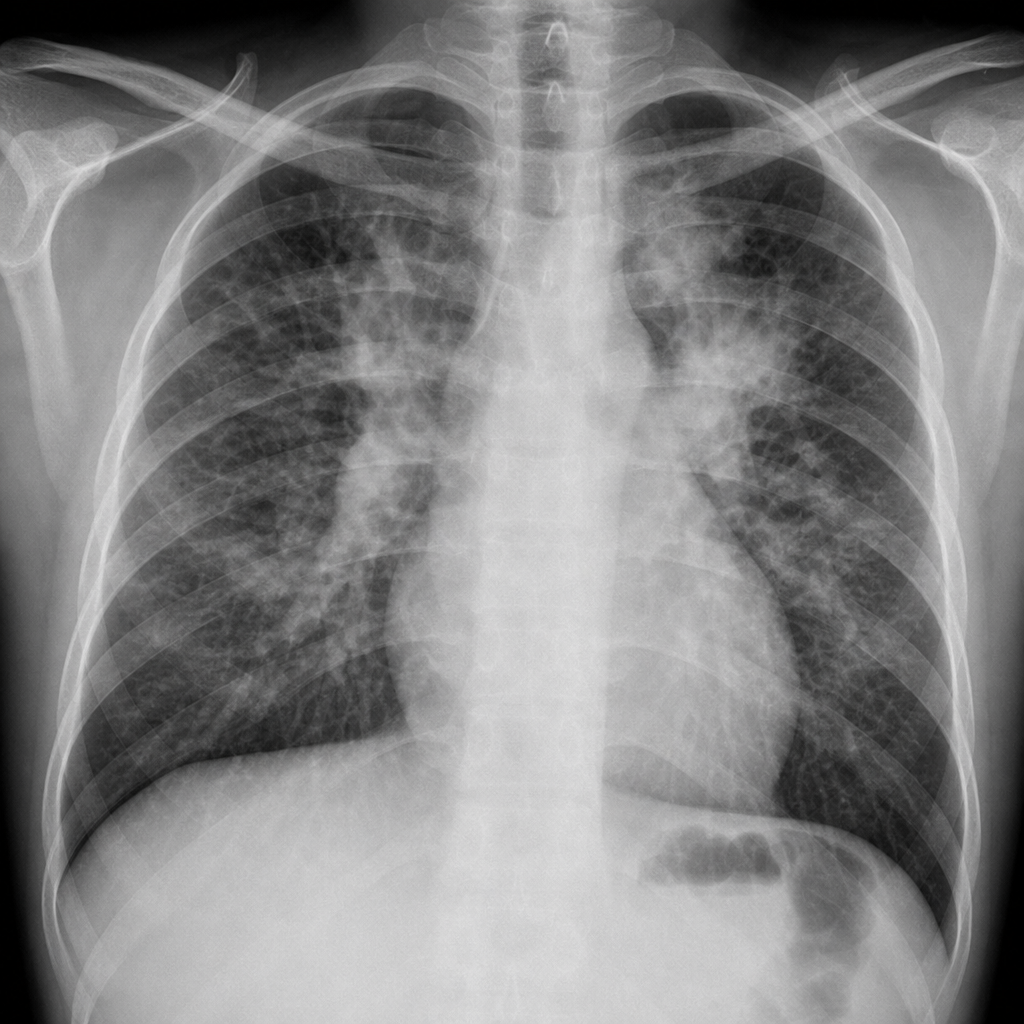
Lingular lobe bronchiectasis is most commonly due to which of the following conditions?
What are the risk factors for pulmonary embolism?
Which one of the following is not a feature of type 2 respiratory failure?
A patient presents with decreased vital capacity and total lung volume. What is the most probable diagnosis?
Which of the following statements is FALSE regarding flexible bronchoscopy?
A 65-year-old man presented with hemoptysis and stage 3 clubbing. What is the probable diagnosis?
Which of the following is NOT a consequence of obstructive sleep apnea?
Serum ACE levels are reduced in which of the following conditions?
Which one of the following parameters is consistent with pleural transudate?
Which of the following is not a feature of idiopathic pulmonary hemosiderosis?
Explanation: The correct answer is **Mycobacterium Avium intracellulare (MAC) infection**. **Why it is correct:** MAC infection is the hallmark cause of **Lady Windermere Syndrome**. This clinical phenotype typically affects elderly, non-smoking women who chronically suppress the cough reflex. The voluntary suppression of cough leads to the stagnation of secretions in the **lingula** (left lung) and the **middle lobe** (right lung). Because these lobes have long, narrow bronchi with a relatively poor gravitational drainage, they are highly susceptible to chronic infection, leading to localized bronchiectasis in these specific segments [1]. **Why other options are incorrect:** * **Cystic Fibrosis:** Typically causes widespread, bilateral bronchiectasis that is most severe in the **upper lobes** due to higher oxygen tension and impaired clearance. * **Tuberculosis:** Post-tubercular bronchiectasis is a common sequela in India, but it characteristically involves the **apical and posterior segments of the upper lobes**, following the primary site of reactivation. * **Aspergillosis (ABPA):** Allergic Bronchopulmonary Aspergillosis classically presents with **central (proximal) bronchiectasis**, often involving the upper and middle lobes, but it is not specifically localized to the lingula. **High-Yield Clinical Pearls for NEET-PG:** * **Lady Windermere Syndrome:** Look for a triad of elderly female, chronic cough suppression, and MAC infection in the lingula/middle lobe. * **Kartagener Syndrome:** Associated with situs inversus and lower lobe bronchiectasis. * **Williams-Campbell Syndrome:** Bronchiectasis due to congenital deficiency of bronchial cartilage. * **HRCT Chest:** The gold standard investigation for diagnosing bronchiectasis (look for the "Signet ring sign") [1].
Explanation: The core concept underlying the risk factors for Pulmonary Embolism (PE) is **Virchow’s Triad**, which consists of three factors that lead to thrombus formation: **Endothelial injury, Stasis of blood flow, and Hypercoagulability.** [1] **Explanation of Options:** * **A. Oral Contraceptive Pills (OCPs):** Estrogen-containing OCPs increase the synthesis of clotting factors (fibrinogen, VII, X) and decrease natural anticoagulants like Protein S. This creates a **hypercoagulable state**, significantly increasing the risk of Venous Thromboembolism (VTE). [1] * **B. Pregnancy:** Pregnancy induces a physiological hypercoagulable state to prevent hemorrhage during delivery. Additionally, the gravid uterus can compress the inferior vena cava, leading to **venous stasis** in the lower limbs. [1] * **C. Leg Paralysis:** Immobilization due to paralysis (e.g., spinal cord injury or stroke) leads to the loss of the "calf muscle pump" action. This results in significant **venous stasis**, allowing thrombi to form in the deep veins of the legs, which can then embolize to the lungs. [1] Since all three scenarios fulfill components of Virchow’s Triad, **Option D** is the correct answer. **High-Yield Clinical Pearls for NEET-PG:** * **Most common source of PE:** Deep veins of the lower proximal limbs (Iliofemoral veins). * **Strongest risk factor:** Previous history of VTE. * **Genetic risk factors:** Factor V Leiden mutation (most common inherited cause) and Prothrombin G20210A mutation. [1] * **Trousseau’s Syndrome:** Migratory thrombophlebitis associated with visceral malignancies (especially pancreatic cancer). [1] * **Gold Standard Investigation:** CT Pulmonary Angiography (CTPA). [2]
Explanation: ### Explanation Respiratory failure is clinically defined based on arterial blood gas (ABG) parameters. The fundamental distinction between Type 1 and Type 2 lies in the level of carbon dioxide ($pCO_2$) [1]. **1. Why Option A is the Correct Answer:** Option A describes **Type 1 (Hypoxemic) Respiratory Failure**. * **Criteria:** $pO_2 < 60$ mmHg with a **normal or low** $pCO_2$ ($< 45$ mmHg) [2]. * In this option, the $pCO_2$ is 38 mmHg (normal range: 35–45 mmHg), which excludes the diagnosis of Type 2 failure. **2. Analysis of Incorrect Options (Features of Type 2):** Type 2 (Hypercapnic) Respiratory Failure is characterized by "pump failure" leading to alveolar hypoventilation. The hallmark is **$pCO_2 > 50$ mmHg** [2]. * **Option B ($pCO_2$ 68, $pO_2$ 50):** This is a classic ABG profile for Type 2 failure, showing both hypoxemia and significant hypercapnia [2]. * **Option C (Papilloedema):** Severe hypercapnia causes cerebral vasodilation, increasing intracranial pressure, which can manifest as papilloedema. * **Option D (Asterixis):** Also known as "flapping tremors," this is a classic physical sign of CO2 narcosis/encephalopathy seen in Type 2 failure [3]. **Clinical Pearls for NEET-PG:** * **Type 1 (Hypoxemic):** Caused by V/Q mismatch or shunting (e.g., Pneumonia, Pulmonary Edema, ARDS) [1]. * **Type 2 (Hypercapnic):** Caused by reduced minute ventilation (e.g., COPD, Myasthenia Gravis, Obesity Hypoventilation Syndrome, Opioid overdose) [3]. * **The "Flap":** Asterixis is not specific to liver failure; in pulmonology, it signifies severe CO2 retention. * **Acidosis:** Type 2 failure is usually associated with respiratory acidosis ($pH < 7.35$) unless compensated chronically [3].
Explanation: **Explanation:** The clinical presentation of decreased **Vital Capacity (VC)** and **Total Lung Capacity (TLC)** is the hallmark of a **Restrictive Lung Disease** pattern [1]. In restriction, lung expansion is limited, leading to a reduction in all lung volumes [1]. **1. Why Sarcoidosis is Correct:** Sarcoidosis is an interstitial lung disease (ILD) characterized by non-caseating granulomas [3]. These granulomas and subsequent fibrosis increase lung stiffness (decreased compliance), making it difficult for the lungs to expand. This results in a classic restrictive pattern on Pulmonary Function Tests (PFTs): reduced TLC, reduced VC, and a normal or increased FEV1/FVC ratio [1]. **2. Why the other options are incorrect:** * **Asthma:** This is an **obstructive** lung disease. It is characterized by a decrease in the FEV1/FVC ratio (less than 70%) [2]. While VC may decrease during an acute attack due to air trapping, the TLC is typically normal or increased (hyperinflation). * **Bronchiectasis:** This is a chronic **obstructive** airway disease involving permanent dilation of bronchi. PFTs show airflow obstruction and increased residual volume (RV). * **Cystic Fibrosis:** Primarily manifests as an **obstructive** lung disease due to thick mucus plugging and bronchiectasis, leading to hyperinflation (increased TLC) rather than restriction. **NEET-PG High-Yield Pearls:** * **Restrictive Pattern:** ↓ TLC, ↓ VC, ↓ FRC, but **Normal/↑ FEV1/FVC ratio** [1]. * **Obstructive Pattern:** ↓ FEV1, ↓ FEV1/FVC ratio (<0.7), and **↑ TLC/RV** (due to air trapping) [2]. * **Sarcoidosis PFTs:** Usually restrictive, but can show an obstructive pattern if there is endobronchial involvement. * **DLCO in Sarcoidosis:** Typically decreased due to alveolar-capillary membrane thickening.
Explanation: ### Explanation **Why Option C is the Correct (False) Statement:** The removal of foreign bodies is generally **more difficult** with a flexible bronchoscope compared to a rigid bronchoscope. The **rigid bronchoscope** is the "gold standard" for foreign body removal because it has a wider lumen, allowing for the passage of large grasping forceps and better protection of the airway during extraction. It also provides superior suctioning capabilities for thick secretions or blood. Flexible bronchoscopy is typically reserved for small, distal foreign bodies or when rigid bronchoscopy is unavailable. **Analysis of Other Options:** * **Option A (True):** Flexible bronchoscopy is usually performed under **local anesthesia** (lidocaine) and conscious sedation. Unlike rigid bronchoscopy, it does not mandate general anesthesia or muscle relaxants [1]. * **Option B (True):** Due to its portability and lack of requirement for an operating theater setup, flexible bronchoscopy can be easily performed at the **bedside**, especially in ICU settings for toilet bronchoscopy. * **Option C (True):** The flexible scope is thinner and can be maneuvered into the **segmental and sub-segmental bronchi**. This allows for much better visualization of the distal/peripheral airways compared to the straight, wide-bore rigid scope. **High-Yield Clinical Pearls for NEET-PG:** * **Rigid Bronchoscopy Indications:** Massive hemoptysis (better suction), foreign body removal, and endobronchial stenting/laser therapy. * **Flexible Bronchoscopy Indications:** Diagnostic biopsies (TBB, EBUS), bronchoalveolar lavage (BAL), and intubation of difficult airways. * **Contraindication:** Severe hypoxemia or unstable cardiac status. * **Complication:** The most common complication of transbronchial biopsy via flexible bronchoscopy is **pneumothorax**.
Explanation: ### Explanation The combination of **hemoptysis** and **Stage 3 clubbing** in an elderly patient is a classic presentation for **Bronchogenic Carcinoma**, specifically **Non-Small Cell Lung Cancer (NSCLC)** [1]. **1. Why Non-Small Cell Lung Cancer (NSCLC) is correct:** Clubbing (Hypertrophic Pulmonary Osteoarthropathy) is a common paraneoplastic manifestation of lung malignancies [1]. Crucially, it is **frequently associated with NSCLC** (especially Adenocarcinoma and Squamous cell carcinoma). Hemoptysis in an elderly smoker is a "red flag" symptom that strongly points toward a primary endobronchial malignancy [1]. **2. Why the other options are incorrect:** * **Small Cell Lung Cancer (SCLC):** While SCLC causes hemoptysis and various paraneoplastic syndromes (like SIADH or Cushing’s), it is **rarely associated with clubbing** [1]. * **Tuberculosis (TB):** TB is a leading cause of hemoptysis; however, it typically presents with constitutional symptoms [2]. While chronic TB can cause clubbing, the association is much stronger with malignancy in this age group [2]. * **Sarcoidosis:** This typically presents with bilateral hilar lymphadenopathy and dry cough. Clubbing is **extremely rare** in sarcoidosis and only occurs in advanced Stage IV (fibrotic) disease. **Clinical Pearls for NEET-PG:** * **Stages of Clubbing:** Stage 3 is characterized by increased curvature of the nail in all dimensions (**"Parrot Beak"** appearance) and obliterated Schamroth’s window. * **Hypertrophic Osteoarthropathy (HOA):** When clubbing is associated with periostitis of long bones and joint swelling, it is most commonly due to **Adenocarcinoma** of the lung [1]. * **SCLC vs. NSCLC:** Remember, **"S"**mall cell is associated with **"S"**IADH and **"S"**yndrome of ectopic ACTH, but **NOT** usually with clubbing [1].
Explanation: Obstructive Sleep Apnea (OSA) is characterized by repetitive episodes of upper airway collapse during sleep, leading to intermittent hypoxia and hypercapnia [1]. These physiological stressors trigger a cascade of compensatory mechanisms, primarily involving the **Sympathetic Nervous System**, not the parasympathetic. **1. Why "Parasympathetic hyperstimulation" is the correct answer:** In OSA, the primary autonomic response to hypoxia and arousal from sleep is **Sympathetic Overactivity**. The body perceives the drop in oxygen as a stress state, leading to increased catecholamine release. While transient bradycardia can occur during the apneic episode (vagal tone), the hallmark of the disease and its long-term consequences is **Sympathetic Hyperstimulation**. **2. Analysis of Incorrect Options:** * **A. Pulmonary vasoconstriction:** Intermittent alveolar hypoxia causes **Hypoxic Pulmonary Vasoconstriction (HPV)** [2]. Over time, this leads to remodeling of pulmonary vessels and Pulmonary Hypertension. * **B. Systemic hypertension:** This is the most common cardiovascular complication of OSA. Chronic sympathetic surge and activation of the Renin-Angiotensin-Aldosterone System (RAAS) lead to sustained elevations in blood pressure, often presenting as "non-dipping" nocturnal BP. * **D. Polycythemia:** Chronic nocturnal hypoxia stimulates the kidneys to produce **Erythropoietin (EPO)**, which increases red blood cell production (secondary polycythemia) to improve oxygen-carrying capacity. **Clinical Pearls for NEET-PG:** * **Gold Standard Diagnosis:** Overnight Polysomnography (PSG) [3]. * **Severity Marker:** Apnea-Hypopnea Index (AHI) >5 is diagnostic; >30 is severe. * **Classic Triad:** Daytime somnolence, loud snoring, and witnessed gasping/apneas. * **Associated Condition:** Pickwickian Syndrome (Obesity Hypoventilation Syndrome) is a common co-morbidity. * **Treatment of Choice:** Continuous Positive Airway Pressure (CPAP).
Explanation: Angiotensin-Converting Enzyme (ACE) is primarily produced by the **vascular endothelial cells**, with the highest concentration found in the pulmonary capillaries. **Why COPD is the correct answer:** In **COPD**, chronic inflammation and alveolar destruction (emphysema) lead to a significant reduction in the total surface area of the pulmonary capillary bed [1]. Since the pulmonary endothelium is the primary site of ACE production, its destruction results in **decreased serum ACE levels**. Other conditions associated with low ACE include starvation, hypothyroidism, and the use of ACE inhibitors. **Analysis of Incorrect Options:** * **Sarcoidosis (Option A):** This is the most classic condition where ACE levels are **elevated**. ACE is produced by the epithelioid cells and activated macrophages within the non-caseating granulomas. It is used as a marker of total granuloma burden and to monitor treatment response. * **Diabetes Mellitus (Option C):** Serum ACE levels are typically **elevated** in patients with DM, particularly those with diabetic retinopathy, likely due to generalized endothelial dysfunction and microvascular damage. * **Histoplasmosis (Option D):** Similar to other granulomatous diseases (like Tuberculosis or Silicosis), Histoplasmosis often causes an **increase** in serum ACE levels due to macrophage activation within granulomas. **High-Yield Clinical Pearls for NEET-PG:** * **ACE as a Marker:** While elevated in 75% of active Sarcoidosis cases, it is **not** diagnostic due to low specificity. * **Other causes of High ACE:** Hyperthyroidism, Gaucher’s disease, Leprosy, and Alcoholic Liver Disease. * **Key Site:** Remember that the **Lung** is the primary organ for the conversion of Angiotensin I to Angiotensin II due to the vast surface area of its capillary endothelium.
Explanation: To differentiate between a transudate and an exudate, clinicians primarily rely on **Light’s Criteria**. A transudate occurs due to systemic factors (e.g., increased hydrostatic pressure in Heart Failure or decreased oncotic pressure in Cirrhosis), whereas an exudate results from local inflammatory or neoplastic processes. ### **Explanation of Options** * **A. LDH < 2/3 of the upper limit of serum LDH (Correct):** According to Light’s Criteria, a pleural fluid is classified as a **transudate** if it meets **all** of the following: 1. Pleural fluid protein/Serum protein ratio **≤ 0.5** 2. Pleural fluid LDH/Serum LDH ratio **≤ 0.6** 3. Pleural fluid LDH **< 2/3** the upper limit of normal for serum LDH. Since the option describes a low LDH level, it is consistent with a transudate. * **B. WBC count > 1500/mm³ (Incorrect):** Transudates typically have a low cell count (usually < 1000/mm³). A WBC count > 1000/mm³ is more suggestive of an exudate. * **C. Specific gravity > 1.020 (Incorrect):** Transudates have low solute content; thus, the specific gravity is typically **< 1.015**. A value > 1.020 indicates high protein content, characteristic of an exudate. * **D. Protein level > 2.5 g/dL (Incorrect):** Transudates are "protein-poor." Traditionally, a protein level **< 3.0 g/dL** (or < 2.5 g/dL in some texts) defines a transudate. A value > 2.5–3.0 g/dL points toward an exudate. ### **High-Yield Clinical Pearls for NEET-PG** * **Most common cause of Transudate:** Congestive Heart Failure (CHF). * **Most common cause of Exudate:** Parapneumonic effusion, followed by Malignancy. * **Pseudo-exudate:** Patients with CHF on chronic diuretics may have protein levels that rise into the exudative range. In such cases, calculate the **Serum-Effusion Albumin Gradient (SEAG)**; if > 1.2 g/dL, it is still a transudate. * **Low Glucose in Pleural Fluid (< 60 mg/dL):** Think of Rheumatoid arthritis, Empyema, Tuberculosis, or Malignancy.
Explanation: **Explanation:** **Idiopathic Pulmonary Hemosiderosis (IPH)** is a rare condition characterized by recurrent episodes of diffuse alveolar hemorrhage (DAH) primarily in children and young adults. It is a diagnosis of exclusion, defined by the classic triad of hemoptysis, iron deficiency anemia, and pulmonary infiltrates. **Why Eosinopenia is the Correct Answer:** Eosinopenia (a decrease in eosinophils) is **not** a feature of IPH. In fact, approximately **10–20% of patients with IPH exhibit peripheral eosinophilia**. While the exact etiology of IPH is unknown, the presence of eosinophilia in some cases suggests an underlying immune-mediated or allergic mechanism (similar to Heiner Syndrome, which is IPH associated with cow's milk hypersensitivity). **Analysis of Incorrect Options:** * **Hemoptysis (Option A):** This is the most common presenting symptom. It results from the rupture of alveolar capillaries leading to bleeding into the alveolar spaces. * **Iron Deficiency Anemia (Option C):** Recurrent alveolar bleeding leads to the sequestration of iron within pulmonary macrophages (as hemosiderin). Since this iron cannot be recycled by the body for erythropoiesis, patients develop microcytic hypochromic anemia despite having high pulmonary iron stores. * **Diffuse Alveolar Hemorrhage (Option D):** This is the hallmark pathological process of IPH. On imaging, it presents as transient patchy or diffuse ground-glass opacities. **NEET-PG High-Yield Pearls:** * **Diagnosis:** Confirmed by finding **hemosiderin-laden macrophages** ("siderophages") in bronchoalveolar lavage (BAL) or gastric aspirates. * **Biopsy:** Shows intra-alveolar hemorrhage and hemosiderin without evidence of vasculitis or immune complex deposition (unlike Goodpasture syndrome). * **Treatment:** Systemic corticosteroids are the mainstay for acute episodes; immunosuppressants (e.g., Azathioprine) may be used for maintenance.
Obstructive Airway Diseases (Asthma, COPD)
Practice Questions
Interstitial Lung Diseases
Practice Questions
Pulmonary Infections
Practice Questions
Pulmonary Vascular Diseases
Practice Questions
Pleural Diseases
Practice Questions
Sleep-Disordered Breathing
Practice Questions
Respiratory Failure
Practice Questions
Mediastinal Disorders
Practice Questions
Occupational Lung Diseases
Practice Questions
Pulmonary Function Testing
Practice Questions
Bronchiectasis and Cystic Fibrosis
Practice Questions
Lung Cancer Approach
Practice Questions
Get full access to all questions, explanations, and performance tracking.
Start For Free